Avoiding Contract Sticker-Shock: User-Friendly Tips for Salespeople
IT contracts lawyer David explains how salespeople can avoid contract sticker shock, the surprise when legal language diverges from negotiated terms. He recommends surfacing difficult clauses early, understanding the business rationale behind legal language, and working collaboratively with internal legal teams to prevent deals from falling apart.
Chapters
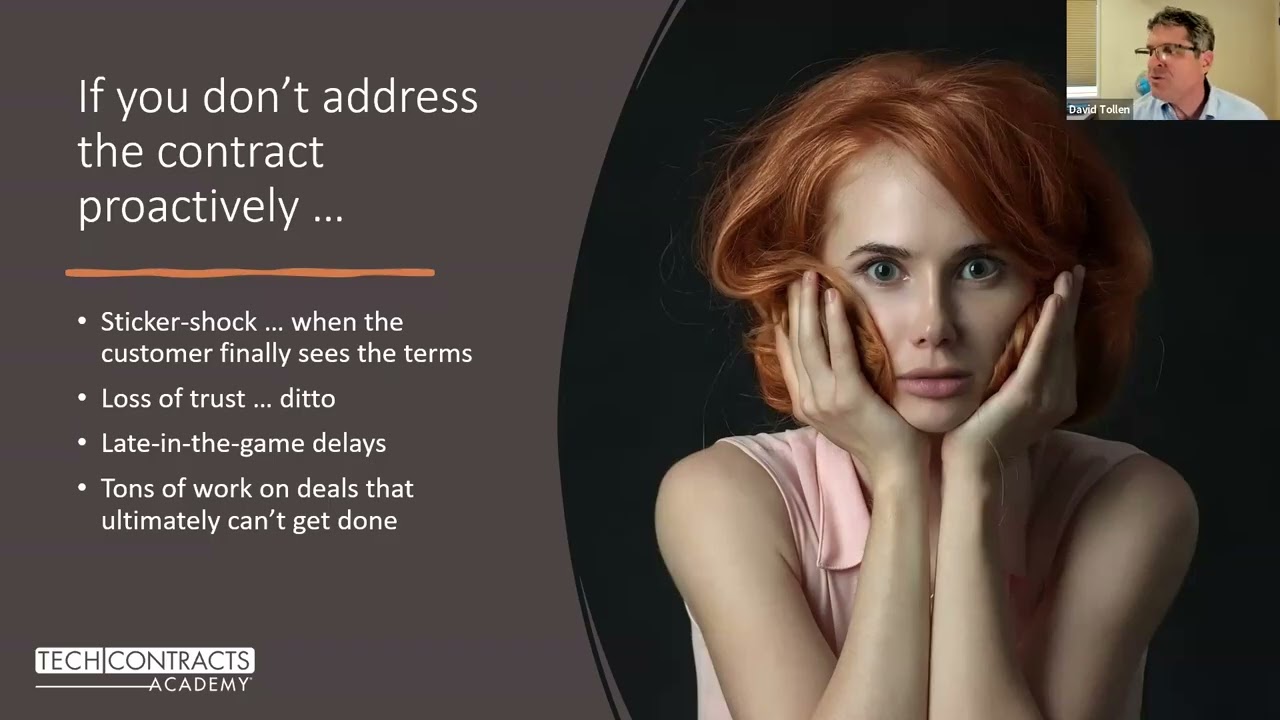
So the concept that I'm talking about is really arguing with this idea, trying to correct this idea that there's a firm distinction between the job of selling the deal and the commercial terms, quote unquote, and then getting the contract done. The reality is that the contract is part of the sale. You are always selling the contract, and if the contract doesn't get signed, you don't end up with a deal. And what I've seen in the past is that some of the most effective salespeople with the biggest numbers do more than just sell their product or service. They sell their contract. And that's sort of the point here on the screen, that sales heroes sell the product or service, sales superheroes sell the deal. And what do I mean by that? The contract The contract signature is the point in which you have the deal, you have your commission, you have everything closed. If we're going to get into a difficult and drawn-out negotiation at the end of what seems like a successful sales process, we may not have a successful sales process. And what I've seen over the years is that some of the best salespeople take responsibility for the contract, at least to some extent. This is not about them becoming sort of junior lawyers and learning how to do the contract as well as any lawyer. It is rather doing a couple things. It is being proactive about contract negotiation. The legal teams to get involved in contract negotiations. Some of these sort of superhero salespeople I have seen are looking ahead. They're aware of difficult issues that come up in, in our side's standard form. They're aware of difficult issues that are likely to come up in the other side's standard form if you're working on customer's paper. And they do a few things. They proactively address some of those issues, and then they also serve as essentially a mediating role between the customer and the— and their own legal team. So what I mean by that is it starts with a recognition that you're negotiating a contract really from day one. From the beginning of the sales process, you're negotiating contract terms. You're probably focused on the concept of commercial terms, and you're looking at the price and the delivery and the structure, and you're trying not to get into potentially unpleasant terms about warranties and indemnities and limits of liability, data security. All that stuff. But if you know that's going to cause trouble, it is often worth getting into it. And this is really what I mean by contract sticker shock. Contract sticker shock is where, you know, we know it's sticker— till the middle of the negotiation or late in the negotiation, and then you get this very unpleasant reaction. Well, sticker shock can include the contract terms if you're moving along with a negotiation of commercial terms that the customer fairly assumes is going to look a lot like what they're used to, and then it doesn't, and then your side has a contract that's very different, or your side has a clause, uh, that is very different, or your side is unwilling to accept their terms, that leads to sticker shock, and then you lose trust and you get delays, you get long negotiations, and sometimes you lose deals. So the logic here is to say We're going to take ownership for all of the contract. We're going to make a judgment in advance whether it makes sense to take some of the terms that we think are going to be trouble areas and introduce them to the customer and discuss them with the customer in advance and say, look, you need to understand. And this obviously calls for a lot of judgment at what point to do this. But again, I have seen some of the most effective salespeople do exactly that. And I've been surprised to find that when I, as the the attorney engage in negotiations on those very terms, the ground's already been somewhat softened. The customer understands, the customer isn't offended by the term, and there might even be some willingness to accept it or some ideas on the table for compromise. So doing that requires some recognition. You got to recognize, first of all, that there's really no such thing— there's no firm divider between commercial terms and legal terms. They're all business terms. It's all about whether or not, uh, people are gonna make money, how money is gonna be made, who deals with this or that problem. It's all business terms. And if you get something of an understanding of what the underlying terms mean— not again a deep lawyer's understanding— you're in a good position to do that. That's the sort of proactive side of avoiding contract sticker shock and avoiding losing deals and delayed deals as a result of contract terms. The other side of it is when you do have the legal departments engaged, I find that effective salespeople can serve a really good mediation role. There is a tendency for the salespeople to want to argue with their own legal team, to just advocate for the customer's point of view, which Can work, but keep in mind your legal team. This is something I point out in our training. We have a whole segment on dealing with the legal team. Your legal team are professional arguers in most cases, certainly your lawyers, maybe your contract managers too. Engaging in an argument with them isn't necessarily the best place to get them where you want. Sometimes the job is a little softer. It's more of a sales job. You're selling some of the customer's contract positions to them. You're explaining what the customer's concerns are. Again, what the customer's business issues are that lie behind the terms, which once again requires something of an understanding of what those terms are. And then you go back and forth between the two sides. Again, I've seen these most effective salespeople do that and as a result win and close more deals. It's not that you're a truly neutral mediator when you're when you're performing this function, you have a side, you're on your own side's team, but you know the customer better than anyone else on the team, and you know the customer's concerns better. And maybe through that proactive side of things, that stuff you did in order to avoid this, this situation on the screen, the sticker shock, you've actually gotten pretty well familiar with what the customer's concerns are. Contract sticker, sticker shock to avoid deals getting pushed into the next quarter when they were supposed to close this quarter is learning those basics, learning what is at stake with a particular clause, learning what the business issues are behind it, learning what the business issues may be on the other side. And let me give you an example of something that is sort of the most lawyerly clause you ever hear about it. So it makes a good example. You think you just can't possibly talk about indemnity terms. The customer wants a data indemnity and our side is saying no data indemnity. And so we're— that just has to go to legal. If you understand what a data indemnity is, You may have learned it's protection against a third-party claim about a data breach. And if we don't give a data indemnity, and maybe your legal's not flexible, that doesn't mean we're not liable for that third-party claim. That doesn't mean if we breach the contract and that leads to the data breach, we don't have liability. We, we have liability to the customer for third-party breach. We're just not protect— promising that we're gonna protect the customer against a third-party lawsuit. We're saying we may owe you damages. In other words, it's a situation to take something customers are very often objecting to and saying, hey, I can explain what's really going on here and what our concern is, and also show you it's not as bad for you as you may think. And there's constant opportunities for you to do that. Um, so this is all part of taking advantage of your existing knowledge of the customer, your judgment, your ability to assess what customer needs are. This is me. I am an experienced information technology contracts lawyer. I teach IT contracts drafting and negotiation at UC Berkeley Law School, and I have this company, Tech Contracts Academy, and this is our course for salespeople. We have this 3-hour course that teaches you to do exactly this stuff, that teaches you the basics, not the lawyer-level stuff, but the basics of all the different terms you're likely to have in your contract and get into a battle with customers over, and help them avoid that sticker shock and close more deals and close deals faster. So this is a course you can take online. It's an on-demand recorded course you can do at your own pace. It's also something that you can, you know, your whole team can do either online or have me come in live and do it. And in those cases, we sometimes customize it. And it's at techcontracts.com, or we can, we will include the specific link to the course in the chat and in the metadata for this talk. So I hope you'll check that out. I hope you'll grasp this idea of always be contracting, of using the contract as part of the sale, or at least not ignoring it, not waiting for the legal team to come and get involved, but looking at it as part of your larger, broader relationship In which case, it makes sense to learn a bit about it.
David, thank you so much. And hey, those links are in the chat, so make sure you grab those because again, it's going to be to your advantage to understand better how to deal with the contracts. David, thank you so much for being with us here today, giving us the overview. Real quick, 30 seconds or less, what's the big challenge you feel companies have today in dealing with this contract issue?
So the big challenge again and again that I see in my negotiations is not— it's not so much the two sides are having trouble agreeing, is that the two sides are talking past each other. In my world of information technology contracts, stuff has become very complicated. I mentioned, you know, widespread understanding of an indemnity. You're not giving us an indemnity for data. That means you're not liable for data. No, we're liable. We're not just protecting you against third parties. It's those kinds of misunderstandings. But you see it rising every, you know, as technology evolves, understanding goes down. And so you see it lately a lot when what you're selling has AI features, particularly agentic features. The customer has a strike list of stuff that they feel they need to get to buy AI, and your side can't give it, and you're not really talking about the same thing. And it is a particularly good area where a salesperson who understands the customer and the technology, not at a technical level, but what it does and what risks it creates and what happens when an agent runs off and does things it's not supposed to, or when a model hallucinates, you're in a good position to express that and help the two sides come to resolution to make sure we're not arguing about just words In fact, we're arguing about concepts and maybe our concept desires are closer together than we think.
Terrific. Georg, what do you think?
I love it. I wanted to hear from David. What is your sales experience? What did you sell?
Yeah, so it depends what you mean by sales. So for most of my career, I've been an attorney and I was general counsel of a public publicly traded software company selling embedded databases and database management systems. But as an attorney in my practice, I have been on both buy side and sell side. So I have the customer's perspective with just any number of technologies. It's hard to say what. However, I also have served as a business development vice president at a company called ClickTime, selling early— selling alliances and deals related to early software as a service. And of course now Tech Contracts Academy, I'm selling that. So my experience as a lawyer is definitely greater than my experience as a salesperson. But I do work as a salespeople person, and mostly I work with some great salespeople.
So what do you like most about selling?
Oh, I like about selling that you're I like that it is so much less of a technical job than the lawyer stuff. I like the very highly interpersonal element of it, the value of making connections and friends. That's really valuable. And the salespeople are in a unique position to do that. The legal department, it's best if they can do that too, but to some extent they're pursuing something different. Again, understanding their work is a way to kind of bridge that gap.
So, final question. What is your best advice for salespeople when they have to negotiate with their own internal legal department that are usually a little bit in opposition of the way they think?
Well, I think the best thing you can possibly do is start out by telling the lawyers and contract managers that they are the deal prevention department. That'll go over really well. They'll be your best friends. They'll give you what you want. Or maybe not. The— I think the best thing you can do is first of all start out by recognizing their incentives. And we talk about this in our training. The fact that they are not incented by commission the way you are. They have a salary. They may have some kind of equity bonus structure, etc. But they still have an incentive to close deals. It's just that their incentive to close deals is like less directly financial, and it is also more— it has to be weighed against getting various terms, various things that the company hopefully wisely cares about. So their incentives don't match yours, but they are still very similar. And the flip side of that is you need to understand how they operate. There is a lot of sort of focus on the language. And that's appropriate. In the end, what the parties said, what the parties thought, shouldn't matter in terms of what legal rights are. It's just what's in the contract. So again, you have the opportunity to be the bridge with them, helping them see the customer's point of view about what's underlying the language, what scares the customer about the language. And again, that's not— coming back to where I started with this— It's not really arguing with them because that can be very unfruitful. It's offering them the benefit of your greater personal knowledge of the customer and framing what you're doing as helping them get their job done easier and faster. Particularly if they're in-house, they don't want this to take longer than it needs to either, and they certainly don't want the deal to fail.
Thank you so much for your time, David. That was a great contribution to our Sales Acceleration Summit. We are back in 3 minutes with Dagmar Eisenbach from salesforce.com. Thank you. See you on the other side. Thank you.
More from Gerhard



What Selling Looks Like When Your AI Agents Have the Context Your Sellers Do

Better Conversations, Smarter Support: Wearable AI in Business






When Scarcity-Built Systems Meet Abundance - The Judgment Gap in AI-Powered Sales Leadership
