Barat Dickman delivers a keynote at Sales 3.0
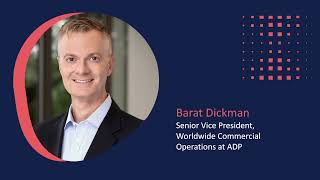
Barat Dickman, Senior Vice President of Worldwide Commercial Operations at ADP, discusses how sales technology is transforming modern selling. He traces the evolution of sales enablement tools and how they adapt to what today's buyers actually expect, using a fictional buyer named Prisha as an example.
Chapters
So next up, we have Bharat Dickman, the senior vice president, adp. We're going to talk a little bit about technology enablement. So please, everybody, welcome Bharat.
When I was in college, I wanted to be a stockbroker. I wanted to go work on Wall Street. I wanted to be Gordon Gekko, you know, the Michael Douglas character in the movie Wall Street. I wanted to go work for Lehman Brothers or Merrill lynch.
And I wanted to make a million dollars by the time I was 30.
But then something happened, and all of that changed.
I went to the University of Michigan and go blue, by the way. And when I start, go blue. And when I started my senior year, sometime around the fall of 92, I had to write a paper.
And back then, when you needed to write a paper and it had to be typed, you had to go to something called the Campus Computing center. You guys remember those? So the campus Computing center is this place, kind of like a room like this. It is filled with Apple Macintoshes. And you go to the center and. And you ask to use one of the computers, and you take a number, just like at the deli counter. And then you wait till the computer becomes available and you sit down, you type your essay, and then you send it off to the gallery of printers that are off on the side of the room.
And then you hope that your computer paper, your printout, wasn't swiped by another eager student while you're waiting the next half hour for your paper to come about. Well, this particular fall day in Ann Arbor, I had to write a paper for one of my classes. So I went to the Campus Computing center, and I'm sitting there writing my paper, and a little box appears at the top of the screen, and it says, JRock, Colon.
Do you want to go get drunk?
And I was, like, dumbfounded. I said, where is this messaging coming from? And I noticed there was a prompt right below it to write something back. And I said, who is this? And the prompt came back, dude, it's Jason. Want to go get drunk on the diag? Now, the diag is the center of campus where all the kids hang out. And mind you, this was 10am on a Wednesday.
And Jason, by the way, was a friend of mine in college who we called J Rock. And I'm still friends with him today, and we still call him J Rock. So I kind of stood up in my chair and I looked around for how he was playing this trick on me. And then I sat back down and I said, I wrote back on the prompt. I said, where are you question mark. And how are you doing this question mark? And the response came back to me, dude, it's this cool new thing, it's called the Internet.
That moment changed my life. I immediately changed my focus to technology.
I graduated from school, I joined Accenture, the large technology consulting firm, and I have basically spent the rest of my career in technology sales.
Now, I am no visionary. I could not have told you thing one about what was going to happen in the subsequent 30 years as it was related to Internet and web technologies. I do not see broad patterns and I am a terrible individual investor. I thought I was going to retire based on MySpace, Yahoo and AOL. No luck.
But.
If.
I had ignored that instinct because I knew that whatever that was that allowed him to send that message was a big deal and become a stockbroker, I would be out of a job today.
But the story isn't really about me. Because what I'm here to share with you today is that I have today and now this same level of conviction that the business of sales, this industry of selling that we all operate in, is about to undergo and is undergoing this same level of, of massive transformation.
And in 15 to 20 years, selling as we know it is going to be completely changed. And if you thought that it was a big deal when we went through the CRM revolution back a few years ago, you ain't seen nothing yet because this is going to be even bigger.
What my presentation is about today and what I'm hoping to share with you by the end of this segment is what is going on in the world of sales transformation and sales technology and have an understanding of how this is impacting the modern buyer.
Because we have to understand the modern buyer to understand the implication for all of your sellers. So I hope you leave here today with a basic understanding of all the technology that is available to all of our sellers that is fueling this coming transformation and how we can leverage that technology to help our sellers win, be more customized and get into more deals.
My name is Barrett Dickman. I'm the Senior Vice President of Worldwide Commercial Operations at adp. For those of you who don't know adp, we sell cloud based software as a service in the human capital management industry. That means that we sell software and solutions that help clients to hire, recruit, pay, manage, engage, insure, benefit and retire their employees.
We have an extensive data set. We have over a million clients worldwide and then we have the data on all the employees of all of those clients. And we use this data to recognize early trends, provide these Data driven insights to our clients and prospects and really to further tailor our products to be effective. In today's world of work, you might be most familiar with the ADP National Employment Report, which is one of the main jobs reports that's looked at by Wall street and Main street and the federal government to get an understanding of where we are within the labor market.
My business unit, which is called Commercial Operations, is responsible for everything that is done to help our sellers to sell more productively, to be more effective. And we have close to 10,000 sellers and they operate in over 140 countries. So it's incredibly important that we ensure that they are equipped with all modern tools and technologies to make them the most effective salesforce in the world. And that's our goal.
But before we can start to help them to know what it takes to sell, we have to start by understanding the modern buyer, which is really hard because a modern buyer is this vague and nebulous concept. It's hard to be empathetic without a, a picture of a nameless buyer, which is exactly what we're trying to do.
So let's give our buyer a name and a face.
This is Prisha. She is 36 years old. She is in charge of buying at a mid sized technology firm in the Southeast United States.
There are four things that we know about Prisha and they are listed on this page. Let me talk about the first one. We know that she is empowered, independent and curious. She grew up using computers and the Internet.
And well, she's very comfortable doing her own research online. In fact, she usually prefers it. So a lot of times before she even engages with a seller, she has been online watching demos, reading blogs, going to the sites that rate products and software, discussing with her peers, bulletin boards, even comparing prices. If that's something that's available to her, then she decides when she wants to engage with our sellers. She decides when to pull the seller in. And we know that she does this much later in the process than she had ever done before. So it's really important that when our sellers, when your sellers go to speak to Prisha, they hit the ground running in the middle of a process.
The second thing we know about Prisha is that she expects customization.
So Forrester recently conducted a study, an in depth study across industries and geographies and sizes of companies. And they found that Prisha isn't interacting with sales as much as buyers did in the past. She's having fewer interactions, which means that our sellers have to make the most of every moment. When they get engaged and to do that, they have to make every interaction highly customized. We have to know what Prisha cares about, where is her company at, what are their needs, what are their challenges, who is her incumbent provider of the solution that I'm going to try to pitch her.
And I also need to know where is she in her buying process because she's already done a lot of research. And so when your sellers arrive to speak to Prisha, it has to be a customized presentation. Everything about that presentation has to be customized. The value prop, the collateral, the demo, the pricing, the third party partners that you might bring in to work with you. All of it has to be targeted and relevant to Prisha's situation and what she's particularly looking for.
The other thing we know about Prisca is that she prioritizes trust. She wants to buy from people that she likes. This is simple but true.
In today's market, with so many digital interactions, believe it or not, this is more important than ever. Our sellers need high emotional intelligence, eq. They need to be adaptive and empathetic and intuitive. They need to be active listeners and they need to pick up on her verbal and nonverbal cues while they're interacting with her.
All of these things are helping them to develop trust and rapport with Prisha. Because when Prisha is done with her process or getting close to the end and she's trying to weigh different options, she's going to revert to that provider who she feels she can trust. She's looking for someone who gave her a thoughtful response, someone she had a positive interaction with.
When you have fewer interactions, this element of rapport and relationship matter even more than they ever have before.
And lastly, Prisca is super solution oriented. Now, this one is not new. We've been selling solutions for years, but Prisca is even more so than in the past. She is a forward thinking buyer. She is looking for a solution that will help her fill gaps for her current needs today, her needs in the future, and not just a single gap, but as many gaps as she could possibly cover with your solution. So she's looking for a partner, not just someone who's going to save her current time, money and energy, but also do that going into the future. She's looking for someone to help her think through her challenges.
And help her go through her own journey. And if you can effectively do that.
The research says you will win her loyalty.
Okay, so now we know our modern buyer, Prisha and what she is looking for. But how do we meet all of these new Modern expectations.
Today we have an incredible number of sales technologies the market. Many of them are referred to as sales enablement technologies. Remember the slide that Warren had up there? With all of the different technologies on the market today, it's no joke. That's exactly what's out there.
Now, on their own, even without the technology, sellers are facing a tougher challenge than ever before. Their jobs are infinitely harder. This same Forrester research that I referenced earlier described cold calling as not just ineffective, but extremely ineffective in today's market. And the deals themselves are more complex. You have buying committees, you have legal reviews, you have multiple levels of approval. You have privacy reviews, security reviews, GDPR reviews. Outside of the US you have DE&I reviews. All of this makes the deal cycle longer and makes it harder for your seller to get to end of job. So sellers need help and they're the greatest investment that we can make. So by leveraging some of the sales enablement technology that's out there today, and particularly the power of data.
We can help them sell more efficiently. Cut through the clutter. Meet Prisha. Exactly where she is.
So these are just a few of the sales technology categories that are on the market today. Again, you remember the slide that Warren showed. I'm only going to have time to touch on the four that are shown on this page, but there are literally dozens of categories and subcategories of these types of sales tax technologies out there. And if you're interested, you can easily research these. You can Google it, you can speak to Forrester or Gartner. They have excellent frameworks that are a lot like what was on Warren's slide that categorize the technologies into different areas.
They call it their revenue stack technology framework. That's the name of it. So what we're describing here though is the portion of the stack that's particularly relevant to our human sellers, which is important because prior to a human seller getting involved today.
There are literally another dozen marketing technologies that occur before these even come into play. And those technologies are used to move a prospect from completely unaware and unknown to a warm lead. But today we're going to touch on these four. And let me start with the first, first one on the left.
In this new world, thanks to machine learning, sellers are able to receive insights and coaching from anywhere at any time. So they're able to get data on what's working for them and what isn't. That helps them perfect their sales messaging and their product demos and their presentation. The software can be used to coach to ensure that your sellers are focusing on the key value props, the messages, the specific competitor information that you would like them to be saying and the overall tone of the presentation.
It can truly ensure that they are targeting and pitching your product the way you want them to be doing it in today's world.
Now they also though can help them perfect the portion of their presentation that is non specific to their content. It can look at their pace of speed of speaking, their hand gestures, their eye contact, how many times they say, it even can say how many times they take a drink of coffee or the person they're speaking to takes a drink of coffee. It can measure how much time they are speaking and the prospect is speaking. And it can use this information to help coach them so that they can have the very best selling conversation that you want them to have. And the software works in two ways. It can happen in practice mode where you literally present your pitch to the computer and it immediately gives you real time feedback on how you did. It can also monitor live selling conversations. It is almost like the how to win friends and influence people sales coaching software for the modern seller. And it can literally help your sellers build greater trust and rapport.
Now secondly, if your sellers don't really know the competition, it is very difficult for them to compete effectively. That's why these competitive intelligent platforms are incredibly valuable to our organizations. These tools can help a seller understand how to approach clients in the way that they want to be approached, based on their current provider and on who else they are speaking with. It can literally attach to your CRM system and drip in competitive intelligence information as the deal moves through the process. So for example, at the top of the funnel it can provide specific collateral based on that deal, the vertical, the geography, the product. As you get further along, it can suggest specific questions that that seller should be asking based on the incumbent provider in the deal. And even as you get towards the end of the deal, it can provide pricing guidance at the negotiation stage.
It also provides access to all sorts of information that you'd want to know about any competitor you're competing with. Their financials, external insights, products, innovation, their go to market strategy. And it can also be used when not in a deal. It can be the single repository for everything you know about a competitor, company, news, product developments, recent announcements, acquisitions, so that when your seller walks in to speak to that prospect, they know what they're up against. They know who the incumbent provider may be if there is one. And they know everything they could possibly know about the head to head competitors in that deal. They even Also include something called competitive avatars, which is you can sit down and watch a live selling conversation between one of your competitive reps who is an avatar selling to your prospect, which can be incredibly useful when you go in to do a pitch.
The third category is sales engagement tools. This is really about continuous learning.
About learning from the best. Because if you can harness what your very best reps are doing and share share that knowledge with other sellers, that can make the whole sales force even more productive and effective.
So these tools help you to ensure that you're taking the right activity at the right time for the right buyer role. You wouldn't do the same things with a CFO, a CIO, a CHRO, in my case, an HR manager, a payroll manager, a person who manages 401k for a company. We treat all these roles different. The other thing it can help you do is to orchestrate your sales forces. When you have multiple sales forces, it can help them to spread out so they're not all contacting the same buyer at the same time. As I mentioned, it can help them treat different buyer roles differently with different types of cadences. It focuses on the highest value opportunities, it self learns and it also can specify what is called these cadences or flows. That's what's in these tools that basically dictate how a seller goes through a pursuit down to whatever level you want. Individual seller, role, vertical product, what have you.
What they do is they provide suggested next steps in the process. They say your buyer is here in the journey. Your buyer fits this profile. We have studied the last ten hundred, a thousand deals that you did just like this one. And what has worked the best to get you to a close fast enough were these steps from this point forward. And that's what this software does. It is really a game changing tool, especially for newer sellers that are just starting to learn the ropes. But it can even help your most tenured sellers to perfect their pitch and their process.
Last up is the optimized demo experience.
We have one of our, one of the vendors that provides this solution in the expo today. I hope you go visit them. We know that Prisha is independent and curious. She is empowered again. She likes to dig in, she likes to do her own research and by herself. So it's important that we don't try to fight that trend. We want to put control back in her hands, let her do her own research. And you do this with a digitized demo experience that allows her to view her solutions on her own time. With these digital demo platforms, it allows buyers to do just that. They can view a demo of the entire solution. They can drill down to specific features, specific functionality.
They can experience the demo in multiple forms. They can do it offline, video, hands on a sandbox. They can even request a customized live demo experience.
Possibly the best part about these tools, though, is that they generate tremendous insight for the modern seller. They allow that seller to monitor everything that Prisca is doing inside that portal so we learn what it is that's important to her. What is the most relevant content that we can bring to Prisha that will make that next conversation as meaningful and helpful to Prisha in her process?
HG Wells Adapt or perish now, as ever, is nature's inexorable imperative. It is really incredible to look at all of the sales enablement technology on the market today, and furthermore incredible to see how far we've come just in the last five years, if not the last 15. There are literally categories of technology to help our sellers sell on the market today that did not exist 10, 15 years ago. And the sales process now is more visible and data driven than it has ever been in the past. We are able to analyze processes, dig into specific conversations, monitor every digital interaction with Prisha and anything that we care about.
And we can also find out what's working and what isn't in terms of all of our marketing and selling. And as technology evolves and we make progress in machine learning and artificial intelligence, these tools will be able to generate even greater insights for our sellers. It is truly all about harnessing that data. It's about making those data insights go to work for you, for your company, for your seller, to help them be more productive. Because it is clear that this business of selling is changing. It is changing rapidly. The buyer is changing and that is what is driving the change in our world of selling. And a buyer's going to continue to evolve. Their expectations are going to continue to evolve. And so in order for us in this room to keep up and remain relevant, we have to adapt. We have to be part of this exciting change. We have to recognize it. Just like I did when I sat down at that computer lab in college all those years ago. Thank you very much. Appreciate your time.
I'm happy to take questions if there are any. There's one over there.
There's some over there.
I think you have a loud voice, so just shout it out.
Great talk. And I really appreciate the, the insights. I've actually done some work in with ADP in the past. So you've always had an Amazing sales force. Okay. And it, it's shown over the years with you how you've dominated the market by implementing this. I'm assuming that you're talking about what you've implemented as well at ADP. You know, we've got rules of sales, 80, 20, you know, 20% to 80% of the business, and, you know, all that stuff and whether it varies up and down, of course. What impact have you seen on the actual sales performance of sellers by implementing this model that you've done?
Thank you. It's a great question and we appreciate you doing business with us. Thank you for that.
So, yes, we are embracing this transformation head on. Absolutely. We call it our modern seller journey. And we're, you know, we're in the middle of it right now.
So we just like everybody else, we are the 80, 20. In fact, we sort of have a bell curve of performance. Right. What we're very focused on with this particular transformation is that middle, that middle, and trying to move them up to the, to the higher end of that bell curve. And if you work with adp, you might know this. Our middle name is data. Right. We are analytic like nobody's business. So everything we do gets measured down to the nth degree. And we are measuring all of the implementations of these types of technologies. And I can tell you that the results are great. They're great. We're seeing our associates move deals through the funnel faster. They're getting to those appointments more quickly, they're able to be more customized. Another vendor that is here in the Expo allows you to use video communication with your prospects and clients in an amazing way and then provide analytics on that video communication. And we're seeing that be very resonant with buyers. And so we measure a lot of things basically first appointments, what we call gaining access, close rates, win rates, all of that stuff. And we correlate it to who's using the tools and who's not. And the results are showing.
So just to kind of follow up on that, so you see the data and the results, and I believe it's more like a 20, 40, 40 rule. There's probably 40% that people that could do better, and then there's 40% of the people you can't do anything about. But what are you then implementing when you identify that group that is showing the need? Are you doing additional training, soft skills? What are you doing to actually make that happen and improve?
Another great question. So one of the things we're doing is just communicating out those results simply, you know, with 10,000 people. And by the way, we don't force any of this on anybody. It's available for usage by any seller. But we use these results to encourage adoption. Right. So we say, hey, those that are using Tool X are getting close rates two weeks faster than those that are not. So, you know, maybe you all want to try using it. And we do a lot of, a lot of change management around it. Classic change management. We do lunch and learns and trainings and webinars and we have advisory groups and things like that. But really we're trying to take that data to your point and communicate it out to the masses so that more people start to use it. That's great.
I appreciate that I both helped you in the sales and been your customer. So I've had, I've had both sides of it.
Well, thank you again for doing business with us. We appreciate it. Any other questions?
Yeah, we actually have a question from the virtual audience. What vendor are you referring to out in the expo?
So there's a number of great vendors out there. I think without calling anybody out by name, there's all of them have a lot of value to be offered based on the business case. And I'm not going to like, you know, throw anybody under the bus, but the vendors here are just fantastic. So I'm not going to name any names, but they're all really good. Okay, but thank you for the question. Yeah, thank you.
Yes. I'm just going to ask if you're running for office with the way you replied to that. Yeah, yeah, it's a very fair question.
Yeah.
Performance coaching tools, does that always require like an additional purchase of a product like from like a different company or have you seen success done if they've tried to implement internally?
Good question. So the question was for these technologies that I discussed, are we needing to buy a different piece of software, a different tool to do that, or are we able to build it ourselves? Is that what you're asking?
Just have you seen any success from companies trying to implement those four stages on their own? Like from the coaching aspect, from the best reps, you know, giving their own feedback to help the other reps? Or is it always like a third party vendor?
You know, I think people are doing all these things probably in an offline fashion to some degree. Right. What the tools I think that are on the market allow us to do is accelerate that and do it at scale. Right. I mean, we're all doing coaching. Right. All of you who've managed the salesforce or been a frontline seller you're all coaching your reps, so you're doing it maybe real time in person. I think with the move to, with the pandemic and all that happened virtually, we needed to figure out a way to provide coaching at scale and in a virtual way as well. And we really couldn't do that without a tool as an example. So I also think, you know, everybody has a sales process, they have a methodology. What the engagement tool does is it takes that process, that methodology and makes it self learning in real time. So again, like, I think everybody's doing some of these things. It's just a matter of doing it at scale. Yeah. Perhaps more efficiently.
Yeah.
Yeah.
Yes, Another question from the virtual audience.
Sure. I'll try not to be a politician this time. Time.
What are, what are the trends of these sales tech usages in America versus Europe?
Oh, great question. So I love that you're reading that from your watch, by the way.
So.
The, the trends are very similar with one very big exception. So everybody who does business in Europe or really outside the United States is familiar with gdpr. GDPR is a stringent level of privacy regulations that they have in Europe that we don't necessarily have here. We have privacy regulations here, but it is perhaps more stringent in Europe. So each of these pieces of software have to be able to pass through a GDPR review in order to get used in Europe, and those reviews can take longer. So I think the adoption is probably one step behind the United States. However, there are firms in Europe that are building these same technologies customized for GDPR rules, and they probably have faster adoption there than here, probably because that's where they're mostly present. Okay, thank you. Great question. Thank you. Yes, sir. That was a great presentation. Thank you. Thank you.
That was a great. That was a great presentation. Could you comment about frontline managers and.
How you engage frontline managers to be part of the process of what you outlined? Certainly. And a great question. Thank you. And thank you for the compliment we had. Actually, we have. Part of our change management program is panels. I had one yesterday with our set of our frontline leaders who are here in the Florida region. And we talk to them most of the time about this, about the sales enablement, and they give us feedback. They say, we like this, we don't like this. You're missing this. What about this piece over here? Can you perhaps fill that in? Sometimes they hear about these, a technology category before we even know about it. Centrally, I support all these disparate sales forces. They're out in the Fields, they're the ones who know about this stuff. I heard about one particular vendor from them that I'd never even heard of before, and then as soon as I asked around, everybody said, oh, yeah, everybody's using it. So the stuff is catching on quickly. We do a variety of kind of formal and informal things to get their feedback. They're also. They're on our advisory boards. We do these panels, and they also are part of the teams that help us from the very inception of these projects all the way through rollout. And then lastly, we don't roll out any of the tools and technologies without doing a certification process for the leaders first. So the frontline leaders get them. They get to use them. They actually have to prove that they know how to use them, and then we share them with their. With our direct reps. Great question. No, thanks. Eli.
Yes, ma'. Am.
You mentioned that the four pillars that you guys have deployed at your company are all very effective. On those four pillars, if you wanted to prioritize, where. Where would you start to get the highest return?
So. Good question. I think of those four.
If I had to prioritize, I'd probably pick the. Either the. I forget which were the first or the third. Third. Right. So I probably lean towards the third for. For us. So again, we operate at scale. So I need that tool. That's the engagement sales enablement. Engagement tool. That's the one that helps with the process. Right. So I have to know that my new hires are getting up to speed quickly and that they can learn very fast what. What. What our best reps do and follow that. So I probably prioritize that first.
Right. U.S. sales enablement. Okay, thank you. And then the second question was, you mentioned the avatars.
Yeah.
Which was really interesting. So is it almost like a virtual role play where the customer. They get to see the objections and it's leveraging AI Is that.
It is. It is. So let's say different industry. Let's say I'm at and T in your Verizon. Right. And that's our prospect right there. I could say. And I'm pitching him. I could say I want to watch the Verizon avatar pitch their solution to this prospect, and I can watch it on screen, and I can hear you throw at and T under the bus and hear everything that you say from an avatar perspective, but that's what it's for. So I kind of know what I'm competing against when I go into the room with my prospect.
I love the technology. Thank you.
Pretty neat.
Great presentation.
Thank you so much. Thank you.
I'm happy to take more questions, but I don't want to take them too much. I'm done. Done. Thank you all very much. Enjoy the rest of the conference. Thanks, man. Good stuff. Thank you very much. Okay, wonderful. That was really great. All right, next up.
More from Gerhard



What Selling Looks Like When Your AI Agents Have the Context Your Sellers Do

Better Conversations, Smarter Support: Wearable AI in Business






When Scarcity-Built Systems Meet Abundance - The Judgment Gap in AI-Powered Sales Leadership
