Beyond the Script: Mastering High-Stakes Sales with AI Role-Play
Gerhard, Michael, and Tricia compare AI avatar role-play with human-actor sessions for sales training. Virtual Instincts uses professional actors and sports-science methods to build buyer personas and record practice sessions, with clients seeing up to 30% win-rate gains. Human role-play captures the emotional nuance and unpredictability that AI simulations miss.
Chapters
I ask you one fundamental question. Yes, we are talking about the sales profession and we are talking about role play. Play something that's professional.
Is role play something that's professional? Yeah, absolutely. You think that sales, in my mind, is a performing art. You're really learning to be a master communicator. You're going to work on that craft. You're gonna perfect that skill. You're gonna learn as many different methodologies as you possibly can, methods, tactics, techniques, and then put them to practice just like a musician is rehearsing, just like a professional sports team is practicing to prepare and play in the Super Bowl. So absolutely role play where you're simulating a situation and it can be a conversation, it can be a play, it can be a a music improv show, whatever, is very professional where you're learning to perfect your craft, your gift, your talent. And that's the way we see it. So that's a great opening question to this topic today. And Tricia, that was funny. I was in a musical improv show last night. I am a little bit hoarse from singing and I'm not normally a singer. So, and Gerhard, yeah, you coined a new phrase. So yeah, role play is very professional. I think in the corporate world, We've got to incorporate it as part of your daily practice, as part of something you do that's preparation prior to getting on a live meeting with a customer. You want to practice, I would say, value justifications, objection handling techniques, opens, really positioning what it is that you're gonna talk about, maybe establishing an agenda, and really be very clear and articulate about how that meeting is going to flow. And that sets the stage for a great conversation, an engaging conversation.
And, and the other thing that I want to, uh, preempt you a little bit, because the audience, uh, needs to understand that there are two kinds of role plays. You can role play with a machine.
Yeah.
And, uh, get automated feedback, which is not always the best way or the best experience for the salesperson because the feedback can be overwhelming from the machine where you're graded on 17 different skills and at the same time and you get bombarded with too much information. So you have an alternative, which is role play with a professional actor where you have nuanced feedback, where you have authentic responses. From a person, human to human. It's H2H. Yeah. And, uh, then you can get feedback from a human that has more empathy and probably more versatility than the machine because a human is creative. The machine is not.
That's a great point. The conversation between two humans is emotional. It's gonna ebb and flow. We're gonna, we're gonna have feeling. We're gonna have a certain feeling when we enter that conversation. That feeling could get shaped, could change, could evolve as we hear more information, as we're now engaging further in qualifying questions, getting deeper into Picture Painter explanations and how we feel about it, both the customer's perspective and even the salesperson's perspective is going to change. It's gonna ebb and flow. We as a salesperson need to stay connected to that. We don't need to be so agenda-specific or script-focused that we cannot guide from the feeling or the sensation of the conversation in our body. And that takes a lot of practice. I think it really takes a lot of knowledge and information and intellect to be able to guide a structured conversation without the presence of agenda, staying connected to it so that you're able to adapt and understand how you're making that person feel. 100% of us, no matter how sophisticated AI is going to be and enables us in the sales process, We're all going to buy on a feeling. And when we arrive at that feeling, and if a salesperson is skilled at navigating and helping the person, helping the company, the multi-stakeholder meeting arrive at that feeling, then you've done a very effective job of engaging that professionally. And they are arriving at a decision that feels good for them. They see it working and it feels good, and they'll move forward with that opportunity. So let's just kind of get right into what Virtual Instinct's all about. I'm gonna share my screen here. And that's a great way to position how we are, we are different. Um, let's see, make sure we could do this here.
Yep.
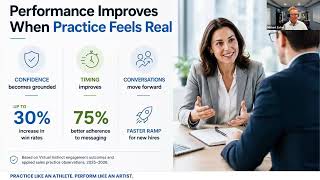
Perfect. So Virtual Instinct is an AI sales roleplay agency. So we're not a software as a service based platform. Kind of think of us as a creative firm, like an advertising agency. We're assessing what skills your team needs. And then we're developing scenarios and exercises specifically around your sales process, your sales methodology, your techniques, which is more likely evolved over a long period of time and a lot of different training and a lot of different branded sales methodology to be effective for you. So what we're gonna do is consult with you at a very high level, understand your marketplace, the resistance that you experience, the current market conditions that are creating apprehension, or where you are competing with an incumbent solution and develop the scenarios. That are customized to you, and then really develop what we call human-like buyers. That human-like buyer is understanding your ICP, your decision-making process within that organization, whether it's multi-stakeholder and how many different people involved and what are their personalities, how long have they been there, what are their educational backgrounds, how long tenured are they, how do they show progress in the buying, uh, in the buying process. So we're going to get very granular, very detailed about how we develop these human-like buyers. And our scenarios and our exercises also provide real-time feedback through analyzing the transcripts. Each meeting is recorded and we can provide a lot of detail and expert analysis on the backend to show you where your team is in skill and taking it further and in instinct. So we're focused on skill and instinct from practice and by creating a very immersive environment that's simulating your customer conversations. I'll just skip one ahead. So we're developing AI-powered buyers from your ICP, any background you have that we can use as context to develop that customer persona. And then we're gonna go and cast the right professional actor to bring that customer persona to life. Uh, what is their tenure? How long have they been in the business? Do they need to look like a CEO? Are they middle management? Are they a director? Are they a VP? Where? What title does that person hold? How do they make decisions? How long have they been with the company? How much authority do they have? And how do they bring a committee into the buying decision with them? We under— wanna understand that dynamic in your sales process and make sure we cast the right professional actor that's trained in emotional range and who will prepare to bring that customer persona to life. And what that does is create a very immersive environment for your salesperson to practice that's so believable. They're now in that situation that mirrors a real conversation with your customer. It is just so highly realistic. So what we're creating there is an environment for your salesperson to practice under the pressure of a real conversation. The stakes are high in sales. It's getting even more difficult now than it was before. This AI is enabling us, is empowering us. However, it's also creating some additional resistance. So we wanna create an environment that's realistic to your selling situations with a real Customer persona, real actor bringing that customer persona to life, and then an environment that's gonna simulate the pressure, um, the same selling pressure that your salesperson would have maybe at different times of year. Hey, we're gonna approach the second half of the year and everyone's gonna have a sense of urgency to move deals forward and close in the fourth quarter to reach their targets. Okay. Well, here's the real issue with sales practice in general. I mean, every sales leader knows that practicing via role play is important, right? However, most companies don't do it. Most companies don't find that it's very realistic for two colleagues or two peers to practice among each other, and they're not able to create a realistic environment. A lot of sales managers are just so busy managing the pipeline and the process, they don't have time to coach consistency, coach consistently, or sometimes it's not seen as subjective or objective. So by having us develop these scenarios for you and getting the analytics on the backend, We're now moving that direction of practicing being more realistic and also being scalable. And what we can do is break down the sales process into what we call shorter interactions, moments where they're developing a specific skill and where we're now using a technique or a method and then reinforcing certain messages that you want your team to deliver during the sales process that are on book or on script. Let's take the word script out of it, however, consistent with the way you wanna position product. Based on practice explanations or value justifications. So really we're now analyzing or understanding deeply your sales process, the mechanics of it, understanding how that framework for the sales conversation needs to flow and developing scenarios and exercises around that specific approach and methodology. So we're now, we're having your team practice under pressure on a very realistic situation. Well, I mentioned that every sales leader knows that practice is important. Practice is really one of the only things you can do where skills are immediately available upon practice. And here are two different well-known industry newspapers or magazines that say, hey, practicing teams that consistently practice, that are organized with their practice, are systematic with practicing, meaning they do it often, see up to a 30% increase in win rates from one stage of the pipeline to the next. You can have practice that focuses on cold outreach. You can also focus on specifically closing, putting your team in situations where they're closing and where the actor brings a different emotional tone to the closing approach, maybe a different objection, slightly different resistance. However, what we're doing there is we're creating an interaction where they're approaching the close, having to interpret the emotion and adjust and pivot accordingly to change that feeling and work back towards closing, maybe using tie-downs or alternative choices or isolated asks, getting a little bit specific. Hey, Harvard Business Review put out a report just last year saying that, hey, most of sales training is forgotten unless it's reinforced. So just further proof that you need to have both training, the knowledge and the coursework, that's a technique-specific method. However, you need the reinforcement of that through practice. And realistic practice. And that's what we're focused on is really creating that environment where they're gonna use those techniques and methods in repetition with the professional actor bringing a different emotional interpretation to each one where the salesperson feels it, has to adjust, and then now go back into a second opportunity to close. They're asking for it again, and then really painting that picture of how your solution's gonna work for them and create value. Okay, so up to a 30% increase in win rate and then 75% adherence to messaging, to sales technique, any specific Brandon Sales methodology that you want to use by practice and creating an environment where it's realistic, you're going to reinforce those techniques and methods. And then by practicing each stage of the pipeline, the individual skill set required for cold outreach, qualifying, what we call proposal to close or close, that's a different skill set. You're going to get up to a 30% increase in each stage moving forward through the sales process. Okay, we're focused on that. Ultimately, the goal with practice is not memorization, it's presence. And when we think about presence, about being composed, being poised, actively listening without the presence of an engagement, without the pre— presence of an agenda, and really being calm and ready to respond instinctually to the moment that they're called upon to use a certain technique or certain explanation for describing your product. So the, the idea behind practice is putting your team in a situation where repetitiously and by a different emotional interpretation by the actor, them having to call up their poise, them having to remain emotionally composed and then actively listen to what they're hearing so that they can use the right technique, not in a fast-paced environment. However, in a scenario or a session that has a cadence to it and a rhythm to it where they're getting repetition and using those techniques with the actor bringing that moment to life. So think about memorization's good, that structure, that means you're conducting the call or the conversation literally in a logical way. Maybe it's very organized. However, really what you want to have is the presence and the feel there and to be able to guide it instinctually to the outcome that you want. So pressure, the stress that you're feeling, or the calmness that you really need. The adaptation— you're actively listening without the presence of agenda, and you can clearly hear what they're saying and adjust immediately to what is the next best response. And then being fully engaged in that, and then that was going to increase performance. Okay, well, there's a lot of AI avatar-based Sales platforms out there. This is such a fundamental problem to solve in sales, and the AI technologies are really allowing us to approach it. And those are all good platforms. It's really remarkable technology, and we believe in both. We believe the AR avatars are good for literal training. It's good for memorization. It's good for structure. However, it's not the feeling of the sales process. So with the AI avatars, it's good for scale, repetition, and consistency. What is missing is the feel. What we do is we're focused specifically on the emotional ability to adapt to the unpredictability of what a customer may say, an objection that somehow surfaced at the later stages of a conversation and how you're gonna overcome that or address it and move that conversation forward. So what we're doing in our sessions is specifically Creating the sentimental feeling of late stage objections or resistance or any hesitation or competing with status quo, and then having your salesperson work through that by using your technique. So what we're doing is we're training in the instinct from repetition, from muscle memory. So that's really etched into the way they're performing going forward. Okay. So our Sales 3.0 Masterclass Assistant method is based on a sports science approach to training called constraints-led. So we use this sports, sports science method called CLA. It's constraints-led approach to developing very challenging, uh, very specific environments with a lot of resistance for your team to work through that gives them repetition in those moments where the constraint is the emotional opposition to where you are in the sales process, from cold outreach to close. Just think about those different stages in between. We're applying real-world constraints at that moment, at that stage. So from cold outreach, you may just have a lot of resistance for, hey, this is another phone call, or I'm now fear-based because I don't want to be led into a decision I'm not ready to make or present a product to my peers that I haven't fully vetted. So you got to think about that moment and the different types of resistance there that the salesperson has to work through. So that's a good idea of constraints. The next stage of CLA is where the salesperson is now in an environment, they're in a situation where they have to think and do at the same time. And thinking and doing is the muscle memory, is where you are feeling the outcome of what you said. You're feeling the sensation of that in the body, and now you're calling up a technique or a method or an explanation to use in that moment. That's a very important dynamic. That's what we get in live conversations with clients that we can simulate in an actor-led roleplay session. And then organization. So through the guided discovery of the session itself, through the way the scenarios and exercises are designed, which is a progressive series of conversations from one stage of the sales process to the other. The salesperson's gonna self-organize in that conversation along the way, just like we would normally do it, would in a conversation. So they adapt, they explore, they figure out by feeling what is the next thing to say that's gonna be closest to what the salesperson or what the customer needs to hear in that moment of the sales process. And then retention, that's how That's how the instinct is retained, or that's how the training is retained, is through the muscle memory part of it. Okay, so we use CLA to kind of think of it as a sales practice plan, very much to sports. Instead of being out on the practice field, you're not hitting each other or scrimmaging, you're actually practicing this in conversation and firing neural pathways and anchoring that sensation down through that new neural pathway. Okay, our targeted practice plans are built around real deals in your pipeline, and what we do is consult with you to understand where you're experiencing the most resistance or what your initiative is in sales. Maybe you're entering new markets, maybe you're deploying a new product, maybe you're negotiating new pricing with your existing customers. Whatever it is, it's going to be a new conversation or a new approach to your market where you're going to experience a lot of resistance. We can develop scenarios and exercises specifically around developing the skills required to be productive in those conversations. So the scenarios are going to be targeted around real deals in your pipeline, maybe opportunities that have stalled, maybe opportunities that you've lost that you want to go back and rehearse and recreate. And put your sales team back in a situation where they can practice the tough objections from that meeting and improve the skill in that area. So customized scenarios specifically to what you're experiencing in the sales process, realistic customer personas, uh, understanding who your idea ICP is, who are you calling on, how long have they been there, what their experience level is, just all the details about what makes that person dynamic in that decision that your company's presenting them and bringing that to life with the right actor playing the part. In each of our engagements, your salespeople get as many as 15 to 20 individual sessions with an actor. And then within each of those sessions, they may have 4 or 5 different attempts, which is a short interaction to develop a skill and work through a skill. So we'll talk a little bit more about that here in just a second. The practice plan overall could have 20 different practice sessions in it. However, can have multiple attempts at developing a skill with a professional actor bringing in a different emotional interpretation to the way they're reacting to it. So what we're doing really is just sparking an interaction between the actor or the customer persona and the salesperson where the salesperson uses that skill and then begins working through it in a free-flowing conversation. Each session is recorded and then converted to a video gallery of shorter clips, 1 to 2 or even 3 minutes in length, which is available in a Success Library for you to go back and replay. This is very important cuz a lot of sales leaders don't have visibility to the skills of the sales team. And this video library is two things. One, it's an opportunity to go back and watch yourself and improve from one practice session to the next. And it's an opportunity for peers, other salespeople practicing the same skill that you are, going back and watching how you handled it. Where you can see growth from one practice session to the next. And at the end of the engagement, what we do is curate that video gallery for what would be the best of the best proven sales techniques and, techniques and methods that were developed from the sessions themselves. And that becomes a video gallery or library for your team to reference going forward. And when you hire new people, you can show that to them and they can ramp up quickly. Okay. You'll see the performance progression from there. So there's the 5 main components of our engagement. Okay. So we develop real scenarios and real exercises based on what your experience— we talked about that a little bit. In each scenario is an isolated area about sales process that represents a progressive conversation from one stage of the sales process to the other, beginning with cold outreach to qualification, objection handling, and proposal to close. And each of those different stages has a different skill set required to be productive or to be effective in it. So think about cold outreach. You're gonna experience the most resistance there. With qualification, you really need to design your questions so that they're yes/no, they're leading, they're open. You can somehow paint a picture from the questions that you're asking and truly identify the pain that the customer is in. And then moving the conversation forward to where objection handling, where you may not be meeting the requirements or need to address how you're explaining something. To meet their requirements, then proposal to close. Here, am I coming up on time? I see you coming back here. Yeah, I'm gonna work it. I'm gonna just go forward here. So hey, it's halftime right now. We're approaching the middle of the year. July 4th, our country's birthday is coming up. And every sales leader I know, I did this when I was in leadership, I was looking at the pipeline to see what adjustments I need to make. So just like a head coach, you're going into the locker room to see what adjustments you need to make the second half of the year. What adjustments you can make. And more than likely, it's going to be skills. And you can develop those skills within just even a couple of practice sessions, and those skills be immediately available to your sales team, to your entire sales organization for the second half of the year. So, hey, we would love to talk to you, consult with you a little bit. We can show you more about what we do from the gallery perspective and how it is so easy to schedule meetings with with our customer personas. Just click the QR code there and book a meeting with me. And I just brought it to a quick close.
Thank you so much, Michael. You know, uh, this is bringing back a lot of memories, and there was a chat going on about whether anybody's had the AI training before, and I, I actually haven't. But I just gave a young person who was asking for counsel, um, how do they get better, and I said just do it over and over and over and over again. And I can't think of a better way this to get both the AI piece and the personal connection. Gerhard, what are your thoughts?
Well, my take is that AI is really brilliant as a replication engine. So if you want to have consistent delivery and repeat something, AI is a wonderful choice because it's It's available 24/7. However, having said all that, Virtual Instincts has the name virtual, and I would almost morph it into virtuous. So if you want to have more virtuous salespeople, then let them work with actors. Why? Because AI is not capturing the messiness of human idiosyncrasies and interaction. There is so much going on in anyone's brain right now that you cannot predict. And AI wants predictability and AI is divining what's coming next.
Yeah.
Whereas if you are virtuous, then you pay attention to more variables. And that is so important when it comes to understanding a customer. And here, here's one formula that I wanna share with everybody who has ever listened to a customer. If you wanna double your listening impact, You allow the customer to express himself or herself fully, frankly, and freely and pay attention to what comes up and you will do so much better. And that is something that I learned from studying acting like you. And that's what we have in common. And that's why I wanna make a case to the audience, go and explore Virtual Instincts, explore having salespeople work with professional actors like Tom Hanks, just gave a speech at Harvard telling them I have only a high school education. He went to college for 2 years, I believe, and he does not have a PhD and And everybody pays attention to him.
Yeah. And the most—
just said, Dan Pink says that enterprise selling and improv are the same thing.
Yes, it is. I love that. That's a great comment. Hey, the most vulnerable moment I can offer you, I set a timer cuz I knew I had 20 minutes and I, we were gonna talk for a few minutes before I got started. I looked down at that timer and I sped up my, my presentation and I knew I was speeding up. I was in my head. 'cause I was speeding up. And that's a moment I'd wanna practice again. That's a moment that a salesperson could practice with a professional actor. That's a moment where you wanna have more composure and more poise. And I was like, hmm, I wish I was slowing down right now. However, I know I only have a few minutes to deliver the rest of this. And that's the human dynamics. That's the human messiness you just talked about. And the AI role play with the avatar is very good. It's remarkable. They're very expressive. However, it's not going to replace that dynamic. It's not. And we just wanna remind ourselves that selling is a feeling. And we want to stay connected and grounded to that feeling for guiding that conversation so eloquently, so, so calm and so poised and use the right explanation or technique or method at the right time. You're not using all of them at one time, you're using one or two. Really what you want to have is just the most engaging conversation you possibly can from being freely, fully frankly and freely. Yeah, just a very free-flowing conversations.
Thank you.
More from Gerhard



What Selling Looks Like When Your AI Agents Have the Context Your Sellers Do

Better Conversations, Smarter Support: Wearable AI in Business






When Scarcity-Built Systems Meet Abundance - The Judgment Gap in AI-Powered Sales Leadership
