Build the Human Sales Competencies That Drive Seller Performance in an AI-Driven Market
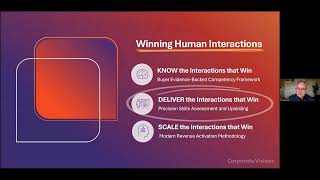
Tim Riester explains why human sales skills still matter in an AI world. Corporate Visions studied buyer behavior to identify eight experiences that predict wins or losses, then built AI simulations to assess sellers and personalized four-week training programs. One client hit 102% of quota by focusing on three high-impact competencies.
Chapters
What I would say about this title is that, like, build the human sales competencies that are still, um, still relevant in an AI-driven world, um, because we have a lot of question marks, um, but, uh, but we are— it is clear humans are still relevant, as I'm about to share. Uh, I'm, uh, about a month ago, um, when you're watching this, uh, it'll have been a month in a rearview mirror, we were at Gartner's conference, almost 2,000 people there. And they were, I would say a year ago they came out and said, "AI, AI, AI." This year they were more like, "AI is the accelerant to the human." And so they sort of softened that whole conversation. Although AI was absolutely front and center, they were really emphasizing the human interaction. And it turns out, That's because buyers were pushing back a little bit and saying no, in, in high-stakes transactions, um, we still want human engagement, and especially at those really important moments, those very specific experiences. So what I want to talk about today, Gerhard, is, um, what are those human interactions that still matter, and, um, how do you know what those are? Like, what's still the domain and the purview that are exclusive to humans, and then how to know who can and help deliver those interactions. How do you get your team ready to be great at the things that still matter? And then how are you going to scale that in your organization so that this happens for and with every human on your team? And we will— warning label— there will be some AI discussed at that point. So, um, um, one, uh, I will be holding off on AI, but I will not be not talking about AI. So, uh, that's the, the, the combo platter. So let's talk about the interactions that win. Um, one of the things that's really important to us is data. And, and a lot of companies we know who try to figure out how you win and why you win or why you lose ask their salespeople to tell them why that happens, but don't ask the customer. So, what I'm gonna share with you is we've asked customers. We, in fact, have a win-loss and a client experience service, which has helped us develop and amass the largest database in the industry of why buyers said they bought from you or didn't buy from you, or why buyers stayed with you or churned. And what we found is that when you ask sellers and you ask buyers about the same exact decision, you get different answers. In fact, 70% of the answers are different. So the question really becomes, um, who are you gonna believe? Well, purpose— for purposes of understanding which human interactions matter, let's ask the buyer. And what we were able to discern out of this database is that there are 8 predictive buyer experiences. What do I mean by that? This means that from the buyer data we have in win-loss is that we found that they expressed certain experiences with your sales teams that mattered. And if you did them well, you won, and if you did them poorly, you lost. And here those 8 are. Again, they're predictive buyer experiences. But when you look at them, you realize these are human interactions. These are the things your sellers control. These are the moments that they either do or don't deliver, and it turns out the buyer can observe them, score them, and compare you to your competition, so they matter. These little numbers at the top are important in that they represent a statistical reference called area under the curve. You can think of 'em as a percentage. How predictive are these experiences? So each of these things, as you read them, are things the buyer can observe and the seller needs to deliver, and if you do it well, It goes from being 91% predictive of a win or loss to 73% predictive, but in all 8 cases, they are materially predictive. More predictive, in fact, over product knowledge, industry knowledge, and even ease of purchasing. So there are some things that fall below this number that are less— in fact, they're no better than a coin flip as predictive value goes. But what was interesting is when we dug deeper in our database, we found that there were a good chunk of deals in that database that were actually renewals and churns as opposed to, let's say, a new buyer, a new budget, and a new business. So, we were able to start to extract from that specific experiences that were customer experiences. And what we found is that materially, they were different. 6 out of the 8 were different experiences that were predictive of a churn or a renewal. As you look at them side by side, you see that only deliver compelling communications and resolve issues effectively are repeats, that your prospective buyer, new buyer, new budget, new business, looks at the engagement and the experience from the opportunity that you took them through, the existing customer looks at it from the way you handled their business up to that point. And I think that's just an interesting distinction to think about if you're thinking about making sure your humans who are developing business for you versus your humans who are retaining your business for you need to operate and how those human interactions differ. So, if you look closely at retention and expansion, again, you see that other than these two, They are different experiences that your team needs to be able to deliver. So, number one thing to understand in a world where human interactions still matter, and you're wondering like, okay, which skill sets and competencies do my team need to have? Let's turn to the buyer. Let's find out from their actual decisions what mattered, and then think about this now as a modern competency framework. So knowing the interactions that help you win and doing that from the buyer evidence-backed, um, perspective gives you a modern competency framework focused on those high-impact moments in complex, uh, B2B transactions. Now the question becomes, how do you know who's good at what and how do you make them better where they're struggling? And so from there, you need to think about how a modern— not just a modern buyer experience-based competency framework works, but how you figure out in a modern way who's good at what. So we have worked with someone from Harvard Skills Labs and taken these competencies, um, to build out an AI simulation-based assessment, meaning somebody actually has to perform against actual selling activities, as opposed to most assessments that allow a seller to assess themselves. And we're here to say that self-assessments are fraught with over- and underestimation of capability. Humans are just not that good at reflecting on and prioritizing where they need help and where they're strong. It's, it's better to put them in an actual situation where you isolate the skills in action and they must demonstrate it in context. So I need you to imagine 3 concurrent simulations where you do the initial outreach and discovery with Persona #1, you do value presentation, solution, value proposition, solution presentation with Persona #2, and then business case justification and negotiation with Persona #3 as you take a 30-minute, they're 10 minutes each, 30-minute performative assessment. So, you're actually interacting with a buyer, you're a persona at each of these, and you're actually running that activity for that deal cycle. So, it's a deal cycle, not just a call, and it exposes all of these competencies and underlying skills as you do the work, not as you reflect on your own rankings. And that gives you some interesting data to now really start to process. Don't panic when you see this, but what you're looking at across the top are those 8 competencies again for the acquisition side. And you start— these are, just to be clear, these are fake names but real data. You start to see where cohorts are forming in terms of folks who are struggling and have opportunities to get better and how you're— think of your team post-assessment. You now have a heat map of who's strong at what and who, where are people struggling. And you can now start to think of people identifying in cohorts where you can start to customize or personalize training and prioritize training and follow-on coaching, because the managers now know who among their team falls where, with way more precision. You're more confident and certain because they took a performative assessment, and now you got a heat map that shows where the personal priorities are. And I just want to tell you one quick story of a company that used this. So number 1, they're confident, okay, these competencies matter, 'cause they're backed by buyer evidence. Two, the scores matter because they actually had to demonstrate the skill, not just self-assess. But then they were still left with all kinds of people struggling in all of the 8 areas, and they needed to prioritize 'cause they had to improve fast. They were halfway through the year and their win rates were plummeting, and this team's achievement was at risk. So what we did was not say, okay, You gotta fix everybody and you gotta fix all 8. We said, where are the high performers and low performers in terms of these competencies comparing their win rates? So we laid the win rate on top of the top 25, low 25% performers in each competency. And what we found is that 3 of these competencies, 1, 2, 3, had the greatest differential in terms of actual win rate performance. In other words, what that meant is we could identify the cohort who was weakest on each of these 3 and begin to isolate and intervene with them. So, what you need to think of is this client was halfway through the year and they needed to make up some ground. So in the next month, they worked with Cohort #1 on Competency #1. In the next month, they worked with Cohort #2 on Competency #2, and then they worked with Cohort #3 on Competency #3. So 3 competencies, 3 cohorts, and they took each of them through a sprint where each team In that month, week 1, did some learning on those particular skills related to that competency. Week 2, they spent some time in a virtual instructor-led workshop, and they did some, they did up to 4 hours of practice, feedback, role-play, coaching, teach-backs. And then week 3, They came back and they worked with an AI roleplay simulation where they practiced that competency and its underlying skills against a very specific roleplay for that competency. And then they tailored it for their deal by filling out the planner that accompanied this training session. And then week 4, their managers were given a kit that said, work with the reps from your team who were in this cohort and help them build out this competency for each deal they're working on, and then run them through some follow-up coaching. So, what I need you to picture is month 1, competency 1, they did these 4 weeks. Then, the next month, competency 2, the cohort went through these 4 weeks. And same thing with month 3 and the competent third competency in cohort. And what I can tell you, I'll just go back to that for a second. What I can tell you is after that was done, the team finished the year, because this wrapped in Q3 and then they had Q4, they finished the year at 102% after being pretty sure that this year was a lost cause. And the only thing that changed is they isolated, the competencies that mattered to the buyer, and they isolated the cohorts who were struggling in those competencies, and they intervened specifically in a personalized way. And so, what we see moving out into the future is training needs to be realigned to the core competencies and building out sprints for each of those so that when you identify where those gaps are, by whatever means you identify what those gaps are, you're not just throwing the same course at everybody. You're zeroing in precisely on the thing that they need. We have now also identified 3 competencies related to foundational prospecting that generate the greatest performance results. So, the library that Corporate Visions brings to you is 19 competencies strong. That can be assessed for and prioritized against, and people can receive learning and training and enablement and coaching that looks like their scorecard and fixes and helps them in the areas they most need it, which helps us avoid one problem training's always faced, which was plausible deniability by the people who were going through stuff they already thought they knew. And therefore didn't really adopt. And now we've seen adoption go up, usage go up, and impact go up because of the ability to personalize. So that's how you think about taking the buyer evidence-backed competency framework and then assessing for and upskilling in personalized learning journeys. With the last couple minutes that I have left, I wanna talk about how to, scale this in your company, um, and what the future holds. And as I mentioned, I'm going to whip a little AI on you. Um, here's the thing we see in too many companies is that winning human interactions, the, the ability to get from what you have to say as a company to get a customer to say yes, requires 3 parts. Let's just say it's a 3-layer cake of methodology. Your sellers have to follow certain steps. They need skills to execute those steps in a way that's different and impactful. And then you need a story to tell that supports, that brings that to life. Too often, this is done by operations, this is done by enablement and training, and this is done by product and marketing. But the challenge we see moving forward is that a human interaction is really the sum of these three parts. And you as an organization need to think about how do you scale human interactions by how you integrate these 3 elements. And I'm gonna show you what that looks like just on one side by example. Let's take the acquisition side. Our recommendation moving forward is that your process, so let's say your steps, need to be rethought and realigned to those things that the buyer says, matter in the experience. So, what you're seeing is your process isn't an inside-out, it's an outside-in established set of steps. Meaning, what experiences do we need to create that will move the needle and set us apart? So, you need to structure the way you run your engagements based on the buyer experiences, but then you need to align the skills that will train and help people execute those steps and you need to align the stories to bring those to life. This sounds hard, I'm not gonna lie, because if you think about it, that means for each of your stages in the buying journey, your seller needs to understand stage 1, they need to know the steps, what they need to accomplish, how they're gonna verify that. They need to know the skills that are required to deliver differentiated experiences, And they need to be able to tell stories that matter and are impactful for that stage of the journey. Hang in there with me, gang, because that then needs to happen 6 times, give or take. But when you look at this from the perspective of there are steps in a journey and there are skills related to each step and there's stories for each step, My 3-layer cake now has 6 pieces to it. And the way this is, that this is gonna come together in the future, because that's a lot for a salesperson to commit to memory and just do. And it's a lot to put in a static playbook and have a salesperson figure out how to leverage that. What we see happening in the very near future, because we're building these right now as we speak, is that there are going to be agents by sales stage that bring together the 3 elements so that your seller can perform them as they activate that stage, and then it's enriched by context, and then how managers and systems intervene to make people better are all going to be part of an agent-driven experience, meaning Stage 1 will have an agent that activates for call prep, and actual call execution, and call follow-up. It's going to be smarter because you're gonna integrate it to your CRM, and that's gonna provide data. You're gonna integrate it to your calls and your email information, and that's gonna enrich that. And you're going to potentially link it to where all your enablement content is, and that's gonna make that even smarter. So standalone, this agent can literally deliver and help the seller, it's only going to get smarter if you further integrate it. And then that means, because this is going multiple directions, that your interventions are going to get smarter and smarter so that you're going to be able to have a layer of assessment that looks at the situation and says, this is the coaching need and this is where the manager can help for this rep on this deal at this stage. So, it literally becomes an adjunct partner to the seller who helps the seller apply the skills, the steps, and the stories for that stage and makes it better and better as they go along. So, real quickly, I know we're running out of time, but I want to just share where this is headed. Today, we have people prompting AI. So, this is prompt engineering. And maybe you're adding some deal context. That's cool. But what— where this is moving to is that, um, AI in these two, um, situations gives plausible-sounding advice, but it doesn't make, um, a good judgment on what good looks like from the perspective of being predictive against performance. And so what we're starting to see is that more people are blending into the seller's AI activities, your quote unquote methodology, like we just talked about, your sales steps, your skills, and your, your story content so that your methodology is informing. And that means that the judgment that the AI is producing is both high quality and more predictive of performance, and it's more consistent with the methodology you want your company to follow. But where this ultimately lands is what we're saying is methodology-governed AI, where there's expert agents applying the methodology stage by stage, judging where you're at and what needs to happen now, and after that happens, showing you what happens next. Again, high-quality judgment and what good looks like is now being determined, but also what must happen next. So this is the big deal around AI, gang, is that there's a lot of AI going on in sales, but it's at levels where you're getting plausible-sounding advice, but not necessarily advice that's good, where it's predictive of wins and losses, and it's proven to deliver on performance. And this is where we're getting to very quickly. That means that your methodology needs to intersect with the AI at the right time so that you can diagnose the selling situation and then apply the right frameworks and then evaluate that against actual validated standards of performance and make sure it stays constrained to the task at hand, the job you need to do now and then next, because The other thing is you, you can get a lot of plausible sounding advice from AI, but is it precisely aligned to where you're at with the buyer and where you're taking them next in the journey? And so the future of scaling winning human interactions is going to look like this, both on the acquisition side and the expansion side, where the expansion side has a similar framework. And is powered by agents to get you through your account management, just like you're going to be driving your opportunity management and the ability to scale winning human interactions, the experiences and interactions that matter across the 3 layers of the cake and the pieces of cake you need when you need it is going to be the domain of methodology-governed AI agents. And that means, but it's not, it's only as good as the methodology underlying it, which is why that's what I started with today. So the future is highly consistent, high quality. We know what good looks like interactions, and that's scaled by assisting the human with an AI agent at every step along the way that helps them get there. So that's a lot, Gerhard, I know. And I think I might have done it pretty much on time. But do you have any questions or thoughts that you need from me today? How do people get in touch with you? Well, you can go to this barcode or whatever, QR code here, and you could hear what I just said because we captured it and recorded it there if you need it. But you could hear what all of our best clients are saying as well. But also, I'm on LinkedIn, Tim Riester, Chief Strategy Officer, Corporate Visions. Find me on LinkedIn and please get in touch with me directly and I'll be happy to answer any questions.
More from Gerhard



What Selling Looks Like When Your AI Agents Have the Context Your Sellers Do

Better Conversations, Smarter Support: Wearable AI in Business






When Scarcity-Built Systems Meet Abundance - The Judgment Gap in AI-Powered Sales Leadership
