Building and Accelerating Pipeline in the Shiny Object Era
Jen Allen Knuth explains why 38% of forecasted deals are lost to buyer inertia and shares three free tactics to break through it: treat self-educating prospects with curiosity instead of demo pushes, write unsure-sounding cold emails focused on problems not products, and ghost-write notes to help champions sell internally before paralysis sets in.
Chapters
Welcome back. We had a phenomenal day but now we have the icing on the cake. Jen Allen Knuth is in the house. She's the founder of demand gen, that's spelled J E N. So she knows about demand generation and she is gonna talk about building an accelerating pipeline in the shiny object era. Can you define what is the shiny object era?
Certainly I can. It is this beautiful era we're living in where every like 2.5 seconds there's a new game changing, AI enabled solution that revolutionizes the way that work gets done. Literally probably like another one just came out in the period of me saying that. So in a world where everything is, everyone is pitching better, shiny objects start to get a little less shiny.
Joe, what, what is your take about the shiny object area? You in the Hollywood business, everything is shiny. Well, you know it is. Everything is shiny and everybody's looking this way, then looking that way, then looking this way. So I have to tell you, I Jen, I am so excited about your presentation to do. You remember back in the day there was this trainer, a female trainer and her name was Susan Powder and she would always say stop the insanity. Well, what everyone, Jen, Alec, stop the insanity. So I think with that it's a great way to say Jen, the stage is all yours.
I love it. Thank you for the energy. I am here for it. So we've got just under 30 minutes. My goal is that everybody walks out of here today with three zero cost things you can start doing today. They don't require a tool, they don't require a vendor. These are all things you can do today after we get done here. So we're obviously talking about how to build an accelerate pipeline in the shiny object era. The three tactics that I'm going to introduce are intended to defeat buyer status quo. Now some of you will know what buyer status quo is, some of you may not. So in order to make sure we're all operating on the same page, here's how I'm going to explain it. I'm going to show you a video. It's a very quick video and it's going to ask you one question. All I need you to do, and you can do this in the chat if you want, make it fun. Is the second you think you know the answer to this question, I want you to drop it in the chat. So let's go. Take it away. This is an awareness test.
How many passes does the team in white make?
Drop your answers. The answer is 13.
But. But did you see the moon walking bear? So if you didn't see the moonwalking bear, we're going to play it back. I want you to watch from the right hand side.
There he is.
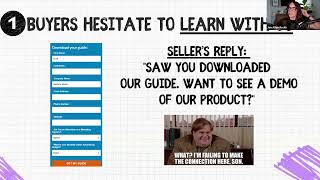
Now, this is an actual ad that the mayor of London ran. And the reason he ran it is because drivers were just opening their doors, not looking and hitting bicyclists. Now, we are not here to talk about bears and bicyclists, but we are here to talk about status quo. And the reason I share that with you is because in sales, most of us grow up in sales learning that our job is to show that we have a better way. We're better than competitors, we're better than a DIY effort, we're better than everything else. But when you actually look at the data this came out of CEB, Gartner and Challenger, on average, 38% of the opportunities that are in your forecasted pipeline right now won't be lost because you don't have a good enough product, a good enough brand, or a fair enough price. They'll be lost because the buyer essentially just says, sure, you've got a better way, but I've decided that I'm good with good enough buyer status quo. Is the buyer essentially saying, I'm okay with how we're solving the problem today. The issue with buyer status quo, though, and what makes it such a tough competitor is that no buyer in the history of the planet, I think, has ever got off the phone from a demo, read a cold email in response, responded back and said, you know what, thank you so much for the note, or thank you so much for the demo. But I have elected to choose status quo instead. A lot of times what they're telling us sounds somewhat positive. So, like the first one, let's revisit this in six months. When I was a sales rep, I was a sales rep for 18 years. When I heard that, I would literally go to my calendar, I'd mark the six month date, I'd show up six months later and be like, hey, I'm back. Meanwhile, the buyer was thinking, I just didn't want to tell you no because I know when I say no to a salesperson, you're going to do what you're taught to do, which is objection. Handle me. And I don't want to be handled by a stranger. So it's much easier for me to punch you off into the distance and hope by the time that six months rolls around, you're gone, I'm gone, we can just forget about the whole thing. We don't have the budget I think we all learned the lesson in Covid. Nobody was lining up around the block to buy Zoom licenses pre Covid. But then the environment shifted. Everybody went remote, and all of a sudden there was a business need that necessitated a virtual communication platform. Budget appeared out of anywhere. So when I used to hear we don't have budget, I would think, that's not on me. We're too expensive. It's just not in the budget. What the buyer was really saying was, we just don't want to spend money on this right now because we don't think we actually need to action it. The third one, I'll socialize in this to get back to you. This was like the kiss of death for any in flight deal. Because what would happen is the buyer would hang up for my sales call, go into probably five more back to back meetings, and at the end of the day look back and say, shoot, I signed up to socialize this. Which means now I got to herd all these cats. I got to ask my CFO for money. I probably got to write a business case, which I don't think anybody likes doing. How bad is this problem? Or could I tolerate it a little while longer? The closest to the truth is when we hear things like, we're good right now. Now, the problem with this is one, it's happening frequently, and two, most of our messaging is actually not wired to defeat this competitor. The thing that I realized way too late in my sales career, I wish I learned earlier, was that our enemy here is actually really problematic. We are out there. If you look at cold emails your sellers are sending, if you look at the messages we're pitching, we are often pitching a message of how we have a better way. But at face value, better rarely defeats. Good is good enough. Good is good enough is a really difficult competitor. And when it comes down to it, we love to overcomplicate sales. We love to apply these tactics and, you know, things that you say and do that will trick your buyer. But it's core sales is really just about deeply understanding human psychology. If you look at human psychology, we humans are very predictable creatures. We make decisions that fly in the face of what is best for us all day long. Like how many of us woke up today, didn't work out, didn't eat a healthy breakfast, skipped lunch? We know we shouldn't do those things, but we perceive that nothing that bad is going to happen. So I'm just going to continue on with my current behavior. When it comes to B2B buying, those same rules apply because it's the same human beings making stupid mistakes that go against their best interest. So here, when a buyer is listening to our pitch or reading our cold email or whatever they're absorbing from us, they've got two sides of their brain working in tandem. The rational side is saying, you know what? She's right. This is a better way. But what does the road to better look like? Well, I gotta make a business case. I gotta pitch this. I gotta get six people inside of my business to agree that we want to spend money on this. I'm looking at my calendar realizing I'm already busy. Do I really want to sign up for this? How bad is this problem? On the emotional side, it's the what if monster. Well, what if I do say yes to this? What if I jump through all those hoops, I get it committed, and then something goes wrong and we don't look like your ROI study. We don't look like your case studies. Now all of a sudden, everyone's like, who changed this? We like the old way better. So these two things come together, and it explains why even prospects who raise their hand, they come inbound often will be closed loss due to them just saying, hey, we can wait. And so this is my favorite sales movie ever. If you haven't seen it, it's Tommy Boy. It's a legendary movie. It's the only movie where someone is portrayed as a salesperson that isn't like a slick dude dressed in a great suit, like just the right thing to say. When we think about the competitor of Status Quo, it is a unique competitor. You have two choices for how your sales team can compete against it. You can either pitch why you have a better way. Get the objection of we're good for right now and try to. Objection. Handle it. Which in my opinion, now we're on our heels. Now we're playing offense versus defense. It's not a place I want to be. Or we can think about where are these moments of buyer hesitation when they're going through the sales process? How do we preempt status quo early? How do we think differently about what we say and do? And so that's exactly what I'm going to teach us today is three things. They cost you zero dollars that we can use to preempt Status Quo so that we don't have to. Objection. Handle it later. So let's get into the first one. Number one. Buyers hesitate to learn with us. How many of you have ever signed up for a webinar, downloaded a white paper, went to a Trade show or conference. And then we're met with this beautiful little gated form on the left hand side, which is kind of wild. This one example I pulled for a reason. Not only do we need your first name, last name, email, phone number, your website, what kind of agency you are, but we're so bold to even ask, what's your budget? I find that to be wild. But I need to pass through this holy gate to even access something that might be interesting to me. Now, let's say I fill that out. Now, what are we all met with on the other side of it? We can almost count down the clock before someone reaches out and says, hey, saw you downloaded our guide. Do you want to see a demo of our product? Meanwhile, we're sitting here thinking, your guide was titled the state of Cybersecurity. It was not titled want to see a demo of our cybersecurity solution? So these two things cause our buyer to hesitate. Next time I see something from you, I don't know that I'm going to, I don't know if I'm going to fill out this, get this gate because I know what happens next. You're going to put me in the same cadence as anybody else and you're going to try to push your, your message on me. So here's one way to think about it differently. If you think about a marketing qualified lead, an mql, we tend to treat them all the same. Hey, this person downloaded a white paper that was a, you know, thought leadership piece. This person came to event. This person joined for a webinar. They're MQLs, like Sick the dogs on them. When in reality there's really two camps. You have on the left, your hand raisers. These are people who want your demo. I want to talk to the sales team. I want to see a demo. Somebody call me. We don't have to overcomplicate it. Remove the friction, make it as easy as possible for that conversation to happen. The more problematic camp is the set of MQLs from these white papers and thought leadership and things like that. That when they hit the seller's inbox, they're like, they're not asking for a demo. Like, what do I do with this? I call these learners because often these are people who are earlier on, they may not have yet decided they need to buy something or do something, but they're expressing learner interest in the topic. They're learning about problems. They might be still forming an opinion about what they do. Now. Most sellers will say, we love the stuff on the left. And to be honest, who doesn't love a hand raiser? But I think what we're seeing now is there's fewer of these folks. So we have to be wiser about how we treat this segment. This segment of learners who are learning about problems, who might be buyers down the road. So this is one tactic, this is the first tactic for treating learners differently. Now, this is a busy slide, so stick with me on the right, I've written an email that is just a framework you can take and apply whatever you sell, whatever your webinar topic is about and use this framework. But I'm going to explain on the left why it's different and why it's effective. Now, I want you, before you look at any of this, I want you to think about the last time you came to a webinar. More often than not, that same day or early the next morning, you get that follow up email that has some thank you for joining yesterday's webinar. And then the first line of the email that is listed there is thank you so much for joining our webinar. Now we're going to talk later about this thing called the mental spam filter. It's a coping mechanism buyers have that tells them clues of things that will tell them like is this a cold email? Is this spam that. Thank you for joining us. Your buyer knows what's coming next. Thank you so much for joining us. We would love to share more about the work we're doing here. Are you free on Thursday or Friday to learn about our game changing? Whatever. And the buyer doesn't even have to read the email to know how the story ends. So what we're trying to do here is completely different. On the right, first and foremost, the subject line. We spend so much mental energy trying to come up with the cutest and most clever subject lines. You know who does not put that kind of mental energy into subject lines? Executives. You look at executive. Many of you are executives. Look at the emails you send. It's probably one word, two word, go against what we've been taught. Pick the most boring potential word you could put there. One or two words you could put there. If this is an example where let's say I ran a webinar on discovery skills, I would just use the word discovery. Now the first line, notice it's not, I hope you're well. Thank you for joining any of that stuff. Because that sends that signal that hey, you know what's coming Instead, what I'm trying to do here is provoke curiosity. Here's something we did not cover on today's discovery webinar. Second line. This is a give, but this is not dropping a case study or a 40 page ebook. Our goal is to spark a reply and make it low effort. If a buyer has to open a 40 page document, the odds of them coming back to this email are quite low. So instead we're doing something we can copy and paste within the email. Hey, it's five questions Betty uses to size the buyer's pain. Now the third line. This is intentional unsure tonality. What we're doing here is anytime we're talking about the buyer's business or the buyer's potential problems, we are not being assumptive. We are not saying things like, saw you signed up for our webinar today. You must be struggling with your team's discovery skills. That's like walking into someone's house and saying, man, this place is ugly. Instead, what we're doing is we're using unsure tonality because we are outsiders looking in. We don't know not sure if is an unsure tonality phrase. Not sure if your teens are stalling at discovery. And then we're going to position ourselves as not someone who is breathing down their neck to book a meeting, but someone who's here to help. But if content like this helps, I can share more. And then the last line is a softener. Either way removes the desperate tone of like, are you free on Thursday or Friday to book a meeting? Either way, thanks for joining. And then finally, we can use a PS in one of two ways. One is a breadcrumb. One is a spiderweb. Breadcrumb is tailing sort of a breadcrumb of saying, hey, by the way, did you see this larger asset? All we want is a yes or no, right? We want to make it easy for them to reply. And if they are inviting the yes. Now, I know I probably have my claws hooked into someone that is intently thinking about this problem or breadcrumbing or excuse me, spider webbing is. Let's say you've got multiple people from one company that are joining the same webinar. Most of the time they have no idea. What I'm trying to do is say, oh, it looks like Tom joined too. Now I'm creating a web of people who are also getting curious about discovery that might increase this person's confidence that, hey, I'm not the only one thinking about this. So this is one tactic so we don't freak out people when they're learning with Us, which is, by the way, the point of content marketing. We want them to keep coming back and learning more. So don't treat hand raisers the same way we treat learners. Number two, everybody loves to talk about pipeline generation. Buyers hesitate to meet with us. And the reason they often hesitate to meet with us is because we act like the people at the mall who work at these kiosks. How many of you have gone to the mall to buy something for yourself, for your family, for your friends, and made this unfortunate mistake where you make eye contact with this person? They're nice people, they've done nothing wrong. But most of us, when this happens, we're like, avoid it. Like, I want to look away. I want to pretend like I'm on a phone call. I walk faster. No, no, no, I'm good. Yet when we look at cold emails, oftentimes we're doing the exact same thing these mall kiosk people are doing. I'm showing up in a place where you don't want me to be and I'm pitching my thing and you are avoiding it. So in my line of work, I work with a lot of companies on outbound prospecting. One of the things I ask teams to do is write a cold email to a Target account so I can see how the team is approaching it. Today I've put up on the screen two emails that are emails I just made up about a made up company. The email that is option a is what 95% of the emails that I look at look like. Doesn't matter who they're selling to, what they're selling, what industry it is. This sort of framework of my name is Jen, I notice this thing and here's who we are, and we're the number one at this and we will revolutionize. And 10 times this, and are you free on Thursday or Friday?
Buyers can smell this from a mile away. One thing that's really interesting that I do is I say, at what point in this email do you check out? And most people don't even make it past the second paragraph to the second paragraph on the right. Notice it's the same solution, same prospect situation, but there's no references to me, my company, our solution roi, any of that. Because for someone to value a solution, first and foremost they have to believe that there's a problem worth solving. So I'm not saying like I'm an author of the world's best cold emails. I'm just saying if you have two choices and you hold them up in front of your buyer Your buyer will always pick the one that is about them because they are inherently selfish. Not because they're bad people, but because they're in their inboxes, they're on the phone doing their job. So we have to be relevant to them. This is what I referenced earlier, the buyer's mental spam filter. Now, this is not the physical spam filter in your email account. This is the coping mechanism that buyers have that allows them to get through the day without spending the entire day reading emails. So the facts show you got three seconds to get an open from the inbox view. If you do get an open, you get nine seconds of reading time, which is 37 words. So check how long your emails are, because we got about 37 before we lose them. The big problem and the reason why people say cold outbound is dead and cold email is dead is because of this stat. 96% of cold emails are out of automated first name, last name, title company. Everybody gets the same message. Which explains anecdotally why the fourth point exists. Personalized emails now receive 1200 percent more replies than they did before than they do versus an automated email. Excuse me, that number is so ridiculous, I feel the need to contrast it. It was only 100% in 2022. That logically doesn't make sense. There's more emails going out. Why would this be a greater return? Well, anecdotally, what I hear a lot from buyers is it is so bad because of this that if I see the fact that a seller has taken the time and energy to be thoughtful about my business before showing up and throwing up about theirs, I want to incentivize. Good behavior doesn't always mean you'll get a reply. Doesn't always mean it'll be a positive reply. But as a salesperson, I would pick 100% of the time a reply over no reply, because the reply is information. So the great Dale Carnegie quote from how to Win friends and influence People, if you want to be interested, if interesting, be interested. I think that should be our philosophy for emails and for outreach. So this is the second tactic. This is for outbound. I call this problem prompting. It's writing an email where you don't talk about your product, your solution, anything at all. It is all about the customer's business and it's bringing an idea instead of a solution. So let me take you through the format very quickly. Saul Read heard. Notice this. This is an observation about something you see their company trying to achieve. Not saw you went to Penn state. So did 700,000 other people it saw. You're looking to do X. I'm going to show you on the next slide a way to quickly do research to get to those answers. Second line connects with the first. Not sure. As a result of pursuing this objective, this thing over here is getting harder. Again, note the unsure tonality. Now, instead of saying, well, we helped acne increase everything by 1000%, that's pitching. What we're trying to do is position ourselves as folks that have insight into what others are doing. It's why people come to events like this. You want to learn what is everyone doing? Is it working? Is it not working? We salespeople sit on so much insight and we never use it. So there's two ways you can do this. This other company was up against this, or Acme was weighing the pros and cons of A versus C or A versus B. If you know there's two things they're probably evaluating against and then all we're doing is just saying, are you open to hearing how they did it? I'm not asking you for time. I'm not dropping a calendar link. I'm not giving you six options of dates and times. I'm making it low effort, yes or no, and then back with that either way or PS close. I actually am a big believer that personalization is better placed at the bottom of the email. Because often what happens when we place it at the top, like I'm a big dog rescue person, is emails sound like, hey, saw you're into dog rescue. Anyway, we're the leading provider of IT and engineering talent and that's just gross. So we're living in a world where we've got access to AI. I use ChatGPT. It's 20 bucks a month. I select the O3 model. This is important. It's the best visualization of the results. So at the top left corner, if you use it, pick 03. Here are questions that I'm asking it. The first two questions give me context. I had a great sales manager who said, if you can't tell me what this company sells, how they sell it, who they sell it to, how they make money, you don't know enough about this company to have an opportunity here. This helps me get to quick answers on that. The bottom three are the three prompts. If I could know nothing else about a company, these would be the three I'd use. The first one about the CEO's interviews gives me actual sound bites about what that company is trying to achieve. That helps me fill out Line number one of the email. The bottom two prompts help me understand what is that individual I'm reaching out to. What are they likely up against? So these are really helpful prompts that kind of eliminate the excuse of I don't have time to do research now. Third and finally, now we're mid cycle. Now we've got a champion. If you haven't seen this research, it's probably one of my favorite bodies of work that was ever done. It's showing what happens as you as the buyer has more people involved in their buying group. This has nothing to do with multi threading. We don't control who they include this. The way to look at this is this. If you have a solution, you're selling it to one individual at the group and they don't have to consult anybody else. They can just buy without you and they see value in what you offer. You have an 81% likelihood of closing them. I'll take those odds all day. But look what happens the second you add just one additional person to the mix jobs down to 55%. At 6, we're at 31%. I am glad they stopped studying it. The numbers across the top were research. They was research they were doing to see how many people on average are getting involved in a B2B buy. Don't worry if you don't have 11 or 2. The number doesn't matter. It's the dysfunction that presents when you try to get any group of people together to make a decision on anything at all. Dinner. Going to a place for dinner is hard with 10 people, let alone making an investment. So when we are here, what we tend to do is champion gets excited and we say yes, let's socialize the solution. Let's show everybody how awesome this is. And then the deal tends to die. Because it turns out the champion is far more interested in solving this problem than everybody else. So what I used to do is send the email on the left. I'm so excited. There's alignment. Here's some information around how we can help. Let me know when you do all the hard work of socializing it with the team and getting buy in and let me push for my next step at Friday at 2. Very easy email for me to write. Very difficult email for my buyer to action. Instead. What we want to go for is on the right. I'm going to intentionally slow down my buyer. I'm going to say I'm excited that you're excited too. I know you want to show folks the solution, but often what Happens is there's different perceptions around the importance of solving this problem right now or competing priorities. So I don't want to shoot for the moon and then fall short. So if it's if okay with you, I'm going to ghost write you a note reducing the buyer's effort to position a call where we align around the problem. So again, it's the same theme that we saw in that cold email. I am positioning myself as someone who's worked with other companies who are looking to achieve something similar, solve for similar problems. And my goal is not to pitch you a solution. It's to come in and provide some outside in perspective. So on the right hand side, what I'm making it easier for the buyer to do is to surface skepticism, misalignment early before we start trying to push a solution. Because I don't care how cool your solution is, no company buys a solution and reaches consensus on a solution if they can't reach consensus on the problem first. So we intentionally want to slow it down here so we can speed up in the end. Now, last things before we wrap up. This is a very simple binary yes or no question. Most of us in my own career, I was not trained on how to defeat buyer status quo until very late in my career. If your buyers have not been trained to defeat status quo, odds are they're trying to treat it like other competitors or they're writing it off as an it's not me thing. So if this is something that you are working on, these are some of the companies I've worked with this year. Status Quo is a different and kind competitor. We have to think differently about it. You do not need to work with me to solve for these. There's a reason I gave you three tactics you can do without me. But we do need to be mindful of thinking about how often are we potentially losing to status quo. Because if we don't change our playbook, we're going to keep seeing the same outcome. So with that, I will stop sharing. Looks like we got a couple minutes. If we have questions from the group.
Jen, can I, can I share something?
Sarah way yes.
My brain is ready to explode. So you got me. You got this Italian. I'll just tell you that right now. So as a former television producer and screenwriter, one of the big things is we have to communicate to our audience fast because if we don't click, we're gone. The audience is gone. And I love, I can't tell you how many writers rooms the conversation we as producer writers have where we say just like you're saying in that first, that first page has to set up the whole show because if we don't we lose them. And it's the same thing with your email. And I, and I, and I own an AI company. But you're, I just learned, oh my gosh. You just taught me just a world of communication.
No, that is such a good analogy. One of the things I say a lot is like our cold email is the movie trailer to the movie. I'm making a decision do I want to go see this movie or do I want to throw this movie in the garbage? So that is such a killer analogy.
But you like, you like mind melted. You did the Vulcan melt to me. Beautiful. Oh my gosh, I loved it. Well, thanks, John. I'm blown away. Blown away. I'm looking at the comment I love the.
More from Gerhard



What Selling Looks Like When Your AI Agents Have the Context Your Sellers Do

Better Conversations, Smarter Support: Wearable AI in Business






When Scarcity-Built Systems Meet Abundance - The Judgment Gap in AI-Powered Sales Leadership
