Create Moments, Not Just Milestones: The Missing Link in Your Sales Methodology
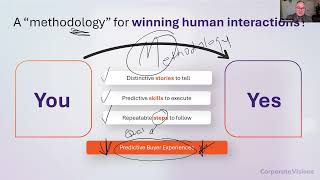
Tim argues that B2B sales needs human moments, not just milestones. Gartner found 75% of buyers want human interaction at critical points. His firm analyzed 150,000 deals to identify eight predictive buyer experiences, then built a methodology around repeatable steps, skill training, and storytelling to deliver them consistently.
Chapters
So I want to circle the word here, methodology, because if there's one thing I've been hearing, I know the term unprecedented is a little overused. So the only way I can describe today's world is unprecedentedly unpredictable. Yet we're being asked for predictable and scalable revenue growth. So in the most unpredictable world, we are being asked to be predictable. And everybody is, is keying in on this idea of like like we need to refresh, rethink, reintroduce, reinforce our methodology because we got to get that right to be predictable and scalable. Everybody's got to go on the paper, if you will. And I want to talk about that today, but I want to talk about it with a broader lens that what we're really shooting for is creating experiences and moments with the customer, not just documenting and tracking and adminning milestones. And I'm gonna explain what that means. So the first thing I wanna do is say greetings, fellow humans, because we're still important. So I love Gartner. 2 years ago, they gave us all the number 75, and they told us 75% of B2B buyers want a rep-free, a sales rep-free experience. Now, 2 years later, believe it or not, in a stunning reversal, their latest research says that 75% of buyers prioritize a human interaction over AI. So apparently, careful what you wish for, they want human engagement and they want it at certain critical points in the decision process. And so, yay, we're still important, but they— we need to know what human interactions still matter in this age of AI. And as a result, what that means to your quote unquote methodology. So I'm going to talk about 3 things in the time that we have today. How do you know which interactions your buyers are prioritizing and therefore you need to get right? How you then integrate those into a sustainable methodology that differentiates you, not just documents the opportunity. And then how you make sure that your teams are ready to deliver that. How do you get people ready to deliver the human interactions that buyers are prioritizing? So that's going to be our agenda today, and, uh, 1, 2, 3. Let's start with number 1. How do you know which interactions are driving the win? And to do that, we have to ask a couple questions about why you win and why you lose. Here's the problem with that. Most companies, when they think about why they win and why they lose, they simply ask their sellers to fill in a dropdown menu in their CRM system, which neglects or leaves out the buyer who is the one who actually made the decision and really holds the keys to understanding why you win and lose. So, what we've done at this company is we went out and actually acquired a company that specialized over the last 10 years in B2B buying win-loss analysis and client experience analysis. So, we now sit on a database and the database is fun if you like to play around and learn things from your database. And you need to have a large enough N, and we do. We have 150,000 B2B decisions, wins and losses, or churn and retention. And, and we now are seeing things about the human interactions because you're asking the buyer what happened, what went well, what didn't go well, why did you choose us or not choose us, or why did you choose the competition? And you learn things. And first thing you learn is that when you ask your sellers why you win or lose and you ask your buyers why you won or lost on the exact same deal, the answers are different 70% of the time. So we're going to choose to use the customers as a data source. And I want to show you when buyers are prioritizing human interactions, what human interactions are actually predictive of wins and losses. So the key here, the key word here is predictive. And the other key word is experiences that your buyers are having that are predictive of wins and losses. So meaning buyers can tell you, they can score you, they can comment, and they can compare you to the competition and you can learn some things if you go out and have 150,000 decisions to look at and you cluster them. So what I'm putting up right now are what we euphemistically refer to as the Great Eight. These are the 8 predictive experiences, predictive of wins and losses that buyers are expressing when we cluster all of these surveys, structured and unstructured data. And what we find is these 8 come to the top when it— in terms of the statistical, uh, concept of area under the curve, AUC. And what that means is anything over 0.5 is, is better than a coin flip. It means it's predictive. And the higher the number, the more predictive. So I want you to just scan these 8 right now, or maybe take a picture of them and you'll get the slides. But when buyers, B2B buyers say We wanna prioritize human interactions at the most critical times. Look at this list, because this is what they're telling us in their feedback after they made actual decisions are what mattered. And if you did 'em well, you won. If you did 'em poorly, you lost. In other words, these are the human interactions that they are prioritizing, and they can score, they can compare, and they can comment on. And now you know what that modern competency framework needs to look like when it comes to being the company who provides differentiated human interactions that matter to buyers and are predictive. So that's a great place to start. You gotta know what interactions matter. So then the question becomes, all right, so how do I make sure my team can deliver those interactions? So when you think about developing your team, hiring for, onboarding for, and continually upskilling, coaching for. You need to start with these 8 and say, these are our goals, but how do we get there? So with the predictive buyer experiences as your foundation, these are the 8, we gotta get better at those. The question about what is a methodology becomes very interesting. Too often what we see passing for methodology is somebody saying, I want some repeatable steps to follow. I like to call them the, the obligatory chevrons in your sales process. And then interestingly, a lot of people pick something that is a subset of even that, and they pick something like MedPick and say MedPick is our methodology. When you talk about repeatable steps to follow, I would argue that qualification is, is just one of those steps. So a methodology for creating a winning human interaction is not going to be rooted in a qualification document or even the chevrons. Like, that's a great way to administer a more predictable pipeline. But now, how are you people going to show up? Like, what skills do they need to both execute the steps but also deliver in front of the customer? And what story will they tell? Here's the problem. We see this as sort of like the capital M methodology, and that if a company is truly going to install a methodology that means something to winning human interactions, you must have repeatable steps that are aligned to predictive skills and are infused with distinctive stories. And too often these are different departments in your company, but you're going to have to figure out how to put a wrapper on that. And we believe the predictive buyer experiences, those 8 moments of truth that you must be great at, in terms of winning human interactions should bring all 3 of these things together. And your methodology moving forward needs to absolutely include those important repeatable steps so that you can run a proper engagement and do that consistently and predictably and, and do that so that you can forecast and manage the growth of the company. Like, it's super important to have a foundational process. But we believe today's processes are too much about what us and what we need and what we have to have in order to manage an opportunity, when in reality it should be rooted in what the buyer says they need in terms of experiences that matter to them. And so one of the first things we're advocating for based on the data is that your steps should reflect the experiences that are predictive of wins and losses. And so that what you're doing in those steps are equipping your team to not only get the company what we need to run a sound engagement, but also begin to create an experience for the buyer. And that's where the steps need to be aligned to the skills. And too often skills training is often a totally different world, trying to help your sellers learn the products and, and get them in a position to, to, to do this initiative or that initiative. Or maybe you just have your own framework of skills that you're trying to train to, but there's no connective tissue between that and the steps or the process. We're saying the new methodology, the new modern era of methodology that drives predictive and, and desired human interactions will align your core skills training content to the steps in your process, which in all cases are built on the predictive buying experiences so that your steps and your skills are reinforcing each other and you can run an engagement, but also create an experience once you're in front of the customer. That's what turns an administrative tool like a sales process into an articulation and execution experience in front of the customer that differentiates you, again, against those 8 experiences that matter to them. And not to, not to try and overwhelm or overcomplicate this, At some point, all of the stories— other words, I like alliteration, so I call them stories— but the messaging that your organization builds off in product land or marketing land or wherever it is needs to also come into alignment so that when, when you go to market with a methodology, your steps, your skills, and your stories are in alignment to create like what I like to call the three-layer cake of methodology. That in every case there is really 3 layers to the experience that you need to deliver to equip and enable your team to generate and drive these predictive buyer experiences. So let's, let's take a, let's take a little bit closer look at this. But just accept for a moment, just breathe in this idea that modern methodology is not just setting up and knocking down milestones and exit criteria and verifiable outcomes. It is about creating a differentiated experience or creating the moments that buyers will recognize when they make the decision. And those moments and your milestones are completely aligned, not 2 or 3 different experiences. If it's your messaging over here, your skills training over there, and your sales process over here. Maybe in operations, maybe enablement, maybe marketing. Those things have to cohesively come together to deliver. And so the way we think about this in terms, again, this idea that your job is to help your teams create a differentiated experience because milestones are not going to move the needle on, on the human interactions. That the buyer's expecting is that you need to think about stage by stage, um, a, a steps, skills, and stories package. Um, the idea that for each of these stages, you know what the buyer mindset is, what the seller activities are, and what it looks like to be done, get to good on that stage. But that doesn't move forward until and unless you actually incorporate a way to activate that. So the idea is that process is process until it's— and it's there and it's documented, but it's not used and activated in a way that matters to the buyer until you integrate the skills with the process. And it isn't the skills to fill in the blanks of your process. It's the skills to say something smart in front of the customer at that stage. So each stage needs to know the steps, but it also needs to incorporate the skills and simply put how to prep for, how to execute, and how to follow up those steps in actual engagement with the customer, how to show up well, create a moment and, and get to, get to done so that the follow-up that you're doing is executing on the verifiable outcome that you're looking for. And that the seller understands that I'm not just populating a green, a blue, a gold sheet of any kind of sheet color or kind. They're actually creating experiences and documenting those experiences that, that helps you get to done. And this is where, again, I think most people are not thinking about how to bring the Big M methodology to the table is that your stories what gets said are what helps bring these skills to life, and the skills are what help bring your steps to life. So the thing that really drives this 3-layer cake is if in your prep, execution, and follow-up, you are telling stories and delivering messages that are memorable, compelling, and impactful for that exact stage. So tomorrow, we believe that there needs to be stage-based steps, skills, and stories. And that is the modern methodology that will move past just running an engagement and the stalemate caused by everybody running similar processes to actually create real experiences that are predictive of wins and losses and responsive to the human interactions that the buyers are looking for in the moments that matter. So I need you just to sort of picture then that as an organization, you need to be thinking in a 3-layer cake and that you need to be creating slices of that cake that include all 3 layers and then helping to equip, enable, coach, follow, feedback, reinforce each of these at each stage. I know that again, it looks like, wow, that's a lot. But I think if you break it down into its piece parts and understand the role of each, the step, the skill, and the story, and you look at this as because of the buyer experiences and what we understand, there are finite number of experiences that matter in this modern world. That it is something that you can begin to lay out and organize and diligently develop and, and, and do so in a way that you will see business impact beyond just better qualification, ruling in and out of deals and opportunities, more so than just predictable, forecastable pipeline. Because if your pipeline isn't growing, and you're not beating the competition and any predictable, forecastable, consistent pipeline means nothing. So what we believe is that it requires a good crust for what you need to run the engagement, but you need the good stuff in order to actually drive the growth. So with that, I wanna take just the last couple minutes and say, all right, What you need to now do is make sure your talent is right and your talent is ready. And so again, hiring, onboarding, and then upskilling to get people in a position to do these things starts with, in my mind, how do you know if this new hire or this first year, second year, or 3+ year experienced person is good at these 8? And so one of the things I want to quickly talk about is that You need to think about assessments that are one step above today's current assessments, which are typically one, self-assessments, and two, the questions and the competencies and skills are not necessarily rooted in any sort of meaningful data model. So what I want to talk about today is that we have taken the data model that shows these are the 8 competencies and their underlying skills. And built an AI-driven precision skills assessment, meaning you have 3 simulations you go through to complete an entire deal cycle in just 30 minutes. You will have 3 encounters: the initial outreach, discovery, qualification, the value proposition solution presentation, and the business justification and negotiation across a deal where you are where we can isolate your skills and we can see you demonstrate your skills in context, and you will know what people can do versus ask them what they think they can do. There isn't a, a respected profession alive that doesn't have some sort of performative or simulation-based assessment and ability to analyze skills and then know what skills to work on. And sales was one of those that didn't. And so we have worked with a group that came out of Harvard Skills Labs to leverage this data model and, and create a simulation-based experience across an entire buying journey where now you can know— hang on for this slide— who's good at what. So we know there are 8 predictive experiences of wins and losses, and we know that these are the human interactions that are going to be prioritized by B2B buyers in the future. So we need to get good at them. The question is, who's good at what and who's not good at what? And how can you help hire, onboard, and continue to upskill people? It's by understanding competency gaps and the cohorts who live there. And so if you can see here, this is real data, not real names, from one of our clients, 150 salespeople in, in 15 territories, and they were able to assess who needs what. Then they were able to apply a trailing 12-month win rate so they could look at the KPI they wanted to improve and then compare win rates to the scores on each competency so that they could identify which 3 competencies were driving that team in that territory at that time's wins so that they could go then create cohort-driven sprints, learning sprints, and learning journeys against the folks who needed it and the things they needed to drive the results they were looking for. And with one more minute, what they did is they did digital learning, virtual instructor-led experiences, practice, role play, and proficiency certification, and then coaching and reinforcement competency by competency based on the cohort who had gaps in those competencies. And the competencies that were mattering most to their win rates. And so I just wanted to lay that out for you at the highest level, that knowing exactly what predictive experiences matter to buyers and are predictive of wins and losses, packaging those together to create real moments, not just have a trackable set of milestones, and then knowing who needs what so that you can improve the performance inside of your teams by creating personalized learning journeys based on the gaps, all working together to drive the winning human interactions that B2B buyers say they still need from the humans in the loop. So with that, Tricia, at 1.5x, I hope that continued your winning streak today of content and engagement.
Absolutely incredible, Tim. I don't know that you could have jam-packed any more data-driven, like, this is what we need to do to succeed. It was Phenomenal. Now, if we can go on a speed dial, I have a couple questions from the chat. So, you know, just maybe a few seconds and then everybody needs to go to the networking session and visit your booth. So Gary Gilchrist asked, would you agree that most potential customers struggle with understanding their own internal buying processes and the steps and influencers who also need to be included before a deal can be closed?
Yes. And this is why this— knowing the steps that, that correlate to good experiences and outcomes is so important. That's why also many of our steps are our steps. And so we think sort of the breakthrough here again is you can help them get through the experiences that they say matter, but you can help them, you can facilitate them through that because you now have steps that match their experiences and you're taught the skills to execute that step. Just so different than trying to make customers follow our administrative process for selling. But I think that is one of the key jobs and why they still want humans in the loop is like, we can't get it done if we just have a bunch of research and ideas and, and content. We're overwhelmed. Please help us. So I think that's spot on.
Okay. Now here's a human issue. Abdul asks, how much influence does marketing have on the customer experience as they make the product and the sales team just engages with the customer to sell the product? So what should marketing be doing?
Well, so, you know, it's interesting, like the, the, there's an assumption that the product can do what the customer needs it to do. The, the, the gap has always been like, have you been able to facilitate a level of confidence and trust that you're the one who can best get them there? And, and these 8 experiences are the way they're judging you. And so I'm not sure what the product itself can do to help facilitate these decision stages. But knowing as a marketer in product development and then product positioning what the customer buying experiences are and the interactions that have to happen, I think puts you in a better position to frame your story along the way. And it really helps you create a customer-centric story to get them through decision-making steps as opposed to here's, here's swear allegiance to all the features and benefits of this product sort of thing. So for me, it really comes down to we have to think about our positioning of our products in a buyer experience journey as opposed to just product differentiation. Gerhard?
Okay, so how do we up the ante from here?
I think we have hit the peak with Tim, and it's only going to get better because every speaker is really challenging the next one. To offer even better insights. But what blew me away here is, Tim, remind me of the numbers. You talked about the hands in poker. It's not that the best hand wins, but the best player wins.
What are the numbers? Yeah, this is free for anybody who hasn't heard me tell this story. And I think it has everything to do with what we just talked about. They looked at a study of 103 million hands of poker, online poker, and they discovered only 12% of the time does the best hand win. Based on the data, that 88% of the time, because they have these analytics, it's the best player who wins. And what I like to say is that means that the player wins regardless of the hand they're dealt. And, and that means the best player knows how to tell the best story with the best skill. And I'm like, this totally relates to sales. Like, we have a great hand. Sometimes it's the best, sometimes it's not. But it turns out it doesn't matter because at the end of the day, this is you as the seller and this is you driving winning human interactions. And you can win regardless of the hand you're dealt or make sure that when you have the best hand, you don't somehow lose it. Because again, 88%, that's on us, right? With our lips moving, us with our lips moving, we drive the bulk of this and then some.
Thank you, Jim, for another great presentation. We need to stop. Please visit the sponsor booth and go to corporatevisions.com. Or connect with him on LinkedIn. Thank you so much, Tim.
Thanks. Always appreciate it, Gerhard. Bye.
More from Gerhard



What Selling Looks Like When Your AI Agents Have the Context Your Sellers Do

Better Conversations, Smarter Support: Wearable AI in Business






When Scarcity-Built Systems Meet Abundance - The Judgment Gap in AI-Powered Sales Leadership
