Create Predictable Revenue In An Unpredictable World
Aaron Ross, who built Salesforce's outbound machine, argues that "more, faster, harder" is broken in the AI era. Instead: narrow your market sharply, build on existing relationships and trust, then add one high-impact initiative. He warns that most companies scatter effort across too many projects when they should be pruning dead ones.
Chapters
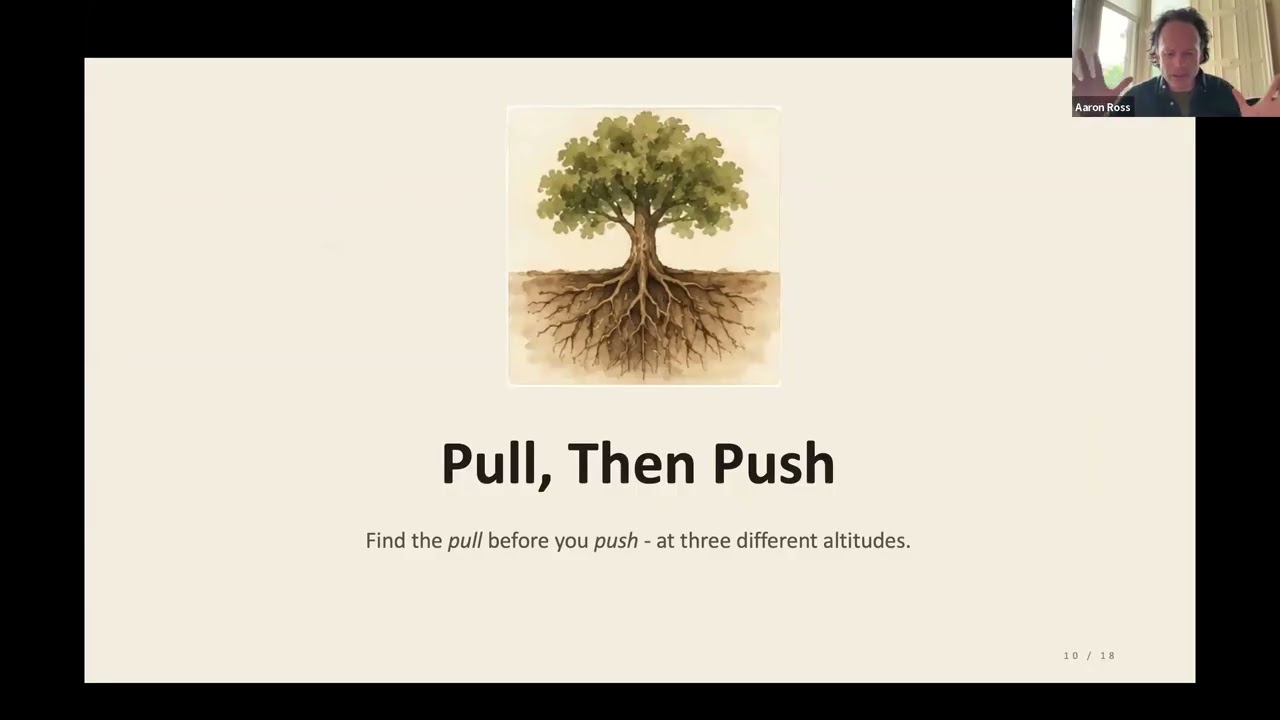
I should say that before I kind of open up with the slides is that this is really— I'm working on a new book. I actually have a bunch of new books, and one of the ones I never thought I'd go back to was kind of like, I would say, redoing Predictable Revenue. But where everything, you know, here we are. And so this is actually the first public presentation for a very early set of ideas around— I mean, the working title could be The new predictable revenue, predictable revenue AI age could be something different. I don't know. It's so early, but I'm doing it with this guy, Gaurav Bhattacharjeeva from— he's the CEO of Jeeva. Probably mangled his last name. Really great guy, enthusiastic. He's not around right now, but yeah, this is the first time to kind of share it publicly. So let me just do this. And what I'd say is these are ideas, you know, I've been playing around with and just observing for a lot of years. And even going back, like, something back towards Salesforce, because I've always seen that as we have more technology, technology will always speed up the pace of change, which in fact also I think would call it, let's call it raising the temperature chaos, chaos temperature of the world. And so I don't ever see the world stabilizing like it feel like it, we used to, right? We can, you know, a lot of us who are old enough might think back, oh, you know, back in the, 2000s or maybe '90s, the world felt more stable, whether it was or not. But I think that sense of stability will lessen even more over time. And what I found, again, a lot of these are lessons from, you know, again, Salesforce. I worked at, if you haven't heard of me, I worked at Salesforce in the early 2000s. I created an outbound prospecting team there that helped them add an extra $100 million in a few years, then probably more than $1 billion since then or more. Uh, it almost helped double their enterprise growth and wrote a book called Predictable Revenue about it. So even back then, I saw that when something stops working, the reflex that people have, whether it's the VP of sales, the sales reps, even oftentimes CEOs, is, you know, more, right? The answer is more, right? There's fewer leads, like send more messages, make more calls, get more leads, right? Your pipeline kind of stalls up. You know, work it harder, like reach out more, like let's get some new tools to figure this out. The reps aren't hitting quota, make more calls, right? Work harder. Like, okay, we need new techniques. And so like this machine that you have, or it may not even be machine, like whatever you have that's working, uh, it doesn't work. So you're like, oh, let's push it harder. I think that is at least a Western, I don't know about the East, I'm assuming it's a pretty Western, let me phrase that, United States, maybe UK reaction because our culture is so embedded with the, like, uh, whenever there's a problem, just like work it harder, harder work, hard work, hard work. However, a lot of times, like the thing that you like react for that reflex for like more actually is the thing that keeps you stuck. Now I saw this back at salesforce.com, right? So, cuz when we weren't hitting numbers in the enterprise segment, people were getting like more reps, more deals, more, um, leads, more cold calling, this and the other, that in this certain segment, nothing was working. In a lot of these principles, it's still the same problem. Like, people don't change. Tech changes, but people don't. And I should say, like, in the plan of writing a book that will endure for 5 or even 10 years, right, because that's just kind of the way I think, you know, what I believe is that the principle— there'll be principles and tactics that need to apply no matter what happens here. And some things are going to be continue, have been true and will continue to be true. And one of those things is that the, as technology speeds up, tech now AI is scaling expectations faster than reality can deliver, right? We're, you know, this is not new now. It's just like the level has amplified, right? Because it used to be newspapers and then TV and then it was social media and now it's AI enhanced, you know, it's called a lot of fake, made-up, performative social media. But we're surrounded by these, again, performative reports of world-class ridiculous results on impossible schedules, right? You know, someone made, you know, it's like, how do you make it? Someone made, you know, $100 million company in a year. And there's just enough of these true cases that, of course, we only see those. And a lot of it's actually being made up or, or, or, or amplified, burnished would be a good term to make it, fake to be, you know, does happen. And so we're, because we're surrounded by these, you know, we're left being like, oh, we're missing something. Like, why, why am I not having anything close to that? Why am I struggling? Right? So it's like, oh, I gotta work harder, I gotta work harder. Right? So this is just something that's gonna put more fuel on the fire of this reflex of trying to like fix the problem by doing something more. I mean, I built the machine at Salesforce, like that outbound machine, and I wrote the book that inspired a whole generation of companies to build, you know, outbound SDR, BDR machines and like specialized sales forces. And you've got prospectors who prospect inbound, who respond to inbound, and closers who close, and, you know, post-sales roles to do all that, 'cause that is the right thing to do. Specialization has always been a fundamental answer to at least creating the possibility of success. Now the problem is there's this disconnect between, we're like, oh, people are building, let's just, I'll just stick with outbound, right? Cause that's kind of what I'm known for, but it could be anything else, you know, inbound, AEO, uh, whatever it is. Okay. Our, this isn't working, right? Our growth is not going where we are. Outbound isn't working, whether the reps are doing it, whether our AI SDR is doing it, whether our BDRs are doing it. And, you know, the machine isn't working, so we need to like crank the machine harder. But I think where people go wrong is like usually the machine can be the problem because we're so enamored of this idea, like the sexiness of an idea that the machine that just cranks out growth and money, because when it works, it's amazing. But it just seems to get more challenging every year. And I've been watching this for 15 years. It's kind of like it used to be easy to build these and you didn't have to be great at it. And every year just gets harder to do, right? So a lot of times that dream of a machine stops us from doing what we need to do to fix what we need to fix and get the insights we need to insight. Yeah, I know I'm just making some of this up right now to set the stage for that machine-like growth. So, you know, again, I'm playing with these ideas to, Ultimately, this would be a book, but I think about, okay, if your business is like a garden, just play with me, it's a garden that needs a lot more pruning and a lot less planting. Again, technology creates this abundance of amazing ideas and amazing tools. It's so easy. We can vibe code anything. We could create any— Okay, that's a problem because we get a whole bunch of good. It's really hard to figure out what's great. And when you're dealing with people, with sales teams, there's kind of usually these two default attitudes when you have teams. I found, you know, one is kind of the farming attitude, and there's nothing wrong with this, right? It tends to react, right? This is in the early days, you know, HubSpot's team, or this might be a team within your company, right? You're handling the demand that walks in. It could be customer success. Account management, depending on the company, right? Really efficient. It's usually more lower. It's not like driving lots of growth necessarily. I know there's exceptions. I'm just saying that most teams I see, this is kind of this attitude of like a reactive attitude for the team. And there's a lot of other teams or cultures, which tend to be like hunters, like growth at all costs, like go, go, go everywhere all the time. Like just never enough. And that can actually create a lot of growth, but it also is usually just exhausting and wastes a ton of time and energy. This would be the company. Let's hire 20 reps to do all these things, or maybe this time hire even 20 autonomous agents, right? And half of them will work out. So both of these are pretty blunt hammers. And I think that if there's a third way, I'm trying to speak from my own experience and put it into words as to what's worked and will work. Because when I'm looking at principles that have worked, year and in 5 years or even longer. And so I'm thinking about this idea of this, how can you source demand from pull? In other words, I think either, especially again, the American, UK cultures are so like push, push, push, force, force, force. And what I've seen, and again, starting at Salesforce, but even other companies and whether I've done consulting for years, I've been on boards, And when companies are kind of looking for the pull first, where am I being pulled by customers? So where am I being pulled by interest or people? And then once there's some sort of pull, then push. All right. So find the pull before you push. And here's kind of these 3 different altitudes where this really works. I feel like this is a really key thing that will, like, as the world gets busier and there's more opportunities, there's more overwhelmed, there's more possibilities. And it's harder to figure out what's actually gonna work well and differentiate yourself. Like, this is something that will help you figure this out. So there's 3 levels. The first is narrow to win, right? And this is kind of like an updated version of like nailing a niche or like ideal customer profile, but it's like kind of narrow to win. And this can be applied by kind of numbers of markets or numbers of problems, but really it's like, how can you find the buyers inclined to pull you in? All right, who needs you, or what type of person would you be a need-to-have versus when you are nice-to-have? And how often, like, if you're in early days of discovery, or maybe you're creating a new product or, you know, changing, you know, if people are saying that's super cool, right, because it's easier to create cool stuff today, doesn't mean they're going to buy it. So if they're like, um, that's amazing, and they don't really respond after that, or they don't buy, like, you're nice-to-have to that type of customer. So there's a friend of mine who, you know, has a cool, like, you know, AI, you know, revenue dashboard, blah, blah, blah, right? And he's just like pounding, he's heavy cold calling LinkedIn. He's just like messaging. He's in that early discovery phase because he doesn't have any paying customers yet. And he's just like pitching to everybody, you know, pitch. And that's fine. But what wasn't happening was really the other side of that, which is really listening and sensing for that pull from people, which is when did someone say, okay, that's really interesting. And he was so busy trying to push this onto people that none of that worked. And he was in a bunch of conversations where people were kind of, because they felt bad and they'd been referred to him by someone, they, they were just, they didn't really feel, they don't say no. They're like, okay, like a friend of mine introduced me. I'm trying to figure this out. But it wasn't, they didn't say no. And so it's like sometimes stopping and sensing, hmm, you know, where in all this is there like a signal, right, for that pull? And then start to push. That's one area. That's like the main place to start for companies. So it might be, again, maybe it's too many markets, maybe it's too many types of customers, too many types of problems. All right, here's the second one. Start with trust. Right. You know, build on the roots you already have. Okay. I've got the garden metaphor. I'm not trying to use it too much. I'm just seeing what works. And, you know, it's like, what existing relationships do you have as a person or a company or kind of traction someplace or assets you have? And oftentimes I've seen this time and again, people overlook this because honestly, there are a lot of times they're not sexy and they're not scalable. This might be current customer bases where you're not actively reaching out to customers and not through email, but on a phone call, like asking them for referrals, right? Very un— it's like, it's not, doesn't feel sexy. It doesn't feel like a machine. It doesn't feel scalable. It's so, I don't know, it just gets left behind. As an example, there's a guy I met who, you know, is he company based outta Europe, all right? And they're trying to figure out how to start go-to-market in the United States. And young guy, he like ended up flying in the Bay Area and just walked the halls and met a bunch of people, was super nice. And getting a lot of, you met a bunch of people who, and he was moving out here. So got more referrals. And within a few weeks had, you know, 3 dozen referrals or immediate referrals. I don't know if you could hear that squeaking. I've got, we got 5 dogs here and one of them just So he, it wasn't even him going back to his own network. He went to a place where it was very easy to establish a bunch of relationships because it was in person, right? And you can see people, um, it was kind of how could he kind of create trust faster? And so one way might be referrals from people, you know, but if not getting together in person, there's a few ways. And, uh, a lot of times though, again, I think it's just because it doesn't seem very Again, sexy. We prioritize— I've just seen over the years CEOs, VPs of sales prioritize new business growth far more than account-based type account expansion, or maybe even, um, and I could say live referral programs. Not like, hey, you're emailing customers for referrals, but actually like talking to them on the phone and asking for help referrals. Et cetera. Okay. Let's start with trust. This third layer, right? We had narrow to win, start with trust and add one layer. And this is good. This might seem really simple, but why don't people do this? I'm just saying our whole culture is so based on more, more, more, more, more. It's like plant more, plant more.
Okay.
This idea of pruning, right? Pruning, not planting. So one layer, add one layer means, okay. You know, a single initiative, if it's a really important one, because they always take way more energy, time, and are more challenging than you expect. I know, expect it to take 2 to 5 times the time and energy. I'm just making that up to try to say, look, it's not like 50% more. So there's a guy I talked to, CEO of a $25 million company, right? And they're growing at 12% a year. I mean, not bad. I mean, who wouldn't want to be growing, you know, own a company, $25 million growing 12%? A lot of people, most of the world would die for that. But yeah, okay, you want more? I get that. And he was asking about how can I do outbound? And, and so I was like, look, let's talk. I don't do that anymore the same way. And I'm like, man, outbound is the worst idea. You want to do— it's like this guy was, um, jogging, running 10Ks, and he wanted to just go, I'm going to do an Ironman. Like, no, no, You have this whole customer base and incredibly high retention and you're not talking to them. And it's not even, it might even be referrals to other divisions within those companies or even to other people they know. Like, so it's like the glamour of the outbound engine was, you know, overtaking the idea of like starting with what you have that you're strong at, but then really focusing on that layer first before trying to add another one. And I think where people go wrong here, the one layer is, you know, there's a company I've been on the board of for a while and he's always trying to do like, there's marketing initiatives and outbound and this other thing and it's just too much and nothing gets done really, really well. Because when you have, especially in the outbound, sorry, the AI age where it's easier than ever to do good work, to stand out, make something work really well, needs to be great. So if you have multiple executives with free time, you could maybe it's a single initiative per like key executive where it takes a lot of time, attention, resources to get something working. Again, this could be outbound, it could be marketing, it could be, you know, AI-based initiative. You know, it doesn't have to be go-to-market based. It's kind of like a big project. And things just always seem to be harder. You have to expect it to be harder and take longer than you think, right? So don't scatter your energy across too many of them. So the way the world is, is that the speed of change is only going to, well, speed up, right? And the shocks to the system, right? There was COVID and then there were tariffs and then there's been energy and then the Iran war and then, you know, heat wave, it's just going to keep coming. There's no reason that'll stop. There's a lot more reasons those will speed up. Now everybody's dealing with this, the change and the uncertainty, this bad weather. And everyone's going to have superpowers. Everyone's going to get the same AI tools and the same data and the same plays. So if everyone has a superpower, I mean, you might be really excited about some AI stuff you're doing, and you should be. I am. But it's not going to differentiate you. 'Cause everyone, it's like if everyone has a superpower, no one has a superpower, right? I'm sure everyone was very excited back in the day when, you know, every tech cycle's the same. There's a short, you know, a short window for a first mover advantage and then it all kind of, you know, spreads throughout the ecosystem, right? So to me, you know, again, this is my lens is that, you know, being better with AI and like working faster and working harder, Those are all good, nothing wrong with that, but they're not going to create a sustainable or durable advantage in the future when it's easier than ever to copy whatever you do. It doesn't matter if you're doing media or software or even AI tools. It's incredibly hard technically to create something that is— to create moats. In my mind though, when you focus on Relationships, whether it's with your customers, your partners, your employees, those actually can transcend, not just, those can transcend companies. I'll bet you can all think of people that you've known for 10 or 20 years if you're old enough or longer. And so to me, where I go to, one of the things, there's not just one thing, that will create durable success will be creating trust within your key constituencies. What does that look like? Okay, trust. It's, uh, well, think, if you think about trust, like that really demands excellence in product, people, and performance, or at least, you know, some of those areas. Like your customers aren't gonna trust you if you're not delivering what you said you deliver on and they're getting value, right? Your, your leaders won't be trusted if they're not being honest with you and it's not performing in some say, right? Like when you have trust, nothing moves faster. Like what's the way to speed up? Everyone has all these tricks to speed up an enterprise sale. Well, there's nothing like if you can have a board member come in who, uh, and a personal referral. That's the thing that'll actually speed it up. Trust increases like any revenue metric you've got. Anywhere there's trust, that'll speed it up and it'll improve creativity and performance, right? So yeah, okay, trust itself is a bit of a fuzzy word, but the way that you implement it, if you do sales well, if you do leadership well, all these things you do well, whether using AI tools, do you put in the AI tool poorly? Probably trying to automate some sales process with enterprise sales, that's going to reduce trust. Consumer, like small transactions, probably fine. So that is actually, to me, the key lever that will create— no matter what happens with tech, if you have trust with your customers and team, you're going to be in a better position. Or partners, right? In COVID, when shit hit the fan, if you had more trust with customers, you had more leeway to get things kind of fixed or changed, right? So when you're going back to pruning, you know what, I think the simplest like operational thing you could do is like everyone's trying to do too many things. So if trust is one of the goals, you know, so if results are an interim goal, like we want to have faster growth, we want X, Y, and Z, And that's a short-term goal, and trust is a long-term goal. Pruning, I think, is the simplest place. Again, I don't know how many people I've talked to, to say, look, start with a first act, like more pruning, less planting. You don't need more ideas. You don't need more ideas. You say no to more ideas. So going back, these are the 3 places that I think would be the most tangible to create some, like to free up your energy. If you're gardening, What pruning does is it kind of gets rid of the dead stuff. If you have a tree that's dying, it's not like you're going to kind of water it more, right? But if you prune back the dead parts, it frees up the energy for the parts that are living, right? So if you can, if you can prune back the stuff where you're pushing and not getting results, it frees up the, your time and energy to find the places where you have some pull and to push there, right? So that might be a marketing type, you know, whether it's in lead generation, sales, Sales 3.0, some AI use case you're finding, right? You're trying to cut out kind of the dead, uh, the dead campaigns, the dead projects, the dead markets, the things that just don't justify the energy. And they're there more because of your, you know, fear of missing out or fear of fucking up or whatever, you know, things just stick around, right? So again, narrow to win, like where, where really are your best markets where you are a need to have and you have the highest chance of the, of winning the biggest deals. It's starting with trust. You know, again, if you're not seeing success in a lot of like marketing campaigns and you have an outbound campaign, like, you know, it's okay to stop them, cut them, and go back to basics on, you know, how can you go back to creating growth, uh, from a place, from your current assets, your current relationships, your current partners, wherever that look, whatever that, whatever that looks for you. This last one, add one layer. Is look, again, with AI, it's easier than ever to put in like 20,000 amazing ideas and it's really hard to say, ah, no. But if you can pick that one really key layer to add, which might, again, might be lead, some sort of lead generation with outbound, inbound customer success. It could be a technology layer, whatever that ma— big thing is. And just stick to tru— stick to that as like your one main thing. It doesn't mean you can't experiment with other stuff, but trying to do— if you try to do two big layers at a time, usually means that two, they don't— you get two done, but just not as well. That's just from my experience. So to wrap up things, I would actually, you know, I mean, still in discovery, would love to hear from anybody, right? What worked in hearing this? What helped? What's missing? I like this, but I'm not really sure how to implement this one idea. If you want to like talk sometime about what you're dealing with. I find like the best ideas for me in a book are from talking to people. So this is my email or one of my emails. You can message me on WhatsApp if you want to just say hi. I have a bunch of other books underway. One's almost out with a guy named Matt Smith called Predictable Income. I got a lot of AI stuff I'm doing, but primarily again, love to talk to you guys if you have some questions. I think we have some time for maybe 5 minutes for a chat, or maybe Mark's gonna pepper me with something here. Hey, Mark. Well, I'm gonna pepper you with a few things. First of all, I wanna thank you immensely 'cause you brought a breath of fresh air. You know, we know you as the really one of the early creators of Salesforce and all the work that you did. And you really kind of brought fresh air. What caused you to come up with this, and I'm gonna say kind of a mindset I don't want to say shift, but awakening. You know, I think it's kind of like how I work anyway. And I'm more of like a turtle, you know. And I think I'm a bit of a slow worker for in general, because I'm like, often sensing things until there's something to really push on, then I can work hard, like I've worked 100-hour weeks. So I think it's just kind of in my nature. And I know what this what I'm doing here is probably not very sexy yet. And it's not all like everyone else's presentations online or LinkedIn, which is like, here's how I'm having 50 agents make me money at night. But I just feel like this is going to be the direction to be the most helpful to people. So what I'm focused on is, you know, talking to people like, what are they dealing with? And I'm trying to think, hmm, what would help? And then help them because there's just so much bullshit out there. And there's so much noise and, um, I mean, a lot of good stuff too. Like we, we're drowning in good ideas. I know too much good. There are so—
what you're saying is that more, more is not better, that, um, faster is not better. But yeah, what, what I, I love your analogies with the, with trees, you know, that, uh, pruning. And it's not about planting more trees, but look at the pruning you got and start pruning and create a healthier ecosystem instead of— I think that I'm reminded of a financial advisor and he said, The philosophy of more is really the philosophy of the cancer cell that kills the organism it lives off of. And what the opposite is not less, but the opposite of more is enough. And I think you're right to say enough of more technology. Yeah.
I look, it's great. I use it. I've got, by the way, I've got a ton of seeds I planted, but, um, I leave them be. And like some technologies, like you said, enough technology, enough new technology, but just cause there's something new and there's, we're surrounded by all these amazing things. And so it's really hard as humans, like we're swimming in, it's like if we were fish in a sea of more. Yeah. And that's why it just makes sense to try to push against that current for me, right? To help people figure out where that pole is in your market or in yourself or in your team. And then once you find that, then you start to, you can push as hard as you want. It's kind of like the AI companies and you see people working 100-hour weeks and that makes sense. If you have something that's working, you're just filling demand and you're just turning the crank 'cause people love it and want it. Work as much as you want, but when you're just working more because you're kind of confused and uncertain and things aren't going the way you want, and it's by default because you're not really thinking, is this actually working? Am I doing this because I grew up this way and everyone's— it's like a competition in the States to who works harder, like who has the worst life. I work— you only work 60 hours this week? Yeah, man, you are a brother.
Where's the— there's a word that, um, we examined yesterday, which is meaning. Uh, what is the meaning for you?
Um, you know, from— well, first of all, I think what I'm— I've been focused on, my pull the last few years has really been figuring out like, what do I really like to— what activities do I like to do for work? What kind of work lights me up? And, uh, that, you know, I realized, okay, books speaking, you know, working with people I like and crafting. And from there, it's like finding that first and then making money from it. So like my work lately for the first time really has been, you know, meaningful in a different way. In the past, the meaning was all my family, making money for the family. You know, I hit a wall, got burned out because I was just doing it for the family and not for myself. And I'm like, I can't do this. I have to find something, work that feeds me too. And makes money. So I'm getting there, I'm pretty close.
We are having a little chat on the side with the audience. If you were a bird, what kind of bird would you be?
If I was a bird?
Yeah. Or a spirit animal.
I'd probably be one of those really weird ones like an emu or some crazy-ass bird that you're like, what the hell is that thing? That's probably what I would be. I wouldn't be like a hawk, one of those cool birds. I'd just be some weird-ass, like, you know, one eye's bigger than the other bird out there.
Well, Bob Britton says maybe an owl, and I said maybe an eagle, and somebody else said maybe a hawk. But you are a multinational bird. You moved from San Francisco to Scotland. And you having more of a bicultural perspective on the world where you are embedded in European thinking now, where things are slowing down, they're more deliberate. So when you change the focus, then you see new things.
And yeah, I think my lens is You know, like, I think there's a ways for me, you know, I can make a lot of money, but I don't have to do it by just throwing hours at something. And AI is helping commoditize activity. So, but you know, it's slow. I feel like I'm more of an oak farmer than a bamboo farmer. You know, a lot of the things I do, it takes years, a lot of, for a lot of stuff I do. But, um, no, that's just, that's, that's me. By the way, Mark, uh, turns out my You mentioned Fresh Air, you know, that's actually my news— the name of my newsletter, which I don't— I'm very erratic on posting this thing, but that's, uh, actually the new, you know, impression.
Oh, I love that. Yeah, I love it.
Every once in a while, you know, if a new book coming out and something. But yeah, I think it's, um, you know, I like being different, thinking different, because especially in the AI age, everything kind of will be commoditized and sound the same and You know, the bloom will wear off quite quickly for a lot of these things, and then we'll kind of see really where we are.
There's another metaphor from planting trees that applies to you, which is bloom where you're planted.
Yeah. Yeah. It's kind of like you can do the best with what you got.
Yeah. And you have repotted yourself from San Francisco. To Scotland, and, uh, you are doing a blooming good job.
Yeah, yeah. Well, yeah, I love being here. We have, uh, 10 children. We felt Los Angeles was not the best place to, you know, have kids, so 6 are here with us and 4 older ones are in the States. Yeah, there's a lot of, there's a lot of blooming.
Yeah.
And by implying that if I, if I'm, if I've implied that I have some sort of like, you know, easy life, I, that, that's actually the opposite is true. But, um, I try to kind of move through when I can with more, uh, grace, uh, and presence as much as I can, because, you know, I have, I have my ups and downs just like everybody else.
Yeah, but I'm also reminded when I, uh, listen to what you're saying is that, uh, B.C. Forbes once said that, um, the business of life is not business, it's living. And, uh, you have shifted gears and, uh, you live your life and as fully and freely as you decided.
Yeah, and, and honestly, part of living my life is, um, now having work, and I'm going to keep expanding that work that I, that I really even love to do, like have fun with it now. I never had that before. It's just work. But so great work can be part of life. It's not— it can be the same thing if you let it. It's not— it's part of life. It's not this thing you don't want to do.
There's one more lesson to be extracted, is that a better life doesn't come through better machines, but through shifting your mindset.
Yeah, that's 100% true.
More from Gerhard



What Selling Looks Like When Your AI Agents Have the Context Your Sellers Do

Better Conversations, Smarter Support: Wearable AI in Business






When Scarcity-Built Systems Meet Abundance - The Judgment Gap in AI-Powered Sales Leadership
