Delivering ROI on your Sales Training Investment
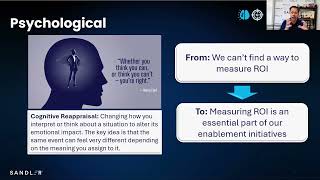
Seth from Sandler outlines a framework for measuring sales training ROI. Start with a baseline metric like revenue per rep, segment your team into four performance quadrants, deliver training with role-plays, then track skill adoption through conversation intelligence. ROI comes from sustained behavior change that lifts revenue, not from training completion alone.
Chapters
Seth is here to tell us how to deliver ROI on your sales training investment. But Seth, my first question is, you were in the analyst business and now you're joining a sales training company. How did you, when you first looked at Sandler, how did you develop that love for that mindset and that solution that has endured the test of time?
To me, I thought it was a unique opportunity. So as I— so hello everyone. I came from a world where I work with clients around how to make their businesses better and then also work deeply with technology in the market. And about a year ago, it became very clear that the technology would allow enablement and training to be a true ROI driver. Like, I truly believe that. I think the technology's there. If you use it the right way, the change management, the willingness to do it, all of that type of stuff. Maybe the technology adoption within enterprise businesses isn't there, but I see the true potential of being able to actually look and be able to use training and then watch how it impacts on a seller-by-seller level the results that, that, that they produce. And then when you look across a broad range of methodology providers, I just I love the, the foundation that Sandler was built on, anchored in psychology, very much focused on reinforcement and getting beyond just the initial training and into helping you become successful as a company and as a person more so than I'm just trying to get something. I'm trying to give you a methodology and walk away. It just kind of became a no-brainer. So I, it was just a really unique opportunity to try to do something that everybody on this call that's doing selling has been trying to do for years. And it's always proved very, very difficult because it is changing from like it used to be a magical black box that it's like, just leave me alone and let me hit my number. That's slightly changing. And I think it's going to change even more, but more in a way where that black box of a seller that does something uniquely well, they'll build that in the lab and, and deliver it themselves. And then that will become a halo for their companies to grow, which is very different than the world we've traditionally lived in. So it's exciting times.
Really happy to be here. Well, thank you for framing sales training as an instrument that determines business outcomes. And if it's done well, it leads to ROI. So share your secret sauce, please.
All right. So I'm going to jump in and just talk you guys through what we see and what I've seen as, as both as an analyst, as a practitioner for 25+ years. Here's kind of the way that I'm going to talk about it. I'm going to talk about 3 different areas. One are just the common challenges, set the frame for what are the things that prevent ROI in most companies. We'll talk through some, some ways to break through those challenges and then an ROI framework and how we're looking at it at Sandler on the— and with our clients how we're looking to be able to really get to a point where when you make this investment, you should feel very, very confident that if adopted, that you're going to see the results that you expect from it. And when you're talking to finance, you're talking to anyone trying to justify the investment, that that's a very clear case. So let's jump in with the, with the common challenges. So one thing, if you take a step back, This stat has come up for me and it's fairly common in how we're talking about this. When we talk about this with business leaders, they don't feel confident they can measure ROI. And what that leads to in a lot of cases is a justification that is not ROI-related. I know it works, so I think we should invest in it. It's part of a wider transformation and I want to be able to set the common way of talking that's legitimate. Those are all things that are valuable when you invest in an ROI, but you should be able to confidently invest. You should be able to look at this and say, this is what I think I'm going to deliver, and we'll talk a little bit about that. So here are the common challenges. One is psychological. There is a learned helplessness, helplessness around training. I get it. It's just over the years it's never been done really well. So most people, when they want training, they know inherently it works and they're really trying to build the case and they build the case in a way of, I know it works rather than I know I'm gonna be able to get the value that I expect from it and be able to tangibly see that value play out in front of me where I could tie it to the investment that I've made in training. Next one is having the right approach. This is something that comes up with AI and it's also very much comes up with sellers. When you talk about compensation, the measures that you give them in a compensate to motivate results in a compensation package have significant impact on what a seller will or won't do. Same thing when you look at an AI model, especially as they get more, more advanced and the ability to give it a target and have it go get it. You need a measure to go after, and we spent a fair amount of time looking at this. There is no perfect measure for growth. Every company, especially when you get into large ones, has different areas that they focus on or different ways they want to look at it. Truth is, you hire sellers in almost all situations to drive revenue growth. The best way to look at revenue growth is to look at it from a measure that, that is as pure as possible. And I'll walk through that in a little bit more detail later. But having a measure that is very much a focus of the company has to be front and center. So when you're thinking about sales training, you should also be thinking about the measure that you want to move that will prove that that sales training had a tangible impact on your business. The next thing, this is a fundamental part of training, is the ability to baseline where you were before you started training. And in the past, like, you would do a baseline around what performance looked like You would do a baseline using maybe an assessment or a talent assessment or some of those types of things to be able to understand where your competencies are. That's always been a little bit tricky to tie to what— to how it relates to training. Some work better than others. But you have to baseline. You have to know where you're starting from. There's another piece that I think is often missed when you think about challenges, and that is what happens right after training, where the people that you've invested in should be most knowledgeable about the methodology. You want to look at and understand how well they've adopted at the point where they should know the most about the training. So you should have a reassess right after training to say, how much knowledge did they gain? Because the reality is you want to identify people who didn't gain any knowledge, because if you know they didn't get any knowledge from the training, that's a different problem to be able to solve that goes far beyond training. If you, if you see that, once you see what the, the results are, and we see 30, 40, 50% improvements from baseline when, when, when we do this, now you have— that's your target to hold. So, and then the final piece is that holding. And so you set the reassess and you understand what I'm trying to keep my sales team at, what they've learned. And then the goal that is so difficult in sales training is how do I retain that? How do I get to the point that I take what I've learned in training, and I apply it in the real world in real situations to improve outcomes. These are all common challenges. Some of them are more well-known than others, such as retention, doing the baseline. Some are obvious to a certain extent when you talk about the psychological side, and some are relatively new in the scheme of things where you're really trying to understand what was learned outside of just like tick the box on your LMS that I did a test. You want to really understand what was learned. So let's go through each one of these. I want to talk through each and just go in a little bit more detail. The psychological side of this is nothing else can happen until you get to a point. I mean, you use a technical, like a psychological, like cognitive reappraisal. But the reality is what you have to do is you have to go from just the biased view of you can't do ROI from sales training to I'm measuring ROI is going to happen. We are, and we're in ROI needs to be more than I'm going to measure my sales growth from year over year. I'm going to measure through, through an assessment or reassess in a year. You have to really be committed to finding true, a true connection to how revenue is generated from this investment. And that mindset shift has to happen before anything else can happen. And if you think in your companies where your mindset is, Even though this is tangibly very easy to understand, I would bet there are a lot of people on this call that are like, yep, we kind of know it works and we're just doing it and we're not really worried about ROI outside of how do I position it with my CFO to make sure that he'll give us the investment so we can go do the training. You got to think of it from how you're going to generate it and really focus on it. The next thing is, is, is around the hero metric. And what we mean by that is what is that measure of success? And we've taken a fairly firm position on this because there's lots of different measures out there. Like I said before, there's none that are perfect, but we believe the best one is revenue per rep. And there are a number of reasons why that's really important. Um, one, revenue per rep is very easy to get. If you try to go get quota attainment, you get pulled into reports that are a lot more difficult to get. Revenue per rep is fairly straightforward. It's also very tangible. If you think of quota attainment puts a territory bias over the top of your numbers. So if you have good or bad territories assigned, it skews your numbers, whereas the revenue you generate is the revenue you generate. And the goal of most companies when hiring salespeople is to grow top-line revenue. Some will go into profit, some will go into other things, but the, the core thing is when I hire a salesperson, more money should come in the door because that salesperson exists. The way that we look at it and measure is we, we center around the average seller, and then we look at the sellers that are above, and then we look at the sellers that are both below, and we normalize it so you can look across different groups because a hunter will have different numbers than a, than a farmer, but we want to see how different they are. And then we plot that. And when you look at the individual seller piece, that'll give you an idea of where they are and what needs to improve. But then you also need to be able to, to kind of take a step back. The number that you really want to, to move is that average revenue per rep. So like in this scenario, you can see it's, it's $1.94 million. When a training program works really, really well, what you see is the compression of that curve, because what happens is your, your teams get better and move up. So the Sales 3.0 team with full adoption of a methodology should compress the capabilities to be able to go win deals and then move them forward. So what you'll see is less of a distribution or a more tightly form distribution, and the average revenue per rep will go up because your whole team is more consistent and they're selling better. So that's why it's so critical to have this number right at the center, because that's what your goal is. And if you think about the difference between these, if I'm trying to justify an ROI, the delta between where I started from an average revenue per rep and where I finished from an average revenue per rep is a very good measure to understand. And if you can move it up $10K per rep, that way more than justifies the investment in training. Hard part is how do you make sure that ties back to the results? The way you have to do that, first you baseline. And the way that we baseline is across two. So we did— I talked about the revenue per rep that would be mapped out accordingly. The other thing that we look at is a benchmark score. So we want to understand the skills that— the skill level of the people that we're training. So we normalize that and we look at competencies that are fairly standard across any sales training, the best, best practices in sales training. So when we do the benchmark, it's fairly vanilla but very deeply tied to the skills that Sandler is going to impart on you. So when you take that baseline, you get a firm understanding of where your sellers are at. And then what we do before we meet with— before we go into the training side is we map them and we look at them in 4 quadrants. One is just, I'm a seller who is struggling to deliver my number and also struggling to understand the training. Fairly straightforward needs to be done there. Another is rogue achievers. These are people who are hitting their number but are not adopting the training at all. So they found other ways to hit the number. You've got rule followers, which are people who understand the training but don't know how to translate it to results. And then you've got your top people. So it's a classic 4-blocker. What we found is this is very valuable to enablement teams, sales leaders to be able to go, what, what is the makeup of my team and how does it look? So we start with that as, as the baseline. And then we go through training where we teach you. So you're learning in person, virtual, however that works for you. Then we want you to apply it. And this is where role play comes in. You apply what you've learned actually doing it, which is much, much more important than I take a test after I go through the LMS. We want you to actually apply it in real-world situation based on the skills that you actually learned. And then we want to confirm it. Where are you at? There's a there's an interesting world we're in right now with AI where we can do a lot of one-off stuff. Like, I can upload a transcript and have it tell me how I did in a very general way. A part that really needs to come together that we've spent a lot of time on is how do you structurally architect it so you can get historical information about performance over time that allows you to tangibly understand what needs to be improved and then also see how that improvement works. So This reassess confirms how much did I learn with the investment of training that I've done once I've exited it. Not necessarily when you're out in the field in a deal, but it gives you a starting point. Next piece is, is retention. And this is what we call progressive scoring. And this is hooked up to the calls that you're taking with customers. You can't really get the best version or the most visible look at ROI unless you are actually measuring the skills as executed on the call with a customer and then measuring those results. So that's taking conversation intelligence, it could be web conferencing, whatever it is, analyzing those skills and deploy and seeing how they're deployed and whether they're deployed. So for example, we talk a lot about the upfront contract, identify when those things are happening. Are you doing them? That's kind of an important thing in retention because in what we've seen in the data is in a lot of, in a lot of scenarios when sellers are doing training, they're just doing training. They're not necessarily committing to adopt. So they will decide what they do and don't adopt. But we can see that from the reassess. We see baseline, they're 40%. They go do the reassess and they're like 80%. So they obviously got the concept. And then literally the next day they drop right down to 40%, which basically says I'm not using it. So first thing is, are you using it? The next thing is, how do you evaluate it? And something that's really important when it comes to methodologies is how do I evaluate it with depth? And that's what we do here. And then the maintain piece becomes using the tools that are out today. Roleplay, everyone knows about the LMS, been around forever. New technology like an AI tutor that'll help guide you through it. And then just coaching with your manager to help unlock those things that are not obvious. That's where managers are so important right now, is unlocking things that aren't obvious. Okay, so now when you think about the framework and when you're building ROI, like putting these pieces together, kind of map out the attitude that you need, the results that you're looking for, and the, and the execution. It starts out with, in my team, we're tangibly going after it. Then I use revenue per rep by role as the foundation to say whether I've actually done it. Your measure of success on your training should be on the number and how it moves. Now, that number may vary and there may be all sorts of other economic factors, but you should be able to see the difference, even if that difference is we had a down year, but the people who really adopted the training did this and the people who really didn't did this, and you can see it. Next thing, when you go into the baseline revenue per rep, you're going to look at, and then you're also going to look at skills. So now I understand the performance number that I'm trying to beat and the skill level that I need to raise. Then I go to the same thing. I look at the reassess and I go into role play and, and have them actually execute it to see what they have improved or how much they've improved. Then you go into progressive and you're using that same number to be able to move over time and you're watching both the revenue per rep number move over the course of the year in line with the adoption. So then you're constantly monitoring it the same way you would monitor deals, the same way you monitor pipeline. That's what, that's what will enable you to get true ROI. So now to give you a picture of how we're thinking about it at Sandler, we take it, we take, we have 5 or we have 6 phases that we go through. First one we talked about is the baseline. The improved piece is the same stuff that you'd see with, with most training providers around, I'm going to do the training, I'm going to enable you, I'm going to teach you the methodology. The difference is what you capture at baseline and making sure you capture things in a way that allows your facilitators and the people that are teaching to teach in a very customized way. So for example, when you do a baseline, you're gonna see people who are doing certain skills very well. A great facilitator, when we put that in their hands, is gonna know that person or identify that person and call them out as an example when they're doing training, or when they see people that are really struggling or a set of skills that the whole group is struggling with., they'll be able to use that to make the training that much better. Reassess, we talked about, that says, how much did you learn? That's as much of a learning process for the customer as it is for the training provider, in that we should constantly and do constantly look at that to be able to improve the experience for our customers. Once you move into that, you go into reinforce and retain. The reinforce is putting on progressive in your daily calls. So I'm looking at how you talk to a customer and use the skills in daily calls with those customers. The retain piece is the layer over the top that gives you visibility to how it looks. And then the optimize part, I'll talk a little bit more about it. When you buy a methodology, you buy a base, and that's just the best practice that's general. The best methodology companies using technology today will take that base and morph it to the point where we're looking at actual data to see what works in your organization and creating a very unique methodology that is founded in Sandler, but unique to the individual companies that we're working, that we're working with. That is the main thing that we're working on and what we've built to be able to support really outperforming, making ROI visible, and getting those numbers. So just to give you a feel for how that would play out, that's, this is the same 4-blocker that you've seen before, but in this situation you're gonna look at it and see, okay, a roguetreaver, like, We're going to look beyond training. This could be a quota problem. Do they have a bluebird? Do we have a certain situation where we're over-allocating leads to one person? Allows you in your business to go out and find out, is this person truly an exception? And then if they're doing something exceptional that's different, do I want to incorporate it or do I need to fix it? Next thing is the sellers who are just struggling at both. This could be a culture thing. This could be a fit thing. So a lot of companies will use talent to be able to— talent assessments to be able to understand what that looks like. When you talk about someone who can show and display a methodology but hasn't been able to translate that into revenue, that is where coaching is at its best. AI can't do this yet. You've got situations that just people haven't seen or don't understand where you're working through and helping someone who's really keen to understand and implement the skills that you've invested in them learning, but not able to translate it. And a great manager and a great training company will be able to help coach and guide and get them into that role model status. And even when you're at the role model status, that's when you start looking at adjacent skills. How do I take my rock stars and make them better at a lot of other things as well? So this gives you our perspective from Sandler around how we're working on ROI. And, and what we're trying to do. Really appreciate the time to talk to you, and I'll open it up for— looks like we have a few minutes for questions. If there are any questions, I'd love to be able to answer them.
Well, my first question is, uh, can you do a little bit of a deeper dive into how to structure role plays that really work where you can— and how do you measure the ROI on the roleplay?
I don't see ROI as in roleplay being intimately connected. I see ROI as being a pathway to understand whether you've adopted a skill. So you can push a seller through that to understand if they've adopted. And then I also see it as a way to improve a skill. So when I'm doing roleplay, it allows me to practice. I'd also say that roleplay is advancing too. So like the best roleplay companies have more than just roleplay. They'll allow you to do a roleplay and then also allow you go in and practice in a way that's very collaborative. So I'm not going in and watching the video on the, in the LMS. I'm going in and saying, I want to learn the upfront contract, help me learn. And it'll dialogue back and forth with you, allow you to move forward, backward, and really educate yourself. But roleplay, or I think a big misnomer, anybody who says that you can get ROI from roleplay. I don't think that is factually accurate. I think roleplay allows you to improve skill adoption, and skill adoption tied to a result in actual execution of deals is how you determine true ROI from an investment like ours.
So for those that don't know the Upfront Contract, uh, can you walk us through quickly? Because I think it's one of the best things ever created in sales training.
Yeah, it's a very simple concept but very much sets the stage for the call. So you, you start at the very beginning, here's what I'm going to talk about, this is the time that we have, is that okay with you? And then getting to the point where you give them permission to say no and, and really work to make sure at the beginning of the call you have full understanding. So it allows the seller to take control of the call. And people who do upfront contracts really, really well will use it throughout the call to really to bring the whole thing together. So they'll do an upfront contract at the end and then they'll almost do another one at at the end of the call to be able to reset it. So just frames the call in a way that's very organized. From a customer standpoint, they appreciate it because it allows them to agree to how the call is going to go and make sure that their expectations are met. From a sales standpoint, it allows you to, to position yourself as a person that is in control of the call, a peer-to-peer connection that is of equal business stature. Like, that's It is one of those things that I think a lot of people look at it at a, at a surface level, and there's a million different ways to say it, but the reality of doing it well is very, very nuanced.
Um, I want to go back to the role play. Uh, a lot of, um, sales training managers and, uh, sales enablement and revenue enablement managers, uh, they either go too high in on the degree of complexity or make it too simple. What is the right way for designing? What are your guidelines for designing a role play that is going to be a good experience for the salesperson from a learning perspective, but also a good tool for everybody that is in management to see how they can then coach the salesperson to the next level.
So the way that I put this in talking with customers is you try to set the stage for where the buyer is that you're trying to engage with. Right? So I think it's going to vary based on the type of call you're in. And I think that's very important. Right? If I'm a farmer that's been working with this contact for 5 years, it's probably going to be an easy call in terms of how that's going to work. And you want to role play in that environment. If I'm a BDR that's doing calls directly in, it's probably going to be way, way harder. So I need to level that up to help our, our BDRs understand how to handle those type of difficult situations. The perfect world and where this is going, and there are already some roleplay providers that do that, is they will take in the call and they will set the tuning of what the difficulty is based on the people that you've met with before. So I'm about to meet with these 4 people, or I'm about to meet with this person. I'm going to ingest all the calls that I've had with them. The roleplay analyzes that, and it sets the difficulty level to be comparable to the person that you're talking to.
That sounds very sophisticated. So what— where is your thinking in terms of roleplay with another salesperson versus roleplay with AI versus— and there's a third option that was discussed yesterday— roleplay with a professional actor.
Professional actor. Interesting. So I think the majority, I would say it should be 80/10/10. And the professional actor thing, I can't really speak to. That's really interesting. I think in those situations, you're a professional actor is trying to coach you on a very specific way of talking. So I almost see that as a professional coach that's trying to coach you on any skill or capability that you'd have. To me, it should be 80/10/10. 80% of your time should be role play for yourself, or you can be comfortable, you can, you can be your own, like you can really do this and you're not taking up another person's time and you're really getting better. The manager should be involved at least 10% of the time just to see how that translates. I think going back to the talking about a person who understands the methodology but can't apply it in real life. That's where you want that role play to happen. I would also say that 10 should not be a complete role play. When you do this really, really well, like the in-person role plays should be around specific situations that you do not do well. You need the tools and technology of today to tell you which skills that you're struggling with and the ones that you do really well so that when you coach I don't need to go through an entire call with you unless maybe I'm preparing for a deal. But I know you're weak in these 3 areas. So I'm going to— we're going to run a scenario around upfront contract, or we're going to run it around pain, or we're going to run it around a 30-second commercial because you've struggled in those areas. So it should be way more targeted on that 10% time. And then the other 10% is just a coach, an actor, someone who's an expert in areas that you are really trying to improve within your business. Seth.
More from Gerhard



What Selling Looks Like When Your AI Agents Have the Context Your Sellers Do

Better Conversations, Smarter Support: Wearable AI in Business






When Scarcity-Built Systems Meet Abundance - The Judgment Gap in AI-Powered Sales Leadership
