Developing Trusted Advisors in the Age of AI
Spencer, Gerhard, and Jim present 2025-2026 research on 270 B2B sales leaders showing AI amplifies but doesn't create trusted-advisor behavior. A small group of A-players drives most revenue. The fix: use AI-enabled coaching and call analysis to replicate their behaviors across your team.
Chapters
We have been doing some research for a very particular purpose this through 2025, coming into 2026 with an important understanding that we want to come to, which is AI amplifies human behavior, necessary to become a, a trusted advisor, but it doesn't create trusted advisors. And so what is the critical question that we need to ask is what behaviors, priority areas, focus points do we need to have as organizations at the human level, making sure we're developing that foundational behavior and skill set such that when we bring AI tools into that ecosystem and it's amplifying and it is extending that capability and it's not either net neutral or in a sense, damaging. And you know, Gerhard, you and I were talking about before we started this session, some of the questions that I've been getting recently around this research. And two of the questions are, can we prove the productivity enhancements of AI? Number one and number two, exactly what tool should I use to enhance my productivity with AI? I am not, as I sit here today, in a position to give a definitive answer on either of those things. Unfortunately, I think in the first question, we are continuing to research it and evaluate it. But as you and I have talked about, the important thing for organizations is to understand what we need to do differently, how we need to use AI so that as we experiment with it, as we use it, we can then define for ourselves and our organization what works, what doesn't work. And secondly, with tools, there's a lot of experimentation out there. There's a lot of different tools and methods people are using. I think what's one of the most healthy things happening right now is organizations and individuals in communities sharing with each other what they're learning, what works for them, what tools have the proper structure, security capability that they need to accomplish what they're trying to do. And we have some opportunities coming up. And I'll share a little bit more about this a little later in the presentation where we can get people together in an environment to talk about that, similar to, I'm sure, the dialogue and conversation that's happening all over in, in this particular event as well. I mean, it's interesting when we look at sales leader use of AI, like what are they using it for? 4. In the study that we conducted, we find that in most instances, they're using it for, to improve their coaching, to improve through practice, role play, giving feedback. They're also using it to augment and strengthen training, onboarding, and to practice and reinforce skills. So a lot of that is focused on developing better behavior. What I want to give some hints around or some ideas around here are very particular ways use cases for it as we, as we go through the research. So let me jump in here, give a little bit of background to start.
Got it.
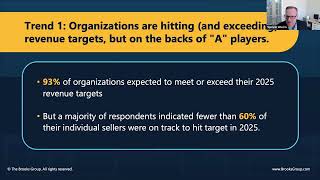
What our study was all about. We looked at 270 North American B2B sales leaders and surveyed and evaluated them very closely. They were in 14 different industries organizations above $50 million in revenue. You can see the sizes of the sales organizations. We looked at a lot of organizations with a lot of people, a lot of necessary scale and then kind of down from there. So we're trying to understand with a very diverse view what's going on. What are the priorities, what are the concerns, the problems, the focus areas for training and development in these various sales organizations and then how can AI help? So let's look at strategic priorities for 2026. I thought these were kind of interesting as we, as we looked at them. There's a story that you can tell around each of these. Number one, the first focus priority area was increasing customer retention. How do we hold on to the, to the base of customers where we've built that trust, we have that value relationship. How do we hold on to them in increasingly greater numbers to protect the base of revenue in our organization? And I think what we need to focus on there is do we have the right capability, skill set, mindset, managing each of those accounts, strength and margins and profitability was number two. This makes a lot of sense in the economic environment we're in right now with the cost of money. We have to fund a lot of our growth. We have to fund a lot of this experimentation around different technologies and tools to improve our go to market strategy out of our operating cash flow. We need good profitability and margins in order to do that. Number three, expanding and growing on our existing accounts. What's interesting that we've seen in recent years is a flip back and forth year over year. We'll have a primary focus in organizations on garnering new business in one year and then they'll shift the next year around. Well, no, we gotta, we've got to expand in our existing accounts where we already have those relationships. Then we're going to go back out to the market and try to grow in the green field. We're going back in. And this is one of those years where we're shifting back into those existing accounts. And so the, the question then organizations have to ask is do we have the capability in our organization to, to not only maintain and manage those accounts but grow them and are we giving the right accounts to the right individuals finally? Improving RIN rates is really important. One of the things that we're seeing and you see this published and talked about a lot right now. In fact, there was a Harvard Business Review article published earlier this week that highly recommend everybody take a look at AI is upending marketing on two fronts. And it's talking about the shift that we're seeing in top of funnel marketing. You know, web traffic down double digit percentages in many instances, contact flow down double digit percentages, MQL marketing qualified lead flow down double digits. What does that mean? It means organizations are being much more deliberate in who they're looking at, the research that they're doing. They're coming at a very different stage in their learning journey to engage with us and tends to be fewer of us in their vendor set that they're looking at. Meaning each and every opportunity we have to engage with a customer is critically important to pull them through that decision making cycle. We've got to focus on getting better win rates, taking advantage of each opportunity that we have. So you can kind of see the story around each of these strategic priorities. But it's a lot about having the right people in in the right places with the right capability in our organization to win. What I want to do here is I want to walk through some of the trends. These are people or human oriented trends that we've identified, talk about the recommendation we have around that trend and then talk a little bit about how can AI help in that particular area. Again, I can't recommend a particular tool to use. I think a lot of people have ideas of tools they're either already using or or are investigating. But more just around what is the concept we can use AI to support in this area. So let's start with trend number one. Organizations are hitting and exceeding their revenue targets. This is what they told us in 2025. Most of them expected to meet or exceed 2025 revenue targets. But that is on the back of a select group of A players in the organization where seeing a Tier 2, Tier 2 tier structure of capability and performance in organizations right now, a set of high performers that the organization is relying very heavily on to carry it across target. And then unfortunately and in some instances this can be as much as 30, 40% of that organization is a second tier that we're churning a lot. We're not getting to that same level of capability. We're not strengthening to where we are confident they can be a net contributor to this commercial engine that we need to continue to grow again, that might, we might have survived in 2025 with that kind of strategy. But if we need to grow year over year, if we need to be a rule of 30 type over organization growing at those double digit rates, this situation is going to catch up to us very quickly. Particularly as I shared earlier, if that growth is going to come from existing accounts, do we have the right players in those accounts? If those accounts are spread across our organization, do we have the kinds of players in those accounts that can generate that additional growth in those accounts in the core of our organization to lift us up? So the recommendation, and this is not a new recommendation, but let's strengthen the core of the organization. And how do we do that with AI? Well, we need to be using the tools in conversation, intelligence, call monitoring, AI practice, evaluation of skill among these high performers, isolating the best practices and sharing those with the core of the organization. We need to be looking at very closely at what our A players are doing to win disproportionately and effectively in the organization and then isolating, synthesizing all of that information to share to others, coaching tools, practice tools identified at very particular stages of the sales process, building those AI practice modules to look at prospecting, to look at qualifying, to look at discovery, finding what the A players are doing and then using them, leveraging them as we go and teach others in the organization to do better. So yes, a lot of organizations have these coaching tools in place, but are we using them very specifically for this end to isolate good behaviors in our eight players, share those with the core of the organization? Curious. Gerhard, if you've got any questions or anything to add on this one.
Yeah, the question I have is, does your research include the percentage of turnover?
Yeah, we have looked at that. And what's interesting, that's in our research report more deeply. So if you download the research report, you can see the data on that. What's interesting is we are still in this kind of low fire, low hire organization. Organizations are making a bet on their core. They're saying this core of the organization that's not contributing heavily right now, we're still making a bet on them. But it's got to be a bet we're serious about right now. They're saying, okay, we're not out there hiring a bunch new to replace the existing. We're going to try to make do with what we got. I think that lines up and I'll share a little bit more about this with that existing.
I, I think that the Interesting way to look at this is when organizations say they have 20% top performer, 60% middle performer, and 20% low performers. Whether the attrition pyramid is mirroring that or whether the heavy hitters leaving the company.
Yeah, I think that, I think that depends organization by organization. What we know is people aren't super actively shedding people right now. And I think it's because they recognize there's relationships in place with their existing customer strategy. But you are going to lose your A players if you feel, if they feel like a disproportionate amount of the performance rests on them. This is why you've got to build the core to put some relief in hitting your overall target off of the backs of those high performers.
And the next big question is what can AI do to create more A players?
It's all. And again, I think a lot of people are playing around with this and this is what I, what I said earlier. It is isolating that behavior from the A players in evaluating the game film, summarizing the game film being very particular in the practice modules, the AI practice and coaching modules that you build, noticing how your A players do it and then using that as the way to develop those modules to train your core performers. Like if you, if you don't have your core performers practicing in a manner that replicates what your A performers are doing, and that's the great thing about these AI tools is they help us do that quickly and at scale, then, then you're not, you're not getting the feedback and the development down to where it's needed.
Exactly.
Yeah. I remember Bill Brooks saying, when we're looking at salespeople, we want to know first, can they sell? Second, will they sell? And third, how will they sell? And I think that's just a great model for, for identifying who's got the potential to someday that A team, you know, the A players. That's just good wisdom I wanted to pass along.
I appreciate that, Jim. And let's, let's play around with each of those elements as I kind of go through some of these findings, because I think the how will they sell is really important and, and the will they sell is a really important thing. Important lenses to add to this. So let me jump to, to a couple of others of these. So trend 2 sales leaders priority is in developing and retaining sales talent to grow profitable customer relationships. Gerhard, this goes to what you and I were just saying. When we look at how they identify their challenges, what they, they're trying to do, number one, of course is achieve sales targets and revenue growth. That's not a surprise. But number two is manage, develop and retain that sales talent. How do we retain those A performers? How do we manage both A performers and core performers and really develop talent across the organization? Again, what's cool is organizations are making a bet on their people right now because they see the importance of that continuity, that investment that they've made. But they've got to be very purposeful in, you know, the tool set and the. And the structure to develop them, watching them very closely, helping them tune out, tune through and strengthen each of those areas that they're working on in the sales process.
So that's a fairly percentage. 42%. How does that compare to previous years?
It's. It's up. So this one, this one moved more predominantly. So these are the percentage of players who said this is among their top three challenges. And that middle one has definitely moved up. You'll see the first one's always up there. Clearly, it's always pressure because we're always growing those numbers. But that saying, okay, we're going to work on developing our people because we're making this bet on our people. This is a new thing. And I think a lot of it is because we recognize how expensive and disruptive it is right now, particularly with the critical existing customer relationships to switch those out. So we, we've got to make this bet on our people.
One of my clients years ago said that 80% of his time was spent with the 20% of his or the people that were producing 20% of his sales. And so he's spending 20%, you know, using the Pareto principle 80, 20 formula. He was spending 20% of his time with his A players, 80% of his time trying to make his B players A players, and it wasn't paying off. And he shifted his energies to spending 80% of his time on the A players and being less available to the B players. Turning that into a system thing. You know, if you follow the system and prove that you've got it, then I'll give you more of my attention. I think that there's some wisdom in that, but there's also some danger in the same thing thing.
I, I would agree, but I think, I think a good principle that you're talking about there, Jim, and this is, this goes to what we've been talking about here, is if we don't understand the AA players, if we don't understand why they are performing disproportionately well, then we don't really have the best practice aligned to our organization to teach to the core. So we've got to watch them closely and that's, that's being present in their calls and their meetings. That's looking at their film which we've got technology to do that at scale like we've never had before. Right. As a. I was playing a sales leader role in my organization more recently. And one of the great things is I can get AI summaries of every call that's going on. I can evaluate them much faster than I've ever been able to evaluate them before and have an understanding of what's going on in that account to be supportive and to learn what it is that the sellers are doing to isolate those practices. And like I never have before and you know, transcribing and summarizing and sharing out that that data is, is fantastic.
Yeah, it truly is.
So here's an interesting one I want to, I want to explore. So we know sales perform process adherence is high, at least in some pockets of an organization. But the sales processes don't always fulfill the same purpose. So we've been studying this for a couple of years now. We've been looking very much at process. That's a lot of. And Jim, you know this from. And Gerhardt from back in the day. That was a lot of Bill Brooks. It was the process, the simple intuitive impact selling process. What we've been really trying to do is look at, okay, do people number one have a sales process answer in most instances, yes, 95, 98% yes, we've got the process. It's up on the wall. Do we adhere to that process? Well, actually that number continues to go up. I think that's a message that's getting out there to organizations. We gotta drive adherence to the process. Problem is that adherence is not consistent in the organization. You have some who are really bought into it, who are doing it naturally well and consistent and some who are paying lip service to the process or not doing the process at all. So one of the focus areas for organizations is consistency driving greater consistency in the process. AI helps us do that. We can gather the data, we can evaluate much more closely at both the output level and the behavioral level whether processes are being followed consistently. But the interesting thing is we've got a large number of organizations who are saying, yes, we adhere to the process, but we still need these consultative selling skills. We feel like we're not customer centric enough. We feel like we're not trusted advisors enough. And you know, this has been written about a lot lately. And I really like a lot of the writing that's coming out of it. And it raises the question of, like, what wall is our ladder leaned against? Is our process truly customer centric or is it a process that we've designed to achieve an outcome we want to achieve? You know, and going back to Bill Brooks, what did Bill Brooks say? You got to be in front of the customer when they're ready to buy, not when you're ready to sell. And I think what we've done is we've engineered processes that are trying to put us in front of the customer when we're ready to sell. And that customer is saying, look, I can get all the information I need served up to me exactly the way I like. Now, unfortunately, the AI isn't always the most accurate in providing that information, but I'm going to take greater control over my decisions and my timing. And we have got to be customer centric in our process. So let's think about that. How do we drive greater customer centricity in our sales process using AI? Well, we've got to use it as a feedback mechanism, right? When we develop a positioning statement or positioning strategy, we can use AI to evaluate that positioning strategy vis a vis the customer. When we do discovery, we can use AI to say, did I get deep enough in my discovery? Did I ask the right questions? Did I gather the right information to really understand this customer? Well, it is a tremendous feedback mechanism to check our customer centricity at each of the stages of the sales process. So we make sure we have a process that is actually serving the customer and not one that's just serving our own interest.
Well stated. I totally agree.
And now where you have to be careful in this and this is where people is the types of tools you use to do that. Gerhard, in your point of like that it is giving you accurate, good feedback that you're not also, you know, that you're following good data security principles and different things like that. So selecting the right tools, prompting those tools, properly building those tools, it's a lot of more technical detail around this. But I think we want to have that vision of can we use AI to test the customer centricity of our activity and our outputs at each stage of the process.
So how do we do that?
Well, one way you can do it and one thing we've been doing. So we partner with a company called Saleshood, which gives us the backbone infrastructure for AI practice and we build on top of that backbone for our clients AI practice modules that are aligned specifically to each stage of a sales process that can test customer centricity, can test, you know, the quality of each of the actions that you're doing. And so if you set up a system like that and get your organization to adhere to that, you can start to change that thinking at each stage of the process away from the seller and toward the customer.
Awesome.
Let's in a little bit of time that we've got left, let's just explore a couple more of these.
Okay.
Friend four. Oh, sorry. Go ahead Gerd.
No, no, no, go ahead.
Skill gaps and challenges signal the need for greater intention, especially in pre call planning. This is what I want to hit on. This is really important. So these are the top selling skill gaps. We asked each of our respondents in the survey to give us three. This is the percentage that gave us each of these. The one that really popped is the one right there in the middle in orange. Pre call planning that has jumped way up the list because organization and there's a couple of trends that are combining to make this important. Right. Number one, we've got fewer funnel opportunities coming in. We got to be more prepared, more effective for each of those conversations. But I think number two, it goes back to what I was saying around this whole AEO geo transformation in marketing. The fact that your customer is doing much better, more thorough research to understand you. They're coming to the table more prepared. They're going to have more pointed, more directive questions in what they want to explore with you. If you have not met them at that dance, if you're not as equally prepared for the the AI to human handoff in that buying journey, then your, your effectiveness in those conversations is going to go way down. If you show up just confident and ready to talk about yourself to inform, well guess what, they've already been informed. You have to show up ready to understand to, to explore very nuanced elements of that customer to show them that you're as prepared for the conversation as they are. So the recommendation high level is let's do pre call planning. Question is how do we do it more effectively and thoroughly? And that is I think in using AI, first of all, having that template for pre call planning and designing it such that you can ask AI to evaluate and coach on the quality of the pre call planning that you do. That's what we do. We have AI practice modules that we build around pre call planning and individuals can test the quality and thoroughness of the pre call plans that they're coming up with.
Good.
So how does AI work. What tool do you use or what process do you use?
Again similar we, we build the AI practice modules on top of the, on top of the sales technology there, which is a captive LLM. I do think organizations also need to be using, you know, public full like ecosystem LLMs to be able to gather the information and the data about the customer, but making sure you're filtering what looks accurate, what doesn't look accurate, checking those numbers, checking all of that data and information so that you know the right questions to ask when you're coming to the customer. So I think it's a combination of tools both out there, full ecosystem tools as well as captive tools to test the quality of the work that you've done.
Is there one more trend that you haven't covered yet? It seemed like I had a sense that there was five of them. Is that.
Yeah, let's get, let's get to number five. Thanks Jim.
Yeah, we just got three minutes left now.
Yeah, let's do this just really quickly. Sales training priorities may not reflect the focus on the customer. I think this is a, this is a full kind of circle in what we've been talking about which when you look at the training priorities of organizations, there are some priorities right up there that are about informing the customer and there are some priorities that are about understanding the customer. This is not to say that every organization is under emphasizing the skills that understand the customer, but it's a challenge to every organization to think about the priorities and where your training is focused on. Is it focused on understanding the customer or focused on informing the customer? And we got to have a healthy balance of both Jim and Gerhardt in the time that we have left. Let me just hit these real quick. What do we got to do here? Let's focus on lifting the core performance across the sales team. We got to match seller skill sets to the right account opportunities, make sure we have customer centric process, make sure we're being very intentional. The pre call planning that we're doing to match the research the customer is doing and we've got to use some assessments to diagnose and remedy our skill gaps, particularly around understanding the customer vis a vis informing the customer ran short on time. But let me just highlight a couple of things here. If you want a full report that we've published here, we've got a QR code there to download that report. On the left hand side, on the right hand side, quick plug and invitation. We've got a sales Leader Roundtable on March 12th in Atlanta. It's a half day morning session, 9am to noon. We'll feed you breakfast, we'll feed you lunch. If you're in the Atlanta area, you'd like to join us. Our hope there is to get a community of people together to share more particular ideas around tools they're using, strategies they're using to incorporate AI into developing seller capability in 2026. So please come join us if you're gonna, if you're gonna be in the area. We have some room left for people to, to join. But Gerhard. Jim. Oh, sorry, go ahead.
Yeah, just downloaded the report. 18 pages of that, I think five strategies for consultative selling in the age of AI. That is terrific.
Guarantee people that if they come to your March 12th event, they're going to leave there being very happy that they made that choice because I business partners with Bill Brooks when the Brooks group was just, you know, a budding organization compared to what it is today. And I've seen the evolution of it over time and it's always been built on genuinely not just teaching people, but developing people in their ability to be better and better at sales and sales leadership.
I thank you, Jim. I appreciate that and that, that is our, that's our goal. That's what we're, that's what we're there for. And yeah, anybody who wants to join us on, on the 12th will be well fed both physically.
Can you, can you give us a little bit of an idea of the agenda for that round table?
Yeah, we're going to go deeper on this research but more in discussion around tools and tactics we can use to develop people in this age of AI. We're going to talk about leadership and coaching. We're going to talk about understanding and assessing individuals so that we have a better understanding of them to turn them from these core performers into our A players.
Another question came up. What AI tools are you seeing being used in core planning?
So it's a good question. There's a host of them being used in pre call planning. Both kind of, you know, public LLMs like people going out researching customers as well as these captive tools for evaluating the quality. That's what we're out there exploring and continuing to evaluate is what are some of the best tools for doing that. So more to come in that area.
And another question. Should we be training sales teams for today's needs or for the capabilities required in the near future?
Well, the answer is both, but it depends on how capable your people are today. And what we are trying to do is look out as far as we can with the trends that I think are. There are some things that are fundamental that you've got to just build as a baseline. And I think until you have developed that baseline of capability, it's hard to look forward and say, okay, what's next? And the best way to understand that capability is assess in the first instance and then train around those fundamentals and then monitor the practice and application to build experience and acumen.
What level of authority do you want your attendees to be for that leader roundtable? Are you targeting VPs of sales, CEOs, sales managers?
Yes. The answer is, is all. All of the above. Sales enablement leaders as well.
Okay.
We'd love to have you.
Yeah, you may want to, Tina, team up with some of the people from the Revenue Enablement Society. They have an Atlanta chapter. Absolutely. Well, so much, Spencer and. And Jim, thank you for sharing Bill Brooks stories because he was a visionary leader and he has made a big difference in elevating the profession of selling. And Spencer, congratulations on continuing to improve that legacy.
Thank you. Thank you both. It's a pleasure to. Pleasure to speak with you and be part of this great event.
You bet. Say hi to my friends at Brooks Group.
We'll do that, Jim. Appreciate it.
I'd like for you to head over to the sponsor booths and also head over to thebrooksgroup. Com. Thanks, everybody.
Thank you.
More from Gerhard



What Selling Looks Like When Your AI Agents Have the Context Your Sellers Do

Better Conversations, Smarter Support: Wearable AI in Business






When Scarcity-Built Systems Meet Abundance - The Judgment Gap in AI-Powered Sales Leadership
