Digital Twin for Sellers – Not Sci-Fi, but Reality
Avi and Gerard discuss Spike 3.0, an AI platform that coaches sales reps in real time during calls. It boosts knowledge recall from 17% to 87-90% and helped Avi close a Google deal in hours instead of months. The system runs hundreds of agents that deliver guidance in under a second, positioning itself against traditional CRMs and post-call analytics tools.
Chapters
That's exactly what happens when a sales practitioner with 20 years of sales experience, you know, thinks about this problem every morning and says, what do I have to do to fundamentally generate more revenue? How does my— how does that improve my W-2? That's probably the only thing that I wake up. And then when you go through tool technology after technology It's all data out there. But the problem that we kind of tried to address was, how do we change that motion into making Avi sell like his CEO?
Yeah, that requires a higher level of thinking. And sales is a very narrow channel. But Salespeople that have Spike can operate like a CEO.
Yes, true. And I think you, you hit the nail on the head. You know, uh, the CEO is always surrounded by hundreds of people, but the rep is poor guys all alone. I mean, he has to prepare, he has to rehearse, he's got to do all the hubs. And then he carries that bullseye on his back every quarter that he needs to manage. He is— So I think our fundamental philosophy is that every rep should be enabled and have the confidence of a CEO when he walks in. As an example, I would say is in the past What CRMs did to us was, yes, they provided us with data, some frameworks, some execution, and then the rep had to bring in his art to close it. What we've designed, the digital twin, is like a 10-cylinder high-powered drag race car that now includes AI, framework, science, art, psychology and real-time execution for him to get to that, to that race in under 10 seconds. So that's probably what we're saying is, and, and, and the way we are thinking about 2027 is that technologies and other companies that use or think of this idea of having digital twin for their sales teams could be, uh, also solution sales, could be services sales, could be BDRs, are really going to be the revenue— I would say the unicorn revenue organizations of the future.
And when, when you and I talked before this, you mentioning a statistic about What the salesperson retains doing a conversation with a client, where I, I think that it, it's like 17% of the knowledge that the salesperson has is activated during a conversation. But with a digital twin, you bring it up to a level of 87 or 90%.
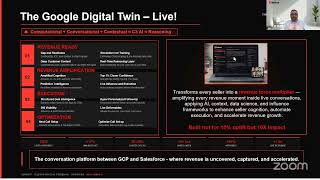
That is true. Yes, that is true. And that again talks about, you know, cognition, uh, you know, one rep versus the other. And Gerard, you've done numerous exercises, you've done— you've interviewed probably the best of the best, and what you've come back with is, hey, it's cognition that makes one rep different from the other. And the other sign says that you only recall 17% of information in the moment that matters. 83% of that information is you just can't recall. It's just, it's just human. It's our brain. Everything kind of— the data center that funnels down to everything is between our ears. That's cognition. And in— instead of saying, oh, I should have told the client this, or I could have sent them this, Uh, you lose the moment, you lose the moment, you lose your advantage. And the way we are thinking about this problem is we want the sellers, uh, to have the ability for them to convince the client to saying a yes. Maybe you could advance the slide to the next one if needed. Thank you. So fundamentally, you know, the rep should not be seen as just a rep. We want to transform this whole organization into, or the seller into, what we call as a revenue force multiplier. He has, should have, the ability to, you know, influence every revenue moment live in the conversation. You know, the context, the data science, the influence are all going to enhance the seller's cognition. And the way we've designed the engine is, is that we call it revenue ready. I mean, your digital twin is revenue ready for you. It's done a gap analysis of everything you should know. It's done this. You have the ability to not just to train yourself, but to simulate the actual client environment and prepare for that. Does everything that you need, prepares your reasoning layer based on your context and everything. Fundamentally, what that means is all the seller should do is turn on Spiked and just focus on improving that experience with his customers and trust spiked on the other side for him to do all the other work that he did in the past. The second part is during what we call as revenue amplification happens when you're actually in an interaction with a client. As an example, I was with Google for 2 hours yesterday. Gerard, believe me, the amount— I had 4 guys against 2 of us. And there was context switching all the time, you know, just like any other client. And I can tell you, Google's a tough place to be, you know. They have some great ideas, and they switched context with me more than 18 times in, in those 120 minutes, between pricing, between technical between value to them, knowing about them, knowing about where their swimming pool was, knowing about the cafeteria, knowing about the DNA. I mean, I typically, I would have been very overwhelmed in that situation. But that situation turned out to be such a pleasant experience for me that they ran out of all the curveballs they could throw at me. And came back and said, "Avi, we love your concept. We want to talk more about this." So I was able to take that conversation to actually a yes. And that kind of made me feel, and I said, well, I'm ready for my next one now and my next one and my next one. Besides that, after the yes, I'd say, you know, tools are there. Follow-ups and everything. What this system does is it analyzes everything that happened, all the moments that were there, all the moments that were missed, and reprograms the engine for my next call. So even I, even if I missed a few cues during my conversation with Google, I know what I did wrong, or I could have done better, but the system has reprogrammed itself and said, Avi, let's go back in. The next time we're gonna do this. So optimization is a big part of this. So what I feel is what I— what would have taken in excess of 2 to 3 months for me to push with Google along my vision on Spy, I was able to cover that in 2 hours.
So eventually, yeah, it is incredible. Let me, let me reflect on that. The, um, maybe you, you want to answer the question that the audience is asking: how in the world did you do that?
Well, I think, uh, I think what we did very differently was if you look at how technology is built You know, the first thing is we want and we go back and say we want our technology to improve the metric of a CEO, the CRO or the CHRO or, you know, the CFO. And what we've done is every technology that out there is actually bought by the CEOs and pushed down and said, I want you to comply to this. Now they forget that as much as they're trying to push that, that technology down, reps are forced to use it. And what people forget is how the reps need to use it. What we did differently is, since I manage reps, I manage field reps, I manage them all across, and so what we did is we flipped this on the head and say, well, we're not going to worry about the CEO, we're not going to worry about the CRO, what we're going to worry about is the rep and allow him to sell like the CEO. Okay, could we transition to the next slide, please? Thank you. That's intentionally what our motive really is. We want the rep to sell like the CEO, be empowered like this with all the 10 elements sitting on the top to do the one thing that he has to do is influence revenue. So we're not talking about a 10% gain in, say, close rates, 10% increase in pipeline, 10% of, say, less work for the rep to do. No, we're talking about a 10x value across the entire revenue stream. If you're not using it, your competition is going to use it. So we've, we've had chats with Microsoft. They love what we're doing. Salesforce loves it. Google loved it. JP Morgan Chase is in with us. Franklin Templeton. Now these are all— a lot of these places are very complex sales cycles. Uh, these are customers with— that have built technology themselves. So the one question that I was always asked is, why don't they do it themselves? I said, because they have not thought about themselves. They have not thought about the little guy, the soldier over there, which is the field sales rep. Call him a, you know, call him a, you know, front deployed engineer or whatever FDEs that you like to name them. But you need to think about his life and how he makes money. If he makes money, if he exceeds his quota, everybody up the chain feels better about that.
So I'd like to clarify something because what Spike 3.0 is doing is giving the salesperson in the moment of the conversation a series of input clues that help elevate the conversation. So it's not like Gong analyzing the conversation after it happened. Spike analyzes the conversation while it is happening and gives you the, the clues that you need in order to conclude the conversation successfully and intelligently and in an emotionally sensitive way where you leverage sales psychology. And nobody else has been able to harness that. Salesforce and Microsoft and Google, they have very bright engineers, but they have not been able to create what you have created, which is amazing.
Thank you. Yes, I think what we have is what we've taken the notion away from a copilot to an enterprise agentic framework, if you would. So it's not like one agent or one copilot is doing one task for me. As I'm speaking and trying to respond back to my client, I have 100 agents that are running different engines all the time, gaining input from the conversation and responding back to me in under 900 milliseconds. It's not that, okay, I'm gonna get my answer in 10 minutes or X, Y, and Z. No, the way we've designed the engine is It's got to be under 1 second, it's got to be 900 milliseconds, and it's got to be an answer that resonates with the customer. And why? Because we've ingested all the information about the customer, his pain points, his, his style. If you were to sell this to a CFO, guess what? He's looking for more numbers. So the system goes back and reprograms and brings out an answer in the way that a CFO would respond. Now, if you're talking to a technology guy and using the system, it's going to be a little bit more technical. It's going to be giving you analogies around, you know, if you ask it, what is React or what is, you know, what is Redis, you know, it's going to transform all that information into the way that a technologist would appreciate receiving the answer. So it's not, the way we've designed it is it's not one size fits all as well. But the mode of this entire thing is it is your digital twin. It is your own twin.
It's so interesting, Abhi, too, because we were just having this conversation earlier, the way that people react to, so I was like, and a woman CEO, that's me, right? So, so how would it react? It's so fascinating. And 900 milliseconds, that's what you said, right? 900 milliseconds. Okay, that's a takeaway for today. We have 2 minutes to jump to the next call. So I don't know, Gerhard, is there anything else?
I suggest that people go to spike.ai and book a demo with Avi.
Amazing.
More from Gerhard



What Selling Looks Like When Your AI Agents Have the Context Your Sellers Do

Better Conversations, Smarter Support: Wearable AI in Business






When Scarcity-Built Systems Meet Abundance - The Judgment Gap in AI-Powered Sales Leadership
