Fireside Chat: The Strategic Revolution: Seth Godin's Blueprint for Leadership
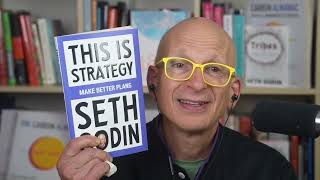
A recorded fireside chat between Gerhardt Haller and Seth Godin about leadership and strategy. Godin contrasts strategy (a philosophy of becoming and system-level choice) with tactics, emphasizes the necessity of saying no to preserve strategic focus, and advocates building systemic advantages rather than relying on heroic individuals. He discusses real-world examples (e.g., FedEx’s overnight system, Yahoo, Kodak, Google), the transformative potential of AI for existing systems, the value of creating productive tension, measuring the right (often harder-to-measure) metrics, and practical personal strategy advice (pick bosses carefully, focus on a smallest viable audience, and future-proof by betting on resilience).
Welcome to our podcast with Seth Godin. He is the author of 20 bestselling books, he has been featured on the New York Times bestseller list, and he is a wonderful keynote speaker and a very good friend. Welcome, Seth.
You forgot to mention that I was focused on that I was featured in your magazine. That was one of my life highlights.
I'd like to talk about your new book on strategy. You write in the book that every strategy requires a choice and you recommend often to say no to things that we could do. Can you walk us through a very specific example from your own career where saying no led to a better outcome?
Let's start at the beginning, because most people who are tuning in are tactics driven. Tactics are Tell me the steps tactics are. If I do this, I'll get that. We grew up with tactics. Tactics are how board games work. But strategy is the hard work we do before we figure out the tactics. Strategy is how we see the system that's even around us. So if you want to start a luxury goods company, a key part of your strategy is wasteful communication, abundance, giant stores that don't seem to have any customers, figuring out how to establish to the world that you're a luxury brand. Those are all strategies. And then you can come up with a thousand tactics to support that. So strategy is our philosophy of becoming. When we are in a tactics mindset, it's super easy to say yes to any tactic, but that denies the fact that you can't do two things at the same time. Every time you say yes to something, you are saying no to something you didn't even realize you were saying no to. The option instead is to understand where you are trying to go so you can turn down perfectly good opportunities, perfectly good tactics, and get back to the strategy at hand. In my career, after I wrote Permission Marketing, which invented the idea of email marketing, there were all these people in book publishing who wanted me to write three more sequels to a book they knew would sell. And there were all these people in the software world who wanted me to start a company like mailchimp. Either one of those things would have been fine, but they wouldn't have reinforced my strategy of being able to do this work that I've been doing for the last 30 years. We got to decide where are you going? Because if you don't know where you're going, any route will get you there.
Can you give me another analogy? That sort of drives home that point.
One of the things we're looking for is to be on the bus with the right people. If you're driving your bus from New York to Tucson and there's somebody on the bus who's constantly complaining because you're not heading fast enough towards Seattle, they're on the wrong bus. And so what we're looking for is enrollment. People who announce, I'm going to Tucson. So this is more than goal setting. This is having a vision for the change you seek to make in the world, doing the you of the future, the kind of work today that the you of the future will thank you for.
You caution people and say direction is more important than speed. Which is a great insight. But how do you help leaders resist that pressure to move fast when they see their competition racing ahead?
I'm in favor of moving fast. The question is ahead toward what? If they're racing ahead to dehumanize their organization, to charge less, do less, exert less, let them, because they're going to crash and burn. I worked at Yahoo. I've seen it happen. The alternative is to race to the top. But in order to do that, you got to know what ahead even means. So if you want to call yourself a leader, not a manager, and we need managers. But leaders are people who understand there's always pressure to do something other than what you're doing. And your job is to figure out where to go. Because it doesn't matter how fast you're going if you're going in the wrong direction.
The other part of your book that strikes me as interesting is system thinking in practice. So you emphasize that systemic advantage defeats heroic effort. Can you share an example of a company where a leader that build a systemic advantage instead of relying on individual brilliance?
So there are systems all around us. And the easy way to know that you're looking at a system is to look for gravity. Gravity is an invisible force that gets everything working in a given direction. The college industrial complex, which has been around our whole lives, makes us as parents, care what our 7 year old gets on their report card. Why should we care? Because deep down we know that in 15 years they might not get into a famous college and then we will be seen as bad parents. And so it infiltrates every part of our lives. The way your organization sells might very well be systemic. They don't sell that way in other countries, in other industries. It's just normal to do it in your industry. We need to see the system in order to understand what the system wants, what the system is going to push us to do, and where our opportunity might lie. Because if we can build a different system, the Competition has no chance. 55 years ago, when Federal Express came up with the overnight package for $20, no one could compete with them, no matter how hard they tried. Because what Fred built was a system where every package went to Memphis, then went back out somewhere else. You couldn't catch up with them if you did only a third of what they had done. You either had to do all of it or you were out. He built a systemic advantage that has lasted for a very, very long time. Technology shifts the world, and when it does, new systems arise. So people are looking at AI right now and saying, oh, yeah, let me replace some customer service agents. No, AI changes everything. It changes it more than electricity did 100 years ago, because new systems are being built really fast that are fundamentally different than the systems we rely on now. Right? And let's think about medicine as a simple example. Around the world, not just in the US if you get sick, you gotta talk to either a doctor or a nurse practitioner. The wait for that is an hour or a month somewhere in between. With AI, you can talk to a nurse practitioner all day, every day, and it can remember everything you've ever told it. So the medical system as we know it is going to have a totally different scarcity than it used to. If you don't think that is going to lead to a spectacular shift in a trillion dollar industry, I don't know how to help you. Of course it's going to. And I can make that case for every industry that you can name.
So are you suggesting that leaders need to look at AI as a way to create, improve and accelerate systems?
First you got to see the system and, you know, just to give you a tiny taste of how we think or don't think about systems, when I was at Yahoo, there was a secret list of the 100 most searched for terms on Yahoo. Search. And it was secret because they knew if they released it, the stock market would fall apart. The number one thing people searched for on Yahoo. Was the word Yahoo. Because no one knew how to use it. And it was the only way they could think of to get back to the homepage. The point is that we erected as fast as we could this Internet thing, assuming everyone knew it the way we knew it, the system of network television, three channels meant if you were programming for tv, you started with one third of the market every night and your job was don't blow it, don't let it go down. But when there's 10,000 channels or now a billion channels, the system's completely different. It looks like television, but it's a totally different system. And CBS didn't see that, and NBC didn't see that and ABC didn't see that. And that's why they don't matter anymore.
When it comes to change. You suggest that leaders should create productive tension. Give me an example.
Tension and stress aren't the same thing. Stress is not good. Stress breaks things. Tension is wonder. Tension is possibility. Tension is what's going to happen. So when someone does something magical and you can't figure out how it possibly could have happened, you have to sit with the wonder because it's impossible, but it just happens. So there's tension. If someone says dun dun dun, there's tension until someone else says dun dun. What we do as change makers, as leaders, is we willingly inflict tension on the market so they will lean in. Listen carefully, wonder what's going to happen next. If you are just going to satisfy needs and lower prices, I don't think there's anything wrong with that in the short run, but you are racing to the bottom. Kodak is a really good system. Story. Kodak invented the digital camera. They had most of the patents on digital photography. They had everything they needed to completely own it. But they were captive to the photography system. They were a chemical company that happened to sell film. The same thing happened to Google. Google benefited from the system of search with ads. They invented AI large language models, but they couldn't release them because it would destroy the system that they were built upon.
A lot of leaders say think big. I remember Marc Benioff telling me, garrett, you're not thinking big enough. You are the apostle of teaching the opposite. Find your smallest viable audience. Tell us why that is to your advantage for making it big.
Mark and I don't disagree about this. During Salesforce's greatest consecutive run, they thought very small. Very specific kind of person needing to move their sales operations to the cloud. The fact that there were a lot of people who would need that is great. But he had to make it work for a hundred people first. If it doesn't work for 100 people, stop trying to make it work for a thousand. Go back to the hundred. That's the smallest viable audience. Where Salesforce gets in trouble is when they buy slack, because that's a whole different thing, right? So you can think big by saying we delivered an enormous amount of value to a small group of people that we picked. So much value that they told their friends, if you can't do that, then stop hustling.
When you look at strategy as A philosophy versus a plan. You used this earlier. You described strategy as a philosophy of becoming rather than a fixed plan. What's the best way to communicate that to stakeholders? Because most people want concrete timelines and deliverables.
Giving people what they want sometimes is exactly what you need to do. I don't think most people in your organization, I think almost no one from your organization should be involved in the strategy conversation. The strategy conversation. Microsoft strategy is no one ever got fired for buying software from Microsoft. Starbucks strategy is every morning billion upper income people wake up with a caffeine problem and a cult and a status problem. We're going to solve both at the same time. That if you can have a very simple strategy, it's not an elevator pitch, it's just something that lots of tactics can support. Then you can say to your team, this is what we do here. Please come up with tactics to make it true. You don't need to be the CEO of Mercedes to green light an advanced computer controlled safety system that most of your competitors couldn't afford to build or put in every car that matches Mercedes strategy at the Ritz Carlton. If you are the person who makes up the rooms on the third floor of their branch in Fort Lauderdale, you have in your pocket a thousand or $2,000 budget to spend. Any time you find a guest who's unhappy, you figure out the tactic. You can spend it on the spot. But the strategy of the Ritz Carlton is totally different than the strategy of the Holiday Inn.
What about strategy and metrics? What you are saying in the book is traditional metrics like market share, revenue growth can sometimes mislead us strategically. What should leaders be measuring instead?
Easy metrics can mislead us. Just because it's easy to measure doesn't mean it's important in our culture. There are all these false proxies about hiring. Does the person look like you? Did they go to school like you? Are they tall like you? Are they same color as you? Are they the same gender as you? Do they interview well? None of these things are related to whether they're going to do a good job. None of them. But they're easy to measure. And if you reread Moneyball, the entire secret of Billy Bean is he measures something that was hard that no one else was measuring because the scouts at every other team were saying this guy looks like a baseball player or this guy's got an ugly girlfriend, as opposed to saying a simple but harder to find metric. What's their own base percentage? If we can just keep Coming back to a useful metric, then we can make things grow. So that's what the Net promoter score was. For a long time. It was a useful proxy, but then it got corrupted. Because as soon as a proxy gets measured, we start to wreck it.
You share two stories. One being in the water and almost drowning, and the other one being on a bike and almost crashing. I think that there's a much deeper lesson for everybody that is in search for higher meaning.
If you're listening to this, you already have the most sophisticated advanced technology in the history of the world. You work indoors, you have a roof over your head, and you probably have paid your mortgage. You have won every lottery, and yet because of systemic pressure, you're going to go back tomorrow and hustle even harder than you did yesterday. The lesson we get when we're flying through the air when our bike hits something, or the lesson we get when we're imagining the loss of a loved one is we don't get tomorrow over again. So what's worth doing? What is our philosophy of why we're even showing up to put in the effort?
What's your belief system that keeps you straight in the face of adversity?
I do have a strategy, and my strategy is to be trusted by enough people to do this work. That lights me up. What motivates me, what lights me up about it, is Since I was 17, I've been a teacher. And the pedagogy of figuring out how to turn on lights for people who are going to do good work with it is thrilling. And I feel like that's a contribution.
What is a good way of thinking about future proofing your strategy so that you look ahead and figure out what systems do you need to see the trends that are emerging and get ahead of the curve?
The most resilient strategies are ones that bet on turmoil and chaos and uncertainty. So if it's important to you to have a resilience strategy, begin with that. This is why when Ford Motor Company was on a roll, then all of a sudden people didn't want to buy the Ford Explorer and they had to lay off 10,000 people in one day. Those 10,000 people didn't lose their job because they were doing a bad job. They lost their job because Ford's executives were doing a bad job, because they were betting that tomorrow was going to be just like today. What we need to figure out is in a world where climate is shifting dramatically, in a world where the economics are shifting dramatically, in a world where the social structure is shifting dramatically, plus Tech, think of all the weirdness. Is the weirdness going to help you or is it going to hurt you?
When it comes to personal strategy development, what is the first mindset shift that people need to go through? What would you recommend that people start doing tomorrow?
Think about four years from now and you're looking for a job. What do you want people to say about you before you show up? You're looking for a job? Do you want to say, this person does what they're asked and they work pretty hard? Because if that's your strategy, please understand it's going to be very, very crowded. On the other hand, if you want people to say, wow, this person launched projects like the world has never seen before, is resilient in the face of failure, and understands technologies A, B and C better than anyone I've ever met, you can make that true, but you have to start today. So when we pick our boss, we pick our future. If you're working for someone who wants you to color inside the lines and do what you're told, please understand that you have given up agency over who you are going to become. That's very comforting, but in crazy times, it's not recommended.
So were you saying pick your bosses very carefully?
Yeah. Audition your boss. You're really hiring a boss. You're not getting hired. If you have the attitude and the skill that I believe you have, then don't let it become a piece of paper, a resume, a LinkedIn page that says, I'm just like everyone else. If you're looking for someone, I'm someone. You deserve better than that. And you're going to do that, to quote Zig, by being a meaningful specific, not a wandering generality.
You've learned a lot from Zig. Zig.
Zig was the right voice in my life at the right time. And I think a lot of what motivates me to keep going as I get older is paying back. Paying back what he and others did for me when I was struggling in the 80s, to have his voice show up and show up and remind me about what was possible. So I know he doesn't know I'm giving him credit, but it feels like the right thing to do.
How do you deal with disappointment, Seth?
What is disappointment right? Is disappointment internal or is it external? Disappointment is connected to expectation. And if expectation serves you, if it's useful fuel, then go for it. But often, as we learned from Pemachodran, expectation isn't helpful. I'm on vacation, but it's raining. Well, okay, we said that because our expectation was that vacation would be a certain way. But if it's, I'm on vacation and it's raining now, we have an opportunity. If we want to be disappointed, go ahead. But if we want to spend our day doing something other than being disappointed, go ahead. It's an opportunity.
Thank you, Seth. I recommend that everybody that listen to this go and get your copy strategy.
There you go.
Simple and square.
Thank you, Gerhardt. Stay well.
More from Gerhard



What Selling Looks Like When Your AI Agents Have the Context Your Sellers Do

Better Conversations, Smarter Support: Wearable AI in Business






When Scarcity-Built Systems Meet Abundance - The Judgment Gap in AI-Powered Sales Leadership
