Five Myths About Generative AI That Keep Sales and Marketing Leaders Up at Night - And What to Do
Jennifer Stanley from McKinsey breaks down five myths holding back sales and marketing leaders from using generative AI. McKinsey estimates $4.4 trillion in value across business functions, with over a third in revenue-generating areas. She walks through eight commercial use cases, from churn prevention to lead generation, showing 5-15% revenue uplift and 20-40% time savings in pilots that run 3-6 months.
Chapters
Well, I am super excited to introduce a friend, a colleague, Ms. Jennifer Stanley. She's a Rhodes scholar and a sales transformation architect and really the go to voice on business to business growth strategy in the digital age. So please everyone help me welcome from McKinsey and partner and head of North American and sales and channel management practice, I have the honor, Ms. Jennifer Stanley. Jennifer, take it away.
Thanks so much Joe. And actually I, I'm delighted to say I'm now actually over across the pond and I'm leading our sales practice in the UK and Ireland now. So much as my accent gives me away, I am indeed an American. I'm over here now which is a lot of fun and I am thrilled to be excited with all of you today talking about the topic of Guess what. I know we're all super exc excited about this and it's the hot topic of the day, generative AI and the revenue generating functions. And hopefully I'm going to dispel some myths and maybe bring you some comfort with practical suggestions on how to incorporate more of it into your organization's daily workflows and share some of what we're seeing that's working, you know, reasonably well. I mean, obviously with any transformative technology like we see things that, you know, don't always work reasonably well, but there's a lot out there that's actually, I think pretty exciting and maybe, maybe before we get going, just to be on the safe side, I always like to not assume that we're all working with the same definition. So I'm going to ground us in what when I say generative AI, what I am talking about is the branch of artificial intelligence within machine and deep learning where we are focused on creating new and original content. And that content needs to come from using assets like large language models or LLMs that get trained on very extensive data sets. And those data sets, they identify really complex patterns, relationships, and then from all of that comes unstructured content, text, images, audio, video, sometimes code, all based on, you know, the data that got trained. So it's just generating new great stuff for us, but it still needs to come from something. And that something is the wonderful content that we humans generate in our brains and put out into the world. So the thing that I always like to start these chats with reminding all of us is that we still need to be as human beings generating new content in the world for generative AI to work well, because it's only as good as the underlying information that goes into it. So maybe with that to set A little bit of context and why I think if you are in the revenue generating space, you're a salesperson, you're a marketer, you're in customer success or service or customer operations. Like it's a really exciting place to be. Because when we at McKinsey look at what we think the value that could be unleashed from this, this transformational technology could be, and we look at it across business functions, $4.4 trillion. Now, I know for you, you folks who are doing the math on the page, if you add up everything around the circle, it's going to be 4.3, but it's rounding. So the real number is actually 4.4. And a third of that, a little bit more than a third of that is coming from revenue generating functions. So with all of that potential, like you would think that commercial leaders would be really racing to embrace generative AI technologies in our worlds. But I would say it's a mixed bag. Not everybody is racing to embrace it. And when we look at like what that deployment of generative AI and how it is helping with revenue acceleration looks like, you know, only about.
Call it, a fifth of commercial leaders would say they have fully implemented one or more commercial use cases. And when I say a commercial use case or a revenue accelerating use case, I'm actually talking market. Something in marketing, something in sales, something in pricing. Could be customer experience, customer success, customer service, but anything that's in the space that all of us, all of us really, really work in. Then there's like another fifth if we kind of come around the wheel clockwise here, who would say like, I'm process of implementing something, but like it's not really being used organization wide. And then once we get out of that, you know, 40% who's doing something with, you know, one or more generative AI use cases in our space. There's 60% of commercial leaders out there who have not really started doing something with it. So there's planning to start maybe in the next year. There's planning to start maybe more than a year from now. There's, I'd like to start, I have no idea when. And then there's, you know, a tiny sliver who would say, like, you know, there's just no plans to start. I have no idea. I have no idea what. No, it's a small, it's a small group, but, but they're out there. And so I think, you know, one of the really interesting questions is, okay, there's 1.6 trillion in value out there. If you are one of the leaders on this page to go capture your share of. So, like, what are you waiting for? Why are you. Why are you waiting? And that was a question that I and a few of my colleagues together with Professor Doug Chung at the of Texas at Austin set out to ask. And what we discovered is that the reasons why organizations are waiting is because there's a number of what we call a kind of myths that are holding marketing and sales leaders back from really kind of going gust go, you know, kind of going with gusto to test and innovate with generative AI use cases. And when we sort of sum them all up, there were five that really stood out. And these are the five that I want to spend a little bit of time with you today trying to dispel. The first one is that there is a belief, and I think this is probably true of any net new transformational technology. Maybe if you think back to when traditional artificial intelligence really hit the scene, or maybe even like for those of us old enough to remember mobile technology, I remember the big, you know, the big brick telephones, like just the wonder around the utility. And so there really is a chunk. There really are a chunk of folks out there who are still kind of questioning what can I truly get out of general generative AI. Like there's just limited utility that I see or that I understand. Then there's a second, I think a second argument. Actually the second and the third argument are tightly intertwined and that is that I need a lot of data. And we hear this one from sales leaders quite a bit. And it usually goes along the lines of, you know, my organization really isn't that consistent, really isn't that detailed in terms of putting information into our CRM. So I'm not quite sure the value that I'm going to get out of the sales use cases. Because if we're training the training the models on anything that's going, going into our CRM, like I just don't think it's going to be that great because I know what the sales reps are putting in and there's just not a lot of what I would consider really high quality data. That's the second myth. The third one is that the data that we have or the data that we have access to, even if there's a lot of it is not well structured. It's too messy. Don't we need to organize it in some way first? We've got to get through some big master data management effort before generative AI can be of significant value to Us. So until that happens, I don't really think it makes sense to go too far down the path. That would be number three. If you take that as one end of the spectrum of like, I don't think, like, we're like, ready for something this complex. Then there's a group at the other end of the spectrum who would say, wow, we are super sophisticated, highly technical. We've done so much with traditional artificial intelligence and actually, actually, like, it's just too new. It's not complex enough for our needs. Which is kind of a, we thought was a little bit of a strange one out there. But actually that, like, that is a, that is a myth that seems to persist. And I'm here, here to tell you, yeah, there's actually quite a bit out there that's interesting, particularly in the world of agentic AI, which I'll spend a few moments on. And then the final myth is that it's just too long to implement to see a valuable return on investment. And this is one that we also, that we often hear from who get a lot of pressure. I mean, every, every marketing and sales leader gets pressure from their cfo, but where the pressure is intense from the finance organization. This myth is one that tends to, tends to stand out quite a bit. But I'm here to debunk all of them for you. So let's start with number one.
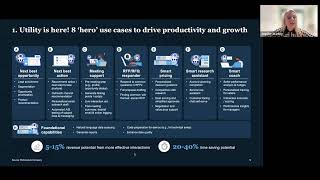
Limited utility. Not so much, actually. In the sales and marketing space that we work in, we have seen what we call eight hero use cases to really drive productivity and growth. And if you were going to take a snapshot of a page, I think this would be the one to take the snapshot of because it is the list of all of the different use cases where we see real value being driven in the commercial organization. And some of these, they may have started with traditional AI solutions. So let's take a next best action. Something that recommends recommendation engine to a salesperson of the next customer to call on your list for the week or the month. Or maybe it's churn prevention, you know, someone who might be at risk, and you've got some models that are telling you why. Well, now generative AI takes that and puts it on steroids because instead of just giving you the recommendation on the customer to call or email, it's generating for you a beautiful personalized email or a beautiful call script with highly, highly customized language. In some cases, if we're talking, if we're talking emails or other kinds of visual content, you get beautiful images as well. But something that like Used to take marketing a while to create for you, but boom, it's right there for, it's right there for the salesperson. If we think about all the way on the right hand side of your screens. Smart coach. I don't know about you all, but I've seen actually some really impressive generative AI sales coaching modules out there where you know, a year ago, even if you were practicing as a salesperson with an AI trained tool to get ready for a complex negotiation, there might be like three or four paths that the model could take you down depending on what your answers were to certain questions and that was it. And those three or four paths were pretty sophisticated and they were good, but they were three or four paths. Now in a generative AI backed world, those three or four paths are 30 or 40. Like you've got the age agent, the model interacting with you in a much, much, much more sophisticated way. And imagine if you're a sales manager and you have maybe newer sales reps who are needing to come up the learning curve and you can have them work with a smart coach like that first and then they come to you after they've done a couple of rounds and gotten their nerves, gotten their nerves out and worked through some kinks and then you're sitting down with them to really deal with the last mile of the complex coaching before going into customer conversations. It just makes for such a different and much more effective and efficient, I think set of conversations. And I've seen some really, really exciting evolution of the technology on that front. But all of these eight use cases each have then their own sub use cases. And when we see them at our clients that we work with at McKinsey, we're seeing real value coming out of them. And at the bottom here you see the range of impact on the revenue side we're seeing depending on your industry, depending on your market context and your start point, anywhere from 5 to 15% revenue uplift in terms of sales productivity or in non sales functions. Some of the, you know, maybe back office customer operations functions, 20 to 40% time savings so efficiency potential from these use cases. So this myth of like limited utility I think is really just that. It's a myth, like the actual impact is there and it's real.
Second, when we get to the myth of gosh, I need a lot of data, I don't have a lot of data or I'm just thinking kind of a bit myopically about my CRM. Well, your CRM data is one of six types that you really should be thinking about, right, it's your private source data. So the second line on this page. But you've also got public source data that you can be pulling from. So you know your customers 10Ks as an example. And those can and your customers websites, right, Those can be sources of information for helping your salespeople or if you're in marketing, helping your marketers get more richer content and doing research for you that before you know, salespeople or marketers would have to take the time to do or if you're in corporate strategy, your, your people are taking the time to do quite manually. But that's, you know, one huge source of source of information that is available to any of us. But if we think about labels, these are like actual kind of when we say labels, information like your label them because you're telling us what they are. So it could be customer reviews for example, that you then tag by product or by segment or by market as one example. If it's unlabeled, it could just be like text. You know, every time we call in to a customer service organization and we get these, the, this, this conversation is being recorded, well the recording turns into text. Somewhere that text gets saved somewhere. What do you do, you know, what do you do with it, that kind of thing. If you can label it and tag it to something, for example Jennifer England, segment A etc. Then boom, you've got more data. And then finally as we just think about other types of information, whether it's financial information, so like tables of data that could sit elsewhere in your organization outside of potentially the revenue functions, you can use that and pull it in as well. My point being here that you always have access to more information than you may think is that than you think you do and you have access to more useful information than you think you do. When it comes to generative AI, the challenge is the implications of what you may then need to do with that data to get it like into.
The right utility for the use case that you're working with. But there's always something that's out there that's available, available and useful for you. When it comes to messy data. I actually just want to share like a quick story. This is a B2B digital startup of where they were on their journey because they were One of the myths of like there's nothing we can really do, our data is too messy because everything we do is manual. And their challenge or their thought was if we had one use case, we would really want to hone in on it. Would be like rethinking, like our lead generation, qualification and outreach engine. Because the entire process that we go through, starting from step one all the way through to outreach, is manual. So if you think about like their before situation, you see the word manually, manual, manual starting at the beginning of all of all of their steps. And the data that was associated with it was sitting in lots of, lots of different places. So they were nervous to get started. But what we were able to help them understand and point out is that there's actually lots of, of third party providers out there at each stage of that lead generation, qualification and qualification process that have solutions that can help them solve for that messiness. And then using generative AI solutions provide an outcome from the outcome for them that actually takes the data that they do have, enriches it, makes it more useful, automates the process and makes it move a lot faster and a lot smoother. And I'm just giving you a list here, an example of just some of those vendors and that's not necessarily to endorse them, but just to give you a sense of, and some of you may be with these organizations a sense of like, the fact that there are a lot out there. And I often get the question of like, is build or buy better? And I think the question you should ask yourselves is where is your competitive advantage and how fast do you need to move? And if there's a competitive advantage that you have in data science, data engineering and like, that's the world that you live in, then maybe build is for you and you have the resources to do it. But in most cases, like buy and partner and get help, particularly if you're living in a highly manual world, that can be a solution to actually getting a generative AI use case or set of use cases stood up really quickly like this organization did. And then if we flip to the right hand side here, we see that their impact was really quite significant. Right? They reduced a lot of the manual workload and then they got a lot better outbound lead, better quality and higher volume outbound lead output. And so, you know, I, I think the, the lesson here is that experimenting can be worth it even in a world where you think you're dealing with data messiness.
The fourth myth. Now we're moving to that other side of the spectrum of the people who would say, actually I'm pretty sophisticated and I don't think generative AI is yet complex enough to give me, you know, really great bang, great bang for my buck. I would challenge that by looking at what's happened in just the last 12 months in terms of agentic AI? So if we kind of step back, maybe rewind our brains a moment to this time last year, generative AI driven chatbots and co pilots were all the rage. This year it's agentic, agentic, agentic. But when we break down agentic, there's actually three types of agentic that we're really talking about. Transactional single agents, transformational multi agents, and ambient agents. And I would love to like spend the time with you all to get into all of the details of what the difference is, differences are between the three. But maybe just to kind of make it simple, if we think about a transactional single agent as capable of sending you a personalized email, a transformational multi agent capable of like engaging with you on that email. So we're going back and forth. I'm now giving you additional information and responding to you when you're giving me that information. So now we're having a conversation, conversation back and forth. And an ambient agent takes that information and then can like suggest new products and services to you on text or WhatsApp and completely gets out of email. And now we're on multi channel. Right. So like that's kind of the level of complexity that we're talking about. And this is all happening really, really, really fast. And there are a number of companies out there that are actually experimenting with all three of these types of agents, sometimes simultaneously, sometimes in different markets, sometimes with different products.
And so there's actually quite a bit of innovation going on in this space. And when we look to see if companies are getting. Actually I'm going to skip forward. I'll come back to those pages in a moment. If companies are getting impact from agentic AI, the answer to that question is yes. And this is just an example here of some combinations of use cases where we have transactional AI and transformation, or transactional agents and transformational agents, as well as just some traditional AI in the mix at a call center. And the four things that they did with agentic AI and a bit more traditional, traditional use cases to really automate a lot of what was previously being done very, very manually. And now you may think, well, if they're automating all that, what's happening to the people and to the live agents, if the virtual agents are taking it over? Actually those live agents were able to be redeployed to handle much more complex cases and also redeploy to proactive, more kind of complex, selling more solution, selling much where it's a lot more kind of expertise, expertise driven. Who knows if the ambient agents are going to get there or catch up, you know, quickly? I don't have the answer to that, but I do think it's interesting to see that when you can get the more rote and administrative tasks out of the way, it frees up much more time for people to do maybe the more creative and exciting tasks. And now I'm just going to back. I'm going to back up for a moment.
Because I wanted to share the fifth, fifth myth, and that is that it takes too long to see results. And the answer to that question is actually, it doesn't. Some of these results that I just showed you were achieved in anywhere from three to six months, depending on the size of the experiment and the time that it took to roll out. And what we're hearing from executives is that they're so excited about the results that they're seeing that 75% of them are actually now investing even more to expand their generative AI use cases. 65% of them are seeing that there are more spaces where they can go automate even further. So they are expanding. If they're the ones who are in the group that are already using generative AI. And so they're looking to go further and go faster because they have been able to make the ROI case on it to their organization, they're already starting to see changes in Net promoter score. For those of you who are familiar with that world, you know that sometimes it takes a long time for those numbers to move, but in these cases, they're moving quite quickly. And all of that is combining to lead to the executives who are really committing and rolling out these generative AI use cases. 90% of them are, are expressing like significant excitement for what comes next. And that tends to be in the space of generative AI. So to maybe sum up, I would love to just leave you with a few thoughts. I know I've shared a lot of, like, what's exciting, but maybe just one thing to keep in mind is like, just because we can use it doesn't mean we always should. You should still evaluate, I think, some of the opportunities here versus traditional AI and machine learning. Because sometimes the ROI on the more traditional solutions may still be better for you than a newer generative AI solution. Second, the technology is actually the easy part. The change management to get people excited to try it and use it is the harder part. So get ready and plan for things to maybe be a little more difficult around that than you expect. Third, I wouldn't just say seller centric design, but people centric design is really the unlock. So when you're thinking about what does it look like when someone logs in to your new use case, think about that really hard because you want to make it exciting and dynamic. And then I mentioned the point about, you know, the build versus buy. It's an important choice, but build only where it really, really, really makes a difference for you and where it also can help you future proof. And then finally just the foundational capabilities don't ever really change when you're embracing a new technology. You do really, really need to have good infrastructure, performance management in place, good feedback loops and mechanisms like that. So like that doesn't go away just because it's a new and exciting technology. So I will pause there and I know, I don't know if Joe or Gerhard, you have any final questions you'd like to wrap with.
Actually.
Jennifer, my first question is what are your findings when you work with your clients on how companies set up guardrails so AI is being used intelligently and safely? I recently had a conversation with the communications director from a public company. I won't mention the name, but she said that she found found that some employees were clever enough to tap into co pilot AI that they had, you know, implemented like three months ago and were able to retrieve personnel information with rankings of the.
And bonus potential in the bonuses earned that and that information can be hidden but the user error, the users didn't hide it and it became a available and everybody was apoplectic and it created a big ST in the company. So how can you develop guardrails that are safe?
Yeah, this is a really, really important point. I think there actually there's three challenges going on here and it's not all like one is not specific just to generative AI but challenge number one is obviously data security and integrity of your data security system. And that needs to exist regardless of the technology like regardless of the technology that you're using. And so let's take that as an aside. The second is what are the policies that the company has in place? And I do realize this one's a moving target, but most companies do have a very specific set of parts, policies and guardrails for what you can and cannot do with the generative AI technology that is accessible to employees. And there are multiple technologies that are accessible to employees and some are not accessible to all employees nor should they be accessible to all employees. And so having a very clear set of policies, guardrails and also that employees should be attesting to, I understand them, I will abide by them, and there's consequences if I don't. So having that whole kind of, of infrastructure in place like you would for other types of topics and policies in the workplace where you expect a certain standard of behavior, this is no different. It's just that it's new and we have to get used to like thinking about, like, what are all of the possible, you know, consequences of it, like if people access the wrong system. The third piece is back to this. Just because you can do it doesn't mean you should. Like, should an employee actually go hunting for that kind of information that they probably know that they shouldn't have access to? Probably not. Again, not an issue with generative AI, an issue with just individual employee behavior. But the policy point I think is the important one.
Jennifer, I've just got a question. It's been burning in my brain forever.
So it seems, and I could be way off base, but is, is the AI being used when you're talking about a corporate structure? Is it being used more on a personal basis within the company? Or are organizations saying, hey, we now have to use AI to be your AI partner if you're, if you're a sales director or if you're a front end manager or you know, just a sales agent. Are the companies now saying, saying we have to learn this and start to partner with the AI, or is it still personal where, you know, employees are still looking at it? What's your take on that?
I think it's both. It's a bit of both. Right. So on the one hand you're starting to see more companies encouraging their employees to, you use co pilots and other types of technologies. Maybe companies who've built their own LLMs for their own employees to become more efficient and things like memoirs writing or email writing or organizing their calendars or things like that so that they can get more productive. Like there's for sure there is that big push. Like I don't, there's not a company that I work with or know of that's like not doing some version of that. Like it runs the gamut in terms of intensity. And then there is the version of it which is, okay, now how do we think about it for different functions in terms of transforming how we sell or how we approach operations. And then there's the version of it that is like, let's think about it in terms of how we partner with the outside world, with our vendors, with our customers, with other third parties. So there's actually like three sets of interactions with it like that you could think about. And I would say the most innovative and forward thinking companies, like they have something going on all three of those train tracks.
Great. Well said. Very well said.
Final question. Does McKinsey and company have AI agents on the website to guide the visitor?
Secret no, we actually, we actually, we have within McKinsey we have our own organization called Quantum Black, which is our, our inheritance house kind of AI group. And then we have third party partnerships with a lot of tech companies who themselves are pioneers in AI. So whether, you know, ranging from Amazon, aws, Microsoft Cohere, lots of different, lots of different organizations and then we've built a few of our own tools in house as well. So we're definitely putting our money where our mouth is on that one.
That's fantastic. That. Yeah. Great presentation, Jennifer. Great presentation.
What I find paradoxical is that we are so smart that we are automating intelligence. But who is going to take care of the proliferation of stupidity?
I mean. A question for another day, Gerhard.
Definitely.
Maybe we already have a surplus and maybe we don't need a.
That's true. Oh, gosh.
Thank you so much, Jennifer, for joining us from London and I hope you join us again. We have an AI summit coming up September 24th and 24th.
You are all always on the cutting edge. It's a pleasure to be with you, Jennifer.
Great seeing you again.
Good to see you too.
More from Gerhard



What Selling Looks Like When Your AI Agents Have the Context Your Sellers Do

Better Conversations, Smarter Support: Wearable AI in Business






When Scarcity-Built Systems Meet Abundance - The Judgment Gap in AI-Powered Sales Leadership
