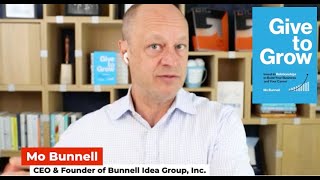
Mo Bunnell explains why givers outperform takers and matchers in sales. Strategic givers scale generosity by asking open questions, offering skills or introductions instead of just products, and separating their emotions from the outcome.
Chapters
Foreign.
Hi, my name is Gerhard Schwartner and welcome to Selling Power tv. Today we have the great pleasure of speaking with Mo Bunnell. He has written a brand new book called Give to Grow. I want to have your take on the the mindset of the giver. There are three sort of mindsets. One is I'm a giver, second is I'm a taker, and the third is I'm a matcher.
Givers weren't always the top of the heap. There's a big chunk of givers that are top of the heap and then of course, matchers and takers. But there's a big chunk of givers that are the least successful. The bottom of the heap the top of the heap givers are what we call strategic givers. They're the people who scale up their give to the size of the expected outcome for them. A simple example like if a client says, gosh, I really need help with Blake or I' starting with blank. Well, we might scale up our gift to do five hours of analysis for them and suggest, hey, would it be helpful if we came back and started solving that problem for you? That's worth it. If we get an inbound request from somebody that went to our college and says, can I take you for golf? I'd like to learn about your career. That might be a five hour request too. But the strategic giver scales that way down to hey, why don't we just start with a 15 minute phone call and see if I can help you.
In a book there's something curious which is the five lies people tell themselves. What are the top three?
One big one is I'm not sure what to do. What most salespeople don't do is they're so focused on their own product, they don't look for other ways to be helpful. So a simple solution for this one is. As we're recording a prospect, we weave in a simple question. What are some of your top priorities over the next year? That I can look for ways to be helpful as the year goes on. That's going to give us sort of the answers to the test about how we can drip out helpful content and follow ups and show them we care as a human, not just as a budgetary line item. The second really big one we see a lot is I'm too busy. The fix here is integrating sales and business development with delivery work. A face to face ask is 34 times more likely to get a yes than an email asks. So if we have something to ask, we just Want to ask that while we're in delivery mode with the client or prospect or customer so that we can get that yes, we want later.
So what is the third?
I'm afraid I'm going to look bad. Things like, well, they canceled on my last two calls. I'm not sure that they even liked me. I met them at a conference. I'm not even sure they remember me. The headline solution here is think 10x, not 1x. What we mean by that is if somebody puts all the pressure on themselves that the next outreach has to work 1x thinking, we hesitate, we don't reach out, we overthink it. Things like that. 10x thinking says, I'm going to add value in this person's life 10 times over the next six months. I'm just hoping one of these things resonates. And 1 out of 10 is awesome.
Tell us the difference between material gifts and non material gifts that salespeople can give.
I think it's easy for us salespeople to like swipe through the marketing department on the way out the door to go have that big lunch and, you know, grab that yeti tumbler. The problem is these days that's not going to result in any kind of meaningful sale. Non material gifts. These are usually in one of two buckets. We want to think about investing in our prospects and customers and clients in a way that's deeply meaningful. Hireable non material gifts are investing in their skills, helping them learn how to deploy what we sell in a way that it's really deep or meaningful. You want the client in learning mode. You want when you meet with them that they're taking notes about. That's a really good idea about deployment. Whether I hire you or not, I'm learning sales mode is fight or flight. As soon as you feel like you're being pitched to, you're like you either want to punch the person in the face or run. On the human side of non material gifts, as salespeople, we have this amazing network we get to see inside all kinds of different organizations. So connecting people with other thought partners or folks that have tackled a problem that the person we're talking to is trying to tackle, that's one of the most powerful ways we can differentiate ourselves because now we're investing in them personally, not just at times where we think they might be able to purchase from us.
And what I also like about the book is that you sort of described that asking the right questions and not tying your emotions to the outcome. Tell us more about that.
Generally speaking, the more expertise we believe we have in an area, the more closed minded we become and we can be in a first time meeting as people, your audience, me, you, anybody and quickly jump to conclusions. And what we want to do instead is have that beginner's mind every time and we want to keep asking questions until we can prioritize or we can share back with them their priorities in their words and test for understanding.
Thank you Mo. That was so enjoyable. I recommend highly that every salesperson needs to read that book, Give to Grow.
This has been an absolute joy. Let's make a difference in people's lives.