High Trust Selling in a High Tech World
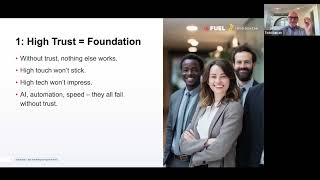
Todd Duncan argues that trust, human connection, and technology must work together in that order to succeed in sales. He uses a story about choosing between two doctors to show that technology amplifies but cannot replace empathy, and presents the Rule of Three: trust is foundational, touch builds it, and tech amplifies it when human-centered.
Questions this video answers
Ask questions ~20% of the time and listen ~80% of the time.
From 17% to 71% conversion (as stated in the talk).
6,000 homes.
Over 1,000 patients.
He described making an annual birthday call (this year his 31st) to a friend/client in Australia on August 16 (or August 17 in Sydney).
Chapters
I know, I know. It's good to be here. You know, I know we're talking a lot about high tech today and we're going to be talking about trust, but high tech's a very, very good thing. And you know, I love high tech. If I were really honest with you, the first time I used Chat GPT, I asked it a question, it a question and it answered, todd, that is a terrible idea. And I thought, wow, this thing already knows me. It already knows me. But then there's a deeper story behind why tech matters and why humanity matters even more. And when we think about just the tension between the two and then the efficiency between the two and all things between not, you know, going anywhere and being stuck and scaling, it is always going to be a little bit of a battle between the humans and the technology that humans are creating. And that in and of itself is a phenomenal place to start. But let me take you to a deeper story about why tech matters. Okay? And why I think humanity matters even more. I'm going to take you to a moment in my life where technology wasn't just interesting, it was actually life or death. You never want to get the call, the call that comes in like this and you pick it up and the voice on the other end says, todd, it's your doctor, you have cancer. And I imagine many people watching this live stream or that will watch it in the replay, probably know somebody. And even maybe for you, you've gotten that call. And the minute that you get that call, your world changes. I remember my moment that that call came in and I got frozen and locked up in a whole bunch of emotions. I got locked up in fear, I got locked up in doubt. I got locked up in, how could this happen to me? I mean, I was healthy, I was in great shape and in great shape. And it's like stuff like this isn't supposed to happen to people that are healthy. But it was very real and it settled in. And, you know, I got into some of the follow up appointments and actually a friend of mine referred me to a doctor that specialized in this kind of cancer. And, you know, he was a good man, he was experienced and because of being referred to him, I trusted him. But the moment that we met, something kind of felt off. His office felt dated, his equipment felt old and he felt stuck, like the world had moved forward and he hadn't. It was almost as if he was still playing in the world where you got mail and aol. He spoke flat data points, no eye contact, no emotion, no Humanity. And I thought these exact words. I'm trusting this man with my life.
And nothing here in this conversation actually feels alive. And then I'm at doctor number two. When I think about these, these doctors and I think about the difference. Doctor number two, state of the art robotic surgery center. Okay, Three robotic arms, AI guided precision, incredible technology. But here's the truth. I still needed to trust the human guiding this. And this doctor was uniquely different. He sat down beside me, not across a desk for me, not across a table for me. He sat down next to me. I could feel him next to me. And he looked me in the eyes and he said, todd, you're going to beat this. You're going to walk out of this. I am with you, and I'm going to do everything I can to make sure of that. I felt something I hadn't felt with the first doctor. I felt trust. I felt connection. I felt hope. Tech was impressive. Tech for sure, very impressive. But what saved me and what saved my life was the human controlling it. And in that moment, I had this kind of perfect storm. I had, I had high trust because he sat next to me and looked me in the eyes. I had high touch. And as you can imagine, what a three part robotic surgery center looks like with three different arms that are going to go inside your body and rid you of cancer. I trusted the technology and we beat cancer. Because of me choosing Dr. 2. I chose Dr. 2, not because of technology. I told. I chose Dr. Tu because of his expertise, his ability to connect with me and his ability to take my fear down and to take my hope up. And that's something that I think is crucially important to all of us as we go through this. So what are we actually talking about here? We're talking about what I call the rule of three. And the rule of three is in business with clients and customers, and in leadership and sales leadership with teams and employees, there are three things that have to happen. They have to happen all the time, and they have to happen in an order of importance. As you now know, between the tail of the two doctors. The first thing that has to be established in any leadership relationship, and partly why we invented fuel, was this idea of helping leaders accelerate trust, not only culturally in their company, but individually, one on one with the teams that they lead, whether they're leading other leaders or they're a direct report to the employees and the sales teams that are on the front line. Hitrust is the absolute starting point for all of this. It is the foundation because of emotional Connection. And because of the tale of the two doctors and because of just the analogy, you can start to see, see that in very many ways there's this relationship between does somebody feel that you feel them or do they think that you are thinking about feeling them? And I say that in this feeling of connection, right? This feeling of heart or this feeling of soul. And it's interesting because any of you that obviously use AI, and we all do, I'm even talking to different AI relationships that I have and notice I call it relationships because I'm starting to think that this AI thing is not an it, but it is a connection of human beings, right? And I can talk to a group of human beings like they're not an it. I can talk to them uniquely and differently. And I find myself in that kind of beautiful, beautiful situation. I can also pick up the phone and, and I can call somebody. I can call a client, I can call a decision maker, I can call a buyer, and I can do something different with that buyer or decision maker or even friend to connect. And what high touch is, is it is the super glue between high trust and high tech. High tech is the amplifier. So with high tech, what we're able to do is we're able to take any of the trust and touch relationships that we have and we're able to accelerate those relationships and trust in ways that scale and scale fast. We're doing that at Fuel. You know, a dream went to an idea and an idea went to an alpha and an alpha went to a beta and a beta went to a beta 2, and a beta 2 went to a beta 3. And then we went live beta and beta 1, beta 2, beta 3. And three years later, you have this beautiful, beautiful platform that takes high trust, high touch and high tech and opens the door to anything you want, anywhere you want, on any device you want, for any amount of time you want, and now allows you to connect in a real safe, as Gerhardt was talking about, way to become the best leader you want to be, to become the best mother or husband you want to be, or parent, to be the best child you want to be, to be the best student you want to be, to be the best fit, fiscally wise you want to be. And I say all of this because the three tenants you're looking at right here on the screen are the three tenants that Fuel was built on. We want this to be what you experience each and every day. So let's just take about two or three minutes each. I'll unpack these for you. Happy to shoot over a PDF to you, Gearhart, so that everybody can have the deck that might replay it. You obviously have the screen, so we're off to the races. So high trust, high trust is the foundation. And the thing that I believe everybody needs to own is that without trust, nothing else works. And if it is working, it's working because of push. It's not working because of pull. I'm wanting to have people pulled into a relationship with me where they trust me. I don't want to try and push them into a relationship. High touch won't stick if there's no high trust. High tech won't impress if there's no high trust. With all the speed we have, with all the crazy automation out there, every single thing outside of this word trust fails without trust. And so trust has arguably become the most important asset you'll ever have. It has become the most important connectivity tool, pun intended, that you could have with another human. If we're looking at sales conversions wanting to go up. If we're looking at, you know, the role of somebody that's on my sales team is to put time in and generate revenue out. Revenue out for the company, revenue out for themselves and bonuses or commission or whatever, it's time in and that out. And they have to trust that you're guiding them that way. And they have to trust that you're going to touch them in a way that shows that you care. Like doctor number two, if they're ever in a funk or they're ever in a sales rut, they trust that you're going to sit down with them and help them out of that rut. You're not going to look at them and say, get busy, make more calls. You're going to come alongside them and lead. And that's the trust thing that is so necessary. And so, again, just be clear that without trust, nothing else works in business. Everything else is harder. And when you have high trust, the highest trust, you actually create demand pull in the marketplace, which is people coming to you that because of that reputation, that trust first is that asset and that currency that you're using in relationship. Transactions are great, okay, but relationship is 100,000 times better. It'll produce more, less expensively, more rapidly, with less shopping, with faster conversions and more loyalty than almost any other thing you could possibly do as a sales leader. And so when we look at this, we talk about what destroys trust. Well, these are obvious inconsistency over promising too much automation, clunky technology, not showing up, not calling. I had somebody yesterday, after two weeks of a 14 day assignment on trust and making calls, after 14 days, she was on a webinar and we were doing some follow up, she started making phone calls, if you can understand this, right? Lack of presence turned into being present. And as shocked as she was, she got three transactions valued at over $20,000 in commissions because she did what really secured trust. And that was following up. And she started that by being transparent and making sure that the customer knew that she was sorry that she hadn't followed up more reasonably and more concise consistently. And it's just crazy when we stop and think about this slide and we think about, you know, if I'm reliable, if I'm bankable, if you can count on me, if my promises matter, I'm transparent, I'm consistent, I'm predictable. I know your heart, you know my heart. We're connecting emotional first, economic second. And we're delivering the best outcome we possibly can for you as a human, same as a leader with their team, right? You want a high trust culture. High trust culture is faster speed from your employees, less mistakes from your employees. A culture of trying things out and being innovative, which is a safe zone for your employees. I mean, everything gets better when your team trusts you. The technology doesn't make them trust you, only the touch leads to the trust. And so we look at this and we don't want to destroy, we want to build, obviously. And so when we get into this idea, I want to just ask you to take 10 seconds right now and think about one client or a team member who doesn't fully trust you yet. Just think about that for a sec. Give you like six more seconds. Isolate somebody, a client maybe, maybe you've had a breakdown, maybe you're still trying to get them to trust you full scale, full stop, whatever that might mean for you, right? And when you have that person in your mind, then I'm going to give you something that is startling. This came out February 11th of this year. It's the Gallup Global Leadership Report. And here's what they said. Employees and clients need two things from leaders. They need trust and they need hope. Those are soft things that make everything else work. If we're not leading from a position of trust, as Marc Benioff says all of the time, then what are we leading from? And his answer is, there's nothing more important. I've been working on trust my whole life. I wrote a New York Times bestselling book called High Trust. Selling the subtitle is really captivating make more money and less time with less stress. And 100% of hands go up in a room when I ask people if they like to do that. And so we're sitting here on the cusp of this beautiful, beautiful scenario where, hey, have people trust you because you're interested in giving them more hope, more passion, more confidence, more consistency. And obviously those results compound in the organization. Now, the super glue is high trust. I mean, high touch. And so high trust is the human advantage. It is what it is. What we have to understand makes the world go around. It is empathy. It is understanding. It is getting on their side of the desk. It's seeing things from their side or their perspective. It is to deeply understand their motivations, their fears and their hopes. And here's a test for you right now. If I showed up at your office and, or, you know, a branch you may run or a company headquarters or whatever, and I just showed up and walked into your office and introduced myself and asked if I could ask you just one question. And you said, sure. And the question I asked you is if I were to pick an employee that is on your team right now, would you be able to produce a document that, that shows me that you know what their motivations are, what their fears are, and what their dreams and hopes are? I did this four weeks ago with 400 leaders in a room and only nine people stood up. I said, stand up if you could produce that. And so I'm just encouraging you to deepen the touch, find out what matters in people. If people know you care, they will produce more for the brand and for the organization. Organization. And when we talk about emotional connection, there is a real truth to this. And while AI can predict behavior, humans understand meaning, right? And so the meaning according to Gallup, is this idea of get into it, right? Have this emotional connection, ask more questions, be more interested. Socrates said, you know nothing without asking a question. And we have to be listeners. We have to understand, you know, Lululemon was founded on a principle that we're going to have every employee figure out how to achieve their one, five and ten year goals. And that PDF is available online today. And it's a $54 billion company. And Chip, who's the founder of Lululemon, started the thing off. If we help our employees achieve their dreams and goals in 1, 5 and 10 year fashion, we're going to have loyal employees who we're going to have more sales, we're going to have faster growth, we're going to have all of these things. And he was right. He was absolutely right. I think the other thing is one of the movements in the high trust, high tech world is slowing sales conversations down to speed contracts and engagements up. And part of how we do that is we understand a phenomenon that we've done research on called talk Less, sell more and more. If you'd like a copy of that white paper, you can contact me directly. I'll show you at the very end how we do that. And at the end of this discussion, with Talk Less, Sell More, we watch sales conversions go from 17% to 71%. So if there's one thing a leader could do for their sales teams is to jump on fuel. Role play, role play, role play. And ask whomever you're role playing with, maybe it's me, maybe, maybe it's one of our other sales leaders. It could be anybody. But role play and find out what you're doing right and doing wrong. And the ultimate conversational productivity move in the roleplay scenario of Talk Less, Sell more is you're going to ask questions for about 20% of the time and you're going to listen for about 80% of the time. The reverse is what's true for most salespeople. People, they get too into pitching, too into selling, too into promoting, and they have forgotten to connect. And what's important about this is Gallup says that businesses that optimize emotional connection outperform the competition by 26% in gross margin and 85% on sales growth. I mean, their customers spend more. Hello. Return more often. Hello. And stay longer. Hello. And so the, the future, the future of business is high trust, high touch, emotional connection supported by technology. It's not the other way around. What's really interesting about this is that person, you just kind of maybe got your eyes on the client, the employee that maybe doesn't trust you fully. Did they feel deeply understood by you in that last conversation? I asked you just a picture and kind of put in your mind, did they feel deeply understood? Deeply understood. And when I use the word deeply, that is to drive this feeling modality, right? It is the, the connection, you guys know what I'm talking about. Out. But too often, business, it becomes the lead and relationship becomes the byproduct. Everything in business today should start relationship first, sale second, relationship first, business development second, sale first, sale second, and connection first. Those are the things that matter most. And when connection goes up, two phenomenons happen. Ten, retention goes away, which provides more room for trust. And when confidence, I mean, when connection goes up, then confidence on the Buyer's behalf goes up as well. And so those two things become hugely important in the dynamic of selling. If somebody's got high tension and low trust, they're not going to buy. If somebody's got low tension and high trust, they're going to buy. And that's all we have to do. We have to figure out how to use these modalities. The rule of three, the three things. We have to figure out how to use those same things so that tension evaporates. Trust and touch fill in and relationship starts. And then business. Boom, boom, boom, boom, boom, boom, boom, boom. I had one client that took three and a half years before they finally decided to do business with us. And people go, how did you stay in touch with them for three and a half years? And I said, well, I just stayed in touch with them. And every three months I gave them something of huge, huge value they could use for their sales teams. And when the policy changed and they started vendor basing their sales training, then all of a sudden I, I got the phone call, right? And when Ginger, I asked her, I said, so, so what made you feel comfortable calling me? And she said, real simple. For three and a half years, you gave me value and you did not ask me for business. And that's called the law of the scale in high trust selling. So really understand the power, being deeply connected. This last one in the rule of three, high tech, it is the amplifier. Okay? So high tech isn't automatically good tech. Good tech multiplies trust, bad tech destroys trust. So we got to understand that, right? And I'm talking in the grand scheme of things, and I'm even talking about all the tools on your phone, right? Everything in between. So this is interesting. This is a research project that I paid to have done. And I wanted to evaluate technology and net promoter score. So I had three categories that the consulting firm thought we should check out in. And we had about 15,000 people that we surveyed on this. And within three years we had a million people that we had surveyed on this. So in the easy to use category, a 9, 10 rating reflected an NPS of 89. A 1, 61 to 6 rating, which are the detractors, had an NPS of a negative 30 or 119 point delta. In the visually appealing category of the technology, a 910 rating reflected a net promoter score of 89. And a 1.6 rating had a net promoter score of negative 27 or 118 point delta. In the keeping the customer informed category, a 910 rating reflected a Net Promoter Score of 1992 and a 1 to 6 rating, had a disastrous NPS of negative 42 or 134 point delta. So when we talk about technology and we talk about it's got to be easy to use, it's got to be visually appealing, it's got to be whatever your your goal in serving the client is, is it checking orders, is it updates, is it status, is it whatever that is, it's gotta be easy. And so when we think about good tech, bad tech, good tech is frictionless. It's fast, it's accurate, personalized, intuitive. This is what fuels become. When I met Alex, who you guys heard from yesterday, and Alex and I are now business partners, Alex said to me, he said, just so you understand, our technology will never be perfect, but it'll always be improving. And I said, that's a really good way to look at it. And I had no idea what he actually meant because. Because he's the tech guy and I'm the relationship guy. But I will tell you, we learned so much from our customers on where the friction was and where the accuracy was lagging and where it wasn't personalized enough or the recommendation engine didn't work. The beautiful thing about having a customer base is they'll tell you how to improve. You just got to have the humility and.
The access to be able to learn what those things are. You know, if tech doesn't work, people don't use it. If it's slow, it's confusing, it's inconsistent, it doesn't boot up, it's over automated. You know, it doesn't speak to the emotions. You know, what's great about Fuel is anybody can learn anything that they want. All they have to do is check a box on what they would like Fuel to drive to them in terms of, you know, things to watch and things to listen to and podcast, you know, test on and things like that. And now that we have the AI agents on fuel, there's 30 of them that can coach anybody on your team for minutes instead of you having to do it or, you know, imagine a sales team of thousands. It's really hard to get all thousands who are all at different points and all at different places in their career. It's hard to get them all going the same way. I've been doing sales training for 30 years. I grew up in selling for 12 years and sold 6,000 homes in real estate. And, you know, I did it the right way with relationships from first, and I did it the second. Way using technology to keep my customers active with me. And somebody told me very early on, the value of technology, whether it's very, very front end, right all the way back to dos, if it's very, very front end, or maybe it's as antiquated as file folders that you move through a calendaring system, it's still a technology. And what he said to me is, he said, listen, if you're not in touch, you're out of touch. And if you want your clients for life, you have to talk to them during their life. So for me, tech is beautiful in talking to your clients and talking to your customers and updating your customers. And in fact, if it's done right, then it boosts trust and it boosts touch. I will tell you one thing right now. I just made my 31st call. I do it every August on the 16th of August in California, it is the 17th of August in Sydney, Australia. And I've used technology to remind me every, every August 16th at 4:00', clock, I call this guy named John Simon. He's a billionaire in Australia. I helped him start a company where he made a billion dollars. And he and I are good friends. And I call him every single year on the 16th to wish him a happy birthday. I have that in my head now. I probably don't need the technology, but it sure is great to get the reminder. And I do that right now for about 8,000 clients. I'm just doing birthday videos for two hours a day, you know, and sending things out and making calls. And so technology is here. It's not going anywhere. It's here. It's to amplify the trust and amplify the impact of the touch. And really, when it gets down to it, we take a look at this tech and emotion formula. Bad tech erases, erases that. If, if, if we do not have high touch working in concert with high tech, if you just have high tech, it's not going to work. And if you have high tech without high touch, as you saw in the NPS descriptions, you can kill, just kill relationships. So the beauty of kind of where we're going on this and the beauty of where I want you to be and understand is I really deeply in my soul believe that the future belongs to humans. I think it always has, it always will. Technology. If I go back to the moment in my life where I got the call that I had cancer, I learned through all of this that technology can extend your life, but only trust can save it. The greatest robotics center didn't earn my confidence. AI assisted precision did not calm my fear. The instruments were impressive. But I didn't put my life in the hands of a robot. I put it in the hands of a human being who chose to lead with empathy. Every day your clients face their own version of that moment. They are deciding quietly if you're doctor number one or doctor number two. Are you transactional or are you transformational? The future will not belong to the most automated professional period, or the fastest professional period, or the one with the shiniest tech stack period. The future belongs to the professional who blends all three of these high trust, high touch, high tech into one unforgettable experience one by one by one. Because when you do that, you just don't win business, you win hearts, you win loyalty and you actually win lives. And you know, my doctor one, doctor two experience, right now I've referred over 1,000 patients to my doctor who saved my life. And I would not have chosen that doctor just because of the robotics if I didn't like him, if I didn't trust him. I even asked him if he had some patients that have given him a five star rating that I could check out before I let him do the procedures on me and help me get cancer free. And he laughed and he said, I haven't been asked that very often, but sure, I've got thousands of them. And you know, it's interesting because a doctor could talk to me for a half an hour and try and talk me into doing surgery with him, but if I talk to 10 of his patients and they tell me everything that experientially they went through through, that's more valuable than anything and that's how the world goes around today. And yeah, so let's just choose to get excellent on these things. Let's choose to make sure that we stick with trust first, touch second, tech third. And let's understand at the end of the day that I am here to help you win. Fuel is here to help you win. If you'd like to speak with me or if you have friends or family that would like to support, speak with me about bringing this high trust culture into your company. You can hit me up@toddyfuelio. My Instagram handle is Todd Duncanofficial. You can find me on LinkedIn easily with just typing in my name. Todd Duncan, I hope you found this valuable. I look forward to spending more time with obviously Gerhardt U. And all the beautiful people that hang out on your virtual webinars around the world that are always so, so profound and so beautiful. And I'm grateful that I had a chance today to hang out with you.
Can I.
Impose on you and share one quick story?
Yeah.
When you read the article on goal setting and Selling power.
I didn't understand goals at the time. I understood that I had to have them, but I didn't understand what they meant. And when I started reading this is so great everybody. Because I knew Gerhardt before he ever knew me. He didn't know me until like 35 years after I knew him. But I was reading Selling Power magazine when I was a new real estate agent. And one of the things I got is that what I do every day in relation to my goals is what matters more than anything else. Goals are a pipe dream. If they don't get measured every day, that's all they are, is a dream. And I started figuring out that if I talk to four buyers and sellers a day and I could get Good enough in my High Trust conversations. It wasn't called that then. When I wrote the book High Trust selling in 2004, that's when we claimed that label and that trademark. But I learned that if I could get good enough to have one of those four conversations materialize into a contract, that I could be a millionaire. And so what I began doing was role playing. And I used a Radio Shack audio cassette recorder and an audio cassette tape and I recorded every objection. This was right out of Selling Power magazine. I recorded every objection I was getting. I recorded every solution that I thought I had. I recorded each one of them 10, 10 times. I did this almost weekly for almost a year. Whatever new objections came up, whatever this. And I recorded and recorded. And then I listen, listen, listen, listen, listen. Repeated it back, repeated it back, repeated it back, repeated it back. And then I got this. Like one of the magazines was. I mean, one of the, the things that Selling Power produced was the. Gosh, it was two audio cassettes. It was the trifecta of true selling power live. Yeah. And I got that. And the only thing I heard that time was, what have you got Good Enough? Where two out of four would say yes. And then what if you got good enough that three out of four would say yes? And pretty soon I said, that's all I'm going to do every single day. I'm going to get better. So the conversations I have lead to more people saying yes. That's all I have to do for the rest of my life. I don't have to, you know, I don't have to check squirrels and Shiny objects. I just got to be good enough at the conversation where people trust me. And if they trust me, then they're going to use me. And if I do them well, then they're going to refer me. And so all of a sudden I went from selling 100, 100 homes to 500 homes a year just because of selling power.
And you still have that laminated gold setting sheet with you.
Oh my gosh. It's the most beautiful thing ever.
You want to see it? Yeah. Okay, just a second here.
This will take less than 30 seconds. This is, this is what I did, guys. IBM Selectric typewriter. And I went in and I said, okay, I am going to achieve these goals. I'm seven years in as a real estate and lending professional. Let me stop this real quick. And.
All righty. Here we go. Share. Boom, boom, boom, boom.
There you go.
I wrote my goals down. What a concept, right? Wrote your goals down. I wrote it down. You can see this is, this is a laminated copy. Now it's in my safe in my home because I never want to lose it. But I did take a picture of it. It used to be folded in my wallet. You can see the fold line in the middle. But I wrote down whatever the mind can conceive and believe it can't achieve. That was from Think and Grow Rich I wrote down. I'm a professional speaker and trainer. I earn in excess of a half a million dollars per year. I always have $200,000 in the bank. I was in investment junkie and I wanted to have a couple hundred grand liquid so I could just invest in real estate and so on. I have 10 successful cassette albums.
Speaking about tech, I'm 100% debt free, only have healthy habits, have a strong marketing network, speak 100 times per year. And I own a 5,000 square foot home with high ceilings, large yard, pool, spa, five bedroom and a tennis court with an ocean view. Little did I know when I bought that home that I would buy a hundred more. But that's neither here nor there. The fact that I was doing well enough that I could invest is one of the things that we always want to do. We want to be in our lane, we want to be in our sweet spot, do what we're gifted to do because it doesn't take a lot of effort and just watch compounding take place over your life. And yeah, so this is courtesy of selling power live and listening to goal setting setting. There you go.
Gerhardt Marinal said. Excellent. Thanks for bringing it home beautifully. You are amazing. This was a powerful and inspiring session, and you reminded us that no matter how advanced technology becomes, trust remains the core of sales.
100%.
And you are called for better human connections, for integrity in selling. Couldn't be more timely. And I'm glad you also quoted Mark Benioff, because he said trust has to be the highest value in your company. And you showed us today why and how to make trust the foundation of everything.
Yeah.
Thank you for sharing your vision, and thank you for your wisdom and your commitment to elevating the profession of selling. Please show the last slide where people can get in touch with you.
Okay, so. Oh, I just already got rid of it. Why don't you just go hit me at todd@myfuel.com. that'll be the best way. Todd@myfuel.com and my social handle is Todd Duncanofficial. So we'll just put that. Maybe put that in chat or whatnot. I. I close that deck down.
Wonderful.
Okay. Thanks, Gary, for all you do.
Yeah, Amanda just typed it in, so thank you so much, Todd.
Okay. Have a great weekend. We'll talk soon.
We'll record something classic next week.
Can't wait. Let me know when. Thanks.
Thank you.
More from Gerhard



What Selling Looks Like When Your AI Agents Have the Context Your Sellers Do

Better Conversations, Smarter Support: Wearable AI in Business






When Scarcity-Built Systems Meet Abundance - The Judgment Gap in AI-Powered Sales Leadership
