How Gen AI Paves the Way to a New Era in B2B Sales
Mary argues generative AI is shrinking and reshaping B2B sales teams into smaller, data-driven units. She used recruiting automation to hire a multilingual seller in Europe in three weeks after cutting headcount by a third, and advises sales leaders to shift budget toward technology and continuous training.
Questions this video answers
$50 million
About one-third
Three weeks
ChatGPT 4.0
Chapters
You.
I'm going to share with you some thoughts I have around the impact of generative AI and advanced automation on the world of B2B sales, specifically focusing on revenue leadership. And with that, let's move forward.
So this is just a quote of mine from an article which I'll share with you because I think it's so relevant to this overall conference. When I looked at all the session time titles and who was speaking, there's such a powerful theme around how generative AI and edge technologies are really impacting the world of the revenue leader. And so, you know, I think we're at a day and time where as a revenue leader, if you aren't thinking of technology and specifically edge technologies as another arrow in your quiver, you are missing out. And so your role is one of the hardest roles in the organization. Right. And it's just gotten harder as we have to stay in touch with new technologies, new ways that buyers want to buy. We have lots of upstarts on the competitive front and we now need to grow our businesses of all shapes and sizes with less financial and human resources. So if you're not using generative AI, you're falling behind. Kind of touched a little bit on some of the dynamics that are out there, which I always love to do. I think that must come from my forester days. But the context is, you know, it's very interesting, exciting and challenging to sell in the current environment. We're seeing inflation and interest volatility. We finally saw in the states here the rates go down half a percent, which is positive. But it's been a very lumpy, bumpy macroeconomic for the last three environment for the last three years. We're also seeing rapid maturation of generative AI and adoption, whether that's through embedded tools that your company will purchase on behalf of its employees or tools that we're all using on our own. I use chat GTP 4.0 pretty much every day in one capacity or another. That brings about a lot of challenges from compliance and security to other things. I'm kind of fascinated with what I'm seeing. And there's a movement around the redistribution of workforce assets. And when I think of those assets, I think about financial assets as well as human assets. And even though companies may be doing quite well and CEOs may be making still $32 million a year, I'm not going to say who I'm talking about. Certainly wasn't me in my CEO.
There's still, we're still seeing a lot of layoffs in movement and what we're seeing is assets being moved towards.
Innovative areas and pockets in the business that are experimenting and using Geni. So that's happening. And then the final thing is this focus on efficient growth. You, I would be shocked if you aren't being asked to grow your businesses, grow your numbers with less sales resources than you had in the past. I think you all know I've been a CRO and in my day if I had a million dollar gap, I'd hire three reps. I'd go to the CFO and say I need to fund three reps. One, who's going to be my superstar? Two, the other person who's probably a B player but who's going to push that seller and be competitive with them. And the third, probably they're not going to make it. I don't know who it is but I need to make sure I have coverage and over assignment at any given time. That conversation will not go over very well right now. So this is what I'm seeing and I've been thinking about this for quite some time, probably since 2017 when I was back in Forester. But now the reality of my visions and some of the dreams I had are coming to fruition. We are in the moment of what I call the agile tech enabled Salesforce and that Salesforce looks much smaller and I'm going to go into a little bit more detail, but you've got smaller, more agile teams. You've got data driven decision making that's happening. Sellers need to be data and technology savvy. You've got access to great tools. We've got a number of other speakers here from late stage startups that provide sales execution, sales enablement, all kinds of tools that sellers absolutely need to use in order to be competitive. And that means leading with personalization insights and operating efficiently. You've got to be cross functional and collaborative minded. We're seeing even for transactional types of sales, large teams that are selling together. And if you're not as a seller continuously upskilling your own learning and skills development, you're in trouble. I'll give you an example. I signed up for Coursera, I wanted to learn how to do prompt engineering better. Those kinds of things need to happen and that's what this Salesforce is doing. They're smaller, they're data driven, they're using tools and they are learning how to keep their skills incredibly relevant.
Now when I talk about this agile tech enabled salesforce, we're looking at a very different model for many, many Many years we always thought that 80% of our revenue would come from 20% of our reps. You can see sort of that visualization on the left side of the screen. But now in this new world order, 100% of your revenue is coming from 80% of your reps, or it must. Now, I know we're in all likelihood not there yet, but that's how you as sales leaders need to think about your talent, your tech and your enablement. You've got to have small teams, and if you're not being measured and comped on participation, I would expect that's going to change soon because it's not just about getting to the number in any way possible growth at all costs. It's about getting to the number in a predictable and efficient way. And you've got to make sure you have significantly more participation across your teams than we've had before.
So, you know, putting my CRO hat on and, you know, I think, I constantly think about what are the big levers I have to pull. There are a lot of levers, right? But when I think about the biggest ones in this environment today, it's number one, talent without people. I don't care how much great tech you have, without the best possible salespeople, you're not going to succeed. You've got to have innovative technologies and partnerships with great, innovative players who are going to help you understand the landscape, whose product roadmap maps to where you want to take your business as well, and who's going to be a resource for you. And then, you know, I want to speak to some of the enablement professionals. I hope we have some here today. Enablement's been hit very hard as a discipline and functional area of the business over the last three years, but I'm going to see, and I predict we'll see a resurgence in real focus on enablement with smaller, more agile teams. You are going to have to increase your participation. You've got to have technology adoption. Some of these technologies are a little bit complicated and you've got to have a strong enablement professional who's driving education, creating personalized development plans, and ensuring that the tech that you spent lots of money on is being utilized and utilized the right way. So for me, I see these as the biggest levers that heads of sales have today.
All right, so I want to talk about the challenge in recruitment. So we all know as sales leaders that we should be recruiting perpetually. We should always be recruiting. We should make time for it, and it should be a high priority. And yet we kind of don't like to spend our time doing that. Why is it? Well, the pressures of being ahead of sales are immense. Right? You've got pressure from your board, your CEO, you've got to hit your numbers today. You've got to ensure you've got a pipeline for your next two quarters. You've got to make sure that you're out performing your competition, you've got to deal with personnel issues. I could go on and on. It's one of the toughest jobs that you're going to find in an entire organization and you know, the headaches don't go away. And I think that's why, and I was very guilty of it when I was a CRO, I would delegate and push talent to my HR business partner. And I think we're in a world now where certainly it's great to have that partner, but you've got to be more involved and more focused in really thinking of talent as one of your top three levers. So I'm super pleased to report that help is here, help is on the way. And if you think about all of the wonderful ways that we automated marketing through marketing automation and how we've used automation and rudimentary AI and some of the original sales execution and sales enablement platforms that had happened over the last 15 years or so, it's not surprising now that some of those techniques and technologies are being applied to the world of hr, into the world of the talent recruiter. And so now we have recruiting automation as a rapidly growing category. Now I know I'm not talking to a bunch of recruiters here. However, thinking about how important talent is, I want to show you a little bit about how I used higher quotient as co CEO of a revenue enablement company to completely transform the organization. And I hope you'll leave this conversation really believing that you need to get more deeply involved into your talent strategy.
So here's the situation. I was a board member at this company and I stepped in to be co CEO for a moment in time to help get the business back on track. And we raised 50 million and we gained a new financial partner. Now we raised that money at a time when very little money was being raised for enablement companies and even late stage startups. So it was a huge win. But I had a new boss and that boss was our new financial partner. They asked us to be prepared to be cash flow breakeven in two quarters. No surprise there. We had gone through a number of acquisitions, so our company was a bit bloated in terms of salaries and duplicative talent. So sadly on the human front we did have to reduce the company by about a third. And simultaneously there were about 10 to 15 very critical positions on the go to market side of the business that I needed to hire for. So I know it's a bit cacophonous to think you've got to reduce a company by a third and then you need to go out and hire. But as you all know, you need different talent for different milestones in your growth trajectory. And it was just one of those cases.
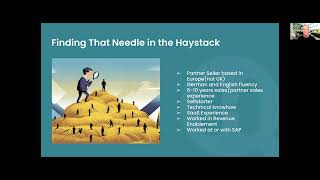
Because I had to be cash flow break even in a couple quarters. I couldn't go out and hire a recruiting firm. I even have friends that are in the industry who were going to give me a break. But even if they took 20% off of 100 grand contract, that was still 80 grand was not a good look for my new partner. And then I had a junior recruiter who was just on his own. I felt that the talent transformation was so important that myself and the Recruiter ran these 10 to 15 searches all while I did all the other things that you would expect a CEO to do to make sure that we could make payroll, make sure that we could close the big deals, make sure I was focused on investor relations and so on. So I actually hired higher Quotient and started using the sourcing tool called EasySource. And I'm going to share with you a little bit of specifics on one of the roles I had to hire because I think it's a really cool story. I had to hire a partner seller in Europe and that seller was going to interface with SAP, who at the time was a very, very strategic partner for the business. So naturally that person could not be sitting in the UK or else SAP would not take us seriously. Ideally I would have loved it if they lived in Germany, but I just needed someone on the continent. I needed them to be fluent in English and German and ideally I kind of wanted another southern European language as well. But trying to be reasonable, they needed to be fairly sophisticated in terms of their tenure and experience. I needed a self starter with technical know how and that was because there wasn't a lot of support in Europe at that point. This individual was going to be on their own. And myself and my head of partner sales, we didn't really want to get up at 3 and 4 in the morning to help with demos and to support this individual. So we really needed someone who could essentially sell, be a partner relationship manager and also essentially Their same be a sales engineer. I needed them to know SaaS worked in revenue enablement and had either been a partner, a client or an employee of SAP. And there were some more things I needed as well. But as if this wasn't enough, I had no idea how I was going to find this candidate. And that was what really propelled me to hire a higher quotient. So I'm going to give you a little sense of what this looks like. And Stephanie referred to this, the exciting new tools that are out there and hire quotient is an AI first company or software company. We have a range of solutions. What we're going to discuss today is our easy source recruiting tool. And in that tool we focus on three things. Sourcing active and passive candidates from a range of proprietary and public sites. We work with the line manager, head of sales and talent partner to rate rank those profiles that the AI will go out and scrape in a matter of seconds. And then we use automation and deep AI to allow you to set up a rich cadence whereby you can communicate with those candidates that are highly qualified for the purpose of setting up a meeting to interview them. And at that point the human business leader, line manager, head of sales, HR partner takes over. Software is super easy to use and pretty slick on the left side of this picture. Just setting up a very high level search on the profile and you can see some of the things that I mentioned in my requirements here, but I'm keeping it very broad because I want to start out with a range of candidates, not two or three candidates. Right. And then I want to continue to get a little bit more specific. Not going to go through all of the capabilities here, but it's simple. Dropdowns, keywords, very, very simple. And we send the AI out to search across all of the different properties I mentioned. The next stage is really your sales managers or yourself or your recruiter will then eyeball some of these candidates. And you can see here on the left hand side we've got a couple of different five star candidates. Miraculously you can hover over the profile and see exactly how the candidate rates and ranks against your must have and nice to have criterion. And you can see that example here. We've got this nice five star and they are located in Germany, which is great and yes I'm aware it's not the United Kingdom, so this is really great. You go through and you give the AI a thumbs up or a thumbs down, a text box will pop up and you can then write in what you like about the candidate. Or what you didn't. If you thumbs down them and the AI starts to learn what you want, it leans into more of what you want, less of what you don't want. And you only need to do this for two or three. And eventually what you're doing is building a project, or what we would call in the sales world an outbound campaign. Because many of the motions, while the nuances are different, are very similar in sales and recruiting.
And this is where even more magic happens. I wish I had more time to spend with you on all this, but on the left hand side of the left screen you can see our cadence, and that is email. LinkedIn email. And you also have the ability to use text. So you set up a cadence, you drop in your templates. I also drop in my calendar invite to make it easier. And you can see where the parentheses are or when we're asking the AI to customize. Now this double parenthesis down on the bottom. Cool. This is where we can communicate at scale, but with hyper personalization. And we all know from our time in sales, the more personalization you have, the more opens you're going to have, more connects you're going to have, and the more pipelines you're going to have. So here we wrote, I think you're going to be a perfect fit for this opportunity we have. Especially because. And then I tell the AI complete the sentence is 20 or 30 words and explain to the candidate why they're a great fit for the opportunity. And by the way, mentioned a couple of achievements too. Who doesn't want to hear about how they've achieved something in the work environment. You then can see on the right hand side of this, within a matter of seconds, the AI will go through all 50 candidates, or all 50, 100 or 25, and will create hyper personalized messaging across all of the channels that we've talked about for the candidate.
And to boot, you have a chance to teach the AI what your writing style is before it will actually do that. And then it can actually map the insert there in a way that goes with your flow, style and approach. It's like nothing I've ever seen. You set this up on an outreach and you're off and running and then your managers are back to doing what they're doing, you're doing what you're doing, and your HR partner is doing what they're doing. It's all about allowing the machines to do what they're great at, which is repetitive manual administrative work. They never have a bad day, they're never irritable, they're always up for more work and allowing the humans to do what they do best, which is really connecting one to one or one to many like we're doing today. I never see that changing and that human interaction and connection is so important.
So I always love to leave folks who attend my sessions with something that they could do today. And so what I'm going to tell you is, you know, start to prepare and think about what a more agile tech enabled sales organization will look like. I did some research last year which showed that many sales leaders were already starting to think this way. And how did I know that? Because they were taking headcount budget and pushing that towards technology spend. So again, start to think about smaller agile technology augmented sales organization and think about the role that tech can play for you as a leader. Lean into your three levers, talent, tech and enablement. You've got to have an active pipeline that's ready to go at any point of sellers that relate to your selling motion. And consider funding a recruiting automation tool. Oftentimes the budget for this comes out of HR from the talent acquisition organization. In my case I just funded it myself. But think about how that tool could really help your managers and help you compress the time to hire. In my experience as a customer, I would say the tool took weeks and months off time to hire metrics depending on the complexity and the seniority of the role. I hired a seller in Europe who sat in southern Europe, who spoke three languages, who worked at a competitor to my company in three weeks and I never thought I would be able to do that.
And then the final thought here I'll leave you with. And this isn't really just a final thought for my content, but for the whole event that we're having today, which is as a head of sales, you don't necessarily have to use every single technology that's out there, but you've got to think about technology as another arrow in your quiver that's going to help you execute against your revenue strategy successfully and your revenue strategy is your way of executing against your company strategy. So in the past I don't think we've thought of tech as that type of arrow in the quiver. And again, while you don't have to be a day to day user, you've got to be conversant and understand what's possible with some of these incredibly innovative and edge technologies that are changing the way we all live, work and interact with each other. So thank you all for listening and absorbing my slides. And thoughts and if we have time, I would love to take some questions.
Wow, Mary, this is incredible. You know, you're talking about cost savings, you're talking about time savings. And I talk to employers all the time that are, you know, trying to recruit students from sales competitions or sales programs or universities in general. And, and they get frustrated because they send an email and maybe the student doesn't respond to the first email. And trying to stay on top of all of that. It's that frustration and that stress and having to multitask and keep track of so many things and this is just doing it for you. Oh my gosh, it's so, so needed now. How do candidates get into the system to be considered?
So the candidates don't actually get into the system to get considered. So that's actually a really great question. So we are not a job board. Right. So, and so number one, employers aren't going to post. It's a proprietary software that you would purchase like any other SaaS product. And the candidates, what we are doing is scraping candidates profile information from sources like LinkedIn, indeed, Monster Zip, GitHub, public websites, association websites, Facebook. We also have a commercial partnership with Crunchbase. So you're able to say get me a candidate who's been on a scale up from series D to.
Series E or series C to series D and the software is actually going to go out and find them. So the biggest advice I would give to candidates is make sure you know, in today's day and age you're, you're being very specific about your profiles, updating them, making sure you have certifications. I didn't show this on, on, on this discussion today, but I actually put in my search I wanted someone who understood and had used Medpic because that's what we used. I'm like, if I can get someone who's already been trained up and certified on that, then that's, you know, someone who's going to ramp up much faster. So the big piece of advice is be very hyper particular and granular around certifications capabilities times when you've attained quota. The other thing I ask the software to search for Steph, is candidates who have had progressive promotions over the course of three years or candidates who have. I love this for sales leadership candidates who have had talent, follow them from company to company to company. What is a better indicator of someone who's going to be a phenomenal head of sales than people that will follow them over the course of the decade? And our software can find those people for you. Wow.
What about two job pools that I think that are neglected, that the sales leaders need to pay more attention to is one is the military.
They show great leadership, they are very resourceful. There's one company that just helps recruit marines for sales and they have a great training program. And the other pool is teachers. Teachers are notoriously dissatisfied with their pay and when the sales job, they get twice the money.
It's so interesting you should say that because we're talking to a number of companies that do just that as well as staffing companies that staff veterans. And who better for us to lean in than people who have served their country and gone out there on behalf of all of us Americans? So it's a great tool to help you if you want to look for a particular demographic or people with background. You could say, you know, in your search, candidate should have been a former military candidate, should have worked at a company that sources military talent or things of that nature. And you might make it a nice to have instead of an, you know, a must have. Or maybe it is a must have. And because we're going after such a wide range of people across so many sources, we can find those types of individuals. And same thing for teachers maybe. I think they make great customer success professionals. Right. Because it's kind of the same kind of thing. And you could say look for former teachers and we can go find that needle in the haystack for you.
Wow, that's incredible. Oh, we have another question here. As someone who's going to be contributing to a hiring effort, have you found technical, industry specific knowledge or role based experience to be the best indicator of a good fit for a position?
Yeah, that's a great, a great question. And you know, I think it depends on, you know, your company, the selling motion, the, the dynamics. And to be clear, this is not assessment tool, even though we do have assessments. This is really helping you just find those active and candid, active and passive candidates that meet very deep criteria. But I will tell you that we can get very specific. I did a search yesterday that they wanted me to find an SAP functional consultant.
And we did. And I learned a little bit more about what that meant. And they had to know Hannah and they had to know a bunch of other things. But you can get as specific as you want and I think that certainly helps you get into the money where you're going to get access to the best talent. And then you would use your own assessment tools after that or ours or your typical interview process to really evaluate maybe that's role Play or maybe that's a project or things of that nature. What we're trying to do is essentially make you 10 times more efficient in that first part. Identifying, ranking and communicating. And then once you've got them in the mix, you know, that's up to the humans to take over.
That's terrific.
I have another question for you. Since I know your background and you worked for different companies, different sizes, you were an analyst and.
You have a lot of insight into culture.
How important is it to put in some qualifying criteria into the hiring search?
Yeah.
To know that this is a, you know, those attributes are good predictors that people are going to thrive in their culture because you have been replanted in different companies and you, you have a knack for thriving and it's not always evident. A lot of people fall in love with a new logo, fall in love with a new company and six months later that disappear and so there's no continuity. So tell us a little bit about the culture fit.
Yeah, you do find that.
So frequently. And I know a couple of really wonderful sellers that have gone to some of these top tier unicorns and just not a fit for them for one reason or another. And you can't, it's not explainable. Right. And so what I would say is we can use this tool for that. I think there's really two answers. The tool can help you weed out folks that may not be the right culture or enter in folks that may be a great culture. And it can save you time so that on the human interaction side, you're spending more time interacting with that individual to talk about things like that. On the software side, we have a lot of not for profits that are our customers. We have clean energy commercial firms that are our customers. And so we might put in candidate should have demonstrated proclivity for social advocacy or candidates should be interested in climate or so what you do, just like anything else is you find a proxy, you find a couple of proxies for what your culture is like and then you prompt those in in a sentence and the software will look for it. But I think in the end, while that helps, it is truly about the managers, the hiring manager, the recruiting partner to have more time and energy to have deeper conversations around cultural f.
More from Gerhard



What Selling Looks Like When Your AI Agents Have the Context Your Sellers Do

Better Conversations, Smarter Support: Wearable AI in Business






When Scarcity-Built Systems Meet Abundance - The Judgment Gap in AI-Powered Sales Leadership
