How to Use AI and Assessments to Drive Sales Skills Development
C. Lee Smith explains how situational judgment tests and motivator assessments, paired with AI coaching, cut training time and boost sales rep retention. A case study of Emily shows how assessment data feeds into an AI coach that generates personalized scripts and session plans for each rep's actual gaps.
Questions this video answers
830 US salespeople (on sales teams of five or more)
Earlier in 2025 (speaker statement)
One third
One in four
TeamTrait / teamtrade.com (speaker referenced 'teamtrade.com' / 'Team Trait')
Chapters
Well, let me go ahead and jump right in. This was my drama and I think this is something that a lot of us have experienced. Have you ever tried putting together IKEA furniture? And worst, you ever try to put together IKEA furniture without reading the instructions? Well, that's me. It's like I want to try to do it myself. I look at it and say, well, that doesn't look so hard, even though I've heard horror stories. But so I tried that. And the problem is you get halfway through it and you realize that.
You'Ve got things on backwards and you've got 11 extra screws worse than that. I never took the time to measure the space that I had available to make sure that once I built it, it would fit. It occurred to me that that's really how most companies build sales training. They just rip the box open and start building and hope it stands up on its own. And just like the IKEA dresser that I failed to build, it collapses, you know, because we've never really checked to see what the salesperson actually needs. And that's really what's wrong with, with a lot of sales training today. I wanted, I wanted to really tap into that. And it's, it's no wonder. It's because of this that one third of salespeople say that their company's sales training is mediocre at best. This is a study that we just completed earlier this year, 2025, called Voice of the Sales Rep. We surveyed 830 US salespeople on sales teams of five or more. So we didn't talk to individual salespeople that are selling on their own. You had to be part of a decent sized sales team and this is what they've told us. Even more alarming than that though, is that one in four salespeople said that they would entertain a job offer from a company if they provided more or better sales training, in addition to all the customary things like.
More ote and benefits and everything like that. So again, that from the voice of the sales rep, and that really leads me into this, is that we tell salespeople to do discovery before pitching a solution. We always do that. But yet most sales training sucks because it does exactly the opposite of that. Most sales training creates a one size fits all presentation first week. It's called instructional design. And without, they do this without personalizing it to what each salesperson needs, or more importantly, what each salesperson wants. So the managers, on the other hand, bless their hearts, they try to diagnose what the problem is. Using the CRM. The problem is that the CRM is a rear view mirror and it only reveals what's happened, but it doesn't reveal why it keeps happening. And even more of an issue is that if you have a new rep that's just joined your team, you don't even have that history of the CRM to know where they're going astray. I want to present to you an idea about using assessments. Assessments are typically used as hiring tools, but they're also the missing ingredient for providing training and coaching that actually resonates, that actually sticks and has a greater chance of being remembered in a week. So first I want to suggest to you to use a situational judgment test. Now if you're not familiar with a situational judgment test, I'm going to tell you all about it. So you've likely heard when you're doing sales training. Well, I already know that. It's like I already know how to sell, I'm already good at that. Situational judgment test reveal not necessarily what they know, but how good they are at it. So if you're ever challenged with that and they say I already know that, then your response should be, well, okay, well how good are you at it? And the idea of sales transit, we want to make you better at that, even if you feel like you already know that particular topic. So a situational judgment test is this. It's a scientific assessment that presents realistic job related scenarios and it asks the individuals to choose the best response from several correct answers. It's the kind of test that we always hated in college, right? If you have a multiple test question, whatever, and you have tricks to trying to figure out what the best answer is. But in this case there's more than one best answer. Now this is not an intelligence test, okay? It's not a knowledge check that you would do after training. It's certainly not a personality assessment. And this has been used as a highly effective tool for predicting near term success in sales for new hires. But it also has another application here. So an example of a sales a situational judgment test for sales is this one here which measures strengths and weaknesses across 18 different sales disciplines. The decision making patterns at every stage of the sales process. So even after you get training it, it also gives you some glimpse on how they might apply what they've learned.
It also has to deal the good ones anyway, has to deal with sales in the digital era. So instead of just know face to face sales or telephone sales, we also have to take into consideration the remote sales and now we also have to of course digital first and now AI first. And so we also have to measure the salesperson's proficiency not only in using AI, but how to leverage AI. And that was a whole other presentation that that I did in a previous summit here at Selling Power gives you global benchmarks. So you can kind of tell in these 18 different sales disciplines, are you ahead of the curve, behind the curve? And it was developed by four of the leading, the world's leading sales consultants. And my role here was to update it to bring it up to speed then for the realities of remote sales, digital sales and AI. So that's an example of a sales judgment test. You can find that@teamtrade.com but here's why you should use it. It identifies skill gaps which might be the real cause of what's holding them back. It determines where you should allocate resources. Is it in training, is it in development, is it one on one coaching, or a combination of all the above? It also creates a baseline for you to measure skills development so you know where you start. If you do the more training you do the coaching, you can come back to it, do another situational judgment test and be able to tell what kind of progress you've made there. Helps you design real world training exercises. But the other thing is this is like AI is one of those things where the better data you feed it, the better output it's going to generate for you. So if you want more useful assistance then in coaching and training you have to feed AI better data. And the situational judgment test does that. And most importantly I think is that it reduces non sales time because every salesperson says I need more time selling, I don't want to be in this sales, I don't want to be in the sales training. And what you're able to do now is you can avoid teaching tactics in where the salesperson already excels. So that's a situational judgment test. The next thing you want to do is you want to determine what really motivates them beyond commission.
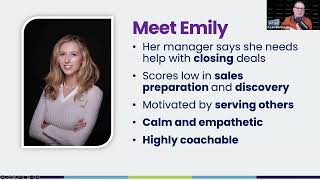
And so the key point to keep in mind here is that adults don't learn because they should. They learn because they want to get what they want. So they learn to get what they want. A motivator's assessment is a different kind of assessment because it reveals their why. It measures their needs and desires across six realms and examples of that, their level of curiosity, compliance, control, originality and such. Then when we blend these six scores in, it also gives us additional insight like their desire to work autonomously, their need to win, their thirst for power, and things of that nature. It's not a personality test, it's not a learning styles test. And to give you an example, a sales situational judgment test measures their skill to sell. The motivators measures their will to sell. So motivators will empower you to connect your training to what's really important to them. And spoiler alert, it's rarely just about the money. And we'll get into that in just a second. So let's bring this all together. So I'm going to give you a real scenario here. The names have been changed, but this is someone that we've worked with recently, and we're going to call this person Emily. That's not Emily's picture, by the way, but nonetheless, Emily's manager said that she needs help with closing deals. The manager then looked at the CRM and they saw that she was doing all the steps, but she just couldn't close. So immediately the manager said, okay, she needs instruction on how to close better. But when we did a situational judgment test, we found out that she scores low in sales preparation and discovery.
She's also very motivated by serving others. She's calm, she's very empathetic, and she's highly coachable. This is also what's really important as well. If someone scores low on a situational judgment test, don't just assume that this person stinks at discovery or whatever. And they're always going to stick at discovery because if they're highly coachable, you can actually get them to a place where they're better at that sort of thing. So the other thing that's interesting about Emily, by the way, is that, okay, the manager said she needed help in closing, but we found that because she wasn't good at discovery, she didn't have the leverage then to be able then to answer objections and certainly didn't have the ability to prevent objections.
It all stemmed basically from discovery, and which also stemmed from her lack of preparation to be able to.
Ask good discovery questions. See how that works? So it's not just evaluating the CRM. You have to dig into what's causing the behavior, why it never changes. What's going to resonate more with Emily is it approach A, which is the ABC always be Closing coffee is for closers and all that hustle, because sales is the number game. And you never want to leave money on the table. And you want to get them into the pipeline. You want to get them through the pipeline quickly because this Strategy is going to increase your win rate by 24% and we all know that that's what you want. Or with Emily, do you want to try this approach? Selling is all about problem solving and serving others. Be more curious. You know better discovery is going to give you the insight that you need to be able to close and make sure that you share customer success stories and impact metrics on how you've helped other people and collaborate more with the customer. And asking for the sale is the most helpful thing that you can do for them. So for someone like Emily, what kind of training is going to work better? As you can see, it's different based on.
What the situational judgment test shows, but also what her intrinsic motivation is. So training and coaching Emily on those traditional coaching methods are going to fail spectacular. That's why we didn't do it. And the cool thing about assessments is that it also gives trainers recommendations on how to train in Emily's situation. It said to show Emily how helping customers is the close for her. You want to create a supportive and psychologically safe training environment that encourages collaboration and teamwork because that's something that she's naturally good at. We want to incorporate experiential learning techniques, of course, but also to teach her that better sales preparation will enable her to ask smarter questions. And we want to demonstrate these effective techniques for asking follow up questions as well. And lastly, Emily can improve her closing skills by getting the buyer involved in discovering the solution rather than delivering the sales pitch, which is what she was doing. Now the other way that assessments helps us when we feed it into AI. And this is a one on one assistant coach. It is an AI assistant. And so what it's done here, it's provided the sales manager some coaching suggestions and it gave five or six of those and it asked would you like a step by step coaching strategy for all of these? And then. Okay, that's great. Would you like to have a 35 to 40 minute outline about what you should cover during your coaching session? Oh, and would you like to have a script and would you like to have an email then to prepare Emily for what she needs to bring to the one on one session so that you can get the most out of it? And so it goes. And of course they'd been a good assistant. It's trained on all the best practices of sales and you can ask it any question you want from that point. So that's a good example about how feeding AI good data and data that it can't find out on the free Open Internet can actually then be used to better train and better coach. So I want to wrap up by saying by using situational judgment test and motivational assessments and other assessments too for that matter, before you train, you can better discover individual and group sales skill gaps. You can maximize knowledge retention by personalizing it to what really matters to them. You can improve your AI assistance because you're feeding it relevant data about your trainees. You can reduce time off the street, increasing the chances of getting salespeople to actually attend and actually go through the training with a decent attitude. And lastly, this is how you get the numbers that you need. So the best training content in the world is worthless if it doesn't connect to the learners reality. So keep this in mind. Start with assessments, enhance that with AI and you'll make a lasting impact. I'm Celie Smith, I'm the founder of Sales Fuel. Our company has been recognized as a top sales training company by Selling Power. I'm a researcher, I'm a teacher, I'm a speaker and I help sales teams understand why they're underperforming before we get about fixing it. So I hope that if you are interested in learning more about this and you'll ask me more, you can go to my website, Sealysmith.com you can, you can scan the QR code and there's lots of different ways to connect with me, whether it be on LinkedIn and otherwise. So with that in mind I'm going to turn it back over to Stephanie and Garrod and if there's any questions from the group, be happy to answer those.
Awesome job. Thank you Lee.
First question is Bob is asking are there any assessments that uncover motivations?
Well that would be the motivator assessment that I, that I just mentioned. You'll get that through Team Trait. There's other motivators assessments as well but basically it's really about getting to the why it's about you. You know you can, a lot of sales managers for example coach this way. They, they don't get the results that they're looking for. So then they dig into, okay, what behaviors is this person doing? And what you really have to look at is.
The activities which lead to the results stem from their behaviors which then stem from their motivation which also stems from their values and beliefs. And so basically then we're just looking at the activities. You're not getting enough in your pipeline, you're not making calls enough, you're not saying this during the demo, that sort of thing. When we really have to Take a step back before that. And Motivators is actually one great assessment to do that.
Next question. What do you think of the DISC assessment?
Disc is a very great assessment. It's not a personality assessment though. That's a misnomer. It is really a behavioral assessment. What's really great about that is that it helps you to understand how a salesperson or any employee for that matter will perform under stress. And in sales as we do, we have a lot of stress of making quota or of deadlines or dealing with irate customers and everything like that. So it's really important then to look at a behavioral assessment to really understand how they'll react to stress, but also then what they're naturally good at and what they have to change their intentional behavior to be good at and to be who they need to be to be successful in a job.
So what are the. What is the number one skill that where in. In your assessments people score consistently low?
That would be. It's closing. But one of the things that we found is that when someone scores low in closing, they also score low in discovery and most of the time they also score low in sales preparation. And so we did another survey called Voice of the Sales Managers. And sales managers say that one of the biggest weaknesses of the sales team is their pre call preparation. Now the sales. And what's interesting about that as well is that when we ask about the strengths and weaknesses of the sales team, we ask that question of the sales managers, we get a totally different list in rank order. Then when we ask the salesperson what are your strengths and weaknesses? And so this is another disconnect that we have is that the salesperson feels like, you know, hey, I need help in this particular area. Sales manager however is looking at it from a different lens and saying no, they need help in this area. And you know, this is also part of the disconnect that we're talking about.
Somebody's asking is the assessment you mentioned based on the research by Gostic and Alton?
Yeah, it's like it is based on historical, you know, references. So it's like the Motivators assessment is. Is based in part on that.
Got it.
And I will let me just add one more thing too. Gerhardt is like, you know, I talked a lot about individual salesperson. The other thing that you can do is that you can take the assessments that are already been done by HR before they've hired these people and you can create a team identity report so that if you're training a group of people or if you end up having to teach a class of people or something like that. You can then look at all those scores cumulatively and you can kind of determine, well, the identity of this team is that they're really strong in this area. They have a great mindset about these things where, but they're, you know, but they're lacking in these particular things. And so what I'm going to do is tap into what they're excited about, what they're good at, but to be able then to help them improve and elevate their skills and what they're weakness at. But a team identity report based off a cumulative assessments of everybody that's going to be participating in the training session is a great way to go.
That's great. I don't know if you have this on the top of your mind, but what have you seen that just didn't align with what you expected to see in one of these assessments or something, something that you were researching here.
So with assessments that it's like, it requires people to answer the question as honestly as they can. And when people try to game the assessment when, because they're thinking that, oh, we're, you know, they're obviously going to be looking for this, this and this. So this is how I'm going to ask the question. And the good assessments basically ask the same question a couple of different ways. One way in a positive way, one way in a negative way and other things like that. So that if you try to trick the assessment, you either do one or two things, you either come out flatlining, so you're not really revealing anything about yourself. And that's a clue right now that they're gaming the instrument. And the other thing is that you might unintentionally then be putting some things out there that's not true about yourself and actually harming yourself in the, in that situation. And so whenever somebody then comes up with assessment results that maybe they disagree with, we always tell them, go ask your best friend or go ask your spouse about this and see what they have to say. And invariably about 94% of the time, you know, and that's like, that's a real number, that's not a made up number. They'll come back basically and say, okay, yeah, all right, well I didn't, I didn't think so, whatever. But that's what this person says. I think they're wrong, but that's what they say. So let's go with it.
That it's so fascinating how you can ask someone questions about themselves. And how they would react or in different situations, and you can know more about them, honestly, than they really know about themselves. It's incredible.
Yeah. The situational judgment test is a little bit different in the fact that we don't even get into the personalities there or anything like that. That's what's great about the motivator success assessment. Some of the other assessments that have been brought up so far, situational judgment test, though, it really is the judgment part is really what I want to get at. So it's one thing to know stuff, but it's another thing then to be to be able to judge which tactic to use any particular situation. So that's what's great about that, because that really reveals strengths and weaknesses better than anything else that's out there, in my opinion. I agree.
Thank you, Lee.
Thank you.
Thank you, guys. Enjoy.
More from Gerhard



What Selling Looks Like When Your AI Agents Have the Context Your Sellers Do

Better Conversations, Smarter Support: Wearable AI in Business






When Scarcity-Built Systems Meet Abundance - The Judgment Gap in AI-Powered Sales Leadership
