Manage, Enhance, and Expand Your Networks With The First Trust Enablement Platform
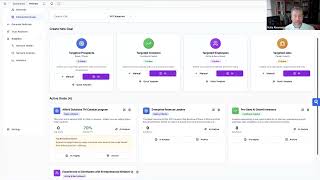
Nate Keefman demos Deep Trust AI, a platform that analyzes your email, calendar, and CRM to map your professional network, score relationships with a "trust score," and surface referral opportunities. It surfaces who can introduce you to your target accounts and tracks engagement trends across your network.
Foreign.
Hi, my name is Gerhard Schwatman, and welcome to our last session of the day with Nate Keefman. He is the founder and CEO of my Deep Trust, AI Nathan. Tell us why deep trust is more necessary than ever before in this new century.
Well, thanks for having me today, Gerhard, and welcome everybody. And I'm glad to have this opportunity to share. Very excited for what we're building for the market. I've spent the last 15 years in the growth and marketing space driving over 100,000 executive to executive meetings for some of the biggest companies in the world and then some of the smallest companies in the world looking to access those big companies. And what we learned is that over 100,000 meetings scheduled over the last 15 years, that only 3% of those organizations were able to close that business because of a gap that we identified just a couple years ago. In that gap was trust taking the same amount of lead flow or even a fraction of it. Typically, our clients would end up closing more deals through a small fraction of the same number of leads, even though we gave them exactly who they wanted to talk with on purpose for the specific reason that they were looking to talk about. And everybody acknowledged that. And so we went down a rabbit hole and we started to do a lot of research over the last year to figure out what was a better solution for the market. You see, we're in a. In a complex time right now in our market space, and probably many of you know it, and especially in the B2B world where the growth engine is really broken down. Many of you know, cold email is not what it once was. Content marketing isn't working. It doesn't typically work with executives anyhow. But it's becoming less and less trustworthy with the, you know, the influx of all this AI content being created. Just who do we trust and how do we trust? It is kind of like on a. On a steep decline. Cold calling also was never really something that was really great for engaging executives. And there's spaces for all that. I'm not saying they don't work in some cases, but when you're trying to engage the executive world like the leaders of leaders, these aren't the things that are working anymore. And there's really nothing that does other than shaking hands and going to events face to face. So when you look at that, what are sales teams reverting to? They're reverting to that unpredictable networking opportunity, getting into an event and without scale, and the, you know, kind of the old school of shaking hands and doing it the Old school way, which is awesome. That's great. But that's not how organizations are able to grow at scale. So there's this big gap sitting right here in the B2B market right now, especially when it comes to engaging the executive market that we see. And we think that all professionals could benefit from what we're building right now. And that's what I'm going to get into in just a minute. But one thing to just note is that with or without all those tools, generally professionals are network blind, right? They're blind to the relationships in their network that could unlock millions of dollars of growth. And what we're seeing is because of that. And part of that is because we don't manage our relationships well. You have five to 10 people in your network. You probably manage really, really well. The next, like 20 or 10 to 50, you're maybe frequently or infrequently engaging, but after that 50, there's another couple hundred that are really worthwhile to you. And if you nurture those relationships, it would be amazing. But you don't have a way to systematically manage that with deep trust and deep authenticity. And that is the currency of your business. And not only them, not only that intimate market, but their relationships are the thing that will unlock your millions and more for your organizations or for you as an individual professional. So the reason that we exist is because this B2B market is broken, in our opinion, because automation has made communication faster, but not more meaningful. And because the biggest problem is that we're losing connection faster than we build it. Right? These are really big issues. And because of that, trust is disappearing from us because of the digital economy, because there's more and more and more. How many connections you actually know on LinkedIn? Very few of you can say all of them, right? And so how do we take all the noise and find the exclusivity within that and then make that our most meaningful effort? See, we're not short on contacts. We all have contacts. I connect a million people all over the place. I have 30,000 contacts on LinkedIn. Right? We're short on trusted relationships, or rather, we might not be short on the trusted relationships as much as we are the ability to manage those trusted relationships and be authentically engaged with those people that we care the most about. So my question to you all is, have you ever lost a great connection? A question I just asked a group of investors the other day, which was really powerful, is, what is your network worth to you? You know, and I'd love for anybody to, I Don't really have access here, but maybe you can share with me if you can put in the chat. Guys, anyone listening, what is your network worth to you? Your professional and personal network? Can you put a dollar figure on it? Think about that. Then I'm just going to ask one more question. If anybody can put that in. You know, the answers that I typically hear at the event I was just at was I didn't get a number from anybody. They all said it's priceless. Right? Think about that. My network, my professional network, my personal network is priceless. So the question to you actually say.
That your network equals your net worth?
Absolutely. It's a very common phrase to think about it that way. But we know that the value of our network is not usually something you would trade for a price because it's gotten you all the relationships. It's gotten you where you've gotten to in this world. It is your future opportunity as well. But the question that I always like to ask is how well do you. Do you manage that network like it's priceless? If it was worth 10 million, do you manage it like it's $10 million? It's 100 million, it's a billion dollars of value to you. Like, do you manage it that way? Right. And we can all probably say no. I can say no as well, right? Because I don't treat the 200th person in my network like I treat the first, fourth or fifth person in my network. I just don't have the time in the day, nor do you. Right. So we need something that's more powerful, something that's going to help us manage that. Every lost connection is a lost opportunity as it shares here. And the problem isn't who we know. It's staying connected. Right? So if you'd stay in touch consistently and authentically with all the people that mattered most in your life or could give you the greatest access or give you the greatest influence or reach, what would that be worth to you? I have a couple stories, right. Just this last week, I got introduced through Gerhard to an individual company that is worth 100,000 users on our platform. Oh, my gosh. That's one relationship. What's that worth? I mean, if they were to sign up on the whole platform with service fees and everything, $100 million a year, that one relationship. But we didn't stop there. A new. A new board member that just joined my organization walking us into Accenture, another one walking us into Northwestern Mutual. Like, I don't know that we'll land those but we're coming in at the C suite. I know that we have the access and the relationships because they're that powerful. Right? So how, how do you manage, like consistently and authentically your network and what can that give you access to? Not only access, trusted access to. Right. That's the big. That's the powerful question. So we're building Deep Trust AI as the first world trust enablement platform. What is that mean? Right, It's a. It's a hub. It's a central command center for trust for you. It syncs up your email, your calendar, your CRM, your social, your networks, AI recording devices, zoom info, all your anything you want. It pulls into the platform as a hub. Right? And it enables you to monitor, manage, engage and enhance trust across your most valuable relationships as your central hub. It uses a tool called a trust transfer coefficient. It's a concept that we designed. It's just how we set up 100,000 meetings in the past. It's our IP on how do you manage a relationship Referral. Because, see, not all referrals are created equal. Right. A salesperson referring up to a C suite sometimes doesn't transfer trust, but sometimes it can transfer peer to peer. So how do you know who in your network holds the highest TTC score and how can you increase your own? That's all part of the platform. Right? So we want you to have that. Now, I'm going to get into the platform and show you a little bit of a demo today. But before I do that, I would love everybody to have the opportunity to jump over to our website, which is mydeeptrust AI. And if you can, on the platform. We are not launched yet. We're planning to go live on hopefully before January 1st for our betas and the early access team. But the live Launch looks like January 1st. But if you go to the get early access, we'd love to have you be one of our early registrants and get live access when we go live as a beta. And that's accessible at our MyDeeptrust AI website. Read through the website if you want. It's really informative and quite accurate. I would love to be able to share that with you. So now what I'm going to do is I'm going to just stop my share for just a second while I set up my demo. Then I'm going to get the demo live for everybody. Okay, so, excellent. Let me do that real fast. Get on the right page. That's always helpful. Okay.
No pressure.
No, we got it. We're good.
Got it.
All right, so excellent. So what we have here, let me just switch this so I can see everything perfect. And sometimes got to move my, my photo around here. All right, so DeepTrustAI is a desktop application. It has a dashboard. This will get updated. It's not quite accurate at the moment. And the main thing is that when you get in, there's a user experience you'll go through. I'm skipping the user experience so we can actually just kind of look at each of the main sections of the platform. And in the user experience, you're going to start with your profile. In the onboarding piece, you just have to do this first page. It's pretty simple, but there's a psychology that sits behind this, Right? So let me ask you all a question. What would you want to fill out on a profile if you knew that the only people that could see it was your most trusted, most valuable network? Out of all your thousands of people you're connected to, you pick 200 people to throw into a network, right? Exclusive networks, various networks, maybe called your, like right here, called your, your inner Circle, your five to 20 closest friends, your executive team, personal mentors, clients, past clients, family, et cetera, right? You can customize these to whatever you want. You can add a new network and you can name it whatever you'd like. This would be like selling power right here, right? And then I could create my selling power network, right? This would just be for Gerhard's people and then that's in here. And then anybody that I dropped into that would go in there and then I'm starting to manage them within that network. Now what happens here is this network is really important. I'm going to get back to this in just a second. But why would you fill out all these crazy details like your core values and your communication style and your decision making style and your risk tolerance and your motivations and your long term vision and aspirations. Why would you add proof like case studies and links and metrics and testimonials and why would you want to identify specific opportunities of what you're looking for? Because this is only relevant for your specific, hyper focused, best of the best friends, colleagues, associates that you're looking to do business with. And they can't even see all of this unless you let them. You see in the privacy side of this, you can turn on all of these cards and you can turn them on or off and make it visible to the public, just your network. Or you can make it completely private, right? And regardless of what you select the network or private. These are the resources the system uses to match people together, to get you the highest quality referrals, and identify people in your personal network that are also ideal for working together on certain areas. So the overview, the professional information, the cards that you can create for your, for each, each organization you might work with, you can import from LinkedIn. There's a lot you can do in here, in the profile side. We're very excited about that. But this, the reason that it's so robust is because we want you to be fully trusting of your personal network. And we know that. And by the way, you know, as a company, you can delete all of this information when you leave. It doesn't stay with us. All right, so here's where we're at on everything else. So when you start to set up your system, you're going to import all of your contacts. This is just a placeholder for, for me, this would be a few, 21,000 people would be dumped into this system. And it's just a placeholder for our network analyzer to run against how frequent, how recent and how consistent have you interacted with your market from your email, from your calendar, from text, from WhatsApp, whatever imports you've brought into the system, even your CRMs, whatever else is attached to. And the system then analyzes those numbers. And it will suggest for us a recommended group of people that we've been highly engaged with to add to a network. And that network would be one of the networks from the other page. Right. Once we've added somebody to a network, then they get thrown into that. This just gets tagged here. But as soon as somebody goes into a network, you're going to want to set these up. Take your time on this one because it's really powerful. But once somebody gets invited into the system now, they're going to get. Get an email, right? And the email is going to say something like this would be, hey, Gerhard, Nate Keeman would like to invite you to his professional network on Deep Trust AI. He'd love to stay in touch with you more authentically and more consistently. The system enables him to do that. And additionally, he'd like to share his professional network with you if you'd like. Here's his mobile phone number to text to verify that this is legit and it's from him personally. And also here's a link to your free profile on DeepTrust AI. And then you're limited to 50 members in this area. If you want to use the free version of it. That's fine. But to upgrade then it's going to cost a little bit on your honor based membership fee, right? And so then they start to get in and now your job is to get your network to share with you and like really be authentic and engaged and you know, you might have 100 people in here or a couple hundred people in here. It's not going to let you do thousands, right? You can upgrade and have for some extra fees and you can get up to about a thousand members. The point of this is not to master all of your connections, it's just the relationships that matter most to you. They're going to help you grow your business and your professional career in the most powerful way. Right. Once they're in here now every single individual in here has, goes into this network enhancer and the network enhancer is going to enhance either all their first degree and or second degree contacts. I'm not going to run that, it'll take too much time. But it's going to run those second degree contacts and it's going to monitor the web, monitor all of our integrations, all of our applications we've integrated into the system and it's going to look for their validated information and then if you invite them in, they're going to fill out their profile and that become a validated profile. So there's AI, there's personal validation, there's AI and then there's integrations that we're optimizing every single record for and we're looking to keep them optimized and, and the most up to date based on the priority that we find that research. The system then is monitoring the web for activity that's going on and anything that we've integrated with and the public web. So if there's anything public on LinkedIn or Facebook or any other social platform, or AP or a news announcement or something like that, it's going to capture that. And then you're going to have a central repository for every single individual with all their demographics, all their psychographics, any notes and activity, and this page will have their email integrated, any kind of communication from your CRM, any kind of text integrations, if we've got text integrated, WhatsApp and so on as a central repository for where your communications are with each individual in your network. So if you're going to have a meeting, you can jump in there, see what's been going on, see when your last engagement was and you can add some notes there or just trust that whatever system you're using Will sync that information into the platform. So you have a central point of truth for everybody that you care most about in your world. So once we're done with that setting up the networks, now we have our connection goals. These are basically like your ideal client profile for the target market, Ideal investors or investments. If you're looking to hire anybody or you're looking to get a job. This platform is really powerful. Now, I have a couple already built down here, but why don't we just go through how easy this is. So let's say I want to create a new target market. Gerhard, who would be a good target market for you? Are you on? All right, well then I'll just keep going. So let's say we have. We're going to target. Let's go small business. I'm looking for small business owners with revenue between 1 to 10 million. Ideally the CEO, founder, owner in the US and in home services industries. Okay, I'm just going to hit my analyze with AI. It's going to go ahead and then kind of make that a little bit more robust. And now what happens is that it gives me a description, it gives me a name, gives me some AI insights, it fills in my demographics. Home services, construction, renovation, HVC Co. Size 10 to 100 geography United States gives me a handful of titles here and I added to those, it's going to give me some psychographics of pain points, motivations, core values, buying triggers. And then it's going to give me a scoring capacity as well. So once I save that icp, that's great. Now I have that right down here under small business owners home services industry. Right. Then I'm going to be able to go generate some referrals. So now I've synced up my contacts, I've assigned my networks, I've set up my goals and now I can go select my home businesses services. Right. This tool is not. I can't go live here because I don't have the all the data imported. But I can search any of the networks that I wanted, right. And I can select them all or I can just undo a couple of them families. Not appropriate. That's not appropriate. Now what this is going to do, it's going to run a first degree, second degree search. It's going to run both. I'm going to just click that. It's going to set up a kind of a cute example. And then what happens is there'll be some actual results would pop up down here. So you'd have your first degree network would pop up and your second degree would be a request for a referral. And so then you'll see that if I click that then I can text them, I can email them and I can call them. Right. And so we're working. I have a huge amount of copywriting strategy that's going to be added to the back end of this. Not quite in yet but these will all be recommended scripts or texts or emails. You can click on send and it will pop up on your desktop or pop up on your phone. We want that to be intimately from you, not from a pass through system like ours. So that you can make sure that you're getting engaged and you're interacting. This system's not meant to capture it. It's meant to be a trigger point for engagement. Right. So you can do that. And then if it's just your first degree network it would go directly to them and then it's going to help you manage these scores. So you have a match score, a trust score and a TTC score. I'll explain those in just a minute. Does that make sense? If there's any questions right now or along the way, please ask. I'm happy to answer them. And Gerhardt, you just want to set them up for questions. That'd be great. Once we've done that we want to jump in and say okay, what's the main two systems of this? It's generating referrals in your trust assistant. So your trust assistant is a tool that's basically your trust coach. It's sitting there ready to help guide you on how do I take Jordan here, who's a good friend of mine from a three to a ten I have a gap of a five. But I've given him a P1 priority which means I have three priorities. Right. And each one of the priorities is weekly, monthly or quarterly engagement. We're going to expand that to 5 and make it bimonthly and then add in every other every six months as well. And then you'll see in here that we have the ability to edit our goal. So we want how long and what's the trust goal score that we want to get to? And then the system is going to build a trust development plan. You'll see a trust development strategy here for each individual. And what's the cadence? Is it 30 days? Cultural moats, hybrid meaning that I'd like to have in person and virtual engagement. You know, what are his focus levers right now? We want to do it through intimacy and credibility. Real, authentic. Right. And then what are the what's the plan? Right now we need awareness and over this timeline, it's a big algorithm behind all this on why this works and then it's going to recommend some activity which is this is all still getting integrated into the system. This is just placeholders. But then you can take action on any of these and it'll pop up and it'll allow me to just send an engagement to him through text, email or whatever it might be. So again, email, text, call WhatsApp and then it'll generate some copy based on our future strategies. But this is just a placeholder for right now. Right. So that's how this works. So that's pretty cool, right? So it allows us to manage who's our ready today people and then we can look at results, we have AI insights that we can run an analysis against. It's not going to work at the moment. And we have our trust development plans, we have strategy milestones and so on. Sorry, it's a little off on my font. But then we have our strategic approach. Kind of get an idea of how this plays and then what's the channel mix for engagement, what are our actions, if any actions were in there and then metrics on success. Right. So all of that's in there just to as a resource for everybody. And then you can regenerate this. I'll fix this font and formatting, it's a little, the UI is a little messed up. Then we have our analytics. Once we have that, we have our network health. Right. How healthy is my network overall? And then I can generate insights against that to give me some ideas of what I need to do to improve it. I have my trust score, my TTC score. So trust score is how engaged and how frequent and how recent are we interacting? Right. And then how authentic are we interacting? Like in what? In various channels. All that plays into this trust score. Also we're looking for in person events that increases the score significantly, events that we went to together, that sort of thing also helps increase the score and that's managed through the email communications, calendar communications, text, text communications. The TTC score is really built on what is their authority and influence that they carry as an individual. I have a board of directors, a board of advisors member who's a executive of a billion dollar tech firm. Anytime she's given me one of her seven referrals, they respond in an hour, I'm doing something with all of them. They're very inclined to do work together. So the higher the TTC score, the higher the chances are of you doing business with them. Right? I'm not interacting with anybody right now, so my engagement rate is zero. But this will show you how frequently you're interacting with your, with your network and then your network growth. How like over time. That's what this is assessing for you. Just to give you some transparency. You have engagement trends, top referrers will be in there and then opportunities that you can take action on will show up as well. The network analysis I think is actually really cool. Like this is just a breakdown of who is your deepest trust network. What's like the demographic breakdown of them generally by titles, by company size, by locations and industries. I thought that was just a fun little thing for us to have access to so we understand our market mix and our deepest trust network. And then we have our analysis. Right. And our analysis allows us to us to just dive deeper into the overall performance of our network. How things are looking, what's the performance and trends of our network, our trust score trends and then who's our top performers in terms of engagement, potential referral value, and then what's the engagement itself?
More from Gerhard



What Selling Looks Like When Your AI Agents Have the Context Your Sellers Do

Better Conversations, Smarter Support: Wearable AI in Business






When Scarcity-Built Systems Meet Abundance - The Judgment Gap in AI-Powered Sales Leadership
