Maximizing Value: 4 Negotiation Strategies
Jeff Cochran walks through a three-step negotiation process: Prepare, Probe, Propose. He plays the Dollar Bill Game with two participants to show why people fail at deals, then offers fixes: drop your ego, find what you both want, make small moves, and use objective standards like a coin flip when you're stuck.
Chapters
Foreign.
To talk about. My name is Jeff Cochran. I'm with the Shapiro Negotiations Institute. I've been a partner here now for about eight years. I've been employed here for at least 25. And I've been very fortunate to travel the world speaking to all types of groups about negotiations and influencing. We're an organization, we are started by a guy named Ron Shapiro, my mentor when it comes to negotiating and the author of our book, the Power of Nice. The Power of Nice came about because when people negotiate, you know, we didn't think the Power of Being a Jerk would sell many books, so we called it the Power of Nice. Fit in perfectly with me because I have to be honest, I'm very nice. I was just born that way, but I never always had a lot of the power. You know, being nice isn't enough. You have to empower yourself by being nice. And that's some of what we're going to talk about today. I know we have in the audience, we have people from all over, CEOs, people from sales enablement, people directly selling. And I want to give you some skills that you can use to take away for hitting your metrics and helping your team perform better and leave less on the table when it comes to negotiations. I always like to start off with a couple of quotations that I have here. Here's a little bit of my background. You can read about that or, you know, take a, take a quick, take a, take a quick screenshot if you need to. But anyhow, let's see. First thing I like to start off with was John F. Kennedy. Let us never negotiate out of fear, but let us never fear to negotiate. Now let me ask you, why would anybody have fear in a negotiation? Why might you have fear in a negotiation? Well, there's a couple things that pop up. The first one, folks might be thinking, fear of losing. You know, if you don't develop a new market, you're not going to hit your goals. If you don't extract as much as you can from each of the accounts that you're working with, you won't meet your goals. The second one, maybe you have a fear of a fractured relationship. Maybe you hit your goals, but in doing so, you ruin the relationship. You know, in a strange twist, some of you have a fear of winning. We all hear about winners, remorse. We might win the negotiation, but lose the relationship. We might win the negotiation only to find out later that maybe we've left something on the table. And that's why I always like to follow this quotation up with a quotation by Madame Curie. Madam Curie said, nothing in life is to be feared. It is only to be understood. And the more we understand some of the nuts and bolts of the negotiation, the more effective will be. Now, when it comes to negotiation, we have a process that we like to use, or for some of my Canadian friends up north, we've customized it. We call it a process.
Specifically for you. So it could go either way. But we talk about that process or process, and it is the three Ps, a straightforward system. We talk about preparation, preparing yourself and building confidence. We talk about probing, asking the right questions. And we talk about proposing as a logical culmination of those first two. Now, I'd like to go off topic for just a moment and have you type into your chat a simple question. I'd like to ask you this question and I'd like to find out. What do you do when you catch on fire?
Should you do when you catch on fire? If you could relay some of those answers to me, it may seem like a non sequitur, but there is a reason I've asked.
What do you do when you catch on fire?
Stop, drop and roll. There you go. How many people had stop, drop and roll? Listen, if you're like most people, that was the immediate answer that came to your lips. Isn't that interesting? I mean, they really drilled that into us as children, didn't they? Stop, drop and roll. In fact, they drilled it in so much, I kind of expected more fires in my life. Yeah, it seems interesting that they. They don't train us for any other catastrophes. They don't tell us to swim or, or hold your breath if there's a flood. But they were very specific about stop, drop and roll. And every kid gets taught that lesson, stop, drop and roll. Well, I would like to make. Prepare prob. Propose the stop, Dr. Drop and roll of negotiations. What do we do when it's time to negotiate? First, you get out your pencil and start to prepare. Second, you start to ask some questions and do some probing. And then third, you make a proposal that's logical for both sides. Now, we're not going to spend a lot of time on that. In fact, I want to get immediately, as quickly as we can to a little exercise that I like to run. This exercise is called the Dollar Bill Game. And for this game, I've contacted folks ahead of time and found two of the most spectacular contestants. So hopefully you can see Shivon Thatcher and Richard Brock. She Vaughn calls to us all the way she's been living in the Bay Area for the last 13 years. She. She's originally from Ottawa, Canada, and therefore uses a process.
And we're happy to have her. She loves dogs and golf and especially dogs who can golf. Shon Thatcher, thank you for being here. Our other contestant, Richard Brock. Richard comes to us all the way from Scottdale, Arizona. However, he was born and raised in Mobile, Alabama. He also loves dogs and grandkids. So I'd like you to give a warm welcome to our two contestants on the Dollar Bill Game, Siobhan and Richard.
All right, now, before we start the actual contest, the two of these individuals are going to negotiate with each other. I want you in the audience just to size them up. Who do you think is more likely to emerge the winner? Enter it into the chat. If you think it might be Shivon, please enter an S. If you think it might be Richard, please enter an R. We'll just take a quick little informal poll and I'll rely on my handlers to feed me the results. We have one R. S, R. Oh, I think we're gonna have a little back and forth here. Yeah. Well, you know, it doesn't surprise me. Whatever your thoughts may be, we're gonna settle it right here. Because you know what? I don't know what you did during the global pandemic, but I spent most of my time thinking of the greatest game show you could ever present on Zoom. And I came up with the Dollar Bill game. And if you look at the Dollar Bill game, you'll know that in the Dollar Bill Game, we make it rain. Yeah, that's right. Now, we've got a couple of great things for a contest. We've got a couple of great contestants. We've got a worldwide audience. We've got a charismatic host. What else do you need for a good game show, Siobhan? Money. You're exactly right. And that's why I have with me 10 $1 bills. It's hard to contain yourselves. And the two of you are going to negotiate with each other for a division of these ten $1 bills. Now, there are a few rules that I'll tell you right up front. The first of the rules, you may not split the money $5 and $5. And believe me, I am going to venmo to you your winnings as soon as we finish up here. So these are props, but you will get the real deal electronically, but you may not split the money $5 and $5. That would just be a little bit too easy. How about this second Rule. You may not split the money by making a side deal. What I mean by that, you can't say, hey, you know what, Shivon? I know that I'm going to be out in San Jose, and I'll tell you what. I'll take two, you take eight, but you can buy me a CO when I'm out there. No. No side deals. The deal has to be fulfilled right here, right now, in the time allotted. And speaking of that.
You will have the next 30 seconds to come up with an agreement. You will negotiate. The two of you are going to negotiate over a division of these ten dollar one bills. All right, so let's see who is the better negotiator. Ready? You may begin negotiating with each other.
Hey, Richard, so when you see those $10 bills, what do you think about?
I think I might use them. And I think it would be better to use you or me to better improve the world.
And why do you believe it would be you?
Well, I don't know. I need to know more about what your goals are. But I know what my goals are, and so I know that I would make sure they were put to good use to make the world a better place.
Well, today being giving Tuesday, I would take the $10 and submit it to a charity. There you go. She's going to take 10 and give you zero. How do you feel about that, Richard?
That was pretty quick. But she didn't. There's a. She took the idea of giving it to a charity, and I would try to do something had more of an impact. And that's a nice idea.
So how about for your charity? Maybe you want to give it to your charity, Richard?
Exactly. Yeah.
How many do you think you ought to get then?
Well, I guess I'd take.
I guess I'd take. I take it 3, 3 and 2. 3, 3 and 4.
3, 3 and 4. What do you mean by that, Richard?
I would split it to three different charities. $3, $3 and $4.
Yeah, but I mean, how much of Siobhan's money do you want? She wants all 10. Or do you want all 10?
Might as well, because I know that I'm not going to keep any of it, and she had neither.
Yeah. Yeah.
The question is, who's going to put it to a better, higher use?
Holy mackerel, look at your time. Yeah, unfortunately, time has expired. You've used your 30 seconds. Boy, I really appreciate the fact that you were going to give this to charity, so, you know, I'm going to give it to my favorite charity Right now? Yeah. Congratulations. Thank you for the donation, Jeff. You're welcome. However, the two of you will not walk away empty handed. I have for each of you a copy of my book, Persuade the Four Step Process for Influencing People and Decisions. Well, there you go. That's the kind of. That's the kind of program we run. Everybody walks away with something. Thank you. What happened in that exercise though, shivon? He said 10 and 1. Why didn't you go for that, Shivon?
Because I think that the money would be better spent on something that both of us can get behind.
All right, all right. Now she. Richard, she said 10 and she was going to give it to charity. Who cares what charity? Why didn't you let her have the money?
Well, the reason I split the My3 charities because you never know which one is the most meaningful and that changes from time to time. So, I mean, in today's world, today after the hurricane damage and stuff like that, you got those kind of people, people with disabilities, health issues, all kinds of things. So I'd like to split it because I don't know where one's going to make the biggest difference and impacting people's lives.
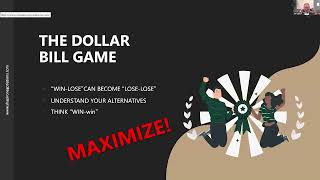
That's right. That's right. And look, I admire both of yours altruism, you know, you got to respect that. Now, in terms of negotiation, you both got zero. Let's take a look at that for a minute. Because you know who's going home tonight hungry? Any of your charities. Because you didn't keep the money. I did. So let's take a look at this deal and see why that. Look, don't feel bad if you didn't get the money. Don't feel bad. 90% of the time, I end up keeping all the money. And I got to be honest with you, that's one of the reasons I keep playing the game. But there are a couple things I want you to take away from. Why didn't you get a deal in this exercise? Well, the first thing on here, win lose very quickly becomes lose lose. Look, we had two people who wanted to give the money to charity, but they both wanted to be in control of who gave it. Interesting. It was going to end up with charity either way. But I want to control which charities it goes to, not necessarily you. So we look at this exercise sort of as a win lose. Yeah, I win, you lose. I get to decide. You don't get to decide. Does that ever happen in real life? Sure, it happens all the time. How about this? Sometimes the negotiation you're facing is just trying to get somebody to enter the negotiation with you. Some people try to refuse to negotiate, and it ends up quickly becoming a lose lose outcome. The second one, understand the alternatives. Who's the real enemy in this exercise? Yeah, it wasn't them, it was me. That's right. I'm the one making up all the crazy rules. You only have 30 seconds. You can't do five and five. Why not? That seems pretty reasonable. Well, those are the rules. You ever noticed sometimes you're negotiating with the wrong person? Instead of negotiating with each other, perhaps you could have negotiated with me. Hey, Jeff, I got an idea. You brought $10. Why don't you give 10 to Siobhan and come up with another 10 and give it to me? Well, that's not in the rules. Yeah, but you know what? That's getting it done. Now, why don't you think of these most of the times? Well, I'd like to think of some win win outcomes. Most people don't. The goal would be to maximize your return. Maximize your return. Even in a little episode like this, there's opportunities to maximize your takeaway without damaging the relationship. Well, the first one I always like to. Oh, here's a question I have. How many of you out in the audience would have said, you know what, you take six, I'll take four, and you'd be satisfied just to get the deal done? How many out there would have done that? And if you're one of the ones saying, yes, Jeff, that's what I would have done. Well, let me just be honest. That's why I didn't pick you to be my partners today. Yeah.
Most people say, look, I think four would be great. Is there anything wrong with four? Absolutely not. Four is a great result.
But did you maximize, did you leave some money on the table? Well, Jeff, four is better than nothing. Well, yes, four is better than nothing, but it's not as good as getting your best deal possible. So what are some of the things they could have done? Look for points of agreement. Well, they were kind of going there, agreeing that they were both going to give it to charity. I thought that was very admirable. What does that look like in the real world, though? Well, looking for points of agreement might be as simple as something as, listen, you know what, you need our product or service, and we have it and want you to have it. We want to sell it to you. You know, look for those points of agreement. Can we both agree, you know, that the, that the, that the market looks like it's going up and we Both want to be a part of that. Can we both agree that if we don't get this item out before the Christmas season, we're both going to lose out? What are some of those points of agreement behind that? We say take the ego out of the negotiation. Was there. Was there any ego involved in this negotiation? Well, sure there was. In fact, I primed both of these contestants. You didn't see it. I did that off camera. But I went to both of them and I said, hey, would you like to be a part of this exercise? Yeah, sure, I'll help you out. Are you competitive by nature? Are you a winner? Are you somebody who's likely to give in easy just because it's a friendly opponent? You know, so you look at this, and how would you have taken the ego out of this negotiation? Well, there's a few things you could have done. You know, you could have talked your way out, but maybe that was going to take too long and you only had 30 seconds.
What about a simple child's game? Maybe you could do a little bit of rock, paper, scissors to see who should walk away with the larger amount. Rock, paper, scissors. Now, why does rock, paper, scissors work? Because it removes that ego. You ever be. You ever involved in a negotiation where both sides just seem to. Neither one wants to give in because both sides need to win? So we look at that, it becomes all about the ego. One of the ways to get a negotiation done is to make sure you check your ego. It's not about your ego. It's about getting the deal done. And on the other side, if you're dealing with somebody with a tremendous ego, maybe we look at that and say, you know what? They've got enough ego for everybody. Maybe we need to play to that ego. You know, be very aware of the emotion behind the negotiation.
The next one we talk about being creative. 499 and 501.
How could you. How could you get the deal done? 499 and 501. Why does that work? Well, I gotta be honest. 499 and 501. A lot of people try to settle the deal.
Using dollars because that's what they're presented with. But what about if we moved in smaller increments? Would that be likely to get the deal done? Well, I think in this case it would. Remember those people who said, hey, you know What? I'd take $4. $4 is better than zero. Well, yeah, it is. But how about this? 499 and 501. 499 is essentially 25% higher return than the $4. And it accomplishes all the same goals. What are some of the goals? Well, I don't want to ruin the relationship. I'm willing to take less, but I still want to maximize my return about 499 and 501. Now, why does that work? Well, one of the reasons that works is because when you move in small increments, you send a very strong signal to the other side. You send a very strong signal of acceptance. Let me give you an example. Let's say you're driving down the road and you see a guy's car for sale on the front lawn, and the individual wrote down the price. They said, $10,000 for this, for this car? Well, what if you stopped in and you offered eight because you're a negotiator and they came back and said, no, I tell you what, I couldn't take less than 9,500. Well, you might come back and say, I won't give you more. I won't take, I won't give you more than 8, 500. How about they come back and say, no, no. How about 92? You say, hey, how about 88? They say 91, you say 89. 9,000. Deal. Now, you notice as the back and forth goes on.
The closer, the smaller increments you move, the closer you get to the point of agreement. Can you send a signal to the other side, a signal of acceptance by moving in smaller increments? You know, can we move in smaller increments to get greater agreement and buy in?
I think in many cases we have the opportunity to move in small increments and we give that up because we're presented a challenge, for instance, in this case, in dollars. Well, what else could we have done? Well, you not only could move in dollars, you could have moved in, you know, in pennies. And then finally, how else could they have split the money? I saw a gentleman one time, we were doing this live, and I and I invited a couple of individuals up to the front so that I could run the dollar bill game with them. I ran it just like I ran it here, virtually. I had the two contestants, one on my left, one on my right, and I launched into my spiel and I said, the two of you are going to negotiate for a division of these ten $1 bills. You may not split it 5 and 5, you may not split it $2 and $8, but I'll buy you a drink later and you must split the money right here, right now, in the next 30 seconds. Or I end up keeping it all. Let's see who's the better negotiator. Begin. Well, the gentleman in that little pair immediately reached into his pocket and pulled out a dollar bill. He slapped it on top of. He said, you know What? Now there's 11. I'll take six, you take five. Well, I counted out the money and gave it to him and let him go. Sit down. I got to be honest, I picked that particular gentleman because he did not look that smart. But he was smart enough to take my money. So I think I was the one that was looking kind of stupid. In that case, yeah, can you increase the pie? Rather than negotiate over a fixed sum, can we go back and increase the pie for both sides? If your product or service allows your customers to make more money, aren't you entitled to a share of that money? I think in many cases you are, but we don't always think of it that way. All right, so you have four solutions to the dollar bill game. Look for points of agreement, $4, $4, and $2. Those are the points of agreement. $4, $4, and two dollars. What do you do for the last two dollars? How do you have a fair distribution of that? You flip a coin. Now, in real life, how would you feel if your salespeople came to you and said, you know what? You know how we got to that pricing? Yeah, I flipped him for it. We did rock, paper, scissors for it. No, that's not what I'm talking about. But if you look at the flip of a coin as an objective standard, something outside of the deal. Can you tie your price increase to consumer price index? Can you tie your labor cost to bls.gov the Bureau of Labor statistics? Can you point to an industry magazine that has indicated what the trends are and where they're going? Look for points of agreement and then take the ego out. 499 and 501. Is that really possible? Think about all of your deals where you've given a discount of 10%. Why is it 10? Why not 9? Why not 8 and a half? I had a very large Fortune 50 customer and I was working with them and they were working with one of their customers and they were looking for a five year deal. The customer refused to sign a five year deal after seeing this course. They went to the customer and I'm told maybe it was tongue in cheek, but I was told that they went to the customer and they said, you can't do five years. How about 59 months? And you know the surprising thing the customer came back and said deal because the customer did not have authority to sign a five year deal, but a 59 month deal, well done that they could sign. Again, not sure that it's 100% accurate, but that's the way it was told to me. Think about moving in smaller increments. Finally increase the pie. If you can get your service or product to increase the amount that the other side's going to get, why would there be dispute? We both want that to happen.
Well, that, that's a quick 30 minutes for me and I hope it was just as quick for you. But I also hope that you're walking away with a few ideas for your next sales interaction. I'm hoping you're walking away with a few ideas you can share with your salespeople so that maybe they leave a little bit less money on the table even when they're getting a good deal. All right, thank you very much for being here. We look at this where this is a classic win, win. In order to get what you want, help them get what they want. And the best way to do that is to find out what it is that they want and get it to them.
More from Gerhard



What Selling Looks Like When Your AI Agents Have the Context Your Sellers Do

Better Conversations, Smarter Support: Wearable AI in Business






When Scarcity-Built Systems Meet Abundance - The Judgment Gap in AI-Powered Sales Leadership
