New Research: Essential Selling Skills for a Buyer-Driven Market
Brooks Group researchers tested 208 B2B sellers before and 9-12 months after sales training. Sellers initially skipped discovery and closing to focus on product pitches. Post-training, probing skills jumped 24% and closing improved 36%. Reinforcement mattered most: combined digital coaching and small-group sessions boosted sales acumen 14% versus 6% without any follow-up.
Questions this video answers
208 sellers.
48 questions.
9 to 12 months post training.
Scores improved just over 20% on average across the sales process.
Probe improved ~24%; Tie-it-up improved ~36% (both rounded percentages).
Chapters
Thank you. Good morning, everyone. Gerhard. Good morning, Stephanie. Good morning. So exciting to hear all of these things happening, particularly with students studying sales and coming into this exciting, dynamic, challenging industry that we're all a part of right now. It is true we have some research that we want to share that is is a big part of what we do here at the Brooks Group. And I will let my colleague who runs our sales performance Research center, Michelle, share a lot more about its background and its details in just a second. But let me tee us off, get us started thinking about the meta topic, the overall narrative that we are looking to address today. And really there's a data point that Michelle shared with me the other day that's going to be part of some research we'll be publishing in early in the new year. But has had me thinking quite a bit about the environment that we're in right now and what this research ultimately shares. Not to give too much of a punchline away before we publish something, but it shows a lot of how organizations out there, B2B consuming organizations, buyers in the B2B space today are thinking about their performance vis a vis their expectations. And what's interesting is you'll always have organizations that will perform better or perform worse than an average in a given industry or across all industries. But what's particularly striking to me right now when we look at the market is how many organizations are either performing significantly better and there are many that are, or significantly worse than they expected. And this is multiple years running. So what happens when an organization performs a lot better than they thought they were going to perform or a lot worse than they thought they were going to perform? Well, I think it creates twin elements in the processes and the mindset of those organizations. And those elements are uncertainty, uncertainty about actions that I need to take to drive outcomes in my business and indecision. And that's a process issue, right? Can we get all of the different stakeholders, all of the individuals in the organization together thinking the same, believing the same, such that we can make decisions to move forward? So we see a lot of organizations out there because performance in market is different than expectations, struggling with uncertainty and indecision. So what do we do as sales organizations? Trying to penetrate, trying to help, trying to drive activity in these organizations? We need to create people. And I want to go back very quickly to what Stephanie just said a moment ago of selling is still and will continue to be about people. But the question is, do we have people with the right capability, acumen, confidence, knowledge to go in and support in environments of heavy uncertainty and indecision. And that's what our research is about. And we have a very unique and we think exciting way of measuring that among salespeople, both in its natural state as well as the progress that can be made in acumen, confidence, knowledge among salespeople over time. Anyway, that's my introduction. That's what we want to talk about. We've brought some data, we're going to share that over the next 20 minutes or so and we're hoping to have about five minutes left at the end of this presentation so we can take a few questions from the audience as well as offer you some opportunities to dive more deeply into some of what we're talking about. Enough from me. I want to turn it over to Michelle, who is our research expert, to give us a little bit of a background and share with us some of the data.
Thanks Spence. Really excited, as you said, to share some of this data with you and give you all some key takeaways as you start thinking about your plans even for 2025. Really quickly Spence mentioned our Sales Performance Research center. Just to give you a quick down and dirty description of what it is that we do in our research center. So we are a department within the Brooks Group with a threefold mission. Number one, obviously we conduct research and we research topics related to top performing sales organizations. What makes them effective? What are the skills and capabilities that are essential for success in today's market? We use assessment tools for diagnostic purposes as well as helping clients select, train, coach and retain top performers. And we work with our clients to measure the impact of our training engagements. And the data that we are going to be talking about today really combines all three of these things together. Best practices, assessment tools and diagnostic tools and measurement of training. So excited to bring this to you all today. As we looked at this research, what we wanted to do was use data to really identify skill gaps within sales teams and understand how that may influence a transactional versus a value based or buyer centric approach and then identify how training influences those skills and that skill development. We're going to be sharing the findings of selling skills assessment results for more than 200 sellers. These are B2B sellers in organizations across multiple industries. And the assessment that we'll be talking about today in these results were given to these sellers before training and then again 9 to 12 months post training. And measures like this are a standard part of engagements with the Brooks Group. So we always want to incorporate some kind of measurement there. We're going to be sharing Four findings from this research. We have a research study that we have published that shares more findings and you'll have an opportunity to dig into that, download that research study later in our session today.
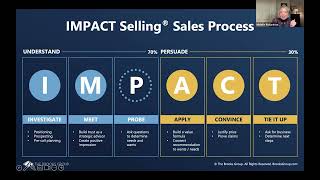
So really quickly just to level set as we share the results and share this data with you, we will be talking about sales process and sales skills. So I wanted to kind of level set with you all on the terminology that we are going to be using. The results are presented within the context of the impact sales process that is our sales process here at the Brooks Group. You can see it here. But really these are common stages within a consultative sales process. We have investigate, meet and probe positioning, prospecting, pre call planning, building trust, becoming a strategic advisor, opening a sales call, really creating that positive first impression and the probe step, asking questions to understand what and why your customer will buy and then the apply, convince and tie it up, presenting a recommendation, building value for your offering, justifying your price, conducting demos, providing samples, managing objections and then negotiating and finalizing the sale. You'll see the first half of the process that imp we believe you should spend or sellers should spend 70% of their time upfront in that part of the sales process, understanding the customer, really getting to know and understand what it is that's most important to them. And then 30% should be spent on that back half of the process persuading customers. So again, understanding versus persuading and kind of important as we think about that consultative value based approach to selling versus a transactional one. Spence, any comments or anything to add on this?
Now Michelle, just to echo what you were saying about, we think it's very important, particularly in today's uncertain environment, complex environment, engaging with customers, that every organization ground on and have adherence to a common process. And so what we're trying to present here is a way of thinking about it, of framing the basic fundamental activities that salespeople should be involved in and in the skill set that they should bring to those activities. What's interesting, and we'll share this in the data, is evaluating where individual sellers are less or more capable in making decisions or taking actions in each of these steps.
Excellent. Yes. And you know, one of the things that we have even seen in our research is that organizations often struggle. One of their biggest challenges is differentiating against the competition. And a seller's ability to leverage these skills to follow a sales process can often be that kind of structure, that framework that allows them to differentiate. Often that seller is the differentiator, even more so than a product or service.
So about the Data that we'll be talking about today. I mentioned a selling skills assessment, and that is the impact selling skills index. This is a kind of what we call a hard skills assessment that measures a seller's knowledge of selling skills within the context of a sales process. So again, it measures a seller's knowledge and understanding of best practices within the sales process. And the results are presented within the context of the impact process. And again, those skills associated with each step are measured there as well. The test essentially reveals whether sellers know the most effective approach within a given sales scenario.
The image that you see here on this slide is actually a page from the the report, the selling skills index results. It is the last page. It is the summary, and as you can see, that it provides feedback in each of those stages of the sales process. The percentage of time that sellers understood the most effective strategy for handling a specific sales scenario, second most, third most, and least effective. The assessment also provides a sales acumen score. And you'll see that there at the bottom. The sales acumen score is a reflection of overall sales effectiveness based on weighted scores across the sales process. So it is not just an average of how well someone does in the sales process. It is based on weighted scenarios that are considered to be maybe more important. Right. Success in certain scenarios has a higher influence on outcomes than others. And so again.
This is just a way to reflect upon someone's overall sales effectiveness. The assessment. Oh, go ahead, Spence.
I'm sorry, Michelle. I just want to.
Kind of double down on. There's two very important reasons why we design this assessment the way we do. Number one is we recognize that in selling, there isn't always just a clear right answer among other wrong answers like you might have in a traditional multiple choice test. What we're looking for is an ability to order thinking among salespeople of better things to do versus less effective things to do. And so not only does it reflect what we believe is a more accurate view of selling behavior, which is better, more effective actions versus less effective actions, but it also allows us to analyze to greater depth the critical thinking of salespeople in these situations, which allows us a better view of really their. Their cognitive ability, their intuition in those moments.
Yeah, absolutely. And you raise a good point on, you know, degrees of effectiveness or right and wrong. The assessment itself is based on 48 questions. Those questions are application based. They provide a sales scenario, a common B2B sales scenario, with four possible responses to those scenarios. And participants rank those responses from most effective to least effective. So it's not A choose one or choose two. It is a rank, a force rank most effective to least effective. And we measure the percentage of times that the seller chose the most effective answer. And we also look at a combined score for most effective and second most effective. So we kind of give them credit or if they can get those top two. So that's kind of just an overview of the assessment itself and the scoring, what we're looking at, and how we're measuring.
A sample question for you all. So out there in the audience, if you'd like to kind of mentally take a stab at one of the questions from the Selling Skills Index. First impressions are important to the sales process because. And then here are the four answers. And most buyers will buy from those with whom they have rapport and trust. First impressions are lasting. A bad first impression may mean a buyer won't listen to your presentation and it is reflective of your personal and professional brand. So again, an example of one of these questions. This one is from the meetstep. And again, associated with building trust and rapport.
All right, let's dig into the findings here. As I said, we're going to share four findings from our study, and there are more in the actual research report. But finding number one is that sellers tend to push product instead of selling value. What you see here are average scores, average primary scores. So this is the represents the percentage of time this group of 208 sellers chose the most effective response as number one. See again, that percentage across each of the stages of the sales process. And what you see is that before training, sellers score highest on those stages related to really talking about their product or service. The highest scores are for the apply step, which is about recommending a solution. You're presenting your solution, you are trying to create value for that offering.
And then the convince step, which is proving claims, handling objections. This is the stage where if you have a demo or you do samples or that kind of thing, that comes into play in the convince step. So again, these are the two stages where that seller can talk about their product. It is really focused on what they sell as opposed to understanding the customer. This is a common pattern that we have found in, especially with technical sellers, sellers who have a complex solution with a lot of features. It's also an area where companies typically train on. We do a lot of training around product knowledge, understanding how to present your product, how to conduct a demo, how to discuss the features. But again, this is really more about persuading, talking about product instead of understanding the customer. And so that really lends to more of a transactional approach. Because now all of the focus is on the product. It sets you and your sellers up for more of a me too comparison against your, against competitors. And so it really does not lead to more of a consultative approach. Sellers may be lacking that understanding of what, what their customers actually perceive as value.
Yeah. And Michelle, just to add here really quickly, I think to me the thing that has always been fascinating when you look generally across this process, as we've said before, most sellers know about the right thing to do about half the time. So if you're thinking about your sellers in their natural habitat, they know the right thing to do about half the time and they are more comfortable or more confident compared to comparatively talking about themselves, presenting about themselves, presenting about their solution, convincing people of their solution. But when we talk about the importance of the front half of that selling process, that's where we see some of the. The weaker behavior.
Yep, great point. All right, let's take a look at the next finding again also before training, so we just talked about where sellers score the highest. Right? They score highest in those areas relative to presenting and talking about their product or service. They score lowest in discovery and closing skills. So as you can see, the lowest scores pre training are in the tie it up step. So this is all about negotiating terms, finalizing the sale, asking for the business, and then the probe step, which is that discovery really understanding buyer needs, understanding buyer wants, what it is they'll buy and why they will buy it. Again, this means that sellers are more focused on presenting that solution and conducting that demo rather than on understanding the wants and and needs of the customer. And so this focus on product instead of understanding customers may actually lead to difficulty in closing. So without training, sellers are weaker in that closing step of the process. So this indicates that they may have difficulty asking for the business or in managing and encountering and managing those late stage stalls or objections because of those ineffective questioning practices earlier in the process. So as you think about a transactional versus a more value based, consultative, buyer centric approach, those earlier stages of the process that investigate, meet and probe where you really understand your customer, build rapport and ask good questions. These are really the essentials skills.
That's right. And as you said, they aren't mutually exclusive of one another. We firmly believe that the better capability individuals can develop early in these stages in that probing and that understanding of the customer, the more confidence it gives them in being directional, consultative in that final closing stage. Without that, we feel very confident in what we have to offer. But we lack that confidence in its connection point and the value that it provides to the customer. Therefore, we either hesitate in that confident asking for the business and tie it up, or we ask it without a clear understanding and perception of how the customer at that point feels about buying, which then tends to not lead to a positive outcome.
Those two, the probing and the closing skills are, are closely related. We often find organizations coming to us and indicating we need training around closing. We need my sellers need help learning how to close. And what we find is it's not necessarily a closing problem so much as it is an opening problem. How sellers open the sale, how they ask questions, the types of questions they ask, really building that rapport, that trust with the customer and really spending time understanding.
What the customer wants and needs, possibly even asking questions to surface potential roadblocks later in the sale. Getting those out into the open provides an opportunity for sellers to then navigate around to structure a solution that gets around those and it does make for more effective closing.
So let's look at after training and how scores change there. So we've talked about before training and some of those findings now looking at after training and again we, we retested these sellers 9 to 12 months post training and as you can see, scores improve over 20% on average across the entire sales process. So we saw gains across the sales process. Again, this is what we call that primary effectiveness. This is average seller improvement. And this is the percentage of times that they chose the most effective answer as number one when they retook the assessment. And as you can see, scores improved 24% in the probe and 36% in tie it up. And these were the two.
Highest percentage of improvement across the process. The probe you'll see probe and convince are both 24%. They're rounded to the nearest percentage and probe with decimals is actually a little bit higher. So again, these are the most, the areas with the highest improvement. They improved more in questioning skills as well as their ability, their confidence, their understanding of how to ask for the business, when to ask for the business and again, how to manage those late stage stalls and objections.
And Sananu, do you have any thoughts on, on, on these improvement areas?
Well, just I think the overall concept here that this can be improved, that we can train better intuition, greater confidence in making the right decisions in the right moments among salespeople is an exciting thing for us. Right, because as we start doing this we always wonder can we change? Can we move this needle? Can we make individual sellers smarter and more confident in their decision making capability. And this would prove to us that yes, we can.
Totally. All right, so one of the things that Stephanie mentioned right at the, at the beginning of our time together was the importance of practice in, you know, in training, in learning how to sell. And this data here really I think backs up the that that statement. What we also looked at was the type of reinforcement that these sellers had post training. So reinforcement could be digital reinforcement, it could be small group coaching with one of our certified coaches, it could be a combination of those. But there was some kind of reinforcement and when there was some kind of reinforcement put training, that sales acumen score improved an average of 13%. And as a, as you'll remember, the sales acumen score was that score. That's a reflection of overall sales effectiveness. Right? That's that weighted score as part of this assessment. So with reinforcement, some kind of follow up post training, the seller's fill, vacuum and score improved an average of 30, 13% without.
Without reinforcement. So just training alone, that sales acumen score did improve, but it only improved 6%. So you can see the big difference there in terms of with reinforcement, some kind of learning sustainment versus without reinforcement. And the breakdown with reinforcement. If the sellers went through a digital reinforcement tool only, and in our case it's an elearning digital tool with AI practice, their sales acumen improved 8% on average. With small group coaching, their sales acumen score improved an average of 12%. And with the digital reinforcement increase and small group coaching, so both of those reinforcement methods combined, their sales acumen scores improved an average of 14%. So that really is kind of the best practice. That's where you're getting or these sellers were getting their best results.
Yeah, I think it goes without saying, right? The more that you do, the more you invest in training, reinforcing coaching practice, all of these elements that we talk about in sales enablement, the smarter and more confident you can make your people, each of those things build on the other in strengthening their capability.
Absolutely. So a few takeaways just based on this data. We would recommend that you diagnose skill gaps to target improvement. Much like we've talked about here. Focus your sales development on those early stage selling skills. We talked about those, know the questioning skills, the prospecting, building rapport, those consultative skills and then strengthen training with coaching and elearning. That's the sweet spot there for that combination of follow up. And then we'd love to take some questions. If you are interested in downloading the full research report, there's A QR code right there. You can also request an ssi, the Selling Skills Index assessment, either for yourself or one of your team members. Feel free to scan those QR codes.
Michelle, I know there were a couple of questions. We've got three minutes left that came through as we were going, so let's just hit a few of those really quickly. The first one I thought was really interesting is is there any difference when using AI to investigate? And the quick answer that I would make to that is we know based on the organizations that we're studying here that some are using AI in their investigate step to a greater degree than others. We have not seen a significant delta there. We see a very similar behavior pattern among organizations and we think that's because AI can definitely make you more efficient and effective even at doing that investigate. But it doesn't make the critical decisions of what to do, the best thing to do, the best action to take, that have that understanding of best practice and investigate that's needed by sellers. So that, that is basically what we're finding is it's still critically important for a seller to have an understanding of what is the best action to take and investigate and then use AI to make yourself more efficient and more effective in taking those actions. Wonder if you have any additional thoughts there.
I 100% agree with you on that. I think you, you summarized that quite well.
Some other questions that came through is, you know, does this behavior differ dramatically in live selling, meaning live meeting selling versus virtual meeting selling? We know we've moved to a much more virtual sales environment, particularly in certain industries, and I'll couple that as well with another question that came through is does it differ in complex selling environments versus more transactional selling environments? My answer to this, and Michelle, I'd love to get your perspective on it as well, is what, what's fascinating to us as we do this study, and again we do it across many different organizations, is we see very similar patterns in those organizations. And those organizations may operate in very different industries. They may operate in more transactional like selling versus complex selling. But we see a similar pattern inside all of these different organizations, which is most salespeople know the right thing to do about half the time before they're trained and we can improve that acumen over time. Now they're the the acumen needed to be successful in a more transactional sale versus a more complex sale. Sure, there may be some differences there. There may be slight nuances in a virtual sale versus a live sale, but we find the decision making necessity the cognitive necessity for sellers to know the right actions to take in a process are very similar even in those different environments.
Yes, I agree. I think really where particularly in that pre and post difference in scores really has to do with reinforcement and coaching and impact of the managers. When we work with these organizations where managers have reinforced, where they have some kind of plan for sustainment, those scores go up and they go up higher again because it's, it's front and center on a more consistent basis.
Yeah. The important thing to note here too is we're showing averages, broad averages over large populations. There are certain individuals who are really, really capable here and there are other individuals who are not capable at all or have very poor intuition as it relates to sales and people who have very strong intuition as it relates to sales. The thing we would recommend to you and what we've tried to design here as a tool is to be able to assess your people, to have that understanding, to plan personalized development paths for each of them. And again, we'd love for anybody who's interested in sampling this assessment, trying it out, seeing if it's something that might work in your organization, please scan the QR code there on the right. We also have a lot more data and analysis that we've done in this meta study and we'll continue to research this as we go in that research report on the left hand side.
More from Gerhard



What Selling Looks Like When Your AI Agents Have the Context Your Sellers Do

Better Conversations, Smarter Support: Wearable AI in Business






When Scarcity-Built Systems Meet Abundance - The Judgment Gap in AI-Powered Sales Leadership
