Paralyzed by Fear: Resistance to Change Undermines Sales Leaders
This transcript captures a plenary presentation and panel-style discussion led by Jeff Seeley (CEO, Karoo International) on how fear and resistance to change paralyze sales leaders and organizations. Seeley argues that fear triggers inaction which undermines innovation, growth, and customer relationships; he proposes replacing fear with a growth/learning culture, taking incremental risks, and developing psychological safety. The talk includes Seely's (sic) Law — a heuristic that business transformations recur roughly every 18 months — real-world examples (Blockbuster vs. Netflix), a client case where leadership cascaded culture change, and prompts for leaders to take immediate small actions to reduce paralysis.
Chapters
Jeff Sealey, he is the CEO of Karoo International and he is going to talk about how sales leaders and salespeople get paralyzed by fear because there's so much change going on and there's so much uncertainty in this world and the resistance to change undermined sales leaders. And that is almost like slow acting poison. It's like the, the boiling frog syndrome and Jeff has the anti toad. So I'd love to bring in Jeff and say hello and give him the floor and present to our audience. Jeffrey, how are you doing? Where are you going?
Gerhardt? Terrific. Joe, Great to see you. Gerhardt, is this a new song or is this the rap song Regenerate? Because remember you've got one, you've got one, you've got one rap song. AI generated rap song to your credit. I know. I think it was last year at this summit in Las Vegas, if I remember correctly.
I know we, I created that rap song and then we had a real rapper perform and show the difference. And that was amazing. That brought everybody to his their feet.
I thought the moment we have an Austrian rapper, life is complete. We've completed the circle. But you wouldn't do it. You turned it over to somebody else. That's okay. You turn it over professional. And you're right about the folks that are speaking today. I know Jennifer and I've shared this space many times and she's just one of the more brilliant people I've ever met when it comes to sales things. So shout out to Jennifer and excited to see some of the other things we have going on. As always, you put an amazing conference on and appreciate being a small part of that. And I will try not to let the audience down with that huge build up. Now they're stuck with me. But that's okay.
You are the opening act.
There we go. You know that guy always gets 5 minutes, not 30.
You get more time.
Joe knows that. Anyway, so I'm gonna share my screen here. And as we kind of move forward and talk about what, what, what fear is all about, quite honestly, and it's really interesting because you had mentioned and Joe had mentioned in Hollywood, the changes that are happening are just so incredible. I mean if you think about the acceleration of change since 2020, which just now seems like a lifetime ago, but it's just five years. And the career of many of us. Five years is nothing. It's a drop in the bucket. And so I'm going to talk a lot about why change becomes so difficult for us to deal with. And it truly is A little bit of a periled moment because we don't really know what to do. And so by not knowing what to do, we wind up really almost being balled and chained together with this big giant fear weight that to some degree is sometimes around our ankles, but more importantly, sometimes it's actually around our neck and we don't know why. And it really becomes really difficult to do something. And so I'm going to talk about, you know, from a truly intellectual level. Fear is, is 100% an emotional response to, to a threat. And to a high degree there's a couple threats that happen when you're in business when it comes to fear. One is how is this going to change my job? How is this going to change my income? How is this going to change what I have to do? My learning all those things, those are all emotional. And the other side of it is it triggers really a fight. I'm going to change, I'm going to be intellectually curious, I'm going to learn new things, I'm going to fly, I'm going to go find a new job, I'm going to go find a new career. Sorry, drop my little pointer here and drop my career. I'm going to change it or I'm going to freeze. And freeze is really almost what happens more often in business is we just do nothing. And so what happens ultimately is this is an emotional response that ultimately affects business. And that freeze really happens because we don't, we have a hard time embracing change. Especially as sales leaders, sales professionals, we get into a comfort zone. And if you think about how much change really happened, if we looked from the 1960s to the 1990s, there wasn't a lot of new things going on in sales. I mean it was relationship based, it was value based. We had long term businesses, people were in their positions for long periods of time. There were lots of long term employees, career, long term relationships. Then really from 1990 to 2020, before pre pandemic, it was changing. CRM came into play. The Internet came into play. So many different things came into play that affected how we do business. Technology changed what we do. For some sales reps, they didn't want to embrace technology. From some sales managers, they didn't like it, having to have their sales team embrace technology. But it was really kind of from 90 to 60 to 90, it was relationship transactional, create some value. 90 to 2020 it was technology, it was sales enablement, it was CRM was all these different things that caused the change. Then in 2020 the big kahuna hit. And that was the, the pandemic. And the pandemic, literally, if you think about it, for many people, stopped almost any kind of traditional sales call for almost 12 to 18 months, depending on where you were. And so now what's happening is with AI and all the different things Joe talked about, you know, we're not going back to making fire, rubbing sticks together. Well, in sales I get excited because I don't perceive AI as a threat to what I'll call sales professionals. AI and some of the changes we're seeing in business, technology, all those things, it's a threat to salespeople, to sales professionals, it's not a threat. And you're probably asking yourself, what's the difference, Jeff, between a salesperson and a sales professional? A sales person is someone who's consistently just trying to do the same thing they used to do and fit that into the old model, use the old model in a new world. It's kind of like being the last Iceman. Sooner or later, somebody had to keep delivering ice when refrigeration came into play because more and more people started buying refrigeration. Pretty soon we're down to, you know, instead of having 50 people delivering ice in New York City, you're down to one or two. And that last person was holding on to be that last person. That's what their value proposition was. That's it was just that was it transactional do that. But really what's happened is the change in sales of business has really become exponential. And I like to kind of refer this to, and I'm self grandualizing a little bit here, but there's a concept called Moore's Law, which talked about when computing first came, that the computing power would double every 18 months. So I'm calling this Seeley's Law and I'm going to tell you sales and business environments will see major transformation every 18 months. So the reality is you're going to have to get comfortable with discomfort because the old days are gone. We're no longer going to do what we used to do. You're going to see new technologies, emerging businesses, just so many different things happening in generationally. If you look at the average person now coming into the workforce with a college degree at 22 years old, by the time they're 40, it's estimated they will have 17 different positions between 22 and 40 in 18 years. 20 almost changing yearly. Now that's not necessarily 17 different companies, but they're going to accelerate, move through organizations where before used to be, put your five years in and get a promotion. Put your five years in, get a promotion. Those days are gone. And we've got short attention span theater, we've got brilliant people coming in, we've got aggressive people coming in and they're going to constantly need this change to feed. So Sealy's law is really sales and business environments see a major transformation every 18 months. And here's the next thing that goes with this axiom, which is, what do you do with this? I like to say there's three, three parallels to this. One, you do something and it works. You're a hero. So as you change and you do things and it works, everyone's happy, works brilliantly. Do something and it fails. And people say, wait, failure? Why failure? I said, well, things don't work. Sometimes we try things, we think things. It's well thought out, but it's still with the best intentions, the best thought, the best mindset. Things don't work. So you can diagnose, you can reset, you rework and you try again. And from a customer perspective, when we think about customers, typically customers understand when you've tried something and it hasn't worked, you did it with the best intentions. You're not trying to be, you know, malicious in what you do. And you know, we can work through those things. Sometimes we don't win all the time, but sometimes we typically can recover. The one that'll get you every time is do nothing. And when we talk about fear, that's that freeze. So if you think about fight, do something, it works. Fight, do something and it fails. Do nothing is freeze. And what you've done is you sent a message loud and clear that you don't care. And the fact that you don't care resonates with customers in a way that's really difficult to understand. Both from my perspective as a business person leading teams, doing that, and as a customer or a client, it's even harder to understand why am I doing this and what's the outcome of that. So Dale Carnegie said it best, and I like to quote Dale. Sometimes in action breeds doubt and fear, action breeds confidence and courage. So the more you less you do, the more fearful you become, you become more paralyzed, more freezing. But when you start trying things that do something and it works, or do nothing and it doesn't work, now you're getting confidence, you're getting courage, you're becoming risk sharing in terms of how you approach things. And this is really unfortunate because a lot of times in organizations they have bread organizations. We work with one of our client at crew and they're really struggling right now because they've got a sales organization that's rooted in 1970 and 1980. And they're really struggling with what do we do to transform this organization. And what they're finding is the salespeople are pushing back and saying, if you transform the organization, I will take your customers elsewhere, I will stop working, I will do all these things. And it's paralyzed the entire sales organization literally from the senior level, cfo, cso, CRO, all those folks down to the district sales managers on down. The only people who aren't really too worried about it are the people who kept making the. Keep making the threats and freeze everything. So kind of thanks to Dale for kind of forcing us to be. Let's talk about confidence and courage. So let's talk about what do we fear? What do we fear the most? And if we think about what we fear most, and a lot of surveys has done, number one, fear for most people is change.
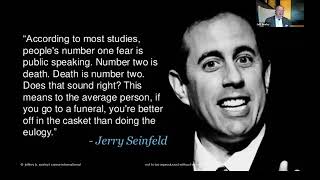
Next is kind of loneliness and what happens when we're lonely. Failure, rejection, uncertainty. And there's one other one that I know is on a lot of them is public speaking. And so we actually fear all these things more than death. And Jerry Seinfeld said it best. So according to most studies, if you're fearful of public speaking and number two is death, then the average person would rather go to a funeral and be in the casket than giving the eulogy. So if we think about that from the perspective of change, most people would rather die than change. Most people would rather die, not necessarily physically, but they'd rather see their career stagnant, be unhappy, not be generative in terms of their, their makeup, everything else, they would rather do that than change. So when we think about in that context, it becomes, we start thinking of our business environment as a train track. It doesn't allow for diversions, it doesn't allow for change, it doesn't allow for any of those things. And that sets us down a path that isn't necessarily positive. Now, if our track is the right track, great. What if our tracks the wrong track? Or what if we want to get off that track? What if we want to jump the track? Well, now the days of a train style business are over. You've got to be agile, you've got to be quick, you've got to be innovative, you've got to be creative. And you have to take in all these inputs that are coming in, whether it's AI, CRM, customer changes, product changes, service changes, so many things that are so different in a regular basis. I think of, you know, one of the people that spoke at this Bill McDermott. Bill was with SAP for a long time. He's now with ServiceNow. And the transformation that he's made in that company, from when I knew it, when I was on the board of a company in New Jersey to where they are now, is incredible. There never Bill made him jump the track. Matter of fact, he made him get off the track. And so if you think about you as a sales leader or you as a sales professional, how do you get yourself off that track is critical to success. And so really, when you think about it, the first thing, and it's a long guy who'd been around a long time is Seth Godden, and he wrote several really good marketing books. But one of the quotes I found from him is being aware of your fear is smart. Overcoming it is the mark of success. So awareness number one, overcoming number two. Well, how can you overcome something if you're not aware? So accepting what's going on in your world, accepting how you're going to do it, becomes really the change as how we move forward.
So the question you ask yourself is, how do we move forward? And what we know is it creates a couple different things. It paralyzes action, it causes issues. And a lot of these are caused by a couple things. Analysis, paralysis. How many organizations many of us work in, we get so frustrated because they're analyzing that we're trying to do. We've got it in the hands of strategy, or we've got it in the hands of marketing, or we're talking to customers, whatever it is, or we get cling to the comfort zone. Don't worry, this isn't going to affect us. We're going to be okay. Well, are we really. Or we have doubt about what it is. We don't have a unified message. We procrastinate. We. Or we have people in the organization who undermine new ideas. We're going to try something new. And somebody is always saying, well, that's not, that's not going to work. And here's why. So those are the kind of things that what happens when we start thinking about.
Being paralyzed? Well, what happens when we're paralyzed? We have a decline in innovation. We have stagnation, not only personally, professionally, but also our business growth. And it's overused. That I understand that. But if you aren't growing, you're dying. And the reality is if you aren't growing as a person, if you aren't growing as a leader, if you aren't growing as a sales professional, if you aren't growing as a senior executive, then you're rooted in really your own operating reality and you aren't looking out what's for the best interest of your clients, your customers, your team members. All these things wind up driving you to quite honestly, organizational revelance. And that's really a very tough place to be because guess what, there's a whole bunch of competitors out there looking to figure out how to grab your market share, how to grab your business and innovate their way a way out of even competing with you. So that becomes really critical. So really, as the saying goes, the risk of staying the same often outweighs the risk of change. And a lot of times we don't see that as being a negative Were comfortable and comfort is really one of the deadly business sins that are out there. Comfort leads to literally decline in innovation, decline in creativity and more importantly decline in revenue. So here's a real world example of what happened with fear. All of us are aware of Blockbuster. I know there's still one around and this may be a little bit overused, but you now think of even we could talk about Netflix from how they've morphed. So if you think about Blockbuster, they were just, you know, didn't want to do digital streaming. We're going to do DVDs, we're doing VHS tapes, the DVDs. It was very comfortable. We're very happy. They didn't want to disrupt their revenue stream. They didn't. They had sunk in tons of money into real estate, branding, all those things. What happened is Netflix embraced the change and now what's happened between Netflix and Blockbuster? Obviously history. Well think about Netflix's innovation. They've gone from streaming movies that were once on DVD to now original content providers using the very things that Joe talked about of the different they're not using studios, they're using content created by people who have created content for just one particular truly system, whether it's Netflix, Hulu, you name it. So there's all this content is now available through all these different mechanisms of original content. I remember the days I'm old. I remember the days of waiting for the new season of Program X to come out that started in September and had to watch reruns all summer. Now new things are being dropped instantly, entire seasons. It's older but I just got turned on to the bear by my partner and she and I are watching the Bear. And I'm blown away because I love cooking and I love the whole restaurant business, even though I was never in it. But now I'm watching this and I can watch the whole season in a couple days. I don't have to wait for next week's version to come out. And you have your own. But think about that innovation and change that's happened to make that possible. So what do we have to do? Gerhard mentioned the antidote. The antidote of replacing fear with a growth culture. So instead of playing it safe, you just don't take, you know, willy nilly risk. You have to take calculated risks and you have to understand the risk, but then also protect against what it is. We can't have a blame culture. We've got to have a learning culture. How are we going to learn new things? How are we going to not be paralyzed by fear? How are we not going to be held hostage by people who don't want to change? And how we do that is a lot of times the boss would come into a meeting, say this is what we're going, and no one said a word. Early in my career, I was with a large Fortune 500 company and I can't tell you how many executive meetings I sat through early in my career as a young executive and thinking to myself, boy, this is a really dumb idea. I can't believe we're going to do this. But never once did I say something. Now as I've gotten older, my filter is gone. I have very candid conversations with our clients. I'm not afraid to tell them I don't think this is going to work and here's why, or here's what you need to do and here's why. And what that really has led to is continuous innovation. So we aren't staying the same, stagnating, rotting, going spoiled. We're changing through innovation. And innovation is just as in technology, but it's how do we do different things? How do we use technology, how do we go to market AI scares the hell out of some people. Well, it shouldn't. Because proper use of AI is a good thing. Improper use of AI is being lazy. So don't be lazy, be innovative. And that's where the power of AI comes into play so dramatically. So kind of what happens is this being paralyzed for fear actually becomes the substitute for innovation. And consequently what it really says is we don't really give a shit about our customers. And we don't say that, but everything we do says exactly that. Sometimes you don't have to say things to show things. As the saying goes, actions often speak louder than words. And so as a leader, we've got to have the action to back up the words that we're saying and that becomes critical. And I love this quote. I've used it before. But science gives men knowledge. Men knowledge. Think about AI. It gives us knowledge. That's science, which is power. AI can give us wisdom. It can do a lot of things to deal with the facts. Wisdom deals mainly with values. So the question becomes how do we work with the science and the wisdom to create a more powerful business model, a more powerful sales organization, a more powerful leadership organization. And, and those are the types of things that when people start thinking about innovation, change AI all these things that are going to be exponentially changing every 18 months, as I said in Sealy's law, is going to be critical. And so that really becomes where we go to. We have to be careful of how we do things. Not staying stagnant, but changing, innovating, speaking up. And guess what? We've got five generations in the workplace right now. We've got folks older than who are used to that hoe. I'm not going to say anything. I'm just putting in my time. I want to get through this. This will go away. To young generations who are now are becoming in more creative, more thoughtful, wanting a say, wanting to know their purpose, wanting to know the why becomes critical. So with that, I'm going to kind of bring Joe and Gerhard in and take questions. If there's questions from the group, questions from each other and I kind of say ask you these questions back. How has fear held you and your team back and what small change can you take or action can you take today, not next week, today, in terms of how you lead to end this parallelization?
Awesome. Well, thank you.
Jeff. You, you open up really a Pandora's box because you're reminding people that if you practice authenticity in your sales organization and I talk to so many sales leaders and salespeople and I can name so many cultures that are fear based and, and not didn't, were the managers are not authentic. And the question is, do you have an example of a company that you have worked with where you've achieved that transformation, where you transformed the fear based organization in a growth focused organization?
I do. I can't name the client, but I'll tell you the case. How about that? The reality is what we saw was and in this truly carried over not only in the sales organization, but the service organization and the Parts supply organization. So you can kind of figure out that they're doing something related to equipment and those types of things. But what they found was, is the service organization was 100 driven by fear. That's the best way to put it. It's like, get your job done. You didn't make these, you didn't make the time, you didn't do this, you didn't do that, and we're going to penalize you for this. And oh, by the way, don't bring any ideas forward of how we maybe could help our, our customers better. And so what we did is we literally sat down with the leaders first and that's where it had to start. Because what we found was, is their initial go was, okay, we got to get our technicians, our salespeople, we got to get them more innovative, we got to get them more positive, we got to get them more motivated. They made an investment in that and then turn around and get hammered by the people who were leading them. So we made it take a step back and said, wait, that's a good investment. Let's make an investment and change the culture at the action level, which is first line leaders, second line leaders, and executives. Well, first, not going to lie to you, the executives were, we don't need that. We're great leaders. What do we need to do this for? But if you get those first level line leaders doing okay, we're going to be great. Good enough for them, not good enough for us. And suddenly what happened was as we sat back with them and said, no, it has to start with you, then it's going to cascade down through the organization. So that way you are modeling the behaviors, you are modeling what we want to have happen. And the CEO who is to this day is still a good friend, he just retired. And one of the guys that was in that second level of leadership is now the CEO. He's just promoted, a new guy's been promoted. And when you look at the culture, it has totally changed. It's gone from every problem is a nail and I'm a big giant hammer to collaboration, understanding how each other thinks, understanding how each other is motivated. Because we're all motivated differently. Not all of us are motivated by go win. Some of us are motivated by go in. Some of us are motivated by let's have a team victory. Some of us are motivated by, I want to know the process. I don't care where you're trying to go, how are we going to get there? And you have to, as a leader, adjust your style. To meet each one of those motivation types. And now you get into generationally where we've got a whole two generations of people who the first question they ask isn't how come? It's why? They don't say yes, they say why. And so if you can't answer their why, they don't care one bit about why you are. And so what that does is then creates transformation. And what we saw with this organization is literally they went from flat to declining revenue growth to now they made multiple acquisitions. They now put this new system into every acquisition which quite honestly creates some turnover because the business they're in has a lot of that involved of fear and the old school way of doing things. And they're just seeing truly double digit growth in a market that is really not highly innovative market. But they are just, they're, they're cleaning it up. And we've, we were able to talk to statistics. If you look at some of the inc's best places to work, I think Fortune does the same thing. If you look at the general performance of places that are identified as best places to work and their financial performance, it almost goes hand in hand. It's really quite startling that people don't think that that's true. But ultimately when you really get into the data, it very much is true.
Jeff, I have to tell you, I love Seely's Law. You know, you can stagnate, you have to change and you're so spot on that the less you do, the more fearful you become. That is so spot on. So what I'd love to know is how do you take when you recognize a company is fearful because that fear, that fear is paralyzing. How do you motivate them to lose that fear and go for it and move forward?
Joe, that's a great question. I think the biggest thing is you can't change is we always people talk about transformative change and none of us really want to be transformatively changed. If you think about how we are, sure we'd all like to. I mean there are some drugs now that do that. Ozempic, you can learn, lose a lot of weight in a hurry. But it doesn't, excuse me, it transforms your body, but it doesn't transform your mindset. You have to transform in incremental parts with a goal in mind. So really if you start thinking about it, we find small areas to get big victories and again big victories are relative because what we find is it becomes additive in terms of how so you find a region or an area that you start transforming. They see a different way of doing business. They may see people who are deselected from our organization because they are truly toxic to where we want to go. Whether it's a leader, an individual, an executive. We, we start transforming the culture of the workforce to go from toxic hammer driven, fear based to more inclusive, more collaborative. And we start seeing victories with that. And what happens is that becomes iterative across the organization. And pretty soon what happens is when people see new things, they want that because they see success related to it. I think that was one of the biggest things. If we look at CRM rollouts, they were trying to do transformational rollouts of they might have done a pilot someplace, but it's like, okay, everyone's now on Salesforce or everyone's on this and no one caught up with the people to kind of explain why we're doing this, what's the purpose of this? It actually became a process of, oh, you're tracking me, you're keeping more close to me. There wasn't a value added to it. That's my concern with AI, quite honestly, is people become fearful of it. Either a, they overuse it because it's a lazy man or woman's way out, or they're fearful of it because they don't know what it is, they don't know how to use it properly and what it can be. And so consequently we get into this do nothing mode with it. Some people adopt it, some people don't. So it becomes incremental. The how you find small victories which then make the big ones more transformational, more easy to do as you do it. So you teach your company to do a learning culture, like say your company should have a learning culture and an intellectual curiosity culture. If you don't have those two things, that's where you got to start. The other piece of it is what we find from a relationship perspective is there are four elements to a really rock solid relationship. Whether it's customer internal trust, credibility, report and respect. Those create an interdependent relationship. If you don't have one of all four of those things, you have none of them. And the number of leaders who do not understand that they do not have a true interdependent relationship with their team is staggering. But yet they're also surprised when they ask a team member, hey, do you trust me? It's like me asking Gary Gerhardt, do you trust me? And rarely does the person want to say no, not really. But their actions all prove nobody trusts each other. And the consequence of that is nothing happens and it becomes this dependent subordinate relationship which is never healthy.
I'd like the, the audience to go to Karu.com to learn more. But also I would like to direct your attention to. And you can Google this. It's called the Google Project Aristotle. And it was a multi year project where Google analyzed hundreds of teams and identified those that were the highest performers versus the medium and the low performers. And what they found is that the highest performing teams they created what they called psychological safety. And they found that this was the single most important factor for creating a high performing team where people could express their true self while working, post questions without fear or sounding foolish, own up to errors without punishment, and share incomplete concepts with supportive teammates. So they're co creating their future.
And.
When you think about the, the courage it takes on the part of the leader to create that psychologically safe environment where it's okay to fail and learn from mistakes.
Then I mean, there's so much potential in organizations that could improve their output by 20, 30 or even 50%.
You know, Gerhard, I have to really piggyback on what you said. And Jeff, what you said, boy, man, it hits home with me. You said, create a culture of learning and curiosity. And it's the curiosity that keeps us process driven instead of results driven. Because I think too many people look down the road and go, am I going to succeed or am I going to fail? Whereas when you, when you're curious, you're always in a discovery mode which keeps propelling you forward. So I, I absolutely love that. I, that is, that is spot on.
Well, it's funny you mentioned that, Joe, because we talked about salespeople and sales professionals. Sales professionals are that curiosity. They're that, that desire to learn. And people say, well, gosh, it's sales. What's that mean? Well, I look at it this way. If you have a doctor that graduated from med school in 1986 and didn't know how, and was an orthopedic surgeon, and in 1986, the way they did surgery on your knee was to cut a big giant scar. No. Regardless of how damaged the knee was, they popped open your knee, you were open, you know, your seven weeks, eight months rehab, everything else like that. If that doctor never learned to be orthoscopic and you went in now and he said, hey, I got a little knee problem. He goes, well, let's cut you open. Well, what about orthoscope? Well, I don't know how to use that. I never learned. So I do it this way. I mean, there's no one in this audience who's going to say, okay, let's, let's go for it. You know what? I'm good. But it's like we accept in our sales profession that it's okay not to learn, it's okay not to develop. But every other profession, sometimes we say to ourselves, well, Lord knows I'd never want an accountant who doesn't know the current tax laws. I'd never want a doctor who knows the latest technology, or I'd never want a lawyer who understands and developed himself any one of a profession. But yet here we are in the highest earning profession and we don't hold ourselves to that same standard. And that, that, quite honestly, is a frustration for me that as I'm in the back quarter of my career here, I hope to kind of get people to start thinking more about that this is truly a profession, and treat yourself and your profession like it is. Super.
We need to stop. Thank you, Jeff, for, for contributing to the success of our conference as you've always done over the years. I consider you a great friend. And I would suggest that people head over to Karoo.com and benefit from that collective intelligence that Jeff has created over the last few decades and change your culture to a growth culture so you can accelerate revenues. Thank you, Jeff.
Thank you, guys. See you down the line.
More from Gerhard



What Selling Looks Like When Your AI Agents Have the Context Your Sellers Do

Better Conversations, Smarter Support: Wearable AI in Business






When Scarcity-Built Systems Meet Abundance - The Judgment Gap in AI-Powered Sales Leadership
