Powered by Buyers, Delivered by AI: An Evidence-Backed Approach to Personalized Sales Coaching
Tim Riesterer argues that buyer feedback—collected at scale and analyzed by AI—is the most actionable source for improving B2B sales outcomes. Drawing on Corporate Visions’ dataset and products (True Voice, TruCoach), he explains that sellers are responsible for a majority of avoidable losses and that AI can turn buyer feedback into personalized coaching, roleplay, and measurable improvement.
Questions this video answers
125,000
53%
20–30% response rate
40% improvement in performance (win rates) for reps with ≥3 deals of feedback
7,000 reps
Chapters
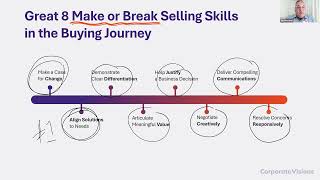
Well, I appreciate that. Thanks Joe. And thanks Gerhard for this opportunity. Yeah, it's one of those things where who can get left out of the equation when AI sort of comes into the picture? I'd like to argue sometimes it's our, our buyers, like wait, where are they? And so the way I want to kick this off is, is acknowledge that what we're seeing inside of companies and we work at corporate visions with like 250 B2B sales organizations every year is how often the, the buyer is left out of the equation when it comes to how are we going to coach, what are we going to coach on and, and being able to do that in a way that is not only meaningful to the seller and, and to their improvement, but is also something that's grounded in fact that, that if you do this, this shall work. Here's what I'm talking about. So I want to talk a little bit about good old fashioned win loss programs right now. Today, what we see in the majority of companies is they ask sellers why did you win and why did you lose? There's a drop down in the CRM after a deal and the seller is charged with self examination of themselves and how the deal went and the customer is left out of the equation. Here's why that should create a big question mark in everybody's mind. When we work with companies and do their win loss, what we find is that 70% of the time when you examine the same exact deal and you ask the customer and you ask the seller, you get a different answer. So my question to the audience is if you are flying with the data from your, your seller inspired win loss and are not asking your customers and asking your customers at a meaningful level, how do you know what to do better or what to do next? What you're, what you usually resign yourself to is let's do the things we think would help us when in reality there's an opportunity right in front of you. Leveraging AI to do win loss buyer feedback at scale and after every deal, imagine sending out out of your CRM system a survey and generating 20. We're seeing 20 to 30% response rates. So imagine getting feedback on 20 to 30% of all your deals and doing that in a way that you collect that and can feed back to the organization. Leveraging AI to take all this information in and then create dashboards and provide feedback back to your executive teams, to your sales leadership, even to your individual salespeople about what's working and not working inside of actual decisions for your company against Your competitors and with your clients. That kind of insight is, has been relegated to again seller based dropdowns or 10, 20, 30, maybe 100 calls to wins and losses, but not been done at scale with an always on ongoing program. And the technology is here to do that and the AI is here to assess all that and help you get to the most meaty and important information. I'm going to give you some insights from our database right now where we have.
Anonymized 125,000 B2B purchase decisions. So these are actual decisions and we're looking at wins, losses and no decisions at 500 companies in 50 industries. And here's one of the most interesting facts that we found after assessing all that information. What we found is that your biggest opportunity to win more deals is by recognizing that your sales team is actually the cause of why you lose most of your losses. Follow me on that. What we found is 53% of buyers said that the losing vendor could have won the deal if it wasn't for something in the sales experience, meaning something that your seller did or didn't do. That means that 47% of the time it's something that was outside of the seller's control, something that your product could or couldn't do, the price you could or couldn't get to or the politics that weren't in your favor. Now it's interesting when you ask sellers why they win or lose, they'll say they lose 100% of the time to the things that are outside their control. But the reality is that's less than half of the losses, more than half of the losses are completely within their control, are completely findable and then fixable. And so the biggest opportunity for improving win rates resides inside of your wins and losses and buyer feedback. But most companies don't get that information and are flying blind. Now getting that information, like I said, at scale can tell you a lot of things. What we've been able to see as the AI assessed all of the scoring and all of the feedback, the unstructured and the structured data, is that there are eight particular selling skills that a buyer can observe, can compare you and your competition for any given deal, can score you on and give feedback to you on that are indicative or predictive of wins and losses. So if you go back to that and think about that 53% that I just shared, 53% of your losses could have been wins if it wasn't something you did or didn't do. The question is, well, what are those things? Here they are. There's eight of them. Your ability to help make a compelling case for change, that is distinctly a sales skill that helps a customer see the need to do something different. And they value that and they can compare you on that score. You want it, and it is predictive of wins and losses. Your ability to gain alignment on the problem statement and show clear connection to your solution is huge. In fact, right now it's showing up as the number one reason for wins if you do it well, or the number one reason for losses if you don't. So this one is up on the charts right now. But every one of these eight is predictive when we look at it, of being associated with a win or loss, significantly predictive and meaningful. So if you just take a look at these, you can acknowledge and recognize these are things that sellers are basically in charge of. And there's a lot of things that AI will do for sellers, but there's many things remaining in the seller's basket of value. Value add to the customer that the customer cares about. And when they make a decision, matter to whether they choose you or not. And again, in, in any of these eight areas, you need to know what your teams or maybe what your individual or sellers need to do different and better in order to claw back some of those unforced errors or losses that shouldn't have been losses. So, so what is it for you? Which of these eight? Well, I want you to imagine that in a world of automated buyer feedback, win, loss, feedback at scale, every one of your reps after a deal closes, and let's say 20 or 30% of those deals start coming in. Every one of your reps and every one of your managers gets a report like this. So it comes in on your email of choice and it talks about a specific client and a specific competitor and it looks at these eight and the buyer's feedback talks about the seller's performance compared to the org average compared to your company's best in class score. And that email comes in with each of these scored. And then as you can see, any of the feedback that the buyer articulated, whether they wrote it in or they voiced it in, because there's two different ways to collect that. And now what you get is a deal by deal report card where you can start to see as a rep and as a manager and as a leadership team, where do your teams or where do particular reps need more help relative to your own team's performance in your market, selling your stuff and with your type of clients and the idea Here is when you get this information and imagine that after each of these deals that you can check up on your collecting score. So what you're looking right here is an AI generated report card again against these eight, we like to call them the great eight. And you start to see for rep a, a scattergram sort of visual where red means these are the particular skills where they're falling below the company's average. And and now you get to see based on buyer feedback, not the seller's own thoughts about what they do well, not even the manager's own thoughts about what they do well. And not even a single call report like you might get from a gong transcript. This is actual deal decision based feedback given by decision makers who've made actual choices. And this is the cumulative of that. So maybe every email you get you don't go oh I got to fix something. But after a while they start accumulating. So right now we're looking at the scores of if I do the math, maybe 10 deals for this rep. And you start to see that in this area of this skill align solution to needs, they're consistently falling below the company average. Well where AI is going right now is not only being able to take all this information in deal by deal is ability to create a report card and assemble then for that rep some coaching and enablement experiences and presenting that to them right in the context of what I like to refer to as the game film that you're getting from your clients. And so what I need you to imagine now is that I am stinking at aligning solutions to needs. I saw my numbers, I'm way beneath the company average. I've clicked on that and now I can not only see my scores but, but I can start to go account by account and look at my feedback and I can start to for this particular skill where I score poorly, hear why that's happening because I've now got my customers words telling me what's happened. I can then also click and look at what's others feedback. So just toggle over to others feedback. And now you start to see when your peers are doing well, what are your customers saying? Like what are those words sound like? So when you think about the capability of aligning or the skill of aligning solutions to needs and you're not doing well and you hear certain words from your customers. One of the ways that you change is not just to see your score but to hear when it's done right, how customers reflect that back to your organization. Hearing your customer's voice in their feedback on what good and bad looks like, feels like, sounds like is a huge breakthrough for for motivating sellers to change so they can think about the outcome, the impact that they desire to have, not the thing they need to do better, but what it looks like, what it feels like in successful deals with clients who are happy with that experience. And then what you need to look at or think about is imagine if then on that particular skill where they now hear the feedback, it's like what can I do to get better? They have to go nowhere else. They've literally could have clicked through an email or or their simple dashboard and they click into some coaching support where you can start to learn about different ways that you can as a seller master that particular competency. What are the core skills and what are the core concepts that you need to learn and master and think of it in short meaningful bursts that they can learn in the moment of of deficit. We call this deficit learning because you have found yourself in a deficit now and deficits create much more momentum and energy for learning than just putting learning on a calendar or on a kickoff curriculum is I learn when I find out that in a particular area I'm struggling. And what I'm about to show you in a little bit is and the the person who's most convincing to me as a seller that I need to get better are actually my customers, not necessarily my managers or even my peers. And so imagine again that all this coaching, including now, hey, you've learned a couple skills and concepts now let's practice it on your next deal, download a planner, listen to a tutorial on how to apply these skills and leverage this planner. Have some good, better best examples of what that planner looks like when filled out well inside your company and and complete that planner. And then once you've completed that planner for your next deal on that particular skill set and competency go into role play. So you got the game film coming in from your buyers telling you this is an area you need some help. You've now taken some coaching in that area because you realize the deficit. Now let's put that into practice and application on the very next deal and get you better so that you can turn that 53% of avoidable losses into a win. And I'm sure you've been watching a number of AI sessions that talk to you about this and role playing, so I'm not going to belabor it. But imagine that that coached session with that planner can now be ingested right there into a Role play where you can practice that skill. Practice that skill, Practice that skill using and tailoring that role play by your account because of that planner. And now you're getting scores. What I want to just quickly share as I wrap this up is that there's a lot to be learned here about AI customer feedback. AI then driven coaching and then AI driven roleplay in equipping and enabling sellers to succeed. When you think about how and why people learn and master things, mastery comes from one on one learning and tutoring. And that's what this drives. They also are more willing to change when they hear it from their customer than anyone else. And so you now have that happening last slide. And the question is, does customer feedback make a difference? We don't have this data yet for 2024, but in 2022 we looked at 7,000 reps who did not receive any feedback from customers. And then we looked at 2023, same 7000 reps, but those who still received no feedback versus those who received customer feedback and customer feedback driven coaching and at least three or more deals. And what we saw was 22 was brutal for win rates and so was 23. But there was a 40% improvement and performance by salespeople who got three or more deals worth of feedback, took that, internalized that, worked on that deficit through some directed coaching and improved their win rates. So Joe, that's it. That's my little spiel on the effect of buyer feedback as your best coach and then how you take that directive coaching and make yourself better. And this is an ebook I want to share with everybody that you can study in more detail.
Tim, Bravo.
I absolutely love that talk about data and analytics to learn and grow from. I mean.
And tailored customized personalized coaching at scale driven by the source that everyone thinks is relevant. Your buyer AI is making that a reality.
What we are way is the number of 53% that 53% of buyers said that the losing vendor could have won the deal. That is ouch.
Yeah, I mean and but it's also opportunity because if 100% of your losses were things that were outside your seller's control, what can we do about that? The majority of your losses are within your control. Now you can do something about it, but you don't want to guess, you want to do it right. So let's look at 53% as an ouch. Trending toward opportunity.
So how can you use AI to understand the bias perspective better?
Yeah, it really means first and foremost one AI can help you sort of scale the request so after every deal, you ask them the questions about the competitor, your product, but also about the sales experience, because we now know the sales experience drives 53% of losses. So let's start asking them questions about the sales experience. And what we found is that in the sales experience it nets out to eight distinguishable competencies that sellers, I'm sorry, buyers can Observe. There aren't 20 things they can observe, there's just these eight. And they can score them in comparison. And then you got a lot of data coming in. And then the AI can assess that data rep by rep by rep and give them the scores, show them the deficit, and then when they click on the one, they're in deficit, AI can direct them to the right coaching content for that particular skill that their customer, their cumulative customers have said are a weakness. So it's like AI in the assessment of that in the buyer feedback, AI in the alignment of the right coaching and then AI in the role play where they can practice for the next opportunity on that skill. So it's, it's sort of infused throughout, but yet it feels like a natural flow from buyer feedback to coaching to practice.
What tool is this? Performance feedback, Tim?
Yeah, so this is a product that we've built called True Voice and it is an automated win loss system. It's tied to something we call trucoach that then presents the right content in the context of those reports. And then we've worked with a third party AI roleplay vendor to build one for each of those eight competencies and be able to tailor it with our planners. So it's a complete package of assessing the customer, coaching the seller, and then helping them practice to proficiency.
Carling's asking, can you filter by business size and segment for variances?
Yeah, once you get to some critical mass on your, on your feedback, then you can start to filter by all those things. But the reality is the, the real filter is I as an individual rep, am seeing, let's say 2, 3, 4, 5 deals worth of feedback that now start to create a pretty good picture for me. And now we have something that we never had before, which is almost bespoke coaching and learning paths because each rep's getting their critical deals worth of insight. And so yes, you can take that data up and start to look at it holistically as an organization, as an enterprise, as a geo or as a team. But the real power is just in how you actually now can get to some level of bespoke intervention by rep because it's their deals that are coming in and informing their performance.
Another question by Thomas is very interesting. How do you account for survey fatigue when gathering customer feedback on a salesperson's performance, especially in cases where salespeople work only with a few large deals per year? Wouldn't limited deal volume and potential reluctance to compete surveys impact the reliability of the insight from a seller's performance evaluation tool?
Yeah, I mean at some point if you are working two or three big clients every year and you're a key account global account manager and we're seeing 20 to 30% response rates, 20 to 30% response rates1 are pretty good. And it works best when you are working with large numbers of deals so that you can get to some level of critical mass. Not going to kid you there, but we do a good job of we've studied so we have a neuroscientist on staff and we've created these emails that rely on reciprocity for the mutual effort that the client and the seller put into the deal. So it's personal and it's reciprocal and we even have a little offer that I'll just explain it real quick. So when you, when we ask, we're like in Exchange for these 10 minutes we're going to give you a white paper on the neuroscience of change management written by our neuroscientist and because if you made a decision, you probably got a change management project on your hands. So we'd like to help with it. Even if we lost, we still want to give you this as a way to help you succeed with your decision. And we find that you can get those response rates of 20 to 30%. And so it works best when there's definitely a critical mass of deals and sellers to to spread this across.
By the way, the, the.
Link about the ebook goes to the website, not to the book download. So we are dropping the link to the ebook in the chat. So if you're looking for that, Marie says love the flow of true voice. How are the GA changing for strategic AMs related to a CEO?
I'm hoping I'm understanding that question correctly. The great eight, the G8 I wrote up there. So one of the things I didn't have time but now that we're asking questions is we have discovered two things that winning new business and getting buyer feedback related gave us this great eight. We are now validating eight distinct I'm sorry six distinct and two overlapping skills for retention and expansion with existing customers. So imagine you're coming into a renewal and now you're asking questions and we're finding that skills like how well did you document results? How well did you drive change management? How well did you drive adoption and usage? Like there's different competencies related to retention, renewal and protecting against churn than the competencies required to win new business like we just described. So in a future presentation like this, I'm excited to talk about the great eight for retention and expansion and how they are similar and what's unique and how you should be doing more feedback on renewals and expansion but with a different set of questions. Because we're finding there there are different skills that you deliver in account management and such that are predictive of retention and upsell as opposed to skills that are predictive of winning new business opportunities. So that should be interesting.
We do have another sales Transformation coming up. April 9th and 10th and maybe we can talk about.
There you go. Gerhardt. We just made this deal right in front of everybody. Exactly.
I love the way you present and the science behind it that sets corporate vision apart. Because it's not about gut feeling anymore. It's about enlarging that radar screen of information so you can have more intelligence conversations. We are out of time, but we want you back.
Gerhard, it's always a pleasure. I appreciate that you appreciate what we're trying to bring to the picture here for everybody. Sales as a profession that's driven by data but yet equips the humanity that is selling. Tim, great work. Thanks, Joe. Thanks, Gerhardt.
Corporate vision is about clarity and that leads to cash.
Oh, wow. There you go. You get to write all our bumper stickers.
See you guys.
More from Gerhard



What Selling Looks Like When Your AI Agents Have the Context Your Sellers Do

Better Conversations, Smarter Support: Wearable AI in Business






When Scarcity-Built Systems Meet Abundance - The Judgment Gap in AI-Powered Sales Leadership
