Revenue Enablement Excellence in the Age of AI
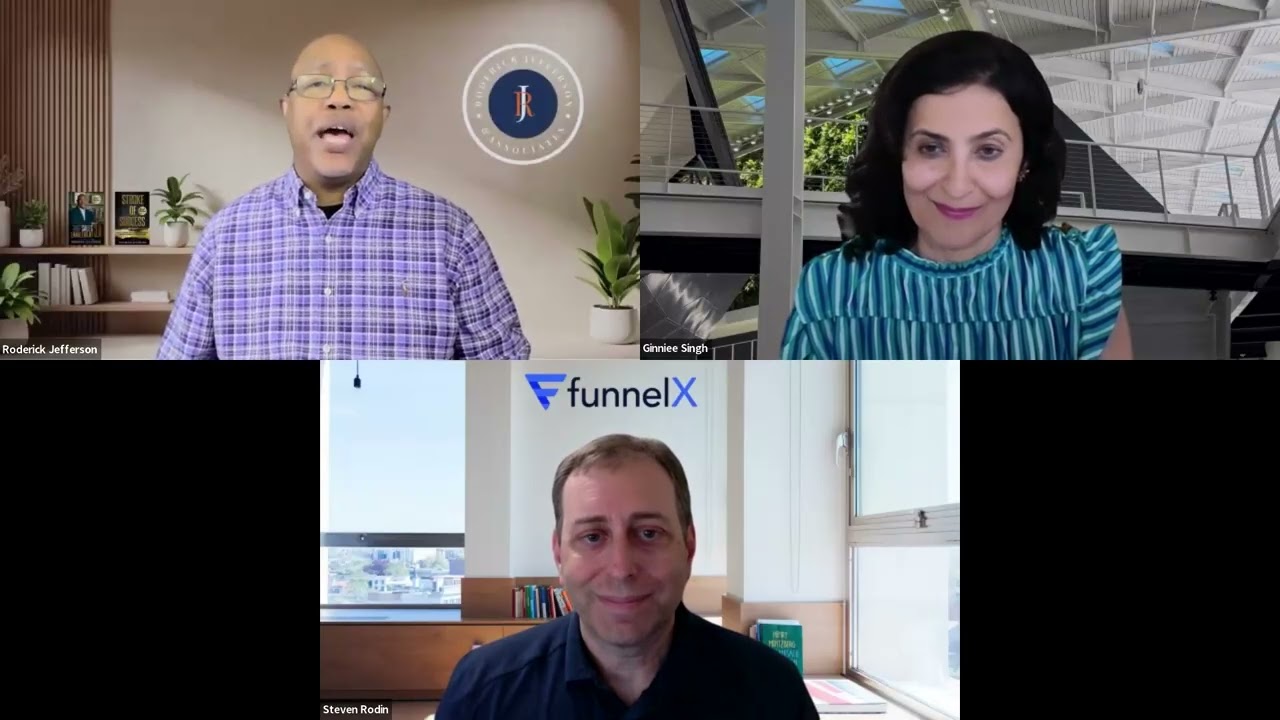
In this 25‑minute live panel, moderator Roderick brings together two revenue‑technology founders—Jenny, CEO of Spike.ai, and Stephen Roden, CEO of Funnel‑X—to explore how AI is reshaping revenue enablement. The conversation emphasizes that AI is an augmentative tool, not a replacement, and focuses on practical, real‑time applications for sales teams. Jenny describes Spike.ai as a "digital twin" that provides live conversational guidance, helping reps recall information (only 17% of conversation content is retained) and make better decisions during calls. Stephen outlines Funnel‑X’s "AI coaching loop," a bottom‑up approach that uses practice, reinforcement learning, and personalized feedback to continuously improve reps’ skills. The panel discusses the evolving role of enablement leaders, stressing the need to blend IQ, EQ, and AI to preserve human connection while scaling coaching. They address concerns about homogenized AI outputs, advocating for human‑in‑the‑loop personalization, multimodal AI, and judgment at scale. Audience questions probe differentiation and client expectations, leading to recommendations that future‑ready revenue teams must adopt real‑time reinforcement capabilities and multimodal understanding within the next six months. The session closes with invitations to learn more about Spike.ai and Funnel‑X.
Chapters
I'm going to jump right in. And before I go and actually do the intros, I want to just kind of set the tone, right? Because a lot of folks are going to jump right away. For me, I want to make sure that this is not going to be your typical AI panel. This is going to be some practical application and live and lived experience from the folks that we're going to bring in. Right. And look, AI is on the top of everyone's mind and on their tongues. For us, we want to talk about and confirm that what's happening where AI is actually completely rewriting the playbook and the technology just doesn't build ready revenue teams anymore like it used to do, right? So in this session, what I want to do is bring 2 incredible innovators, 2 co-founders, and 2 revenue pros. To talk about how do we do it, what is it, and what can we leave you with that you can now take and put into practical application. So I want to start ladies first. Jenny, take a moment, introduce yourself, who you are, talk a little bit about Spiked AI, and then I will turn it over to Stephen.
Thank you so much for this. And, you know, I'm actually looking forward to receiving those books. and, you know, signed by you. So I'm actually all eyes and ears for those now. But just to introduce myself, you know, I run the revenues. As you can imagine, at the end of the day, we become revenue leaders. And in today's world, the way things are advancing, a CRO is going to be managing revenue, he's going to be managing— he or she is going to be managing agents, And then there are going to be so many digital aspects of that. And then our revenue is going to go higher and higher because our targets keep growing and our teams keep shrinking. And that's exactly what I'm trying to address with Spike.ai. Whatever I have lived through these experiences of the past 16+ years leading revenue teams and revenue organizations, I'm actually bringing it into spiked AI. So I'll be talking more about that as we get into this conversation.
Love that. Thanks so much, Jenny. Stephen, who are you? What's happening over in your world?
Yeah, thanks, Roderick. Really appreciate it. Uh, really happy to be here. It's exciting to— I've been watching some of the sessions this morning. Really great, uh, conference so far. Um, so yeah, uh, so I'm Stephen Roden. I'm the CEO of Funnel-X. I'm a 3-time founder and entrepreneur, so I've been This is sort of my— I was just contemplating what it was different when you're doing a new company in your 50s instead of in your 20s. But it's been exciting. It's an exciting journey. My first company was back when the internet was really getting going, and now I'm starting a new company and the next wave of AI really getting going. It's really exciting and it's really an exciting time. Funnel-X is really focused on developing and delivering what we call our AI coaching loop, and I'll get into more of that as we get into it, but it's really about practice before you get into calls and then executing on calls and performing and then improving and creating a continuous and virtuous cycle around improvement for salespeople. And it really builds on my years of experience growing companies, building revenue, and driving opportunity for my teams and my reps.
Perfect. Thank you so much. Since we've got about 25 minutes, I'm going to go ahead and jump in, but I want to say this upfront. This is not going to be a presentation. This is literally going to be a conversation between the 3 of us. And hopefully we can leave a couple of minutes to actually answer some questions that will come in from the folks out in the audience, because we've all sat on the other side, right? And it's talk, stop, talk, stop. No fun. So let's do it a little differently. Jenny, I'm going to start with you again. Ladies first. So look, productivity. Increased revenue, accelerated time to revenue is all important. But beyond productivity, where do you see the biggest opportunity for AI to directly influence revenue, pipeline, conversion, deal velocity, and seller effectiveness?
That's a great question. And I'll start by saying that, you know, Jensen Huang, just mentioned that we are getting into the era of augmentation. It's been a very wrong rhetoric going on in the marketplace where we are saying, hey, we are replacing. We're not. We are actually augmenting our sales teams with these AI tools and the avenues around that. Now, to your point about the pipeline, how do we kind of get into the next level of discussion? If we are not doing these discussions in real time, what are we doing? For the past 40 years, Gerhard has been saying that we've been addressing the wrong problems. We have been just going after data, data amalgamation, trying to summarize this, but we are forgetting what a seller has to do in his day-to-day. He has to be in the real conversation with a customer, the conversation you and I are having, and Stephen is there. That's exactly what counts. Those 30 minutes, 45 minutes to 1 hour of the conversation, if we do not capitalize on that, we will lose it. So that's what we are going on with Spike.ai. Spike.ai is my digital twin, and it's actually my digital teammate which is helping me progress these discussions. And that is the avenue we are taking with our sellers. We are helping them Not to prompt, that is not the job. We are helping them not to do the tasks, an agent can do that. But SPY AI is actually helping you in real-time conversations, helping you make those decisions, and guiding you in that real conversation before, after, everybody does that, that keeps going on. What did Salesforce do? Salesforce has been a system of record. Now they are looking at, you know, with Claude, we just saw that things started to change with that. But when that reasoning meets the judgment, that is the avenue we'll be talking about. And how do we enhance our sales teams and help them in the pipeline generation and reduce the deal cycle? Because I'm responsible for managing billion-plus dollars in ARR. And if I do not do that, my deal cycles keep going up into 12 to 18 months. That just doesn't help anyone.
Oh, absolutely. The last thing we want to do is extend the sales cycles, right? We want to make sure that we can accelerate those pieces and get things going. I want to bring Stephen in because I've got a question for you. I'm a long-term enablement leader, right? Been doing it for 18, 20, 30 years now. I think we would all agree that the way that we used to do things just doesn't work anymore, and it doesn't even exist. And I, for one, am a huge proponent and user of AI. So Stephen, I'd love to find out on your side, what are you guys doing over at Phonelex differently than the way that Jenny and Spiked AI are moving forward with revenue pipeline, things of that sort?
Yeah, I mean, I think one of the things that I always try to impress upon people before I get into, you know, sort of the technical or the process behind that, I always like to impress upon people, we look at the past, right? And the past, I think, was a lot of top-down. And you look at tools analyzing data from the top, looking at wins and looking at data of the end result and the outcomes. But what I've always found, and this has historically been what I've seen in my own teams, is that we always tried to build bottom-up. We tried to build our reps into better reps. We wanted to give them great opportunities. We want to build their skills. We want to make them better at their jobs. And so when I founded Funnel X, it was really on the premise that how can we use AI to make the sales rep better at their job? And so that it's not just about delivering information to them, like in that moment, although that can be part of it. We have, you know, obviously there's incredible amounts of information out now that we can give to our reps. But what's important is that when we— the rep, we start them in, you know, that by the end of the next year, we've got a better rep than what we started at, right? We've built a better rep. And so if we do that through a combination of practice and delivery of information and constant improvement, and we reinforce that, we use reinforcement learning to constantly get better, then we're building a better rep and we're going to build ultimately a stronger team. And that's where I think AI, uh, is changing things, because now we have the ability to use AI to like Do things like gather evidence of performance and feedback, that feed that feedback, feed that back to the reps effectively so they can get better. And not every manager has to sit in on every call, listening on every call to give good advice.
Love that. Love that. I want to change hats just for a second to something that's close and near and dear to my heart, and that is enablement leaders, right? I believe that Culture is what happens when nobody is watching, right? And I also believe that the enablement leaders should be working closely with the go-to-market leaders and so that we can now, of course, craft and build, but then hand things over, but not step back. It's not throw it over the fence and go do it. We're not training anymore, right? We're enabling now. So from that perspective, we have to work with the, the go-to-market leaders to own The adoption, the execution, but most importantly, the positive modeling of what we need them to do. Right? We've talked about the reps. Let's take this up a level now, right now. Stephen, quick question for you. How can we actually, as enablement leaders, ensure that adoption enhances the connection as a human and coaching rather than replacing them? My thought is IQ plus EQ plus AI, because the, the, the AI will give you content beyond any of us existing on this planet, right? It's the EQ, the IQ that gives us context around that. So how do we make sure that we're utilizing AI to actually enhance and create more of a human connection, especially around coaching? Instead of— and I'm sure a lot of leaders are wondering, how is this going to happen? I could be replaced. How can you, as well as you could, make yourself kind of foolproof so that you're still needed for your tenure, your experience, and all the things you've done to get to this point?
Yeah, it's interesting when people talk about AI replacing coaching. And the reality of, I feel like, that is that that it's not a competition really. The coaching isn't really happening to the extent it should by managers because they're overwhelmed with all the other things that managers have to do to manage sales teams. So the amount of actual coaching that managers get to do on a day-to-day basis is pretty slim. When you talk to people like me, they love to do— sales managers would love to be doing more coaching. But what they end up doing is they spend their time on the low-value activities like reviewing call summaries or listening in on calls or gathering the evidence or filling out scorecards manually. If you think about the things that AI can really do for those managers and gather that information so that the managers are doing the human tasks that are truly valuable, like doing the one-on-ones where they can really understand the rep's motivations, they can Encourage them in a, in a human way, right, that they need. That's where the human connection comes in, and that's where managers need to be at the forefront, is doing those activities. They don't need to be doing what AI can do for them. And this is where that idea of augmentation comes in. You've got the combination that can be far more effective at delivering a very consistent coaching approach and one that's much more scalable so you can touch more of your reps.
I love that from the sales perspective. Jenny, I'd love to get your side of this as well because I believe that there's— and I've seen this year over year over year— and that is a lot of managers don't know how to coach because they were never taught to coach. And so that's not one of their strengths. So I think this is an opportunity where they can use that AI adoption to kind of bolster what they already know. one of the things that may not be one of their strengths. Would you agree, disagree, and what are your thoughts on that?
I think, you know, these are all good thoughts and we totally understand because everyone comes from different backgrounds and everyone has a different approach he or she wants to take into a situation. So that is the reason I think simulation is really, really important. You can simulate before a conversation and what has happened. Imagine You have about 275 trainings which are shoved down your throat, but at the end of the day, how much are you gonna be using in your real time and in your real conversations with your customers? That's questionable. So that is the reason the idea should be that you should look at the profile of the person. For example, if I'm meeting a CFO or if I'm meeting a board member or if I'm meeting a CTO, my direction into that conversation is going to be entirely different. What is my objective out of that meeting is going to be entirely different. What is the influence network I need to believe into that is going to be quite different. So that is the reason the real-time avenues are really, really important because each conversation you're having with these stakeholders is just gonna help you improve your follow-on conversation. And imagine if you have an environment, for example, you know, I live my life in Salesforce, HubSpot, et cetera, Clay, whatever you may call it, you know, I use all the tools. I'm a statistician, so for me, models come very naturally to me. But at the end of the day, if I can do all these things touchless and spend the time into my real-time selling with the customer and really build that relationship with him or her, wouldn't that be valuable rather than spending the time about doing those 275 trainings, being certified, being an architect into that. But what happens? I don't use even 5% of that. In today's world, we are changing so fast. So I think the only thing which I tell my teams is permanent is change. So that is a reason if we are thinking of going into those avenues where we go by, you know, cookie cutters, that has changed. So we need to look at it from the modernization ways where the total population is going? And how are we going to make that inference into information into judgment? That really counts for me.
Love that. Love it. Stephen, I want to change hats one more time. And let's go back to talking about the reps a little bit, right? And I'll come back if we have time to the enablement folks. So I think we both agree that there's A really big difference between AI that hands a rep the answer and then AI that coaches a rep's technique, approach, manner, all those things. Which one of those do you think actually builds a better seller?
Yeah, I mean, I'll, it's an interesting question because I think there's a place for both in the mix. And I know that's a bit of a hedge, but what I'll complement that by saying what's important is that you're building— when you say building a better rep, right, we want to achieve that and we want to make sure that our reps are always getting better. So, uh, you know, whether that's over time, and we need to do that through reinforcing the right habits, the right skills, and the right knowledge. And so sometimes that is through practice, right? And we, we believe in that and having that element. And we often talk about— I often use the analogy of a 3-legged stool. Where one leg is the in-person coaching, the human element. The second leg is the content that you'd have from your content management systems because you still need the knowledge, the data, or from your other systems. And the third leg is the practice because you have to put that into use so you know what you're doing. And then if you take that one step further, which is now we've got both Spike and Funnel X deliver information, for example, in real time to callers, right, to the salespeople when they're on calls. So now you can deliver that information in real time at low latency to a rep and give them the information they need in that moment. So now you're extending that knowledge to, hey, maybe I don't remember what that was that I needed to answer, or maybe I need a piece of data, or I need to be coached in that moment on, yeah, I forgot the key question that I should have asked. So I think those aspects are you can build a better rep through that reinforcement, both in practice and on live calls and after calls. And that's why we talk about the sort of before, during, and after all have different elements on improving the performance of a rep. And you can get that coaching as well, whether you're telling them what to say or you're just giving them nudges, right? To say, hey, you forgot to ask about budget. Or you forgot to ask about, you know, establishing if there are someone else in this decision, right? Who are the other buying decisions? Who are the decision makers in this sale? So if you haven't asked that, you can nudge people to ask those kinds of questions if they're not getting there in the moment.
Love that. As an old athlete and old coach, I've always believed that you win games in practice. You're just executing on that day, right? And I always told the folks on my staff, if we're coaching during the game, We didn't do our job during the week.
Isn't the—
yeah, isn't the highest praise to call someone a gym rat? You know what I mean?
100%.
A guy that wants to be in the gym all the time, that is getting prepared, loves being there, loves practicing, because some guys don't, right? I mean, but if you love it, then you know that you're going to be great in games.
You got a valid point there, Jenny. I wanted to see your side of this because he just hit on something that, that is extremely important, and that is Practice, practice, practice, right? Even the definition of coaching now with a deeper introduction of AI has changed. So where do you see now from your side of the world and from your company where you can now take what they've learned and put into practical application right now and again, help those leaders to coach differently now than the way we used to?
Absolutely. You know, just Stephen, in your point, I think coaching is really important. As I say, you know, when we as a toddler and how we grow, first we, you know, learn to crawl and then we run. And that's exactly what happens in today's situations as well, right? We had those training wheels on our bicycles, but we don't need them anymore now because we have all these tools and the augmentation avenues which are going to just comprehend and build a memory around those. And I'll tell you, we've built petabytes, exabytes of data. We've got so much going on, but the seller has a cognition problem, right? Because there is so much being thrown at us and everybody's expecting, hey, you're going to assimilate and give me all that information at the snap of your fingers. So we've done the analysis. We've actually worked with a lot of the organizations, and where we found out is that That how much you remember in those live conversations is only 17%. So we are going after that 83% where we are building these avenues where we can strengthen our sellers in that real moment. Actually, you know, we laugh sometimes and I always say, sell like your CEO. That's exactly the avenue we're taking because when a CEO is going into these meetings and in those board meetings, He knows exactly what he has to say, and he will precisely use those examples in that conversation. And imagine a real-time tool like Spiked AI is giving you those case studies, is giving you those proposals, is building with you. That is the reason it's your digital twin and your digital teammate, because your digital teammate will act with you, and a digital twin will actually take the memory And that's how we live in this real-time AI world.
Love it. You guys have got my mind going. Matter of fact, something you said earlier really stands out when you were talking about agents, right? And so, Stephen, I want to kind of ask you a quick question. We've talked about how do we make the leaders better. We've talked about how we can enhance the enablement leaders. We've talked about the reps and what we can use now Through AI of making them bigger, faster, and stronger, and rep faster. I want to go full circle with this now, right? Because everybody's talking about AI copilots and agents. And Stephen, I'll ask you from your perspective, what changes when AI becomes a digital teammate or a business partner that works alongside with the sellers in real time versus it only being used as, you know, content Yeah, it's a good question, uh, where we're going to see that, because I fundamentally still believe that sales is a relationship business.
And so when you think about building relationships, you can talk about delivering information, and I think information delivery is something that AI does really well. But at the same time, AI doesn't really build relationships, albeit some people would like to have relationships with their AI. Yeah, I think that's a really good point. So, you know, it's a little bit of a different model when you're considering that on how the teammate aspect is going to work or how you have that digital twin or somebody beside you. So I think where it's really effective is if the sales rep and the sales team is controlling that and using it to the best of their ability to, or, you know, how they're guided towards that, to delivering on the things, not unlike what I mentioned earlier about the coaching, delivering on the aspects where AI is most effective so that the humans in the room can do what humans are best at and building relationships, having personal conversations, gathering information, building that trust factor. Those are things that I think we already know that people are— the world is out there now, people are already concerned about trusting AI and trusting technology. We need to be able to adjust to make sure that we've got You know, we've got that balance and that sales reps still have a big role to play in delivering the relationship and delivering that, you know, person to talk to when things go right or when they go wrong.
Love that. Great point. I've got one more final question, but I'm gonna hold that. I actually wanna see what's going out in the real world. And we've got a question from Terry Crockett. And her question is, is there a new coercer now as we all strive to differentiate, i.e., not look like blue and light blue in the marketplace? And the feel will all sound the same leveraging AI, right? We're all saying the same thing. The question is, AI is getting more and more similar outputs than actual differentiators. So we all know that you still need a human touch we talked about. But how do we then pull those together? Ginni, I'll ask you first.
Yeah, I think that's a great question, you know, where the outputs are becoming more similar and similar. But at the end of the day, we always say human in the lead, human in the loop. Never forget that because your point of view is what is gonna drive AI, is going to drive the AI behavior around that. For example, you know, when we are doing those multi-billion dollar deals, what happens? We bring in a deal person as well as part of that. We bring in a legal person, we bring in a compliance person, we bring in a security person. So what are we doing? We're bringing in different perspectives. The idea is that whatever are the best practices, at least those should be readily available. For example, you know, I say to my teams that your best AE should be part of you now because you can take the best practices from that best AE and transfer it to the other people around it so that you learn through that experience. And we are not doing repetitive tasks. What has happened is with AI, we've started to do same things again and again, but we should be using AI to relearn and build that loop mechanism where it's taking into the Graphical intelligence. That's the path we are headed towards.
Right.
Thank you for that. And on top of that, Stephen, I think we've all seen enough AI-written things now where to that point, everything's starting to look— the outputs are starting to look like blue and light blue. If you're talking to me as a prospect and I give you that concern, Stephen, of we don't want to look like blue and light blue, what could you guys do to help us not do that? while still incorporating that human touch, if you will? Again, IQ plus EQ plus AI. What would your answer be to that, Stephen?
Well, I think the key thing for us is that when we are coaching, we're coaching based on the information of the company and the playbooks and the knowledge base of that individual company. So, it's personalized for that organization and how they communicate, how they do their messaging to their customer base. So right away, it's going to be very, very much different for everybody, is going to have a different message that way. But then as well, when it comes to coaching, a lot of what we're doing is coaching with frameworks, right? And with, let's say, recommendations and nudges, not just specific language. So now the rep can take that information and put it in their own context, can deliver that message the way they feel comfortable And I think what I find is that, you know, we deliver a lot of information to the rep, but we don't expect or anticipate that they're going to read. Like, it's not a teleprompter where you're reading directly from a teleprompter or something like that. It is intended to be there to guide them, give them goals, give them nudges, point them in the right direction, make sure they don't forget things. That is what makes them better so that they can, again, oh yeah, I remember that the next time, right? It's the way they still get to deliver it in their own message, in their own way. And so now it becomes personalized. And I think it's important to understand as well that we're moving towards— if you think about where we're moving to personalization, we're also moving towards personalized coaching. So it's not like one size fits all for everyone's going to be coached in the same way. A rep who has challenges with a certain kind of conversation is going to get coached more on those aspects. You know, if they, for example, they get— they don't handle pricing conversations well, well, we'll work them in pricing conversations ahead of time, make sure they're more comfortable in those conversations instead of everyone. You know, the beauty of it is now we don't have to do all one size fits all. We can move towards this idea of personalized medicine, right? Personalized training, personalized practice, personalized coaching, and aligned with both the individual and the company and the frameworks that they want to drive for.
Well, this leads to the question that just came in from, from out in the field, from Tripp Braden. And the question is, doesn't this depend on what clients' expectations are? I'm going to answer that for both of us. The answer is yes, because nothing is always right without that input from what their expectations are first. Then we're just giving them, you know, a generic answer, which no one has time for anymore.
Final question.
And I'm going to give you 30 seconds to each of you. Stephen, I'm going to start with you. I used to say looking ahead 18 months with AI, that's out of the window. So in the next 6 months, what's one capability that every revenue team absolutely must have in place to remain competitive?
I think it's this reinforcement concept that every revenue team needs to be prepared to make sure their reps are getting better and better. We saw even in the questions that, you know, just to tread water, I think there's a question about this, just to tread water, we have to make our reps better. It's not about even getting them ahead. So AI is all about velocity, right? It's about increasing the velocity, increasing the potential of our reps, augmenting them with the right technology and the right information to make them better. And so my thoughts are, I hope 12 months out, we're building better reps and the technology is augmenting us and all of us are selling more.
Love that. Jenny. Yeah, 30 seconds.
No, I think I'll echo some of these things. I think that's really, really important. But in today's world, what has happened is model is actually going to become a component. So we are going to be living in that age where live multimodal understanding is going to be there. Then there is going to be judgment at the time of learning what we need to do. And that is where our sellers, our CROs, as well as, you know, the So many customer support teams, everything need to come in and play that role. So our judgment is what is going to lead us. And the best judgment at scale is going to be really important to reduce the timelines of making these deals happen.
Thank you so much. And thank you to both of you for your engagement, for your amazing answers. I want to— before I leave though, because I know there's a lot of people going, I still got questions, I want to know more. They've done such a great job. So if you want to know more, on Friday, Stephen will be talking at 10:40 on Friday, and then also at 11:20. Right behind that, Jenny will be coming in talking from 11:20 for half an hour there. So to both of you, thank you so much for your engagement and for your amazing knowledge and for leaving folks with something that they can walk away and go put into practical application right away. With that, Jill, I give it back to you.
All right, great discussion. Thank you so much. It is time for us to once again do some networking, visit some sponsor booths, and take a break. We have 7 minutes, I believe, before we come back. And please make sure you come back on time because we have a fantastic session, which is all about pre-call mastery, pre-call planning mastery, how to walk into every sales conversation already Trusted. Um, so please be back and we'll see you back, and we're looking forward to our next speaker.
And I encourage you to go to funnelx.ai and learn a little bit more about Stephen's capabilities. Uh, he will help you, uh, have every sales rep become a super seller. And I also encourage you to go to spike.ai. Uh, you're in for a treat because, uh, this is an amazing tool That will help salespeople in the critical moment when they actually have a conversation to get feedback and input and guidance, uh, to win every conversation. Thanks, everybody.
Thanks, Roderick.
Thanks, Roderick.
More from Gerhard



What Selling Looks Like When Your AI Agents Have the Context Your Sellers Do

Better Conversations, Smarter Support: Wearable AI in Business






When Scarcity-Built Systems Meet Abundance - The Judgment Gap in AI-Powered Sales Leadership
