Revolutionizing B2B Revenue Predictability Using AI Methods
Malay Upade, COO of SalesChoice, walks through an AI app for Salesforce that predicts which deals will close. It scores each opportunity, explains why, rates them ABC, and flags when reps are sandbagging or overconfident. The tool also shows what actions might change an outcome and tracks forecast accuracy.
Questions this video answers
About 5 minutes to install; engineers then connect and validate fields.
Approximately 500 closed opportunities (wins + losses combined).
Every five minutes.
Around 90% (SalesChoice claims typical prediction scores hover near 90%).
Human predictions are described as ~50% baseline; well-organized reps may reach ~70%.
Welcome back, everyone. Now we are talking about a theme that I am most interested in because we live in an age of uncertainty and what we want is predictability. And that's what every sales organization needs. And the revenue engines that the companies run now, most of them are not predictable. And now with AI, we can do it. And here is the chief operating officer of Sales Choice, Malay Upade. I hope I pronounced this correctly.
You did. Thank you.
You, you're joining us from Toronto, right?
Yes, I am.
Well, so explain to us, how did SalesChoice decide to go into that space and what. What is your company achieving right now with us?
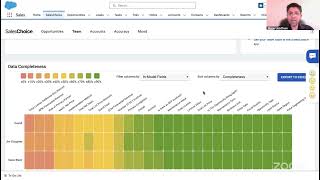
Absolutely. Happy to, Gerard, and thank you for having us. I want to thank both the organizing team and you personally for the invite. And so it's our pleasure to be here. Salesforce has been on a journey for quite a while and it has had several pivots as we have tried to make sure we address new uncertainty needs in the B2B industry. As you rightly pointed out, a lot of it goes back to our founder, Dr. Cindy Gordon, and her original vision that people could be much more productive if there was clarity and objectivity in what they should pursue and what the odds are. So, as we have evolved over time, we started off with a core solution called Sales Insights, which is a Salesforce app on AppExchange. And it's available in five to 10 minutes only, but it scans the entire data set to be able to give you several insights around how to improve your sales performance, some of which are pretty unique. And we have bolstered it recently with something called Mood Insights, which is a completely different dimension that has not been tried very commonly. And this is entity. This feature brings in the ability to take into account the motivation levels of your salespeople to see if your sales performance can be improved. Because sales data aside, your customers aside, at the end of the day, it's the sellers who often influence the success of a deal. And we have been successful and we have been endeared by our clients mainly because of this third component that we also bring to the table, which is to guide them, almost hand hold them as and when needed, to ensure ensure that everything is attuned to their custom business realities. And that's what makes the platform as a whole entirely customizable and flexible and unique to what challenges you are facing. So that's what SalesChoice does. And as we have testimonials and evidence, we have been quite prolific in the accuracy with which we are able to make our predictions. As Gerard Mentioned Predictability is key, but so is how accurate that predictiveness is. And we are probably one of the few solutions out there that have an inbuilt audit mechanism, which I will show you in just a moment, and that allows you to make sure that the solution is being checked, kept in check, and you can lead with trust, knowing that whatever it's saying, you won't be in for a shot later on. And that's one of the biggest things that it delivers to you, confidence and peace of mind. I won't go into too much details here, but this is just for you to internalize the recognitions that we have picked up along the way from some of the top analysts out there, as well as many, many different recognitions that we have received almost routinely over the years, all thanks to not just the pedigree of what we bring, but also the explainability of AI. And to those of you who may not be aware, explainability is one of the most crucial components when you use any AI software because it removes the risk of you being blindly led by the system. And we do it natively, without human bias, which is the most crucial angle to bring into the fold. Now, I've set enough of a stage and I would like to pivot to a demonstration of our software over the next 15 minutes. I will show you what it is that this piece does and how uniquely positioned it is. And, and I will pause for questions at the end of the session to ensure there are five seven minutes where we can address any queries that we have. Let me switch my screens to this one. To those of you who are Salesforce users, this would be a very familiar view. This is the Lightning Dashboard on Salesforce. It is important to point out that SalesChoice works equally well with professional or enterprise editions. It works equally well with Lightning or classic modes. So it's incredibly, you know, flexible. It can be installed in just five minutes through AppExchange and once installed, it scans your entire data set without any pre programming from our end or from any other external sources to ensure that it looks at your processes, your workflows, your sales data objectively, without bias and without limitations. That's the, that's a key point to note and it identifies the factors that are influencing your business deals to tell you five things. Number one, what is going to happen with your deals, both the forecast and predictions on every opportunity. Number two, why the forecast is what it is. Number three, what you can do about it. Number four, what your people are actually doing about it and how effective they are. And number five, how accurate are all these insights? As I mentioned previously, as you come into this app, you will notice that there are a few initial entries that you can play around with. You can choose any date range to see the predictions. You have a lot of preset options here, but you can go to a custom time period and choose any start and end date you want across the time frame. You can choose any user which is natively set up already on your salesforce as per your hierarchy. So anyone who's reporting into you yourself by default, you can choose here. You can play around with the target numbers. Hey, what if my target was twice what it is right now? What would happen? So on and so forth. And we can easily and instantly set up any number of other filters you would like to filter the predictions by. Now, that's one of the first areas of configuration where you're not limited to what you're seeing here. If you want to filter your forecast by industry, by opportunity type, by location, geography, by product line, just about anything, we can set that up immediately. And once you are done, click on Update and Sales Choice will tell you immediately whether or not you're on target or whoever you chose is on target to meet this number in this time frame. And exactly what is that number that's expected from the total pipeline that they currently have? It breaks this number into the amount that's already confirmed and the amount that's predicted to come from the open pipe right now. And it tells you additionally not only how healthy your pipeline is looking given the target you want to achieve and what's forecasted, but how healthy it should be for that particular team or user. And this follows the win rates of that individual or team because as we all know, to achieve the same number, different people require different size of pipe. And over here it contextualizes to give you that information to tell you whether your pipeline is healthy enough. Now, as I scroll down, I get to see a breakdown of the forecasted revenue by different opportunities, because we are in the opportunities tab here. And for each opportunity on my salesforce, I get to see the amount, the stage it's at, but right there as a comparison, what its odds of closing are within my chosen time frame. According to SalesChoice, the entire AI engine is built to give you this number and it's recalculating and recalculating the number every five minutes. So you know that whatever prediction scores you're seeing are extremely current and your forecast is being corrected and audited continuously with each prediction score. The Opportunities are divided into a clear ABC rating so that your salespeople can focus on A's, not worry about Bs or Cs, and their task is very clear. We have had CEOs, CROs who have declared to their team, just focus on A's and use your time well. And you also have a potential red flag on the close dates. Now this is important because typically close dates are always estimates, right? Sales Choice will point out if there's something wrong with any of the opportunities, whether they have been open for too long, as you can see in these cases, or in this case, opportunities where someone is being a bit too ambitious. In this case, as you can read in the note, it says, hey, opportunities of this type in your organization specifically take an average of 200 days to be 1. Michael thinks he'll close it in 82 days. You may want to look into it a bit. The idea is not to tell you what you're doing right or wrong. The idea is to give you enough guidance on where your sales team is deviating from what has worked for you in the past. And that's the single most crucial insight that is needed now. I talked about explainability a while back. We don't just leave you with the prediction score. All you need to do is click here and you get something called a playbook where sales choice explains itself back to you. In this case, as I expand and look at the playbook, Sales choice starts to show me all the different fields or parameters related to my opportunities that are driving this prediction score and the win spread or the values that have existed historically every time a divorce won. And it's doing that to essentially show me the combination of factors that typically signal that I'm going to win a deal of a certain type. And based on that, it then shows me what's going on with this deal right now and where I'm in range or outside of it. These parameters, and I should underscore this, they are entirely unique and relevant to your data set. They are not pre programmed. What you're seeing here are just examples. What you see in your Sales Choice instance will be completely unique and dependent on your own data set. And once you see this view, your sales team can actually enjoy a simulator where they can hypothetically make changes to some of these values just to see whether it increases their odds so they no longer have to guess. If you want to offer a higher discount, play around with it here. See for yourself whether the prediction score increases or decreases. If it doesn't have too much of an impact. No point leaving money on the table, right? And that is how you can better plan your sales opportunities. In addition to coaching items that can also be configured. Now we go into what your people have been doing and how do you track that. There's something called an opportunity history wherein you can see over time how this opportunity has trended in its odds and at what point what changes were made by Michael the sales rep. And you can see as I hover my mouse on the right hand side, you will see this detail keeps changing and that's because it's showing you what changes were made, at what point and as a result of those changes did it increase or decrease your odds of winning this deal. This is important because it tells you in a nutshell, the recency, the frequency and the effectiveness of every single action that a rep has undertaken on an opportunity historically. And it can also educate them or coach them on what they have done that has worked for them and what hasn't in the past, which is a natural self learning exercise. All of this allows you to not only know where your opportunities are right now, how likely it is to close, what you can do about it, and also what's being done about it in reality. If I now jump over to the team page, this is where I get to see a breakdown of the forecast. Not by opportunities, but by people who report into whichever user or team you chose and I can expand them to go into their view and so on and so forth, looking at how much predicted revenue is coming from each individual and what's the quality of pipe they are dealing with to achieve those numbers. This is important because people who are sitting on too many A's should typically perform much better than people who are sitting on too many Cs. So if you see a trend that's defying the odds, you know who your true over performers are or underperformers for that matter. Now when I scroll down I get to see something really interesting and this is my one of my favorite views in this entire environment and it's called data completeness. This is a view that our clients have used to single handedly improve Salesforce adoption to 99% levels. In this case, sales choice reveals not only all the fields that are in the AI model and therefore relevant for your opportunities, but also any other fields that you may have picked and chosen to track individually and for each of those fields. It shows you how complete or incomplete the data is across the teams or individuals. And you can go down right to the rep level, the entire organization if you will and it will show you who has missed entering data and where. And this view, if you bring it up in your deal reviews, deal review meetings weekly, people can know exactly where they need to go in and add in the missing data. It helps improve compliance adoption to unforeseen levels. Now, all of this relates to predictions at the end of the day. And as I mentioned, one of the most crucial aspects of any prediction is how accurate is it. Sales Choice doesn't hide behind any kind of wall or blanket in revealing how its outcomes are when it makes a prediction for any opportunity. As soon as that opportunity is closed, whether won or lost, SalesChoice will tell you whether it was right or wrong in its prediction. So to give you an example, in this case, if a project was won or opportunity was won and SalesChoice predicted over 60% odds of it being one, SalesChoice would say all right, I was right. Now this is crucial because at the end of the day, if there are inaccuracies of any kind, you can see immediately what's going wrong. So in this case, Salesforce said, hey, you know what? You have only 16% odds of winning this deal. You are most likely going to lose it, but you won it. So Sales Choice is saying, all right, I was wrong. This transparency can help you trust what the AI is telling you about your odds of an opportunity, even when you feel that it's not, you know, accurate because your understanding was different. This accuracy can also allow you, besides trusting the insights and acting upon it, to know immediately when the accuracy starts to falter and we can get it to work and look at what's going wrong with the model. Because sometimes it's not about model not working, it's simply that some changes happen in your salesforce or something that the model can take some time to learn. We can fast track it because we can see whether the accuracy is dropping at any point. That is what trusted certainty when it comes to revenue looks like. And Sage Choice will always show you not only how accurate it is in its predictions overall for wins and for losses separately, but most importantly, it will also reveal how accurate it is for each specific aspect of your organizational salesforce. And what I mean by that is thanks to the filters here. Imagine if you have set up a filter on products, right? Or industries or one of these sales regions or opportunity type or something. You can filter them to see whether the AI seems to have learned parts of your sales realities really well and is making accurate predictions but but not the other so much. That's the level of specificity with which this model can be tweaked branched. A lot of things can be done to ensure every unique part of your business gets taken care of. That is what the strength of the solution is. And that is the kind of flexibility the solution has been designed to keep in mind, besides being robust enough to be able to reveal accuracy to everyone transparently. 247 and that finally brings us to the last segment which is Mood Insights. Mood Insights is an add on feature on Sales Insights and what it does is it allows your people, your sales team at any point to go in here and look at this drawer and choose how they are feeling as well as the reasons why they're feeling that way. And the reasons can once again be configured as you wanted to and they can share more in open text whatever they want to express. All of which is anonymized for privacy reasons. The mood, the mental well being, the reasons, the grievances, anything that is shared is completely anonymous. Now what you get as a result is this Mood Dashboard and on this Mood dashboard you'll be able to see several really revealing insights. Number one, what is the mood share across the team? How many people are happy or not so happy? You'll get to see how the moods have been trending over time. You will see whether they had any churn risks because of increasing mood issues or reasons that are leading to the mood not being alright. And most importantly you will get to see whether there is any correlation between happier people and more sales. If there is no correlation, you know something. If there is a correlation, now you know one of the key aspects that you need to improve in your sales organization to improve performance. We also take all those comments that people have shared anonymously to show you the sentiment that people are expressing in their words, the themes that they are talking about and perhaps most amazingly thanks to generative AI, how controllable or non controllable they are. In addition to giving you reports in a CSV file where you can actually see those comments, you get a clear categorization and distinction of what the controllable negative comments are, meaning problems or potential problems that are within the control of your organization to rectify and that can singularly ensure that you manage risk. You reduce operational issues that may emerge, you extract the tribal knowledge from your people and you keep the retention levels high among the top performers and that encapsulates the awesomeness of what Sales Insights bring to the table to help you improve your sales performance in an all round way. With that, in the last minute I will Conclude with just a quick view as an example of some of the benefits that come out of this entire theme. As you can see in this view, this is an actual client data where you can see how the data completeness that I showed you a while back improved over time. Look at the number of red cells and how they kept decreasing just because they were able to track it in a regular routine way. And we have had many happy customers who have used us in many different ways thanks to the solution. With this level of flexibility, there's a lot you can do and has been used up with. But with that I'm now going to stop here and thank you. If you'd like to get in touch with us, here are the coordinates of our CEO. You can also of course visit www.sales choice.com to find all information you need. Thank you so much. And Gerard, back to you.
Well, I have a couple of questions and the first one is how accurate are your AI forecasts compared to a REP prediction or a C prediction?
There's a significant difference. What we have found, by definition, any human prediction has 50% odds of succeeding or not. If the sales teams are well organized and the reps are well aware that prediction score goes up to, to what we have seen around the 70% marks. What is still always missing is the element where a rep may be bringing some kind of emotional bias to the equation because they have a good relationship with the customer or so on and so forth. But there's so many other things that come in the way which doesn't get revealed and that's where more objectivity is needed. Our prediction scores typically hover around the 90% mark, which humanly it's, it's very difficult to achieve.
And next question is how much historical data do you need to train your models and how long does that process take?
That's a beautiful question. So the system has been designed to be as adaptable as possible. And one of the key requirements there that we engineered our way through over the years is to reduce the amount of data needed. The system can work pretty accurately as long as There are approximately 500 closed lost and closed win combined opportunities. Just 500 is sufficient loss and wins combined. And in terms of, you know, how much time it takes. That's the other beautiful part. 5 minutes to install and then our engineers make sure everything's connected. Well, we come back to you with those list of win factors to make sure that the AI is looking at the right fields of data. All you need to do is advise us whether any of Those are legacy fields or fields that are no longer being used so that we can clean that up and then you're ready to see the insights from that point on.
So the next question is, can sales choice identify and explain sales bias, for example, sandbagging, overconfidence, you know, salespeople.
Absolutely. Absolutely. So yes, it can. And the way it does that is starting with the close date, close date filters, when they red flag what they are. Red flagging is exactly that. Sandbaggers or opportunities that have just been sitting in the pipe for too long. So that gets addressed directly. Biases get revealed thanks to the playbook, because what happens there is you can immediately see whether certain kinds of behaviors or rationale are not working for you. And that's where a team is diverting because they're still focusing on it. And the best way of revealing bias is thanks to our ABC rating, because if a rep keeps going after a C rating, there is a reason to ask them why are they doing that when there's so many A's sitting in their pipe.
So is there a difference between a deal that is naturally slow because the company is slow to process everything versus a red flag?
Yes, that is another good question. So if we go back to the robustness of the AI model that I was talking about, one of the things it does is it takes into account because it's so custom and configured only to the customer's data set, it will look at historicals to identify those anomalies. And thanks to our multimodal functionality, which I didn't get into, I didn't want to get too technical, but multimodal functionality means that if there are parts of your business that are significantly different from other parts, and the AI has natively not already learned that, we can also force the model to evolve into two or more models looking at each of those realities differently. That's how flexible it becomes to exactly how different parts of your business sales work.
And the final question is, how do you drive adoption among reps or managers that have a distrust of AI predictions?
That's a very vital one as well. So there are two things that we do. Number one is once again, uniquely enough, we push all our scores into the opportunity object on your CRM from where you can extract it and use it in your own dashboards or reports that you custom made. So many of our clients have their own forecasting equations or calculations that are in place that they just start bringing the sales choice metric into. What that means is you're not married or tied down to The Sales Choice app. So for managers who may not start from a trust trusting position, you can very well make these scores part of their daily life without them having to go through any disruption. The second thing that we do is coming back to the audit mechanism, because the whole point of the audit is we all have our ideas, our perceptions, but at the end of the day, the only absolute truth is, did you win a deal that was likely to be won and did you lose a deal that was not likely to lose as per the AI? If so, then it knows something that we may not.
That's awesome. I have one more question. How do you measure success 90 days after you go live with SalesChoice?
Thank you. There are. The best metric to measure success with using Sales Insights is to look at your win rates. If you're using SalesChoice. Right. The entire purpose of this app is to ensure you focus on the deals that are more likely and therefore end up closing deals that you would have otherwise lost, either by taking timely corrective action or simply through sheer focus on the right things. So that is one of the strongest metrics that we look at. The second metric that we look at comes down to your unique challenge. If your challenge is not so much with win rate, but simply with process compliance, especially if you're in sales ops or revenue operations, then everything from the data completeness levels to the accuracy of the overall forecast, all of those things come into the equation that we can track for you. So it comes down to the objectives with which Sales Insights is being used, and accordingly, the metrics get defined.
Yeah, and Carrie dropped your LinkedIn profile, your link to LinkedIn so people can connect with you directly if they have any more questions. And I can't thank you enough for preparing this so diligently and presenting this so clearly, because we all need to move towards a predictive sales organization that is also authentic. And you also have a heart in this, where you measure the mood of the culture of.
The.
More from Gerhard



What Selling Looks Like When Your AI Agents Have the Context Your Sellers Do

Better Conversations, Smarter Support: Wearable AI in Business






When Scarcity-Built Systems Meet Abundance - The Judgment Gap in AI-Powered Sales Leadership
