Rewiring B2B Sales with AI
Jennifer from McKinsey maps how AI is reshaping B2B sales, from machine learning to autonomous agents. She presents a five-part framework spanning opportunity identification, go-to-market execution, offer creation, pricing, and enablement. Top performers now excel across the entire sales value chain, compressing cycles from months to weeks.
Chapters
Hi, Gerhard. It's such a pleasure. Thank you as always for having me. I love the Sales 3.0 Community. I can remember when it was Sales 2.0 Community. We've been together a while and what a pleasure it is to be joining you all globally. So good morning, good afternoon, maybe some of you good evening. Thrilled to be here. And Michael, thrilled to see you as well. Thanks for having me.
Yeah.
Well, I'm very excited to be here as well. And I attended the last AI Sales Summit in February where you gave a talk. And I love the opening thought was the art and science of selling.
Yes.
And the art is the humanity. It's our creativity and the conversations and how we go about preparing ourselves as professionals, then being in this, in this career. And then the science is all the AI enabling us, empowering us. Uh, so I took 2 pages of notes from your presentation.
Big work.
I'm looking forward to hearing about the progress. Excellent.
Well, well, you can keep me honest then, Michael.
Yeah.
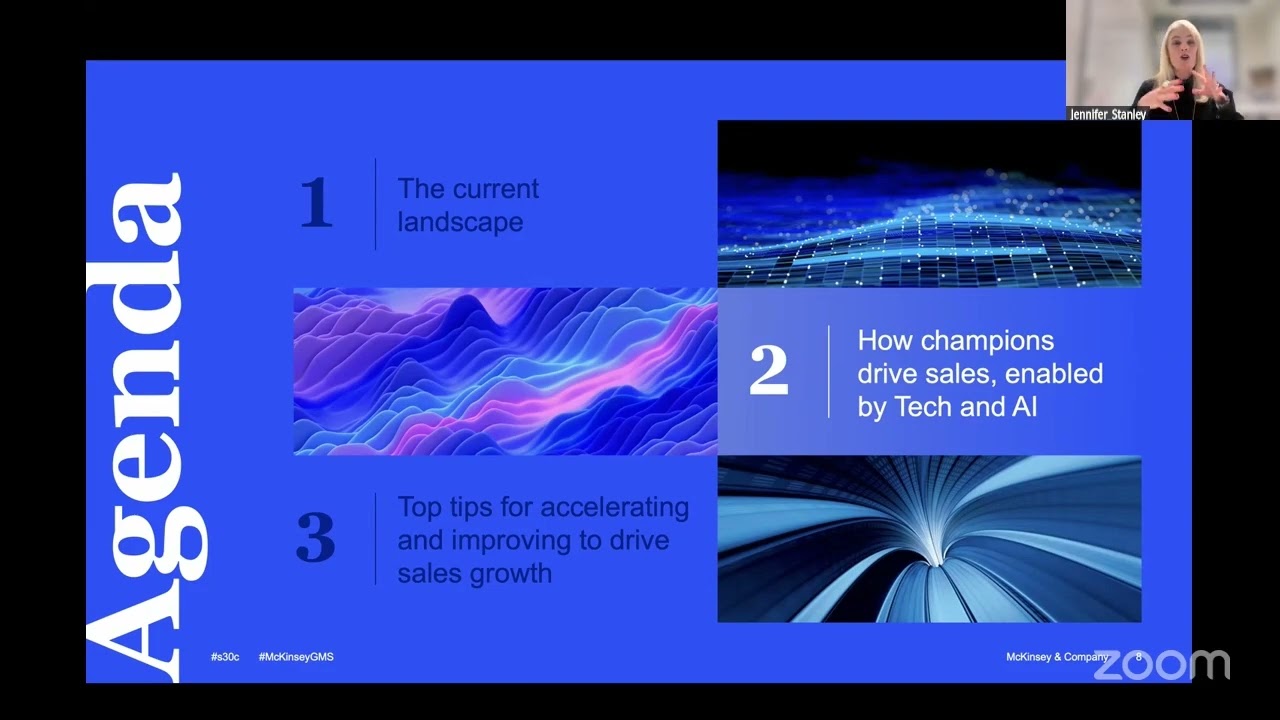
Well, let, let me dive in. There's 3 thoughts that I wanted to sort of share with you all in the group today. One is to talk a little, just a little bit about the current landscape. I mean, February feels forever ago when we think about what's been happening with AI in all functions, but particularly in commercial and in sales and in our function. So second, I did want to share then some very, like, practical examples of what other companies are doing to really drive change and to finally start seeing actual kind of economic and operational impact from those AI investments across not just the sales function, but frankly, like the entire, I'll say, commercial function. So if we include marketing and customer experience, customer success, those types of functions as well, and we start thinking a little bit more about things end to end and how sales plays in that whole ecosystem, I think we start to see some really exciting, exciting use cases. And then finally, just some top tips, even at the personal level, I'll leave you with for utilizing AI to really accelerate and drive sales growth. So, you know, just a reminder, I don't think anyone really needs it. But I'm always, I always have to step back and think to myself, because where we are today feels so different than maybe past technological revolutions, if you will. But really, it's been the past, call it 13, 14 years where we've seen step changes in AI in particular. So if we think about machine learning as almost the start point, and, you know, those 13 years ago, a lot of us in our organizations were really embedding advanced analytics that were grounded in machine learning. So improving our prediction and classification, getting a little bit better, for example, at lead generation. And that was pretty much the norm until about 6 years ago when generative AI came on the scene. And we were cruising along pretty well getting used to that, creating new image, creating new content, experimenting. And then boom, we find ourselves even more quickly in the transition to agentic AI with autonomous systems that are really planning and acting toward our organizational goals. And you all may be in different parts of the journey with the embrace or not in some cases of agentic in your own organizations. But I did want to say that one I just use the phrase AI, I'm actually talking about all of these. So machine learning, generative, and agentic. Although, you know, I'm fully conscious that a lot of what's most exciting is on the agentic front. One of the things that we've seen recently in our McKinsey research, and Gerhard, thank you for mentioning this, about every year we release what we call the B2B Pulse at McKinsey. And this year was the 10th anniversary of that. It came out at the end of May. And basically what we've been doing for 10 years is assessing buyers and sellers on their experiences and then trying to match up what the customers, the buyers are saying they are both doing in terms of interactions with companies and what they would prefer to do in their own buying cycle with then what sales organizations themselves are doing to respond to that customer demand. And every year we break out like, what is the cohort of sales winners doing that's very different from everyone else to reach those, to reach those buyers. And for 9 of the last 10 years, the theme was basically you had to be good at like really good at 1 or 2 things. And if you were okay at the rest, you could actually launch your organization into the top 10 or top 20% of growth organizations. And by that, I mean, you're consistently outgrowing your peers by call it 5 to 7 points of, points of net revenue. What we found this year is that that previous kind of ceiling of being really good in one or two areas and being okay at the rest, that's the new floor. Now what we're starting to see is that to really outgrow, you have to be able to do everything that you see on this page at a pretty high level. So it's almost like be great at it all. Be great at responding to your market dynamics fast and in a very nimble, in an agile fashion, meaning product development, solution innovation, happy happens at a clip that's much faster than it used to, because you can now get your voice of the customer a lot faster than you used to. Omnichannel orchestration, utilizing e-commerce, now utilizing agentic commerce, your partners, your inside sales, your field sales, like every type of way that you could possibly imagine going to market, being really good at all of it and making sure your customers can engage with you how they want to. That's also now just an expectation in the marketplace. Third, this one was really interesting to me, hyper-personalization. I think we all experience as consumers, right, what it feels like to be targeted with hyper-personal messages. But interestingly, business-to-business buyers, they want and expect that too. Because part of the impact of generative and agentic AI means that you should be able to know your customer very well before you even have an initial interaction with them. And one of the things we saw in the research was that companies that offered consistently hyper-personalized messaging in every single sales channel to market outperformed by about 10 points on the growth dimension versus, versus others. So this was a real kind of winner, if you will, this past year. And then finally, pricing flexibility and how you think about the demand for talent. More and more customers are expecting sales organizations, again, empowered by AI, to be able to offer much more customized pricing that matches their needs, their terms, their conditions, the quality and status of the relationship. So kind of the notion of like there's a list and then there's, you know, different ways that we can shape price, but it's a pretty fixed menu. That used to be yesterday's ceiling. Now that's the floor. That's kind of bare minimum. But getting really creative and appropriately and of course lawfully creative with pricing is an expectation. And then all of that leads to a demand for talent in the sales function and frankly all of the commercial all of the commercial functions that requires a really somewhat detailed understanding of the technology behind the tools, and then an ability to very rapidly translate insights that you're getting from the tools back out into the marketplace in a compelling way. So this year, you know, I, the way that I think about it is we just saw this massive leap in expectations from customers and companies who can meet or exceed those expectations. It shows up in their revenue line. Companies who are barely hanging on or thinking, okay, we'll wait, or budgets are tight this year, or, you know, whatever the reason is for not investing behind improved technology, improved tools, those are the ones that are really struggling to get the growth. And if I really kind of step back and think to myself, okay, of all the other things you could be doing in your organization, is reaching the new seal ceiling actually worth it by investing behind new technology that helps you drive the growth engine? The answer to that is absolutely yes. A dollar of organic growth for most companies, public or private, will actually result in 2 to 3 times higher valuation than a dollar of cost savings. So back to that, like, where should we spend our budget? Or maybe this is too expensive. And then as we kind of move on through, we also start to see that you end up really getting outperformance on, on the growth function, when we look at better returns to shareholders. Again, this is both public and private. The data is based on public, but anecdotally, we can see from, from private ownership, it works there as well. So if we translate that into our world in, in sales, what are we really starting to see? So all of the numbers on these, on this page, they're not guesses. They have been demonstrated in organizations. They've been measured, they've been verified. So if you're starting to wonder, like, how do I make the case to my company's CFO or other business leaders for really doubling down on the promise of AI in the sales function, this is the page to take a picture of and share, share with your colleagues. Because what I've— what I find is there's a disconnect between a lot of the conversation that I hear anyway externally, and I'll be curious to hear from all of you as well, about AI as it relates to cost savings, as opposed to AI as it relates to either growth Or perhaps, you know, increased effectiveness for us as sellers, having better conversations with customers, more consultative conversations with customers. What about the customer experience, enhancing that and creating, you know, increased loyalty? How about moving customers through your sales cycle faster because you've got better campaigns, you've got better content, you've got better and faster production? There's so many more ways to think about and benefit from AI and the selling function than as like something that just drives efficiency or as a potential cost lever. So, for me, I'm much more interested and excited about the growth side of that equation and the experience side and the human side of that equation. And so, I'm looking forward to hearing, I think, the conversation become a bit more balanced as we start to see more data coming out from more companies who are actually benefiting from AI in that way. Here, I just collected, you know, a few, a few quotes to sort of reflect again, at least what I'm seeing and hearing, hearing in the marketplace. And it kind of comes back, if I take it all together, to what Michael was saying at the beginning, is that there is a science to be benefited from here. So AI is an asymmetric amplifier. But there is also still an art to sales. And sales is still sales. It's still inherently a human-to-human relationship. business. So matching up that asymmetric amplifier or the freeing up of a day of a week of a salesperson's time, as we heard, as we hear or see from Hyatt, with then the ability to go much more deeper on relationships and really drive competitive, really drive competitive advantage. I think you all have been hearing at Sales 3.0 this fall, this notion of like the humanity in sales alongside the tech becoming more and more important. I actually think we're going to continue to hear even more on that, even more on that dimension in the coming months. So that's kind of our current landscape. There's just a lot going on. I've got a page coming up later that I shared back in February, but I updated and shared. I'll share again with you all here in a bit, which is all the different technologies that are available at different points in the selling cycle that you might be able to benefit from. And just changing that page in the last few months, or I should say updating that page in the last few months, brought some new ones onto the scene. So stay tuned in a few moments for that. But let's dive into, you know, what does it take to really, really benefit from AI in sales and to see those kinds of results that I was just sharing? I think 5 things need to go right. And each one of these 5 areas can have different types of tools and analytics technologies merged together to be able to deliver, deliver against the outcomes. So first is all about getting to the right opportunities. This is your demand gen engine. So lead generation, lead prioritization, making sure that the right type of prospects get matched with the seller who's most likely to convert those prospects. And in some cases, that may be an agent, it may be a human, kind of depends, right, on your own marketplace and the types of customers that you're targeting. Second, you've got to be able to reach those right prospects with the right go-to-market model. And so this could be where your omnichannel orchestration makes a really big difference. Where are the places that humans are the highest and best use resource for your organization. It could be in connecting with your key and global accounts. It could be that e-commerce and agents might be more well served to transactional sales where maybe it's just an individual product or it's a quick refill and the humans can continue to focus on the more complex sales. 3, with the right offer. I think we still see a lot of generative AI, frankly, in this space helping companies produce better proposals, better account plans, better value value propositions, and then the ability to quantify those value propositions, and then lead to getting to that right price, which is number 4 here, and offering customers something that is much more tailored to them. And then number 5, I say that like the thing that must go right is like doing all 4 of these every single time for every interaction and every market that you operate in, in every sales channel that you have. And so this is where performance management, tooling and enablement, training and capability building come into play. And in the last few months in particular, I've seen many more companies getting excited about and actually not just experimenting, but using, for example, Agentic AI to help train their salespeople. I was talking to a CEO who was sharing with me that in one part of the organization, the time to onboard a seller to get to full ramp of ARR capability, it used to be 6 months, but now using autonomous agents for coaching, digital coaching offline before they get the together with their human sales manager, they've been able to cut that ramp time from 6 months to 3 months. So imagine the power of that in your organization. What would it look like to cut your new seller onboarding and ramp time in half? To me, that's a really exciting, exciting innovation. And I also think it's helpful for newer talent as well because they're getting the benefit of being able to get out into the market faster than any of us did. I know certainly for me when I was an inside seller, many years ago. So those 5 things need to go right. And good news, right? Agents, if we think just about agentic AI, have a role to play in all of them. And I would encourage all of you to think about these a little bit less as like the use case for which of these 5 areas and more about like, how can you knit different ones together to fundamentally change the shape of your sales pipeline? So for example, Could you put a market scraper together with an opportunity finder together with a campaign manager? And all of a sudden, your kind of awareness all the way through to proposal part of your sales pipeline goes from, you know, taking 4 or 5 months for an average deal to 4 or 5 weeks for an average deal. I think that's actually one of the ways to think about the promise of agentic AI across these different areas in sales is not isolated use cases, but more from like an end-to-end workflow. And how do you put things together and mix and match in different ways? And I think that's one of the exciting things that I'm starting to see as well. And then practically what it all means for sellers. This is where it starts to get truly, I think, exciting. And I happen to be of the camp that it means sales is a much more exciting profession to be in. It means that we all have much more challenging jobs to do and not that sales is getting replaced. Placed, because you can imagine generative AI giving you insights that then allow you to expand your share of wallet because you can proactively go propose to customers with confidence now knowing that you've got a message and you've got a product that they will be excited about, all the way through to getting to negotiation and closing, knowing that you are more closely matching your customer needs with the offer that you have on the table. at a price that is fair for the customer and also margin optimized for you. And that to me is like even 2, 3 years ago, something that not every organization could transparently show to a salesperson the role that they were playing in making that margin optimized outcome happen. And all of this is starting to now happen working alongside agents. Curious to hear from some of you, what are the new AI roles that you are seeing in your organization and what are some of the new human roles that you're seeing inside your organization, because they're all changing. For example, in technology, I'm starting to see actual go-to-market AI engineers alongside the forward-deployed engineers, and their whole job is to manage both the humans and the agents now in that omnichannel orchestration. So that's a new role, much like an AI agent for a BDR/SDR is a new, is a new role. But this notion that somehow it's just like the individual role of the account manager or, you know, the inside sales rep that shifts. I don't think so. I think every role in sales is getting upended by the need to work alongside AI agents and also the need to use still machine learning and generative AI in our own work as salespeople. So if I sort of sum up what I think, you know, who knows, I don't have a crystal ball, but I try sometimes. Tech and AI are going to continue to really do over, you know, let's call it the coming 6 to 12 months and what humans will continue to need to drive. A lot of it will be much more of the rote work that is important and necessary, but doesn't really need a human in the loop anymore. So, the initial gathering of account intelligence, the initial setting of a deal or a list price, the initial coaching for a salesperson who might be nervous to get in front of their new manager. All of that tech and AI can do. On the other side, we're all still charged with, you know, bringing the humanity to the equation of relationships, of navigating and understanding the unstated needs in stakeholder networks, really thinking strategically about an account's context, checking the information that AI is providing us to be sure like it makes sense and it's right, right? It's not always correct. And we have to have that ethical check, check on all of it too. And then finally, like Like someone's got to manage these AI agents, and those someones are you and me. Wanted to give you a sense of maybe this combination of what the tech is doing and what AI is doing into three archetypes. And I shared these back in February, and I'm sharing them again now because I think we're actually really starting to see more and more companies fall into one of the camps. And that is maybe what I'll call like a people forward or people first. So really trying to embrace AI and end-to-end workflows. So like at T-Mobile, that is. Coaching for 35,000 frontline sellers that's powered by Agentic, or it is rewiring processes that you have been known for for years. So, for example, supply chain and warehousing at Amazon. And also within Amazon, they've rewired their go-to-market organization with their own tools and with others' tools in the AWS part of the org. And you can read that case study, by the way, on McKinsey's New at McKinsey blog. If you're interested to hear how they did it. Klarna has really completely rethought the customer service function. And they've got, I think, agents that represent about 700 FTEs. But that doesn't mean FTEs went— actual humans went away. They're just doing different parts of the customer service job now. And then finally, and I know some of you out there belong to this camp, these are the AI natives where you started with entire workflows and in some cases entire functions like at Wonderful AI being completely agentified. And the humans are managing, right, those managing those loops. So, it doesn't mean that you wouldn't bring AI to different kinds of core processes or empower— you would only do that, or you would only use it to empower your people. But I just wanted to kind of showcase a few of these to give you some inspiration about what you might be able to do at your company. All of these archetypes are showing meaningful impact. So, this is new since, Michael, since February. Like, what are we starting to see when we actually go in and invest investigate changes in pipeline, changes in conversion. We keep hearing that AI is saving sellers time. I also hear that it doesn't actually save time because the time gets repurposed, but that's actually the point. So the time is still saved, you're just using it for something else. But we're seeing that now. I mentioned the, the onboarding changes, but even in just a few short months where we are tracking meaningful impact in selling organizations. And then one of the things, and you all will have these available, I did this go around is to include a few case studies on those different areas, 5 different areas that I said you absolutely have to get right. So one of these is a financial services organization that really rethought their entire demand generation engine. So lead prioritization, you know, all the way through to getting to an ideal customer profile, completely benefiting from all types of AI in that transformation. And then that ending up resulting in faster conversion rates, more valuable leads that are converting. And also just some of the basics are even improving like email open rates because the content is more hyper-personalized and meaningful to a customer. And then I've got 2 more, which I won't go into detail here. But again, you'll, you'll have them available. But you know, one looking at in a global professional services company redesigning their go-to-market model. And then also looking at a tech— I should say AI-native fintech, who still struggled with the normal things that every other company struggles with when you are rewiring your sales function, but really rethinking their performance management engine to help get it right every single time. So, maybe some tips for you to make any changes in your organization stick. And these are all, again, researched and backed up by the numbers. The first, you cannot get away from a business-led roadmap. Like, why are you using AI in a particular area in sales? There's got to be a North Star. There needs to be a bigger reason. So you using it to improve your customer experience in mature industries so that you reduce churn and you increase loyalty. It could be You are a fast growth unicorn and you need to continue to find new customers. And so that net new logo engine needs to really be highly powered, whatever it is like the outcomes that you're driving for need to guide everything. And those outcomes should be big ones. They shouldn't be, you know, save the average seller 3 hours a week. Like that's not what I'm talking about here. That is one outcome, but it's not the big picture. Second, to the point of like humans managing agents, having new roles for your humans, having new roles for your agents. But a complete shift in the talent and operating model is actually really required. And also maybe rethinking the traditional capabilities that you might be looking for for salespeople, thinking about like their affinity for technology, their curiosity and willingness to learn, like those types of intrinsics are becoming more important because the job itself is changing so quickly. And so you need people who are able to change, change with it. The third shift there's no getting around it. Like, if you're in an organization where you would say, oh my gosh, our data foundation is a mess, what can we do when the data is a mess? I'm here to tell you, like, everyone's data is a mess. Get some of it cleaned up and just go. I know that sounds like it's easier said than done, but actually it really, really is important having that foundation, that spine of enough clean data, enough workable data is really required. And then, you know, as we think about some of the things that often get skipped or not thought about as deeply when you're trying to make a change in your organization stick. One is that, you know, the design itself of roles needs to be thought about with an eye toward career pathing. So it's not just the new roles and the new agents, but like, where do they play in someone's ability to progress in your organization? How attractive can you make that career path? That design or those design choices are actually quite important and seem to be a difference maker for companies that get better talent than those that don't. And then finally, like incentives and how you role model for people, encourage people with carrots to try to work in new ways and to benefit from technology in new ways. I would not underestimate the importance of the change management piece. In fact, we have like a 3-to-1 ratio that I would share with you, and that means For every $1 you're spending on AI-enabled technology, you're probably going to spend $3 in actual either cash cost or opportunity cost on the change management to make it happen. I often get asked the question when thinking about making these shifts, should you build or buy new technology? I, you know, there's no right answer to this, unsurprisingly. Maybe one thought I would leave you with here is, as you think about a buy question, looking at availability, looking at your own in-house capabilities, what you have that's proprietary, how tough would a new tool be to integrate into your existing stack? Like, that's all important to consider. But maybe step back and ask yourself, what is our source of distinctiveness? What is it that we do better than anyone else? What content comes out of my organization that I can actually meaningfully monetize? That's probably more your answer on build it versus buy it. And I mentioned earlier, I had a slide for you that I updated on what could you buy if you were interested in the buy side. So what I've done here is I've lined up a bunch of different organizations that offer solutions. Maybe some of you are online today, all throughout the entire sales cycle, and some of them are privately owned and have had a ton of investment put into them. That's are stacked down the left-hand side. And then of course, some that are across the bottom are ones we've known for a while, like Salesforce with Agentforce. But this is a good one to take a snapshot of. So maybe I'll just wrap with what could you do as individuals? And Gerhard, I see you've come on, you always have great questions, questions for me. I have 6 ideas for you all. But maybe I'll pick out just one in order to, in order to really focus you in on something practical. And that's number 3. If you actually don't know where your salespeople spend their time today, go find out, because that will be one of your biggest clues about the benefits that they can reap at different points in the sales cycle from AI. So I will leave it at that. I would love to stay connected with you. You can click the QR codes here for some of the research or to find me on LinkedIn.
Thank you, Jennifer. That was outstanding. Um, questions are pouring in. Um, Bella is asking, is it a good practice to build agents for each stage of the sales process? If not, what's a better framework to build agents?
That's— Bella, thank you for that question. I think the answer is we're not entirely sure yet. And the reason I say that, because there are some agents that can span an entire Workflow, and so we at McKinsey would typically say it's better to span the entire workflow. So that would say eight, you know, and when I mean workflow, that often goes across more than one stage of the selling cycle. So if you think about demand gen can go all the way from initial awareness building that's more often owned by marketing all the way through to like a sales qualified lead, that entire workflow may benefit from multiple different agents. Now some of them might be individualized in a single part of the sales cycle, but I think you should think about it from the workflow and then back into. And then when you back into it, it can help to have individual agents or groups of agents whose job is that one part of the funnel, because you can then more easily manage and measure the impact of it. But they should exist on a continuum of a workflow. They shouldn't exist in an isolate, like just in the isolated single stage of the sales funnel.
Who needs to be on the AI adoption team to help ensure success? That's a question from Trish.
Oh, that's interesting, Tripp, because it sort of presumes, I think, that like there's a team that's responsible for it and the rest of us aren't. And so I kind of think that like we all need to be on board, on board that train. But if you're really trying to get your team to embrace use— usage of more of these tools, every single sales manager. So if you have frontline folks or inside folks rolling up to you, you're going to need to be part of that adoption team. And frankly, if you're an SVP or a CRO, you absolutely better be because the role modeling needs to start at the top.
Robin is asking, where do you find the latest technology to support sales teams?
Whew. Uh, Robin, million-dollar question. Remember that page I showed you with all of those different technologies? Truly, like, it is, it's hard for me to, it's hard for me to keep up. But I think, um, one of the places you can go to, to, um, like often understand like latest and greatest are either your existing CRM provider, or if you work with a hyperscaler, you know, like a Google or an AWS or Microsoft or someone like that, they also see a lot more than any of you in your own individual organizations will ever see. And so that's actually a question for them. And by the way, it's one I ask them all the time too.
So we need Google Maps for AI solutions?
Kind of something like that. Yeah. I mean, it's, it's, it's happening so fast. Like if you can't keep up, you're not alone. None of us can.
I recently did a search for AI simulation tools, and the first go around I found 21, and then I used other AI tools, and all of a sudden I ended up with 65. But I know there are probably over 100.
Oh, easily, easily, easily.
Yeah. Ali is asking, what is the reliability level of AI search results data? Is it times we get different answers from AI versus an experienced person in the field?
Yes. So maybe 2 parts to that question. The first is just like the LLMs themselves. By the way, I've done this research for some of my clients here at McKinsey to show how their own content and their products get ranked and, and rated differently depending on the LLM that you're using, because they all have— their underlying technology is built a bit differently. So you might rate first coming out of ChatGPT, but fourth in Perplexity, or first coming out of Claude and third out of ChatGPT. So I think this is— we're at this new era of if you go all the way back to search engine, early days of search engine optimization, like how do you get your tagging right to get picked up correctly? It's the same problem. It's just now manifesting itself in the LLMs. So moving from SEO to GEO and thinking about like what are the drivers of your rankings in GEO is actually a really important capability, but it's not that different from you know where we were 20 years ago with with SEO. It's just a different source. And then your point about the field information, I so don't kill me for saying this. I know some of you are out there going Jennifer, I so don't want to do this, but like this is a reason to put your notes. Notes, your own thinking into your CRM, because most of them connect now with enterprise versions of different LLMs. So if you really want to get like great intelligence on your customers that then feed account planning with a great generative AI tool, you need the combination of the seller's knowledge and the institutional knowledge with the external research. And so they have to put it in somewhere. It can't just stay in their head.
So Jennifer, let us know when you find an AI tool that creates more time so we can have better conversations and longer conversations.
I'm trying. I've, I honestly, by the way, I've spent more time myself this one year in training on tech tools than I have in like the last 6 years added up together. So like, I'm trying to practice what I preach here. I probably, I use like 4 or 5 different tools now on a regular basis every day in my own workflows, and I'm still learning about That's awesome.
Thank you so much. I— we have more questions, but we've run out of time. We— our next session is going to start in 5 minutes. Michael, you have the final word.
Jennifer, outstanding presentation, and you definitely demonstrated the progress and the acceleration of AI increasing and improving sales. That was there. I was, well, I was curious how you are seeing the sales cycle being accelerated and if you had a measure or a number on that. Was that in, was that in the numbers you presented?
Um, so it's different for every company. I mean, everyone that we've, we've researched has some element of shortening of the velocity, but I would say that actually that, that's the thing to measure, the 3 Vs: volume, value, velocity. So are you getting more leads in? How much faster are you getting them through? I've seen everything from 20% faster to double So 200 times faster. And then value, what's the dollars that they're actually worth? So all 3 of those we're tracking.
Making the right offer holds the value.
100%. Yeah, that's great.
Thank you, Jennifer.
Wonderful.
Thank you very much, Jennifer.
More from Gerhard



What Selling Looks Like When Your AI Agents Have the Context Your Sellers Do

Better Conversations, Smarter Support: Wearable AI in Business






When Scarcity-Built Systems Meet Abundance - The Judgment Gap in AI-Powered Sales Leadership
