Sales Isn't Getting Easier. Here's How to Lead Through It.
Justin Zapula explains why B2B sales has gotten harder: effort no longer works because process, skills, and technology are fragmented. Leaders need to connect all three with AI as the glue, embedding coaching into sellers' daily work. His platform, Genius, uses AI to decode body language and deliver feedback tied to real call data.
Questions this video answers
Nearly 50% longer — from 83 days to 123 days on average.
Over 70% ("70+ percent").
71%.
About 35%.
74%.
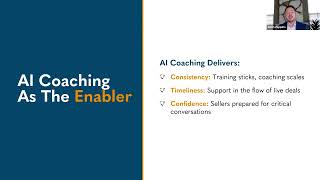
You excited to be here and share some insight on a super important topic? So, good afternoon, everybody. My name is Justin Zapula, and yeah, I'm the co founder, managing partner here at Janic Performance Group. And for the last 20 years, my team has been working with leading sales organizations, you know, all over the world, helping them improve sales performance. And through that work, we've gained a very unique perspective on how selling is evolving and what's working right in terms of driving sales performance. And over that time, one thing has become increasingly clear as selling continues to get more and more complex and ultimately harder to navigate. So let me, let me share a few data points that illustrate just how much things have changed just over the last two years. Okay. B2B sales cycles have stretched nearly 50%. Now, it used to take 83 days to close a deal, now takes an average of 123 days. And the typical B2B buying decision now involves two or more departments and more than seven stakeholders. Millennials and Gen Z. They now make up 71% of your B2B buyers. And those buyers, they continue to do most of the work on their own. Most sources agree 70 plus percent of the buying journey happens before the seller's ever invited in. So sellers have more to do with less time. And even a recent Gartner survey showed that 74% of sales leaders agree that deals are just getting higher, harder to close. Now, these shifts aren't happening because sellers and leaders aren't putting in the work. In fact, most teams are working harder than ever. Organizations are implementing initiatives and doing more around driving performance. But the issue is that the environment has changed faster than our systems have in the way we've built our systems. They weren't designed for the reality of that sellers face today. And that's where the breakdown happens. So today I want to do three things. First, I want to unpack why selling has become more challenging than ever. Second, I want to explain why the fixes we've all tried haven't fully solved the problem. And then third, I want to show what leaders, revenue leaders, can do differently to restore that clarity, the consistency and confidence in their teams. So the question is, why is it getting harder? Right? So let's take a look at what's really driving that complexity. First, buyers have fundamentally changed in a very big way. As I said earlier, you have a new buyer demographic, right? They're more digitally savvy. They do extensive research before ever engaging a seller, and they expect strong value in every interaction. They don't want pitches or canned Presentations, they want insights, they want value, they want partnership. And second, sellers are drowning in disconnected systems. We see this over at Janic, we see this over and over again in our client organizations. In fact, Salesforce just found that sellers spend only about 35% of their time actually selling. So the rest, the other 65% is consumed by admin reporting, toggling between tools, searching for that critical information, preparing content, and many, many more non selling activities. And third, the training and enablement initiatives we all been working on, they fade quickly. We've all seen it. A seller leaves a workshop energized, but without reinforcement and without that consistent coaching, that knowledge doesn't translate into those permanent behaviors. And sellers, they just go back to what they've always done. And then finally, deals are stalling. Forrester reports that 70% of sellers hit multiple stall points during the sales process. And this can be difficult to manage. So the pipeline, it looks full, but the velocity has come to a screeching hole. So the truth is sellers aren't failing, the system around them is. And we've been adding point solution on top of training, on top of tool, on top of messaging and enablement and more tech. And the weight of these systems on our sellers and is heavy. But they're all fragmented. And when they don't show up in the field at the point of execution, performance breaks down. And that is the execution gap. The point where effort and results fall out of alignment. Now the gap is real, but it's not permanent. And this is exactly where leadership needs to step in. Because the execution gap, it won't close on its own. Sellers can't fix it by just working harder and doing it more. Training or enablement initiatives alone won't solve it either. It's imperative that leaders move in not just to manage performance, but to do it in a very new way, to orchestrate it. So here are the three essentials that need to be carefully orchestrated to really drive the execution that we're all looking for. And you've seen these before. But first, it's is process, right? That strong process gives the structure, provides the clarity that guides that entire sales motion. So you get that consistency and that playbook to follow. Second, our skills. Sellers need incredible skills. They have to have the ability to build trust, to differentiate, to create value in every customer interaction and ultimately win that moment right when it matters. And then last is technology. And technology should make sure that the process and the skills come together and actually show up in the field, embedded in the workflow, in the tools. Ideally, that Sellers already use today. The challenge is, and what we see over and over again is most organizations treat these in silos. Training is one initiative, process is another. Technology sits somewhere else. And to a degree, they're managed separately. So the system, when the system fragments, execution breaks down. So leaders need to put the seller back at the center point and carefully orchestrate these essentials in a whole new way. And the leaders that do, they create a multiplier effect. They turn what sellers know into what sellers consistently do. So, and that is the leadership imperative. So let's unpack this more. So what is. What exactly is orchestration? Orchestration means bringing process, skills and tech together in the daily flow of work, not as separate initiatives, but as one system that supports sellers where performance actually happens. The point of execution. Now, we've all seen it, right? Two sellers on the same team. They've gone through the same training, they follow the same process, they're using the same tools, yet their results are completely different. One consistently advances, deals and wins, and the other misses the mark. And as a leader, I know you all look at this and you're wondering, what's the difference? Right? Why does one thrive in this environment and the other stall? The answer is execution. One seller gets the right behavior to show up in the field at the point of execution, and the other doesn't, right? And the real job of leaders today is to close that gap through orchestration. So orchestration is delivering personalized support. So every seller can perform at their best in the moments that matter most. And personalization is key because every seller is different in terms of what they need. But also, what's even more different are your deals. If you look at the reasons why you win deals or why you lose deals on an individual level, they're all different. They're all mix of different things. So it has to be personalized to that scenario and to that seller. And bringing all of this together through carefully crafted orchestration is powerful. But to make it stick, we need something else. We need something that helps us pull this together and deliver it at scale. And that is where AI enters the conversation. So AI helps us solve this critical problem we've all been facing for years. It's coaching at scale. And as leaders, we all know the value of great coaching. We all know what great coaching looks like. The problem is, how do you deliver it consistently? Right? How do you deliver it at the right time? Across every seller and on every deal with AI, AI enabled coaching delivers three critical outcomes. First is consistency. So every seller has access to consistent coaching not just when the manager has time, all the time. In every critical moment, when it's needed most, there's an always on sales coach right by their side. The second is timeliness. So now the guidance appears in the flow of work, exactly when it's needed. For example, a competitor enters a deal, a battle card appears. Right. We lose a key contact in our buying group. A relationship map opens up, A seller is about to make a high stake sales call. A custom AI based role play around that specific scenario appears for practice and feedback. So it's the right guidance, training and practice surfaced in the right moment. And finally it delivers confidence. Sellers feel more confident than ever. They feel prepared. They're not guessing, they're not searching, and they're ready to win that moment. AI becomes this connective tissue of that orchestration layer, the piece that finally makes execution real at scale. And this is how leaders move from simply managing effort into orchestrating performance. So the truth is, sales isn't getting any easier. And that stubborn fact probably won't change anytime soon. But leadership can. Leaders who orchestrate process skills and technology powered by AI create teams with clarity, consistency and confidence. Now Yannick, we've seen these challenges up close and we knew a different approach was needed. And that's why we've developed Genius with a J. And Genius is our AI enabled platform designed to orchestrate these essential capabilities directly in the flow of work. And the reason why I'm sharing all of this with you today is because the results that we're seeing with clients are incredible. I mean, they are truly, truly breakthrough. We've been doing this for over 20 years, delivering great results for clients, but this is something different. Pulling this together delivers something special. So I'm incredibly excited to share this with you today. Now of course, if you'd like to explore more about what this could look like inside your organization, please reach out to me. I have my LinkedIn link here. You have my email. Email me directly. And also there is a QR code. If you scan that QR code, we've put together some great resources that will help you understand this a little bit more, how it can be implemented inside your organization and some, some additional tools there. So thank you everyone.
Dustin, thank you so much. You know, I love what Tara Gamble put in the chat. She said, you know, sales isn't getting any easier. We a lot better so every day, right? Right. Gehard.
Yeah. I have a specific question for Justin. You, you mentioned the role play and I have actually two questions. How long does that role play last?
Typically role plays are three to 15 minutes, I would say, on average. I mean, there's no, there's no real endpoint. Right. It depends on the, the scenario. The beautiful part about these role plays is they now gather context, right? It's looking inside the CRM. It sees all the emails you've sent. It can look at the call listening tools, it can get your call notes, sees the information that you sent. It knows the next moment you're about to have. And now instead of making that big sales call, you can practice that big sales call and get some feedback right there. So whether you're, you're trying to practice something short, right, Something small or a longer presentation, it can, it can go longer.
And is the role play audio and video or just.
It's both optional? There's an audio option and there's a, there's an avatar based kind of video option.
And the second question is about the feedback. What I'm. Am I learning from the performance that is going to help me do better the next time?
Ask that again, Garrett.
How, what kind of feedback do I get? What is that tool teaching me? Yeah, is that feedback quantitative, qualitative, better scripts?
What is the Great question?
Prescription for improvement?
Yeah, great question again. What's the beauty of this is context. So with us at Janik, it's looking to the sales methodologies that we train. Right. The skills and the best practices. But our clients are also putting in their information. So there's a section called Teach Genius where you teach it back your information, your profiles, your customers. So it's teaching back to the messaging that clients want to see in the field. It's skill sets and frameworks. It's really pulling this together and giving you that actionable feedback that sellers really need in that moment.
And final question. Is there a tool that you're using that decodes body language, doing that role play?
Does the tool decode body language? Yeah, absolutely. It's looking at your body language. It's looking at not just what you say, but how you say it. It's got the sentiment analysis, the US and the ums, and all of that is pulled together as part of the overall feedback.
That's awesome.
Yeah.
It reminds me, Gerhard, the whole thing of personality tests and if applied correctly, wonderful. If not, not so great. And there are certain things that inauthenticity people do that endears them to us. So I'm curious, are you, are you advising or counseling people to take that into account when they get that feedback? How do you encompass that, that piece of it Justin?
Yeah, 100%. So the system's looking at two things. One, it's looking at the seller profile so we're building in the competencies, the skills that are important to that seller and then it's pulling in all the data points around that specific seller so it knows what needs to be worked on, what's lacking. Right. And what's showing up. And two, for customers, you can continue to add more information on that customer to teach it for context. So if you have a common personality style of a business oriented or visionary, whatever that may be, that additional context you put in the system personalizes that feedback and the coaching. So it's just phenomenal.
Well it brings me back to a quote I read once from General Suvarov. He was a general in the Russian army and he said train hard and fight easy.
Yeah, I love that.
I love that. No question.
Justin, thank you so much for joining us. And now we need to set up this agentic army that we're going to have around us doing all the things we need to do to be effective for us. So thank you again. Justin thank you. Gerhardt.
Yes, thank you for having me.
More from Gerhard



What Selling Looks Like When Your AI Agents Have the Context Your Sellers Do

Better Conversations, Smarter Support: Wearable AI in Business






When Scarcity-Built Systems Meet Abundance - The Judgment Gap in AI-Powered Sales Leadership
