Sell Alongside AI: A Live Walkthrough of Hero
Brett Gerain demos Hero, an AI sales assistant that listens to calls in real time and surfaces answers, objections, and next steps. It integrates with Salesforce and HubSpot, updates your CRM automatically, and has helped customers like DocuSign and ADP close deals faster.
Questions this video answers
Whisper gives AEs real‑time in‑call support. It detects questions and objections live and surfaces concise answers or next‑step prompts without interrupting the conversation.
The sales reasoning model is grounded in Hero’s knowledge graph, deal context, and sales process, delivering consistent, actionable guidance, whereas a plain LLM is only fluent without that domain‑specific grounding.
Hero informs the rep it doesn’t know and suggests how to handle the situation, keeping the rep present and the conversation moving forward.
A small pill UI or hotkey can be used to summon assistance; it’s glanceable and does not appear on shared screens, minimizing distraction.
Initially suggested as Help Every Revenue Operator; refined to Human‑led, Empowered, Relationship‑focused, Outcome‑driven.
Chapters
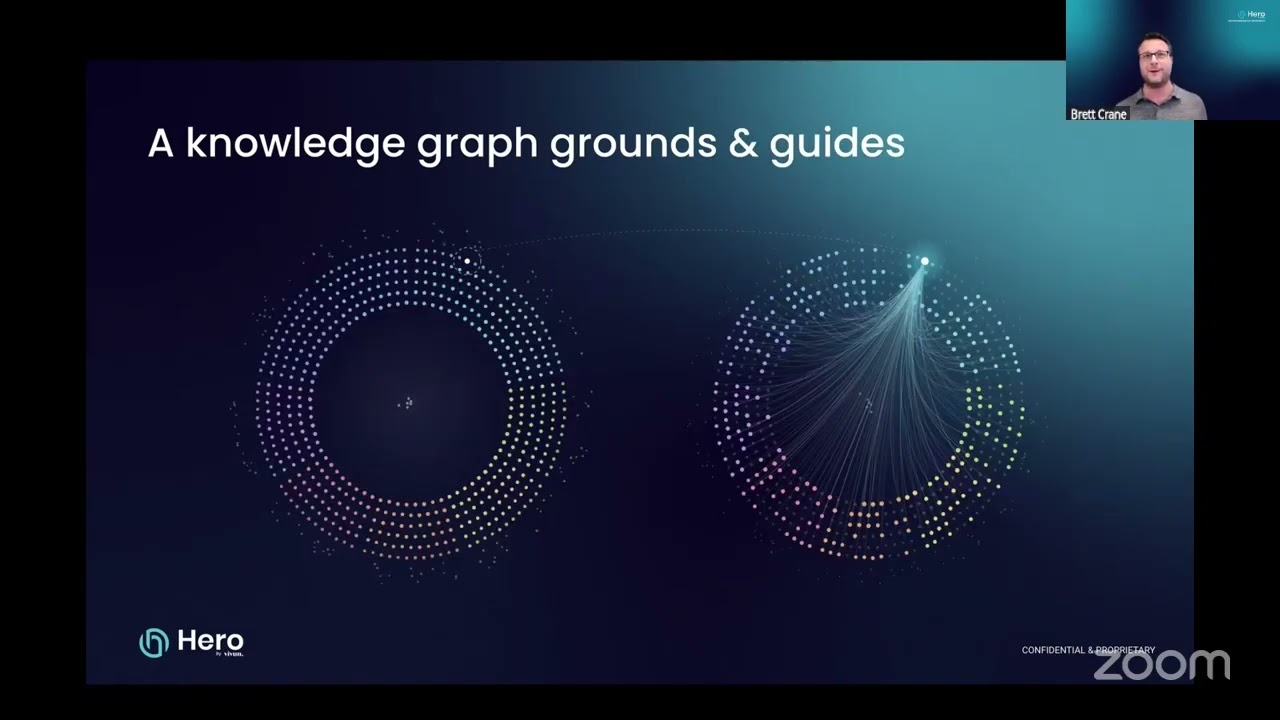
Yeah, hello everybody, I'm Brett Gerain. I run the Sales and Solutions team at Vivint. Thank you for the intro there, Gerhard and Stephanie. Again, really excited to be here. I was able to attend the conversation yesterday with our CEO Matt and Matt Miller and Luke from the ADP side, great customer of ours, really excited to continue the partnership with them. And I think it goes to show that even a company that's been around for a really long time and has a really large sales team and a lot of regulation and things like that that Gerhard just described, We're able to roll out really cutting-edge tech with them, and I'll talk to you a little bit about more of what that is and what we built and what they're using. So today will be a combination of a little bit of why we built the thing we built and how we did it, and also then a demonstration of how it actually functions. So let's dig in there. So the first thing I want to sort of mention is that we came to the conclusion and felt this ourselves as well too, that, you know, as AI started to roll out, and I'm looking at ChatGPT's logo here. And thinking this is like the consumer thing that blew everyone's mind, that no one had any idea what to do with. And over time, it started to make a little more sense. And then it started to get rolled out in different departments. But the sales teams, the people that are sales leaders on these calls, they're looking to get the most productivity because they're trying to get a lot of these things on the right. They're gonna cross this chasm of the tool is there, IT handed it over. How the heck do we make sense of AI for the world of sales? They want higher velocity deals, better win rates. They want reps to ramp faster among a variety of other things. And reps want to crush their quotas, be in accelerators, make a ton of money, right? So we've seen a bunch of productivity gains, things like maybe write more of the things you'd want to write in an email because you don't miss those pieces you've forgotten, or maybe things are a little more polished, or maybe decks come together a little quicker, or things like research and planning. Like there's, it's really good at web searching, right? But some of these things aren't necessarily really geared towards sales specifically, and some of the challenges that sales have is really unique. The pressures we have while on calls are different than the pressures you have if you're on an engineering call, for instance. And obviously AI has shifted and changed and transformed the world of engineering, and we're looking to do something very similar on the sales side as well too. So, so they're trying to get all these things, but the problem that we thought we wanted to address first was How do they get the benefit that AI promises to people like engineers to do the function of the job, which is sell better on a call, for instance, right? So the problem that we saw is AI is not geared to actually do those things in real time and give a well-vetted, strong answer that's convincing to a prospect that lets a rep keep eye contact, keep trust, and do the thing they do so well and are so highly paid for, which is create that human connection and close deals. So we wanted to give them a tool that's out there that lets them do that, not distract them, and get them out of the jams that they might be on live calls and do this in a way that's tied to the knowledge of their deals and can be done across multiple sellers, right? So take the knowledge of your best sellers, roll it out across the team, and help everyone operate and aspire to be like them and hit their quotas the same way. So how do we do it? We focused on live call assistance, as I mentioned. Real answers fast that really help move deals forward. And ADP talked about this yesterday, but they've rolled this out across thousands of people. It's a really hard problem to solve because you have to get something that's grounded in real, real facts that is not AI slop. That is something that someone can read, ingest, and say back in a matter of probably 2 to 3 seconds from a question being uttered by your prospect. So that's what we focused on. And it's built on top of sort of this framework of We call it sales reasoning. There's a variety of technical terms for it. You can think about it as like the brain of sales. We've architected that and put that in our product to make sure that it actually can be something sellers can use. And we wanna have fit in where you work already. So whether it's Salesforce, obviously have been that way for, you know, 20 years, or HubSpot CRM or others, but also these AI agentic approaches where you have Claude becoming really kind of a You know, it's kind of taken the market by storm, I think, in a lot of the B2C, B2B functions, especially sales teams, where it's how do I take that stuff, do my work in Claude, but make sure it's connected into all the systems or the brain of systems like ours. And off you go, your workflow is actually faster and turnkey. So that's what we're looking to do. I'll talk to you a little bit more about that. So why did we do this and what is sort of some of the history around this, in my opinion? Well, one is Like when people's minds got blown with ChatGPT a couple of years back, they started off with prompting. And then like if you looked at LinkedIn, you started to see this thing of like, well, quality wasn't quite there. So people kind of talked about like, check out this prompt library, check out this prompt. It's the best thing out there. But what you found is that one prompt done across different companies and across different teams, it still ended up being pretty generic. Like it's impressive, but it's also a book and 50% of that stuff didn't matter as much. And then you have to spend the time to call it out and then There's kind of this, probably this meme of, do I spend more time going through the AI stuff that I read and see versus just actually doing the work? So if you could connect it to the sources of where this data lives, you start to get a little bit more accuracy, right? So now the agents can go out to these places and say, well, I know the data of Salesforce, or I know the data of something else that tracks like Slack where I'm communicating about my customers or prospects. And so that actually helped encode what they need to go do in terms of knowledge. But it didn't help them understand, how do I go do that? What do I use it for? What's the right way to do it? And that's where something like skills came online. You saw this, and I would say probably right about here is where I might start losing some of the sales leaders because you may or may not at your company have adopted strong set of skills for your team. You may or may not have been starting to think about does RevOps or enablement or some outside hire that's an AI guru start to pick this up? and start to make sense of this stuff for my team? And so we're seeing a lot of, I almost think about this like a maturity curve of the tech came fast. It was really meant to, I think, empower mostly engineering first, then it's rolled out cross-departmentally and you're stuck in this place of, well, how as a sales leader do I make sense of this stuff that I probably haven't done a lot of myself necessarily? And then let's keep going, right? So skills are great and make things work and it sort of created this problem of, How do I package it up in a way that my salespeople can just click the button, right? And that, that gave rise to things like plugins. And it's funny to see Anthropic and, you know, OpenAI, they're like fighting over these protocols of MCP and plugins and skills and like, who the heck cares? But at least there's a standard being created for us. So now we can start to make sense of this. But as this is happening, there's still a lot to be desired because agents aren't there necessarily operating against these things. You know, dynamically. I'm on a phone call. Is it actually doing the work I need, which is telling me answers and knowledge in that moment? No, it's not. And that's why we created an AI teammate to be there for you, not make you get confused about all these tools and protocols, but be there for the moments that matter the most. And we think that on a call is probably one of the highest stress moments for sellers, and we want to be there with the right information at the right time for them. So if you're trying to do these things on the right, depending on where you are in the maturity curve, it doesn't really matter, but you might be good or bad at these things on the right being automated by AI. And so our whole goal is like, let's be the tide that rises all boats here, regardless of whether you're just doing chats and prompt libraries or whether you're super sophisticated, have really strong like IT and, you know, maybe like an AI hire that actually does these things for you internally at a strategy and operational level of your sales team. We wanna be there to make sure you can do things better regardless of how sophisticated you are in your adoption of AI. So some nerdy stuff, and then we'll get into the demo. One of the things we wanted to do, and I wanted to kind of tease this out as how you feel this in your personal life, you're probably really familiar with the pattern of you talk to Claude or ChatGPT, you start to give it information, and it starts to get things a little wrong, and then you correct it, or it asks for more information. It gives you that nice wizard where it gives you like a 3-step process where you, you pick the thing that you want or that applies the most. And the reason why it's doing that is because it doesn't have the right context to make decisions, right? You need to give it all the context it needs to get correctly routed the right way so it can give you the best output. None of that can happen on a sales call. You can't sit there and say, hang on, prospect, I know you asked a good question. Let me just go chat over here. Oh, let me go correct it. Let me go to step 3 of this wizard. You can't do any of that stuff, right? So we wanted to make sure our product kept the fidelity of what a super complex sales question might ask. And how you can come back with that in 2, 3 seconds with a response that's grounded in real knowledge tied to what your products do, how your competitors sell against you, what the real source of what the question was all about, maybe a follow-up question you should ask to get to the real root of the problem. We wanna surface the thing that actually helps you in that moment, not make you think about how do I give this context. And so that's why we built a knowledge graph. What the heck's a knowledge graph? Well, it looks like this under the hood. But the whole idea is that you tie our— I'll show you this in the product. You tie our agent into where your stuff lives, your product information, your sales process, how you run your team, where your competitive battle cards are. All that stuff gets pulled in. It gets coded by what type of information it is by us. You don't have to do that. And then each one of those elements, it actually gets leveraged as those questions pull in, and it has all these connections, this web of information. Where a single data point has tons of connections. Think about a single product feature. It's related to a product. It's related to how it compares to a competitor's product features. It's related to which customers leverage it, which customer stories use the value, the value component of that feature. So all of these things are interconnected and get hopped and understood within a few seconds of a question being asked on a call and surfaced to you live. So that's a little bit of the nerdy stuff. But again, the whole goal is to make it easier for your sellers to sell and be there for you in the moment on that call. And yeah, kind of a cheesy thing here, but you know, just like I think it was Staples that had the red one, we're looking to be the easy button for sellers, an easy button for sales leaders. We see a lot of people out there saying there's a lot of tools, a lot of promises. I just want my sellers' workflows to be simple. And that's what we're looking to do. The big missing piece in the middle on the call We wanna be there for you and be the kind of the only tool in the game that can actually do this at scale. And we, we had some really good proof points being, being talked about yesterday with ADP, with, with hundreds, now thousands of sellers on the product. But they're using the product just like our other customers to do things like prep before the call because it has all that sales knowledge, be there on the call. They actually even let it speak to their customers directly on the call with its voice. And then after the call is over, They can instantly go do things like update CRM, update Slack. Those— these are the things that can get hooked in for our customers so that they don't have to do a lot of that grunt work before and after. It actually gets done for them. So that's sort of the workflow we like to empower here. And these are some of our great customers. I mentioned ADP a couple of times because they were on with Gerhard yesterday and our CEO, Matt Darrow. They've had some great results around SEs coming in, getting aligned on fast deals. You know, reps getting in on more complex, longer-running deals that have much more complicated product sets they're selling. All of those things are ways that they improve execution across the board. And then other, you know, great customers of ours here that are referenced on the slide, people like Dayforce and DocuSign, very similar things where they're looking for technical things to be conveyed as value statements on calls and moving AEs and SEs faster on these calls, getting the help they need and helping them win more quickly. Doing things like saving their time, like I said, on some of the grunt work stuff that we do automatically for them, improving win rates, boosting deal values because you're not missing the opportunity to sell something that you didn't necessarily think of. So those are some just kind of customer examples here. And with that all said, I'll kick into the demo. Now, just a sort of disclaimer, we are not on a sales call right now. We're on a webinar. So what I'm going to do is pull up a mock sales call. I promise you it's a short video. I know videos are, are tough to sit through on sessions like this, but we'll pull up a video to show what a mock call would look like for 1 minute, and then I'll kick into the real product and show you this stuff in action as well too. So hopefully we can hear sound. I'm just gonna ask, I don't know if Stephanie or Garrett, I'm gonna hit play and I'd love for one of you just give me a thumbs up or let me know that you can hear me. All right, so before we go further, I'd like to learn more about the feature you showed during the demo. What does the Whisper functionality do for AEs?
Whisper gives AEs real-time in-call support. It detects questions and objections live and surfaces answers or next-step prompts without interrupting the conversation.
Okay, that actually sounds pretty helpful for our AEs. It's something we definitely don't have today. Another question, so how does the sales reasoning model perform differently than just using an LLM? I'm a little concerned about getting pushback during—
because of our existing A plain LLM is fluent. The sales reasoning model is grounded in our knowledge graph, deal context, and sales process, so it gives more consistent, actionable guidance.
Gotcha. And, and what happens if there's something you don't know that Hero can't answer either on the spot?
Hero tells me how to handle that too. And in fact, let me just show you. Hero has been helping me answer these questions the entire time. So I've been able to stay present, avoid wasting your time, and confidently provide correct answers to keep the deal moving forward.
So I wanted to pause it there. Um, I was obviously acting as the prospect on that call, but I hope you get a sense for what Whisper looks like on a call live. Again, the important thing is we need this stuff to come back fast, concise, something that the rep can say and grounded in real knowledge that you want reps conveying to your prospects. As they ask questions or have objections. I think you even saw an example where I layered a question and an objection in one statement and it picked it apart to allow the rep to pick which one they wanted to address. This happens all the time with multi-part questions from prospects that we see. So that all said, let's kick into the product. I wanted to pull it up here. This is an example of what a call would look like after it ended, right? So you'd be able to see not only the transcript itself, but the whispers that were said and who said them and what the questions were. Now, why am I pulling this up? Well, one of the things that matters for us is how strongly can someone actually leverage this? So it's really important that we measure the utility of this and the feasibility of people giving those answers on a call, and do they actually do that? And so for that reason, we have a feedback loop of saying, hey, this is, this is good or bad. Now, the interesting thing about this, this may not have anything to do with our product. It may have to do with the fact that they've hooked us into some knowledge that maybe isn't great, right? So how do we prevent against that? So this is the type of feedback that helps us understand, you know, what happened on the call, what can we do to improve. It helps our customers and folks like Matt Miller and Luke Shoemaker from yesterday to figure out how they can improve and optimize for their teams as well too, because they're looking to centrally make small changes that really help those hundreds or thousands of users on our product. And so to do that, we have this area called training that you can see here. Some of the sub-elements of this is product and process knowledge. I'm not going to drill into this much today, but the whole point here is that this allows you to tell us where to go to get the right information that we need to pull in. So as an example, the first thing you would start with is what products do you sell? What are the features, right? So you can give us the place where that documentation, documentation is stored. You can upload documents. It will pull in all the information it needs and it will start to ingest all that stuff into that graph where you saw all of those points that's going to pull in. And then you tell us what your sales process is. Do you run MedPic, Sandler, different processes that you're running? And then off you go. Our knowledge— our agent has the knowledge that it needs to go convey the right answers at the right time for your reps. So that's all great and helps you know that you feel confident about the knowledge that's going to be said on a call, but I did mention some other things in the workflow. How do people prep? How do people get coached? How do people actually do the other things that go on in sales deals? So we've solved that as well too. The first thing I wanted to point out, ADP talked about this yesterday actually, but we do have a concept of an avatar. So if you prefer a face, you can actually do this face-to-face. I'm gonna pull this up just for a second so people see what I'm talking about. So you can pull up the avatar, speak to it. You heard it start to talk to me a second ago. What I'm going to do now is I'm going to actually— I have, if you look, I just ran a MedPic review for our deal here, and it started to sort of flag some things that, you know, maybe weren't going so well because, again, we have all the knowledge of this deal and we can do things like the MedPic analysis and a variety of other things. I know I have a call coming up, and so I want to actually talk to to my agent about that right now. So let's, let's prep for the call coming up.
Hey, Brett, what do you want to work on right now?
Hey, I'm doing a live webinar demo, so let's not use real names here, but we have a call coming up with them on Tuesday. What do I need to prep for? Can you help me?
Absolutely. For the Tuesday call, I'd prep around the buyer's top concerns: predictable pricing, fast setup, and how the solution fits alongside their existing telephony and Salesforce workflow. I'd also be ready to address security, legal, and procurement early since those reviews are a blocker. And to be clear that complex live quoting is out of scope while live call support and post-call automation are the core value.
So you can probably imagine you're not in this deal with me, but those are real grounded things that happened on this deal. And those are the things that are being conveyed, whether it's voice mode, whether it's chat, whether it's an output like this medic review, whether it's the whisper on the call. These are where it's all being grounded in. It's really detailed information. And the thing that blows people's mind is when they start using the product, like Dayforce as an example, talked about pricing and packaging of how they package some of their complex products. Like, those are the things that you wouldn't necessarily think the agent could give really good advice on, but it does because of the way our knowledge graph works and how this functions and allows that level of detail to be conveyed to their reps, give that expertise in that moment when they need it, because we know Time kills all deals. We want to make sure that we don't have reps saying, let me get back to you. I don't know, losing credibility, losing that human connection as well too. So I showed you this med pick review really quickly. I did want to mention that that's sort of a function of having what we call skills. And, you know, that's some of the things I showed in the previous slide. But people have what they would think about as like a popular prompt, right? That's a skill that people can run in our product. Things like med pick review, things like Sales handoff to the post-sales team, things like exec readouts. Those are really common. We ship with a library of those. And so I wanted to show you actually something a little different, which is the agent that I just spoke to on the call, on the voice there, I could bring that on the call. It would show up as a bot on the call. That's what ADP talked about yesterday. They actually have it speak up and talk directly to their prospects because they have some teams that are like commercial deals, move fast, they want answers in that moment for their prospects. So they do that. For us, not everyone needs that, not everyone wants it talking directly to their prospects. And so we also built out, I'm gonna make it put into dark mode so you see it, but this is the desktop agent where it's actually transcribing in real time here, you can see that. So this is again happening here as well too. And the thing that's important about the desktop is it's botless, it doesn't have to talk to your prospects if you don't want it to. But I also did want to take the opportunity to mention that we know that people are working in a lot of these new places like desktop apps for Claude and things like that. So we've created all these connectors and connections, meaning we can connect to a variety of sources. So as we're thinking about the knowledge that we're pulling, the reviews of things like MedPic that we're putting together, all these different sources and more, by the way, we built a framework where it's really easy for us to roll these out in MCPs. Are connected to the system. And then if you want to connect it to your assistants, whether it's Copilot, Claude, ChatGPT, you can go do that as well too. And we're listed on those marketplaces. So with that in place, then all this context is pulled together. And what I wanted to show you is how do you take that and put it into a last-mile workflow, right? So if I pull up one of the conversations I've been having, you know, I wanted an output. In this case, it was You're checking all the different sources like Salesforce and all the other places it might go look. And I wanted the output to be a value pyramid, right? So you put in your sales process, that's a part of the skills our system looks for. So imagine you get off a call, you probably want 2 things to happen. You want to update your sales deck because you're going to have your next call, your internal strategy call, and maybe you want to do things like update your team over Slack, right? All that stuff can happen for you after the call is over. But what we know and what we found out is that not only do people want a desktop experience because they don't wanna necessarily have a bot on the call, they also don't necessarily wanna work in our product all the time. They might wanna work in Claude. Right? Or they might wanna work in ChatGPT. And so regardless of where you do that, you're able to do that with our product as well too. So I'm just gonna type in, you know, this is a skill in Claude. And what you'll see happen here, and this is just be illustrative here for the demo. But what you'll see happen here is it will pick up what that's supposed to be. You know, obviously this is just Claude stuff where it'll give me sort of the progress of what's going on. And it obviously asks you like, hey, if you're doing stuff over and over again, how do we start to create skills? So it's trying to introduce you to that. And what it's going to do is it's actually going to look for all the different tools that it could have out there. And one of the tools that's out there is the Hero product, right? So it's listing out all the things that we've created already and it's going through and connecting to our product. Of course, you can connect it to other places too. But it's getting not just raw transcripts, it's getting the skill-based artifacts of what we create. That value pyramid, as an example, is what it's going and getting. And that's going to be influencing when it goes to create the deck. And I'll just give you the kind of the end of the story here. But when it goes to create the deck, it'll actually have that based on all the artifacts and things that we've created because we know your sales process. We produce that stuff for you in the system. So while this is, while this is churning through, The one other thing I wanted to mention is that, and I'll show you an example output in a second, is because we have such strong grounded sales knowledge of your deals, the place, the facts that you have about the value props you sell against your competition, etc. We also have this. There are other places where people have this. So this is something that I've seen people have mixed opinions of other tools that do this for them. This is super strong for us because of 2 main reasons. One is It shows you all your deals. Within your deals, it'll show you anything that might need to be updated. So it'll actually propose updates for you. You tell us which fields matter the most, and you're able to see where it got those, the source information. You're able to see what it used to say. And the thing that you actually do is you tell our system, should it be timestamped? Should it be bullets? You give us the format and how it, how it should look. So it actually saves your rep the time, both not only the knowledge, but also how it should look. So they can get on the forecast confidently and they can either update in bulk or one by one or make changes themselves. So makes it really easy for them to go between, you know, call ends and Salesforce is updated with strong sales knowledge imparted into those fields of Salesforce that you've told us how they should actually function, how they should be formatted, etc. So takes out that last mile for them. And while we were talking, I think we're— yeah, there we go. So the deck was created. So it went through, it pulled up that artifact from the hero side and it populated a normal deck. And I'll go to that value pyramid side slide. Here you go. So it produced that value pyramid slide for us based on that, based on that artifact right there. So anyways, that, that's, that's what I really had for you today. I wanted to showcase again, back to our slides here, how we help salespeople operate better on calls, insert into your workflow, I went through a lot really quickly, but hopefully you could see a little bit of the day in the life of prep for a call, have the call, get help on the call, and then update the systems I need to after the call as well too. And if that was interesting to you, I just want to leave this up. I think we leave a couple of minutes here for questions and be great to hear if anyone has anything they want to hear more about. If you're interested, you know, always be selling here, but Please scan this, come to our website, ask us, ask us if you can get into a trial. We're happy to showcase our product. We think seeing is believing here, and we'll make it really easy for you to get started, run the product for a few weeks, make a decision, and join others like you saw on the slides, Salesforce, DocuSign, ADP, and others for the journey of helping out your sellers sell better, sell faster, and really have the right answers on all of their calls.
Well, that was fantastic. Um, quick comment by Ryan: I think it empowers sellers. They can roll into calls solo. Um, I like the preparation part of, uh, Vivian. Uh, Chris is saying: I believe, uh, AEs can become smarter and more effective through time if they learn and absorb the information presented in the text while in a meeting. So that brings up a question. Do you get pushbacks where salespeople say, I don't want to be distracted during my meeting with a client when I'm on a Zoom call?
Yeah, it's a, it's a question we get nearly every time, especially from enablement. So the thing I would say is that we're, we're there to help, but we're also not there to be in the way. And so one of the things that we I didn't mention on our, on our desktop app is we're actually launching out this ability to also, even for a single screen person, have a little pill for you to see these things. And you can actually hotkey or click to say I need help. And so the idea is that you don't even have to look at the broader web, the app that I showed you. You can actually just get the help when you want it with a click, with a quick click or click, quick hotkey. And then the interesting thing too is you can even be sharing your screen on Zoom or Teams, and it won't show that either, right? So we're looking to be as helpful as possible in that moment and no more. You could pull up the full app if you want to, but you don't have to. And I also say, like, don't over-index on the tool. Like, you'll know when you need help. So when you need help, have it glanceable. And that's why we're looking at those different form factors that, that we've rolled out as well too on the desktop versus the, the app I showed earlier.
So, Brett, You're in sales and you want to explain what a hero means. If you had to create an acronym for the word hero, what words would you assign?
An acronym? Help Every Revenue Operator. I don't know. I hadn't thought about that, but there we go.
That's— Okay, let me, let me help you out. Human-led. The rep stays in charge. The rep is in charge. AI amplifies judgment. It doesn't replace it. E, empowered, you know, armed with real-time insight during the conversation, not just after. The R, relationship-focused, using influence and psychology, not just data to build trust, and outcome-driven. Every insight ties back to closing and revenue impact. So human-led, empowered, relationship-focused, and outcome-driven.
I like it. Yeah, that's, uh, crisper than what I had.
And, uh, that's thanks to Claude. While you were presenting, I was researching that.
Well, thank you for the curveball. Uh, I got there slowly, but I like yours better.
No, the, the reason I'm, I'm doing this is because We need to demonstrate that there's so much intelligence available in real time while you're having the conversation, and we need to take advantage of that. Yeah.
I mean, well said. I think that sellers have tons of knowledge. It's hard to figure out what the right case study, what the right fact is at that point. So even if you're the best seller in the world, we give you a sidekick to help you there as well too. But, you know, if you're a brand new seller, whether you're not good, not necessarily what versed in the product or you're not necessarily, you know, tenured in your career of selling, Look can help you regardless of where you are in that journey.
So I wanna go back to what we discussed yesterday when ADP rolled this out. What was the initial reaction when you pitched that to ADP?
Well, yeah, it was interesting because I, you look at ADP, they're, they're a very large organization. They've been around forever. I think they were processing payroll before there were like real computers or internet for sure. I was worried it was gonna be too forward-looking, too out there. And it was interesting because what they wanted to do is say, how far could we stretch this innovation? And they started with things like our avatar and voice and bringing it on the call and seeing where that might work in market in pockets. And I think one of the things they mentioned yesterday was, it was interesting 'cause it ended up being a pull scenario where they had the product that they had an offer to the sales team, They didn't have to push it and force it onto the team. They saw team members that were in the pilots. They were like, there was jealousy almost of other teams that were like, how do you have that? What is that thing? Can I, can I get that thing? So they started to actually see that almost virality roll out internally as they saw people showing the stats to prove that it actually helped them on their deals.
So it sounds like it stimulated creativity and jealousy.
Yeah, there's a fine line between making it difficult, but there is some sort of scarcity tactic, build the line outside the Apple Store, that they do a great job with balancing of forcing versus creating that pull by broadcasting how people are having success within the company over and over again.
But I also saw that you have DocuSign as a client. How are they using it?
Yeah, I mean, similar thing. The one thing that's interesting there is that in the lower end of the markets, we see this is actually a pretty common theme. When you look at commercial accounts, SMBs, they don't necessarily get the love of people like sales engineers, right? Or the technical people that are on the calls. That's actually how we began there, where it's like, hey, I'm selling a product that's becoming increasingly more technical. DocuSign's not just signing something digitally anymore, right? It's way more complicated than that. But it doesn't mean that because you're a seller, you get an SE on every call, right? So that's the type of thing that they wanted to do because the unit economics didn't make a lot of sense. to pull in an SE on every single commercial call, as an example.
It was a great session. I really appreciate sharing your insight and sharing the demo with us. We need to make a short break for 6 minutes. And I suggest that you go over to our digital showroom where Vivaan has some content assets. So look at the sponsor booth. And you can also go to Viven's website and you can reach out to Brett on LinkedIn. Thank you, Brett. Great job.
Thanks, team. Appreciate it.
More from Gerhard



What Selling Looks Like When Your AI Agents Have the Context Your Sellers Do

Better Conversations, Smarter Support: Wearable AI in Business






When Scarcity-Built Systems Meet Abundance - The Judgment Gap in AI-Powered Sales Leadership
