Selling to the C-Suite: Utilizing Innovative AI Strategies for Sales Success
Lisa T. Miller on selling to executives: bigger deals, faster closes. Focus on ROI, stack concrete examples, deliver results in 30 days. Use AI tools like VR training to prep your team.
Questions this video answers
1999
2022
2024
csuitetitles.com (shown verbally as c suitetitles.com)
Virtual Speech — virtual reality (VR) training
Chapters
All right, so I'm going to jump in. Thank you Gerhardt. I appreciate the opportunity and was, was a great presentation by Mark and I'm, I'm excited to be here. So I've got a, a number of things to like run through and, and talk about today. And as everybody knows, selling to the C suite, there's some challenges, right? It's the realities. It's, it's difficult. It requires a financial investment. It requ. Investment of time and resources. It's, it's not the, it's not easy. However, there's some great benefits. So why do we want to sell into the C Suite? We know that there's an increased deal size significantly even I think above 50% time to close. We, we all know that selling to the C suite, where deals go close faster and we have a higher amount of win rates, right? There's a lot less stalls and a lot less indecision. And as Mark Benioff was just here earlier, I'm quoting him when I look at our largest transactions. Every transaction was done with the CEO. So we know that there's a lot of value in selling to the C suite. So just really brief about my background and where I started. I started with a company called Cyto Diagnostics, sold into healthcare for a few years, then went to Stryker Surgical. I started my own company in 1999 called VI Healthcare. It was sold in 2022 to Morgan Stanley and bolted us onto a company called Spend Med. And now this year or in 2024 I started my own company based on selling in, you know, selling to C Suite. And I do quite a bit of work in selling into healthcare. So what's my big why? When I started vi, we were a small boutique company competing against the giants. And so as a boutique firm I had to figure out how to compete. And what I learned early on was that figuring out or elevating my message and speaking to the C Suite was the secret reason and how we succeeded in the marketplace because otherwise we were going to get beat. We didn't have the amount of money, the resources that these large multinational, multi billion dollar companies had. So I had to think differently about how to, and how to get into, you know, selling into the C suite. So just briefly, just some, just some proof and then we'll go into some content. I really spent quite a bit of time creating resources. I mean Mark brought up about head trail and other resources and I did very things very similar. I created quite a bit of content on my website. I shared content and it was Free and many times we would have, I would have CFOs reaching out going to my website because they did search for something specific. We I did a lot of emails about insights and as you could see this one 30 day year end cost saving sprint where C CFO replied back to that C C suite coming to you know, to my webinar. So I believe in the power of that content and delivering value. Again I had hundreds of C suite people on my webinars.
So this speaks to what I want to speak about today is the method that I've created and again I getting feedback now I want to just dive into this feedback a little bit because as you can see more less about you know, I got, you know, good feedback but if you're interesting you'll see some of their comments right about what they think is valuable and they think obviously it's the numbers, how fast, how much savings and speaking to you know what the results are. And so you know, as we talk about AI and how do we incorporate HAI and AI, human intelligence and artificial intelligence. And I think again Mark did a great job in of course you know, speaking about agents. But as you know AI is the engine and the human intelligence is the pilot. And I think we have to look at how we use some of the amazing technology and resources that AI gives to us but that the humans bring the strategic thinking, the judgment, the relationship building and particularly as you get to the C Suite you're going to be in positions where you need to ask questions and you need to be able to kind of think on your feet. So here are some ways that I see artificial intelligence can be used in your preparation to the C Suite or as you, you know, work in there. And these are, you know, one is speaking the C suite language. Garrett and I had a great conversation and I took a quote, right you get delegated to the person you sound like and it's true. The C suite has its own language and so can we put content in from Harvard Business Review and other speeches their speeches, keynotes and understand their language. And that's a big yes we can. I use some custom images in this presentation and I've been using a custom app to to create a custom app within minutes. I have two examples to share with you and I've got a the number one way I see selling to the C suite so I'll reveal it later on in the presentation.
So quickly just three reasons why human intelligence is essential to selling to the C Suite.
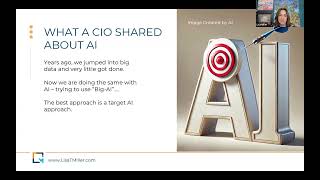
C Suite decisions are rooted in strategy, not just data. So they aren't looking for numbers, they want insights, they want vision, they want to win, they want to look for how they can solve their problems differently. Emotional intelligence drives that trust. While AI can predict behaviors, humans are the ones that build relations that connect. And it's not transactional, right? It's a trust, it's alignment, it's a lining with their mindset. And then complex problem solving, you know, requires human judgment. And so, you know, humans, and particularly as we sell, we're going to connect patterns, we're going to reframe problems, we're going to co create solutions. So I think that while there are a number of applications in selling that we can use AI when we sell into the C Suite, there's just an elevated way to, you know, to, to be able to be successful. I was at a conference recently and the CIO was talking about big AI and he, he made a comment which was really interesting. Years ago we all jumped into big data and so much so it really just seized everything. We weren't able to figure out in a practical terms what to do. And he said, we're trying to do the same thing with big AI. And he said the best approach is a targeted AI approach, which I really love. And using a, in this case, in specific areas of a hospital, right. How do you target those areas that are going to have an impact and you learn from and then you continue. So I really feel like that's a great insight for all of us, right? How do we use AI in different places and we become successful at. So a little bit more. I think we're going to focus really on these three challenges, right? How do we get access, what's our messaging and differentiation and our presentation? Because only 10% of the C Suite executives say sales calls were valuable enough to follow up to, you know, schedule a fop. And that's a, that's a pretty stark reality. So how do we succeed once we get access, you know, till after, you know, while we end the presentation, what's really important. Two months ago I had the opportunity to interview a number of different C suite executives. And the goal was to just get their insights. And I had a series of questions about why they accept calls, or how do they accept, or how do they get information about challenges and problems and that they have and then what's that presentation like? So I'm taking a few excerpts from those interviews, but I think they're really valuable, right? The C, these C suite interviews reveal that they really want a deep understanding of their current reality before they're pitching, so it's like specificity. Bradley noted he appreciated when a seller knows exactly what's going on and opens with relevant context.
Stephen said he, he said he'd engage only if the person knows his company situation.
I think some of the other, you know, highlights to these interviews is that, you know, they want to state your value proposition simply. They didn't want jargon, they want clarity. And they didn't, they didn't need a lengthy background on the company. They really wanted to go in and understand what's, what are, what are your insight, how do you understand me? Can we get into a conversation? Right. And so, you know, they want highly specific pain points and relevant proof and, you know, even which I thought was really interested that, you know, this. The C Suite wants to use discovery to let the executive talk. Right. There needs to be a communication. And so, you know, Zach pointed out that there was interactive dialogue rather than, you know, a salesperson barreling through a standard pitch, which I think happens often. Right. And we've got to be comfortable in that environment and know our product and know.
You know, how, how, you know, our, our solution impacts their business. And what the other thing I wanted to point out here, they want respect their time and being flexible and prepared. Right. And so it's interesting, One of the CEOs mentioned that sometimes weekends, for an outreach, he was more available. He might be, you know, whether that's LinkedIn or email, even though emails didn't seem to be the best, best way to reach out or get to the C Suite. So I wanted just to, you know, talk a little bit about what these interviews really spoke about. I, I have an upcoming book where I'll be sharing a lot more of these. But just as a highlight for the presentation today.
There were other takeaways from those, those, those interviews, Right. The main places and methods that executives described for researching their solutions. Right. So they go to their internal teams and trusted colleagues, which makes sense. Which, which speaks to. And I'll bring it up shortly. Why having a number two strategy makes a whole lot of sense. Who's that? C Suite's number two person where you can outreach.
Personal and professional networks. Where do they meet? I mean, you know, I, I do think it's valuable being here, being in front of the executives, being where they are. And that could mean whether it's, you know, speaking, exhibiting, having white papers, but you really have to be where they are. And then, you know, a lot of these executives really do go to Google, but of course, now they're Using AI like chatter, perplexity. And so they are a big source of information and questions and how do you show up and what information is there for you or for them about your, your business and then industry specific journals and websites. And what I thought was pretty interesting is the advisors, right? So they're bankers, consultants and people that they surround themselves with and it speaks to that whole network and really growing your network and maybe those surrounding areas where they would seek advice from. So come today to kind of talk about what I've created which is my exact method for selling to the C suite, something that I've used for years. I've had such great success getting into the C suite, being able to get those appointments, being able to present and sell seven and eight figure deals over multiple years. And you know, I've kind of narrowed it to this, these four areas and one is enter their world as we just talked about, right? Be present where executive are executives are. This is going to require an investment in attending those events. But it's also the thought leadership that you bring to those events, right? It's you know, they're there to learn how can you teach, how can you provide something that's going to get them to think differently. Number two, it's express the roi and that comes in many different ways. But they do think in ROI and in many different ways whether it's financial, operational and or you know, an innovational roi. Three, once you get that meeting you've got to, you know, earn the business and so you've got the opportunity to demonstrate credibility, differentiate yourself and how do you make it easy for them to buy from you and then for it's you know, commit to delivery and it's, you know, once you get that contract, whatever that looks like, that's the time to not be complacent. That's the time to commit and to, and to focus on their outcomes and that's focusing on it for results and speed and success.
So I'm going to go into a little bit more depth but I don't, you know, I may not have time to cover all these slides and you certainly welcome to reach out and I think these slides will be available. I can send you the slides. So these are just a little more context, right? So you have to show up in their circles. You had to consume the content they value. Again I'll mention Gerhard, you know, you got to understand and speak their language, right? It's so important. And so for me when I was selling into health healthcare I had 10, 11, 12 different healthcare journals. And I, in, in different ways, whether it was executives, whether it was nursing, and just consuming all different areas. And that allowed me to get a different view, right? To see patterns. And when I had conversations, I could connect differently with the C suite because I was reading things they were reading, but across the entire organization. So that really, you know, was a, was a big benefit. And, and frankly, even my presentations, I was able to present things that I had read and, and, you know, were able to kind of intersect that in different ways again, speak their language, and then kind of build that insider trust with the roi. I think this is a big one. You know, we're always having to show our financial impact, but I think it's, it's got to be clear numbers. And sometimes I saw this the other day and in a presentation, working with one of my clients, and they presented like this really large number as one of their ROIs. And I really, you know, I think that's, that's a great large number. And you want to be able to maybe break that into a smaller, sizable, targeted number where it may show 500,000, $700,000 in a specific service or specific area versus that larger multimillion dollar number. And, you know, it just becomes believable. Not that that number isn't believable, but sometimes they hear this so often that it becomes, you know, they, they kind of like, okay, I've been told that so many times. And where, you know, how we break down that value is important. And then really connecting ROI to their strategic goals. And they all have goals, of course, of saving money, you know, revenue. But there could be some real specific ones like, you know, building relationships with the community and their, and their suppliers. Or I mean, there could be other ROI that they have and you've got to really understand them. And sometimes, you know, it's going to be publicly available, right? I mean, it's going to take a little work, more work to understand their strategic goals. I, I call, I, I created, you know, a wording called exam, example, Stack. And in my presentations I would have very quick snippets of results and even like five or six little mini case studies and all the C suite, they love it, right? Because then they'll stop and say, wait a minute, we have that same issue. Can you speak to that more? And I feel this example, stacking, mini stacking was so valuable in building credibility. But also in, in, in getting that presentation, getting them com. In, in conversation, in discussion. And also it shows, you know, you, you are a thought leader, a trusted Leader because you, you know, you, you're, you're showing proof and you're able to, you know, discuss that proof.
And then we'll jump to earn the business right. So you know, one of the big things, you know, as we present, how do we think about moving that presentation, you know, into a contract. So you know, it's, it's, you know, you've got to align with, with your value proposition, with their priorities, differentiate from their competitors and of course the credibility which I talked about a little bit. But number four is make the investment decision a no brainer and you know, whether that's some kind of short term win. Removing obstacles, making that little frictionless, addressing a decision maker, you know, their, their concerns proactively, you know, even a proof of concept project, you know, is really valuable. And then number four, it's commit, delivering impact. And I'm a big believer. I tell my team we gotta go out and we gotta get results within 30 days. We have to show results within 30 days. You know, our job now is to focus on their outcomes and everything is about achieving their, our clients outcomes. So you know, it's speed matters with a long term mindset. And like I said earlier, you got to commit and don't be complacent. Now's the time to go, go beyond expectations. Because these quick wins and having that mindset really gets a customer thinking, wow, this is the right decision. I made the right decision. I love how they work. They're easy to work with and I want to continue to work with them. And this was actually one of my, you know, biggest, most successful strategies over 23 years. It's getting results within 30 days.
I'll go through a couple of things quickly because I want to show you.
Two more important, couple more important concepts. You know, this is, we used, I use this high value assessments for executives and I allowed them to self assess. So all three were individual assessments. They could come onto my site and be able to, to self assess and get a diagnosis. This was really a fantastic way to not only showcase our thought leadership but also, you know, get them engaged and get them to think differently. And I have a couple of strategies, you know, that have also been successful. It's the elevating the message strategy. Right. Again, how do you speak.
To, you know, to how they speak? Right. I mean we've got to really pay attention to words they use, things they're concerned about, you know, generic, generic messages just don't work. It's got to be personalized and insight driven. They buy vision and Strategy, not solutions. And I think that's really important.
One note here and it's a little bit tactical but I think it's really important. Right. So two of my interviewees noted that they love to receive education, educational items. They didn't, they didn't want a gift but books on leadership or specific big business topic. And one of Steve recalled that you know, someone mailed him a book and a strategy with a note and, and that really stood out to him. And in both cases they did connect. And I think how do we get out of the email? LinkedIn. And not to say that emails don't work or LinkedIn connection doesn't work, but how do you do something differently particularly in a, in a C suite way, you know that you can get your content, a book that you're thinking about them on their desk and this has worked very successfully. Speaking of book, you know, knowledge is really powerful, right? They want to know that you're not a seller, you're an educator, problem solver. You know, I work with Colin books that get leads. And I'm going to be sharing my story in great detail about selling to the C suite, having a whale deal strategy and the principles of operational excellence which I really have felt that you know, that drove a lot of our success at vi. And everybody here has their own knowled, they can share in a, in a way that will resonate with you know, an executive leader.
And you know, speaking is, is really important. Earlier in my career I had a opportunity to speak in front of a hospital association. It was a half day seminar and I remember somebody from my team saying you are not going to give all this information away. And I said I'm absolutely going to go there. I'm going to train them with everything that we do. And, and so there was a little bit of rub to that conversation but ultimately I gave that presentation right how to save a million dollars a year non labor cost savings to 30 CFOs and VPs. And immediately after that we signed two multi year, multi million dollar con contracts. And yes, they could have walked away and done a lot of the work that I presented but at that point they didn't have have the resources and the time and they wanted an expert to do that work. I feel like, you know, offering those educational workshops, you know, master classes, those things is so important. I speak to CEOs very often and over the years and it's the same thing, you know, you know, how you present is, you know, it's a little, it's a little more Stressful. You know, you're presenting from a large health system, CEOs and you know, but again, if you're, you're speaking and you're prepared and you know your product and you're offering value, they're looking for people they can trust to help them solve their challenges. And that's been very successful for me. I spoke a little bit before about example stacking and of course the mini case studies, which have been very successful. And I'm going to pause for a minute. You know, one of the things that I do want to share and I'll end with this in a little more detail, but I do work with clients and helping them sell into the C Suite and I have an immersive program and it's customized for your company. And I go through an assessment process and we create a strategic C suite approach. So it's very targeted and then we workshop that and then there's kind of infield reinforcement and, and mentorship and it's been very successful. And you could, you could reach out to me at Lisa. LisaTmiller.com to learn more about that. But I love, as hard as it is and how roll up your sleeve. This is, I love doing this work and helping companies sell into that, into the executive suite. So a couple of things as we wrap up, it's creativity. People love, you know, a creative way, you know, to maybe get an appointment or to provide thought leadership. So I, I have created two, two apps and I just share with, you know, some of my, my clients or people that are thinking of working with me. And you can go here to c suitetitles.com and in it are, I think there's about 30 or 40 different C Suite titles. And if you click in, so this, you can click in and you can learn about their roles, their responsibilities, their strategic focus areas, challenges, opportunities and effective ways to sell. And I'm going to be adding to this over time, but, and the reason why I'm showing this to you again, I started my first one with Healthcare Intelligence platform and these 35 top titles because people often think about specific titles and yes, the CFO and you know, the COO are very important, but you know, in different industries there's some nuances and I think it's important to understand those different titles. So again, you can go to those, look, you know, those URLs and check that out. So Gerhard mentioned lovable. I use both. And lovable, yes, you can build an app in seconds and literally this is the screenshot, right, of putting in what I've, you know, want to create and there's a little bit of back and forth and then here it is, you know, my healthcare leadership intelligent platform. So I say that is what could you create for your customers that's a free resource that helps them and it also elevates you amongst your competition. Now with AI, these, these kind of apps allow that. So it's really like your human intelligence, what you can think about, create, offer value that's unique to your business and your industry and get that into, you know, the public domain or get that to your, you know, your customers. And it's, it's a great way to really differentiate title targeting. I mentioned that earlier and why the CFO isn't always the best bet. Right. So there could be other titles that are in the executive suite. And I think we've got to think about all the C suite titles as we are going into the C suite. The number two strategy, second in command. I love this because many times there's a, there's a VP of, of finance or there's some kind of VP that is that second person that speaks, that really is basically almost like a C suite person that really knows a lot what's going on in the organization. And having a number two strategy makes a whole lot of sense.
We talked a little bit about, you know, just overall a little about capabilities, but I'm a big believer in investing in, you know, in selling training in capabilities training. I think the, the quick one min video he talked about that we've got to invest into to sales and, and so we've got to figure out different approaches. So here is my number one way to use AI in sales, at least as it is today for me, and that's virtual reality and training. I know we've, you know, there's been a lot of presentations about taking that sales presentation content and kind of listening to it and, and having AI kind of, you know, you know, give us feedback. I think VR is extremely powerful. My son uses V, loves it. I was given a VR set for a, a business meeting a couple of years ago to attend. But VR is known to increase learning effectiveness by as much as 78%. So literally putting on that headset, practicing your pitch. This company is called Virtual Speech and I'll talk to them in a moment. But it's this, putting on a headset, being in, in a virtual reality world and being able to present and, and I think this is very, very powerful. This is doing the practice work, the hard work in this environment so that when you're in that C suite selling environment. It is very natural. Right. And this allows for that. So if anyone's ever had a VR set, you know what this looks like. So you can have a practice room, you can do role plays, you get results.
And you can go through the results and you know, as much as eye contact, you can get, you know, kind of review yourself, you can pitch, identify pain points. And I think my time is kind of wrapping up a little bit. But I'm going to end with, you know, you can, I work with virtual speech. So here's my link, VRselling AI and you can enroll and have a debrief with me and then I'm going to end with, you know, how we can work together. And again it's the selling to the C suite immersive program. Right. We want to get you larger deals faster, give you a competitive differentiation, have a long term relationship building and you can, you can email me at least@lisatmiller.com to learn more about that program. And I want to thank everyone, you know, I have an, you know, for attending and I have an onboarding calendar. We onboard two a month and you know, this is where, this is our schedule now. And as a bonus for attending, please go on to lisatmiller.com forward slash, win C suite strategy. And that's it. Thank you everyone.
Lisa, I got a quick question. How will sales leaders use AI as a live interaction with their C suite prospects and not just as a tech tool?
Wait, I'm sorry, say that one more time. Garrett. Sorry.
How do you should salespeople, sales leaders use AI as a live interaction with their C suite prospect and not just a tech tool?
Yeah, I mean I think the example, I think one of the examples is what I showed everyone in that VR environment as a practice environment. I think think that's the main, we know one of the main ways that sales leaders can use. How do you get your team practice in an almost real environment.
Talking and then having the VR, you know, those avatars speak, you know, back to you and be in that moment and going through a pitch and conversation. And that's where I find just huge value where I'm looking at creating those specific environments.
You know, I, I'd like to get your take on the difference between practicing with an avatar that's on a screen in front of you.
Yeah.
Versus VR.
You, you mean like online screen, like an avid, like, like logging in, like to an environment? Versus yeah, it's, it's immersive. I don't know if anyone's been how to put a VR headset on. I mean, Joe, you're in Hollywood. I, I don't. You've, I mean, you could probably speak to that better than me, but plenty of time. Yeah. So my son puts the VR world. I've put my VR headset on and he likes the boxing and oh, wait a minute, this is like real. I'm gonna get hit. I mean, I think being in that immersive environment and, and maybe asking some of those questions or, or maybe there's somebody that's not aligned. I don't want to say hostile, but maybe a little more challenging. That's going to be different in putting yourself in that environment. I mean, you could probably answer that better than me, Joe.
I, you know, yeah, I will definitely touch on that. But, but you said a couple of things that just knocked me off my chair here. And I just want to reiterate it because it was so powerful. What you said is being that I deal in the Swedes C suite is. No, no, that executive's company. Know that executive's company. And today with all the AI, it's easy to get a profile on a company and whatnot. So, so know their, know their company. And the biggest thing is when you said, hey, you know what? I'm going to go to this and I'm going to provide so much education. And I think your, your team is going, why are you going to give all this away? But at the end of the day, when you provide all of that education, that's how you show your value. And when you show value, that's how we influence people level. So it's so important. And as a, as a former karate instructor, we used to have this saying in the dojo and if you want to show someone something, show them one thing and let them practice it. And a lot of times when we give all this information, oh, it's great. And they could probably do 70% of what we're telling them, but at the end of the day.
They just, it's, it's just too much. It's information overload. So you wow them and then they go, you know, and then when they look at their notes, they go, you know what? We got to get Lisa back on the phone because he was rocking it. So, so great. And with regard to what you just said with AI, virtual reality and all that. Yeah. In Hollywood it's a big thing. And, and I can go down the whole rabbit hole on it, but I think how AI, how you were saying it, I think AI and the coach, what you do, I think it works hand in hand.
Correct.
Because as a former stand up comic, as an actor, as a public speaker, when you're out there in front of the, in front of that room or that venue, yeah, the AI, you know, you can get that feedback, but it's, you know, what's that, what's that body language? How do you deal with that kind of rough crowd? How do you. It's all that, it's all that nuanced stuff that I don't think AI is there yet. So for someone like you, you are so extremely valuable to these companies when you go in and you work with the AI and then that whole nuanced approach. So I took so much out of your presentation.
Thank you, Joe.
You just knocked it out of the park.
Thank you. Thank you. Thank you, Gerhard. Thank you, Joe. I appreciate that.
And I got a follow up question because I don't think we answered Joel's question to the full. He says no. How do leaders use AI, not just for practice.
Right. So how do leaders use AI? That's a really good question, I think, you know, I guess it's one of the ways leaders can use AI is if their sales teams are using any kind of, of programs where they're, you know, you know, the, their, their sales presentations are recorded or their VR or, or, you know, they can, they can view that. Right. So, you know, obviously the reason why we want to use AI to improve presentations. So you can take that as a, a way to train, to see improvement, to be able to, you know, focus on. Right. So you can bring in somebody to help them coach or help them teach if there's some weaknesses or some opportunities. So I think you take AI, see, evaluate and, and then you bring in the human component to coach and mentor. So I think that's probably a good way to use AI.
Awesome presentation. Thank you for clarifying that question. And thank you, Joe for sharing your Hollywood enthusiasm. And what I wanted to add one more quick things. When you use VR, that immersive experience is what I call emotionally significant. Far more significant than having a screen in front of you.
Yes, great point. Thank you.
More from Gerhard



What Selling Looks Like When Your AI Agents Have the Context Your Sellers Do

Better Conversations, Smarter Support: Wearable AI in Business






When Scarcity-Built Systems Meet Abundance - The Judgment Gap in AI-Powered Sales Leadership
