"Soar Sales AI", The Future of Sales
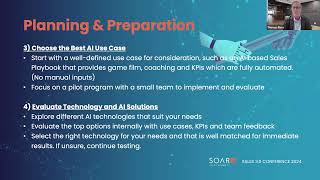
A recorded presentation by Thomas Ross (Director, Sales AI at Soar Inc.) introducing Soar Sales AI and a roadmap for successful AI adoption in sales. Ross emphasizes starting with clear goals and KPIs, assessing organizational and technical readiness, selecting the right use case and pilot, change management and automated accountability, then iterating AI into daily sales processes. He describes Soar Sales AI: a meetings-first platform that records, transcripts, timestamps, indexes and analyzes virtual/hybrid meetings, offers searchable meeting libraries, clip-and-share functionality, team/manager/executive access layers, over 100 configurable AI insight modules ("game film") for scoring and coaching, calendar integration, and reporting for sales coaching, hiring/retention, proposal follow-ups, and other sales KPIs.
Chapters
Good afternoon, everybody. I'm Thomas Ross and I am the director for Sales AI, which is a division of Soar Inc. Soar is a portfolio of AI solutions designed and developed to uplift humanity. Sales AI is today's most powerful AI solution designed to improve sales performance through continuous coaching and game film. Over the years, I've worked with many technologies, but none represent the kind of change that AI brings. We can't get away from it, but are we ready for AI? And we're going to talk a lot about that today. And I'm going to break up our talk today into two components, the first of which is AI is more important than the second, because the first is is the why and the second is the how. So the first being the why we want to talk about again, are you ready for sales and for AI as it relates? And that's really what we want to start with. It might seem strange that I asked this question, given I'm here to promote our powerful new AI solution. But then a solution is only as good as the problem it solves or the opportunities it creates. So today I want to talk about how to prepare for the use of AI so that many of the amazing new solutions that you've already seen and that you're going to see more of can actually be successfully implemented into your organizations. In addition, I also want to show you our incredible new sales AI tool. So the truth is, most organizations today are not prepared for any AI implementation. Estimates suggest that 50 to 70% of companies are unprepared for AI, even though well over 70% have already begun to implement AI in their businesses. So what does it take to get real results, especially as it relates to revenue growth? Know there were a few questions asked today that caught my attention by way of not just the questions, but the answers. And one of them was, should our sales team be trying and playing with with AI? Should they be using AI? And there were a number of different answers to that question. But as an organization, if we haven't addressed that question already, then frankly, we might be barking up the wrong tree. At the end of the day, one size does not fit all. There is no silver bullet or perfect AI solution. The opportunity is not the technology, but rather how can AI help you reach your goals? And this requires strategy and planning. In fact, the first question is, what is your goal? And if your goal is simply we want to implement AI, I'm sorry, but that's not a goal. So we need to talk about that and build out the the outline and the opportunity and the roadmap by which AI can be impactful for you. Now, again, it might be strange that I'm talking more about strategy than our solution, but in fact, no solution, ours or anybody else's, is going to be sticky, is going to be working across the organization, integrate with all your tools and be used by all your people if we don't address these questions first. And while, yes, we want to implement our solution with as many organizations as we can, we also want it to work and to be successful. So that's why I want to have this little chat initially first before we jump into the amazing solution. So, number one, you want to define your sales and growth objectives. What are they? What are you trying to gain? Is it more revenue? And if it is, is it based on profit? Is it based on gross? Is it based on net? What is the specific problem you might be having with or what obstacle have you identified is in the way of those goals being reached? And lastly in that category, how are you going to measure this? Are today's KPIs, that is to say, the way you're measuring your, your sales today, are they keeping up with results? And if they're not, or they're not being used, then why is AI going to be any different? So assessing current readiness for AI maturity and AR maturity is the next key element in that we need to know is your tax your, your tech stack for digital sales and marketing in line with what you want to implement with an AI solution? If you're still relying on and, and not to be negative emails are still a part of what we do. But if you're still only relying on email campaigns and cold calling as your baseline technologies that you're working with and a few maybe graphic tools for, for marketing, you're likely not ready for AI and AI is not going to implement with that. If, on the other hand, you're working with more up to date CRM systems that incorporate many of these things, then AI can be integrated with that and we can look at that. And we need to look at how savvy your teams and your people are with respect to these technologies. To begin with, nothing worse than a full enterprise level integration of a technology that nobody uses. So we need to get a good look by asking the right questions so that we can create the digital roadmap for your organization. And that that requires a good look at your resources, at your team, and the extent to which you're digitally ready for the next steps. So choosing the best use case. So we heard a lot of use Cases here today already with respect to some examples of ChatGPT being used with LinkedIn, with ChatGPT being used for articles writing, for gauging how our customers are reacting to two articles through analytics. We've heard a lot of these different things. But which use case is relevant for you? Could it be that your use case, as in the case of being at this event today, is more sales related, so you want to be able to get more sales with less wasted time, more productivity and people that are enjoying what they're doing? The big thing about sales and any customer facing role is if your team isn't having fun, they're going to fail. And by the way, if your team isn't having fun, I guarantee your customers aren't either. So it really is important to develop that use case that we want to build on. Could it be helping your salespeople in their calls improve what they're doing by building up maybe a library of their calls and applying KPIs and measurements against how well they're doing? We're going to talk a lot more about that. But whatever the pilot program is, you want to develop a team within the organization that could implement that use case in a pilot format. We're going to talk a little bit about that as well. And then on that basis, you want to be able to explore some of these technologies. You've heard but a few today. Every day that we get up, there's another couple of thousand new ones that have come up overnight. So there's no shortage of new AI. This, that or the other thing. That's not the issue. The issue is what do you need, why do you need it, and how impactful can it be in your organization by way of the goals and the KPIs that you want to address. So you've got to select the right technology for your needs and then match it accordingly. We're going to talk about that again. The pilot project, have you laid that out? Have you planned it? Have you created all the steps that need to be in place? There's going to be lots of changes as you implement and you can adapt to those. But if you didn't have a plan in the first place, the odds are very, very high that whatever you're trying to introduce is likely going to be a flash in the pan. So these are the kinds of things that we want to address. So you want to build a partnership and develop a change management plan. What does that mean? That means with your technology partner, whoever that might be, representing the AI, but also with your teams. So that pilot team that you may pick, maybe it's part of the sales team, maybe it's the CX team, maybe it's even part of your leadership. They need, they need to be part of what you're doing and they need to be just as interested in the results and integrated in what you're doing as everybody else in order to make it work. And you've got to prepare the road in front of you as you start to get more and more successful. What does that mean? That means training and onboarding and creating one of those words that we all know is important but have a hard time using accountability. And we need to create what I call automated accountability. And what does that mean? Automated accountability is when a system creates the data and the measurements based upon the KPIs automatically and it doesn't wait for people to create inputs because it's already collecting the inputs, creating the data, applying analytics against that data and giving us the measurements and therefore the accountability that we need. Most companies don't do that in, in most areas of their business today, certainly not sales. So we need to make sure that we create that accountability. Then we've got to pilot that solution. We've got to create a method by which we can implement, measure, improve, improve, improve what we're doing by adjusting it to meet the KPIs or if the KPIs don't allow the don't align, then create KPIs that do, but still get us the results we were looking for. So there's lots of room for adaptability. Don't be afraid to try out new technologies that can help with the top of the funnel lead generation. So today there are so many AI based chatbots and systems available, some of which you've heard about today. We're going to talk a little bit about how ours integrates with this. There are many great ones out there, but there's your top of the funnel opportunity. When you build that into your content through social media, digital assets, websites, microsites, all of these kinds of things, this is your best friend. This will fill the top of the funnel and bring those opportunities down to Those better trained CX, inside sales, SDRs, etc, to develop and really bring on customers that are enjoying the customer experience. Got there because of the way they found you in the first place and are already consuming the content and the information that you're giving them by way of some of these chat bots. So this is an amazing opportunity. Don't be afraid to try it out, but Again, it's got to be planned and it's got to be built into what you're doing. So then once that's done, you, you can begin to iterate AI into your sales process. So what does that mean? That means ensuring that AI becomes a seamless part of the day to day sales activity from field management right on up to to, to leadership and to the teams. Right. That means when they come online on whatever device they're using, whether it's a desktop or mobile, whatever it may be, they're automatically in it and they're using tools and they're communicating with people vis a vis that system that is collecting the data that we need to help them enjoy what they're doing, have fun and get results. And then we can continue to adjust all of these tools in order to continue to get even better results. Also you need to develop standard operating procedures. So process. And once you develop process and you gain the cadence by which that process is implemented, these become behavioral patterns that people can now put into play and be incredibly effective with. When people come in day to day and do a little bit of this, a little bit of that, a little bit of the other thing based upon how they're feeling or based upon how the day started out by way of what calls or emails they got in, that does not lead to results. What you need is a consistent pattern that AI can help you measure built into a cadence against every element of that process so that you can measure it, improve it, get results and have fun. Right? And on that basis you can continue your AI expansion across the organization based upon that implementation that now gives you a roadmap. And in so doing you now have the opportunity to gain these kinds of advantages. And if we use that use case that I was talking about, I'm going to elaborate a little bit more on that based upon our solution that includes the game film. Then these are the kinds of areas that you can see very, very effectively impacted with AI tools of the kind I'm going to show you. So, sales coaching, sales training, sales accountability, sales results, team competition, sales targets, sales follow ups and proposals, team evaluations, hiring and retention, management reporting, market and account AI insights, again, leadership training, and last but not least, and we have this built into ours as well, a tool to help your team optimize their emails based upon disc cliftonstrengths and many other tools that we have built in with our insights. So without further ado, I want to get into the important part of what we're here to talk about today and that is our solution. But let me just, let me just stress that on the basis of that roadmap, our solution, along with any other solutions you might consider, are much more likely to be successful. So our hope in working with yourselves or anybody interested in our solution is to ensure that we've done and asked the right questions to help you implement that roadmap such that this comes in and is nothing but successful for your organization going forward. Because just buying another software tool does not mean success, whether it's AI or not. So we want to start from there. So we've talked a little bit about how to ensure your AI project is successful. Let's talk about my favorite AI solution, Soar Sales AI. Our solution can fit many of the possible case examples. But whether you're a manufacturer, a distributor, a technology company, or whether you're in leadership, sales or customers, service, meetings in most cases tend to be virtual. In fact, in 2024, virtual meetings accounted for 70% of all meetings on average. Which much with much of the difference being hybrid of in person and virtual. Today's event is an example. We have a virtual event today with everybody watching and, and I, and I think you can see just how impactful that can be. And certainly that's been the case. So that being said, there's an opportunity to create a tool to measure and collect all of your meetings and source sales AI does exactly that. So what we do now with our solution is collect and in fact record all of your meetings, video and voice in a library. And now you've got a library of all your meetings, both individually and by managers and teams. And that's important to differentiate. So your individual users have access to their meetings, managers have access to team meetings, and executive and leadership have access to all meetings. And that gives you the opportunity to do many things that we're going to talk about. So the ability to search all of your meetings, whether individual, manager or leadership, by keywords and phrases creates an incredible opportunity to gain access to information. And that simply for most people, hasn't been there after the fact. Many of us write notes. If you're like me, you've got boxes and boxes of notes. In fact, I still have one wall of my garage piled bottom to top with notes going over a couple of few years. We won't get into that. But my point being that I never go back to those notes again. And in fact, if I wanted to go back four years or three months or two weeks or whatever the case may be to find something that somebod said or to See patterns and to see what's changed or what hasn't changed, I couldn't do that. Now I can. So with this tool and the availability and the access to that data across the board, I can now do amazing things. So unlike those boxes of notes that you may have kept all over the years, you we that you'll never access, we can now do that. So it's just an incredible opportunity to make an enormous difference in what we do with our meetings. So every meeting now in, in, in our system, and you've seen this with some of the basic transcription tools that are available today, think of ours as one of those on steroids. So taken those 10 steps further. So every meeting now can be summarized and analyzed using AI. I'm going to show you those, some of those steps here shortly that can really take it to the next level. But this data, as I say, is now available for you in that library to slice and dice as you see fit and as you have need to do. In addition, you've got a complete transcript and timestamps that allows you to get what's important quickly and easily for all those who attend the meetings. They're going to receive a summary as you've seen with some of these other tools. But in addition you can manage that. So if you want to add people to that later, if you want to take people from that later, you've got full control of that process at all time. In addition, it tells you simple things like the percentage that somebody spoke compared to somebody else. And if you're in a sales environment and you're measuring your sales team as we're speaking about much, much more today, then it's important to know how much time your people are talking rather than listening and or asking the right questions. These tools, I'm going to show you more of that as we go here. Do exactly that. So you get to see in fact how good these meetings really are. How many salespeople after their most recent sales call are jumping up and down saying that was the greatest meeting I ever had and we'll definitely have that sale by the end of the week. Too many. And the reason is because they get excited hearing their own voice in some cases and getting excited about talking their story with respect to the solution or product at hand and they forget to listen and they may miss some of the key elements of the sales process that are really important in order to confirm the the customer is, is as excited as they may be. So these are incredible tools that can now help us do that. Now in Addition, we can take clips from the transcripts and from the notes and we can send those clips off to people. So if we want to send a follow up email to a client or one of the people on our team that says here's what Mary said in that meeting, here's the clip and here's the verbiage that goes with it and then we can discuss further how to improve or what we can do in that case. Very powerful tool in, in terms of the clips. Now this is one of the areas where our solution gets even more powerful. Now we can query all of the meetings in the system. Now if you're like me, over a period of time, you know, a few months, you've had hundreds of meetings and you can imagine your team, you've got 5, 10, 15, 20 sales or customer service people, you multiply that out and you can imagine the number of meetings being recorded and put in the system gets pretty high. The ability to go through those meetings and find the information that you're looking for is like pulling a needle from a haystack. Now we've got AI and AI can do in a second what would take us an immeasurable period of time to find. We can query all of those meetings for the important information we're looking for. How many times was price and cost brought up by who and what was the response from xyz? AI will now tell me that and I can see how many times that objection is coming up and I can also see how we're handling it and who may be doing a better job of doing that and why. So we've got great opportunities to see how we can query and see how we can help our customers get the information they need by listening and analyzing the data that we have. Now, from a sales management point of view, with a sales manager having all those people, you can immediately see the huge opportunity gained by having the ability to query all of the team's meetings or one individual's meetings with simple questions that you can then fill a report out with very rapidly. So reporting on managing and getting the analytics across the team is built in and available incredibly powerful for, for sales teams, customer service teams and even leadership teams. So here's an example of how we might use another huge area of our opportunity here with respect to AI in our system. And that is we create AI driven insights. These insights or modules we build into the platform for you on the basis of the kinds of questions you need to know or that we already have available from some of our existing partners. Partners like Sandler training or shrm, to name a few. So we already have their insights built in and we can measure the effectiveness of a salesperson, sales team, leadership team, whatever it may be, to allow for personal and team feedback. We call this game film and this game film is with us in every call. And this is like having a coach, a trainer, a mentor on your shoulder in every meeting and every call for constant learning and improvement. No annual or even quarterly, or maybe even weekly rah rah sales session could ever provide this kind of feedback on an individual basis. So this is automatically in the meetings and it automatically helps your team out. So what is an AI insight module? Well, this is where we take sales or a leadership methodology and build it into a series of AI prompts, some of which you've seen earlier today when Bryn was doing the chat GPT example for LinkedIn. Those are prompts and those queries and prompts can be very complex and they can be difficult to master. So we've done it for you. We create that in AI insight modules against and for you on your meetings so that you can get the kind of in depth insight from the meetings that has just never been available before. This allows us to create scoring for sales improvement that has immediate impact for continuous learning and improvement. Managing Tracking Improving all of your meetings has just never been as available as it is now. So whether you're coaching your sales teams or helping your leadership teams, this kind of instant analysis is incredibly powerful. For many other basic transcription solutions, you are still left to sift through all the meetings. Now you can query and search instantaneously to find what you need and create constant improvement as well as reporting. Sales professionals love the ability to leverage this tool not only for improvement, but to quickly create summaries and follow ups for their clients and customers. Sales managers love this tool because it saves them significant time in managing and coaching their teams. The ability to create reporting is an enormous time saver that every sales manager will love. Owners and leadership love this tool as it is the most cost effective way to improve sales with accountability and real KPIs.
So diving a bit deeper, you can set up specific insight modules to run against specific meeting categories. So if it's a leadership meeting, you might, as in this case, run something we've got called Trust and Inspire from Stephen M. Arcovy's collection. So we can apply the types of insights automatically against certain sets of meetings that you set up in the meeting. So if it's an executive meeting or a sales meeting, we have a library of over 100 plus insights that can be assessed. I'm sorry for every type of analysis you may want. In addition and more importantly, depending upon the nature of your organization and how you want to do this, we can build one for you so that you don't have to. So there is no limit to the kinds of insights you can build as they all come down to what data you want to measure and what kind of reports and ongoing continuous improvement you want to create. Now not all meetings need to be recorded, so it's important to note that you can adjust that manually or automatically. Right. And those meetings that are, that are outside the organization, that is to say you're attending a meeting based upon their allowing you to bring in our bot, you can copy the meeting link, pop it in the box and that will record that meeting as well. So a lot of flexibility with respect to that. In addition, you can connect this directly to your calendar and of course we would suggest you do so so that it becomes automatic and you get those KPIs met and you can see exactly what's happening with yourself and of course across your team. Right. We suggest that you link your calendars right into your networks if you've got that available and we will help you do that. Once your team becomes accustomed to, to using a solution, this solution, they'll wonder why they weren't losing using it a long time ago. Being able to go back and see what Mark said or John said or Mary said, how it was said, when it was said, in what context, and how many times these kinds of things are coming up across our team is just a game changer. So this is something that I think once you, you start using, you will never look back. So while you might not yet be ready for AI, we're here to help you get there. So if your goals include sales growth, vastly improved team productivity and getting much more accountability with your sales KPIs, we've just begun. Now there's one last sign I want to, I say before Gerhardt jumps in and that is there is no greater risk than the status quo. Thinking that you can sit pat and wait while the world goes by is not a plan. So I hope that we can help you continue to move and make the best out of AI for your organization.
Wow. I love that the status quo is your biggest enemy.
I really think it is. And, and, and while everybody's jumping up and down and, and, and excited by AI, which is great, it's not about, you know, the, the AI in and of itself, it's about what do you want from it? And why? And how are you going.
To.
More from Gerhard



What Selling Looks Like When Your AI Agents Have the Context Your Sellers Do

Better Conversations, Smarter Support: Wearable AI in Business






When Scarcity-Built Systems Meet Abundance - The Judgment Gap in AI-Powered Sales Leadership
