Stop Grading Your Own Tests: A Data-Driven Revolution in Sales Skills Assessment and Coaching
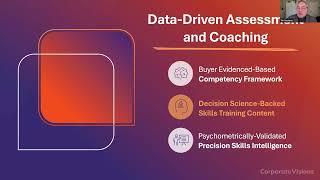
Tim Resterer argues sales leaders should stop relying on self-assessment and instead build competency frameworks from buyer feedback and win/loss data. Corporate Visions analyzed 125,000 B2B decisions and found 53% of losses were avoidable, identifying eight buyer-observable experiences that predict outcomes. One client saw a 50% increase in net revenue per account within a quarter after targeted coaching on storytelling and specific skills.
Questions this video answers
April 11, 2025
Approximately 125,000 B2B decisions
53% of losses were deemed avoidable by buyers
Eight predictive buyer experiences
Area under the curve values of approximately 0.73 and above were described as highly predictive
Chapters
Tim Resterer is our first speaker today and he's the Chief Strategy Officer of Corporate Visions. And he talks about stop grading your own tests. And he talks about a data driven revolution in sales skills assessment and coaching. Tim, thank you for joining us.
Thanks for having me.
We are honored to have you. You speak at so many events and you have so many amazing connections. So I'd like for you, before we begin, to share your perspective on the state of sales and how sales leaders need to shift gears to prepare for their team for that shifting economy.
That's a simple question. So where do we find certainty in uncertainty? I think sort of begins the question. There's a couple things that our research has shown us in moments like this, and I've kind of joked with some people that we had a sort of healthcare pandemic and now we have a socioeconomic pandemic as we are globally experiencing.
Some of the same things that are, are causing a paralysis in decision making. And what we see in these uncertain times is that your bet, your, your, your best next customer is your current customer. And I know that's a little bit of an uncanny grasp of the obvious, but do you have a, a disciplined account planning, development approach? Do you have a deliberate retention, cross sell upsell approach that you know is optimized for this moment? If you're trying to win new business right now, the idea is you gotta find a new problem. People are less likely to solve existing problems with a new vendor, but they would entertain new vendors for new problems. So what's sort of an emerging problem threat, challenge, missed opportunity that you can solve for that? Maybe your customers.
Haven'T gone outside for help yet, but you can help them. And all of these require, as Stephanie said, the, the specific equipping and enabling of sellers to have those specific conversations. It's not like, okay, I'm just gonna spread my, my methodology like peanut butter over the top of everybody. It's like, no. Who's making this move with our existing customers? Who's trying to break into these new problems? Those are different conversations, different competencies, different skill sets. How are you acknowledging that in the way you equip and enable your teams so, so that they can win on those hills? And so I think we just gotta, we gotta figure out how to have very optimized SWAT like initiatives for growth, targeting very specific opportunities with the right stories and the right skills behind them, versus again, just like, hey everybody, you should just be doing medic today. So I think that's the world we're in a Little more guerrilla warfare.
I like the way you describe it, and it reminds me of an Austrian proverb where they said that there's no such thing as bad weather, only inadequate clothing.
Yeah.
Well, I mean, I'm in Wisconsin, it's April, whatever, and it's 40 degrees today. So I just, I relate to the idea of being prepared for the context and the situation and finding a way to make your way in it.
Yeah. And if the economy gets sick, we got to keep our sanity, batten down the hatches and move forward and look at the fundamentals and optimize everything.
Yeah. What's within your control. Right.
Yeah. There's one more thing before you do your presentation, which is the. You are the master of structuring a story that's engaging to the customer, where you and you have something in common with Stephanie because she's preparing students for conversation mastery. So what is your advice to all the sales leaders out there on how to use stories as a. A tool for customer creation?
Well, this is a spoiler alert for what everybody's about to hear, but.
I always say that a salesperson with their lips moving is your last bastion of competitive differentiation. When everything is. When everything else feels like, smells like, sounds the same. Especially when you hear that back from your customers that what's going to make the difference is the story you tell and the skill with which you tell it. We have a conference next week in Denver called the Emblaze Growth Conference. Stephanie's going to be there, and we've got some new research on the distinctly human skills of storytelling for differentiation, active listening for differentiation, how you, as the human can be the differentiation in an undifferentiated, information overloaded world. And so I am absolutely of the mindset that your ability or inability to articulate value is. Is the difference maker right now. And so what I'll talk about in a minute is, is how to equip salespeople with the right skills to do that, which I think is really the remaining irreplaceable part of the human in the sales cycle.
Is there any books that you recommend on the art of storytelling?
I don't know. You got any more you can hold up there?
So I'm running out of books.
This is. I hope you were asking me to give a shameless plug. I'm hoping that. So we've written three on this topic. One was called Conversations that Win the Complex Sale. The second one was the Three Value Conversations. When we discovered there were more moments of truth that you needed to be great in and Then most recently we wrote a book called the Expansion Sale. Came out during the pandemic when existing customer retention and growth was the thing. Well, we're back there. So the Expansion Sale is the one I'd probably recommend now since it's targeted to the strategic opportunity before us.
Wonderful. And I also want to thank our team, Carrie and Rob and Amanda and Jeff for working behind the scenes and making this possible. And I'd like to ask Terry to find the link to Amazon to Tim spoke so we can share that with the audience.
So take it away, Tim.
Tell us all about the data driven revolution.
Awesome. Well, I'm going to share and I'm going to have you confirm that you're seeing my slides before I let you go because I want to make sure everybody can see this. Are we good, Gerhardt?
Yes. Stop grading your own tests. All right, well, thank you.
Try to take this as I try to put a provocative title under these things, gang, because that's the way you pay attention, especially first thing in the morning, first presentation. This idea that there are certain competencies and skills that this moment demands as well as certain competencies and skills on your team. That will be the remaining competencies and skills that if you have real live sellers still selling, they're going to need to master. But the question really becomes, what are those skills? Because it's rather abstract and rather complicated to say, hey, the main thing we have to be doing with our teams is getting them to have a better conversation. And it's like, great, so where do you start with that? Today I want to introduce you to a new concept that's kind of emerging. We train about 100,000 sellers every year and we work with 300 different companies here at Corporate Visions. And the thing we're really dialing into for L and D leaders, sales leaders, enablement training leaders, is a concept of precision skills intelligence. There's, here's a formal definition of precision skills intelligence. Basically it's identifying and measuring and developing those skills that have the greatest impact. And the world as we're seeing it is moving away from job descriptions to something being called skill clusters. And we're also seeing a move that says what's more important than even the content of the coaching is assessing and finding the deficit and then precisely personalizing the coaching like the content is the content, but getting the right content to the right person. And so the struggle really has been in terms of growing performance is I mentioned it earlier, is how do I go from spreading my methodology like peanut butter and hoping all boats shall rise to more precisely assessing and identifying and intervening. I just alliterated in a way I hadn't had practice identifying and intervening after you've assessed and go after that with your sellers and watch the needle move. So a couple things I want to talk about today are the idea of generating a competency framework, but not one that's based in personal preference or opinion or self assessment or even manager assessment. A framework that was identified by real B2B buyers who are saying these are the experiences that matter in wins and losses. In other words, your competency framework should align to predictive customer experiences that will end in wins, not losses. And we'll talk about that. Second, I want to talk about the then the resulting alignment of the skills content. Once you have a framework, there's a need to align your skills training and coaching to that framework. But as I said just then, throwing the same thing at everybody doesn't work. Because here's the deal. And if sellers have been scheduled for a certain training, they may not disagree that some training is needed. They just have plausible deniability that they need this particular training. And so one of the main goals you have to have is you have to have the precise skills intelligence that is unassailable and invalidated in a way where it identifies, I like to call them, deficits that remove plausible deniability so that you are working with people on the thing they need work on and there's evidence behind it that is inarguable. And now you go to work on the thing that matters and means the most to them and their performance. This was a dream. It is now a practical reality and scalable with the techniques, the tools, the concepts I'm about to show you. So one at a time, let's talk about this first. I don't know if you have a competency framework for your various sales roles and like what they must be good at and whether or not you've mapped them to roles or whether you have learning journeys attached to those. But I would ask you to think about your competency map or competency framework and compare it to what I'm about to share. The question I always have is where did it come from? What's the origin story of your competency framework? And many times what people do is they go and they try to figure out what they need to do better by looking at wins and losses from their customers and say why did we win? Why did we lose? Excellent first step. The problem with most is that you're only asking your salespeople for A dropdown, right? So you have a drop down in Salesforce and you're saying why did we win or why did we lose? Interesting, the answers you get for wins and losses. But you forget that the person who made the actual decision might have something to say about this. So we now run the industry's largest win loss program and have the largest database of B2B wins and losses. And what we found is when you ask customers and you ask sellers about the exact same deal, you get answers, different answers, 70% of the time. So we dug into that a little bit more and have now created win loss at scale. So imagine a deal closes in a CRM. You send out a notice to all of your wins, losses and no decisions. And you start to see critical mass level feedback that you can get. And you can identify opportunities for change, opportunities for adjustments, opportunities to fix areas that are broken. Not by guessing, not by personal preference, not by self or manager assessment, but by buyer feedback. Right now we're sitting on top of a database of 125,000 B2B decisions in the last few years that we can assess, aggregate and anonymize and figure out what's going on. Here's what we found. If you ask your sellers why they lost, I'm pretty sure that 100% of the time that your sellers will tell you it was something outside of their personal control.
The product didn't make it, the price wasn't right, the politics weren't in our favor. The reality is that's not true. It's not 100% of the time outside of the seller's control. We know this intuitively, but we don't get any insight into that. What I'm here to tell you today is looking at 125,000 deals, your next best win is going to be one that was a potential loss. More than half of your losses were avoidable. They were the cause of unforced errors or self inflicted wounds. 53% of your losses, losses. Buyers say you could have won it if it wasn't for something that you did or didn't do. Inside of the buying experience. This, this idea of the buying experience is really important. As I mentioned earlier, you are creating the experience and the experience is the differentiation when all products and services and solutions sound and look the same. And it turns out that this is huge in terms of whether you win or lose. Because buyers, even when you lose are like, you could have won this. And it wasn't because of your product or your price or the politics. You it's something you did or didn't do. So your next question has to be, well, what are those things that we can and should do and what are those things we should avoid? What we've been able to find in these 125,000 deals is eight predictive buyer experiences. What do I mean by this? These are experiences that your buyers can observe, they can score you on, they can give you feedback on, and they can compare to your competition. We're able to survey and get answers to questions, and as we get answers to those questions, we've been able to find. So check out these numbers here. This is called area under the curve. A 0.50 means this thing is interesting, but it's basically a coin flip on whether or not it impacts the outcome. But anything from 0.73 and above is highly predictive of whether or not you will win or lose based on the score you get from your buyers in these areas. So there could have been 12, there could have been 14. There's not, there's eight, there could have been two, could have been four. There's not, there's 8. 8 predictive buyer experiences. And my submission to you today is when you look at these as the buyer's experience that they can score, they can give feedback on and compare is it makes the great foundation for your competency map as you want to overcome your 53% of losses that you could have won and you want to make sure you win consistently and you want to figure out how to get salespeople with their lips moving, doing the right things, equip and enable them to master these eight experiences, or in other words, these eight competencies. What's interesting, as we talked earlier about a world where expansion and retention maybe is equal or in fact more important, given the world of uncertainty we're in. I don't have the time to dig into this today, but we've been able to identify 8 and 8, if you will, to overlap between the two. But we found pretty much distinct competency frameworks for distinctly human sales skills driven by buyer or client evidence and experiences. And so what you see in front of you, you should take a picture of it, is these are the outcomes, these are the experiences that buyers have that are predicted of wins on the left hand side and avoiding churn or maximizing retention and expansion on the right hand side. So from here a buyer evidence framework means you are now working with a competency framework that you know will increase your chance of wins. Because these are the experiences buyers can observe, score and compare that are meaningful and predictive of wins and losses. So the next thing you have to do is think about now, how is your coaching, how is your training aligned to this? Because right now you've now eliminated the grading of your own test that sellers and managers do when they identify why they thought they won and lost and and are often telling you what they think they may need training on. Is now you're in a position where you're like, okay, these are the competencies you need. Let's talk about the training and how it aligns. So let's just look at acquisition for a second. When my suggestion to you is.
That you would go and think about restructuring your framework around these eight for those sellers whose primary job is new business development and acquisition. Again, we don't have time for it, but these would be the eight for your account management and CS teams. And now think about these eight and what they a seller would need to do in terms of skills to master these competencies. So what we've done at Corporate Visions, just to help you think about this, is we've created a competency map, right? So here's your eight along the top line here and the jobs to be done. Here's the outcomes, the measurable outcomes and impacts that they have to be able to demonstrate they can do and then identify. In our case, we've done the additional research to identify the subset of skills per competency. So let's just take the competency of Aligned Solutions to Needs. Spoiler alert. Aligned Solutions to Needs is coming back in all of the data we're seeing from all of our clients. Wins and losses as the most predictive of wins when you do it well and the most predictive of losses when you do it poorly. We see it on both. And that what that says is this is currently the most.
Impactful competency and skill set your sellers can have to maximize wins and avoid.
Unnecessary losses. And so if you don't do anything in the near future, I'd concentrate on this one. And so what we've been able to identify then are the core skills that actually make that competency, make them competent in that particular experience for customers, and then have been able to create specific concepts around those skills to get to competency in this area and then begin to instantiate or embed this. And Stephanie will love this. We've been able to leverage AI roleplay and planners buy competency because these competencies nicely align to key moments in any particular methodology. But like I'd like to say is methodology itself will not get a Customer to change their mind. Methodology itself will not articulate meaningful value. Methodology itself will not create clear differentiation. Methodology does not create urgency. Methodology does not negotiate well that there are competencies that are above the methodology line that you need to know that when a seller is activating and executing your methodology in the buying experience, they can do it. In other words, the story and the skill they tell when they're in front of the customer and the skill with which they tell it when they're in front of the customer. So what I want you to think about is going back to your.
Competency map. Think about aligning it to the competencies that we now show are predictive of wins and losses. And then begin to reassemble, recombobulate your content to align to those competencies and begin to think about competency based training and the skills aligned to that relative to what the customer is expecting. And we know our predictive of wins and losses. The final thing I want to talk about here real quickly and see if we have time for questions is the competency framework. Awesome. You now know that buyers care about these things. They can score them and they can compare you and that these are predictive of wins and losses. Your job then to align the right skills, concepts and training, coaching, reinforcement tools, practice tools, demonstrated proficiency and certification all by these competencies, everything aligned to that. But the real question now is, as we talked about is but who gets what? It could be overwhelming to look at these eight and, and those things and say everybody gets them, let's get through them. The reality is no, not everybody needs all of them and not everybody needs the same ones. So I want to talk a little bit about like what you're doing for assessment. And I'm just going to grab align solutions to needs over here on, on the left and take a deeper look at this. What we're doing to kind of move the needle on precisely prescribing the right intervention for individual reps is to break down each of the competencies. In this case, align solution to needs into the core skills. As I mentioned and we begun to create behavioral outcomes type questions ranking on a scale of 1 to 5. What is it? What are you hearing? What are you seeing? What are you experiencing when you interact with the clients? What are they saying about the experience they're having with you? And it asks you to not just think how am I doing? But it asks you to reflect on what am I hearing? And so step one is still a meaningful solid self assessment. You do want salespeople to ponder this and we've built this out for each of the eight competencies and the respective skills under each of the competencies and for acquisition and for expansion. And I'll give you a link here in a second. But the idea is when you take this assessment because they're behavioral outcomes questions, it asks you to reflect on what customers are saying and how they're reacting to you. It really makes you think about am I creating these experiences or I didn't even know there was a better experience to be created. And so one of the things to think about in trying to align your training and the right competencies to the right person with the right problem is self assessment is meaningful if you do it well. But it's going to have its limitations. But what I would offer to you today is check out this QR code and you're going to get access to and you can do this as often as you want. An opportunity to run the assessment on the competencies and skills that have been identified by the buyers and our research.
And do the self assessment on either the acquisition or expansion skills. I think an improvement over some of the ways people ask questions. But self assessments and grading your own tests will only take you so far. If you look down here to the left, it's a useful directional signal but it does not demonstrate performance and it can end up biased. Right. Because there's just general overconfidence and a general lack of self awareness. Where this is going. And I'm going to invite you to consider being a pilot for this is we're investing in our research labs right now in a unique approach to assessments in this area of precision skills assessments. There's. And again Stephanie can hear me in this one. This idea of using AI, in this case micro simulations to simulate the experiences. In this case we've identified sort of three main moves in a seller's trajectory. You have to be great at initial outreach, you have to be great at differentiated value driven solution presentations and you have to be able to help justify, create, urgency and justify and get to a decision.
We've been able to work with an expert in the area of psychometrically validated skills assessments. It came from the Harvard Skills lab where they're building these for complex ideas like leadership and teamwork and management. And now building this for the sales arena, baking into the micro simulation experience all of the customer driven buyer evidence frameworks, competencies and the underlying skills. So you're taking realistic skill isolating scenario based simulations and you have to be able to demonstrate these skills in actual context and you're actually getting measured on what you do. And one of the words I want to sort of give you here today is the idea of formative assessment. The, the assessments, most assessments are summative like they, they test and summarize what we know. Formative assessments are doing the same. But while you do it, you're actually getting better at the thing you're being assessed on. There's this interesting learning experience, self awareness experience while you're performing these microstimulations that you start to get better as you do it, but you also start to feel and sense the gaps as you do it well before you even get the results. But this one's in our pilot development stage. But this is where the world of assessments is going. And like I said, we think that there's going to be more of a premium placed on assessing and identifying precisely the skills that are needed and prescribing the right intervention as there is the content and training and coaching itself because there will be no plausible deniability and you will be working on the thing they need the most work on. And so I will get personalized now at scale training based on this and this, this prescript, this more precise skills assessment is going to eliminate the problems of bias, overconfidence, lack of self awareness and really just Q and A multiple choice versus actually performing. So this is, this is where everything is headed. We have assessment pilot opportunities. If you are really into this stuff and you would love to try this on your team, we are in this phase right now. I'd encourage you to just send me an email and we could have that conversation. If you are really into and really believe that things are moving towards a more precise, intelligent assessment and insights on what your teams need versus I get to grade my own test. We would love to hear from you about that. So with that I just want to remind you that competency frameworks based on real buyer predictive experiences with key competencies in areas aligned to the outcomes that you wish to have and then the ability to put skills, concepts, training, practice, certification under each of them and then being able to assess for them so that you can prioritize and precisely dispense the right training. Coaching enablement is the wave of the future in terms of helping your humans, your, your, the people with their lips moving, the stories and skills that still make the difference, be your difference. These are some of the numbers we've seen when people are more precisely prescribing these types of interventions. I think these are the kinds of numbers you want to look for. I'm going to highlight this one right here. I just recently was a Forrester event spoke with a company that changed the story and skills for their account management and CS team because they had been using the same story and skills as their acquisition BD team and just changing the story and skills for the account management team. They saw a 50% increase in net revenue per account within the first quarter of releasing and the new story and the new skills. So the power to change things without changing product, without changing price, without changing your sales team and and despite politics is still the customer conversation, the story they tell and the skill with which they tell it. So there you have it. That's my content for today. Gerhard. I landed pretty close to the finish line. This is a freebie as well if people want to hear more about how feedback can drive customer feedback. Buyer feedback can also be part of how you precisely identify what's needed by.
Each rep. And you did get one interesting comment. Steve Keck. It's a, it's a long post but he's using psychometric assessments. They are 80 to 90% accurate and I dropped sales turnover by 10% using them. How is that?
Yeah, that's awesome. I. I hope you grab my email. I would love to hear more about that email.
Quick.
I'm gonna. Don't get dizzy. I'm gonna go backwards here and yeah, so yeah, hit me up gang. I really like to nerd out on these conversations and, and we're all kind of in the storming forming stage with all this stuff and would love to know and even introduce you to our scientist who's working on this. He'll take all comers because uh, it's a fascinating uh, new area and I just the discipline of assessing and precisely prescribing versus the discipline and just the right training and coaching content I think is kind of the new frontier for all of us because what we've learned is when you are in deficit, you are more likely to learn and be willing to adopt and change. And we just have to help people find real life accurate, validated deficits so that we can improve that outcome.
I will drop your email in Umbrella right now so people can get in touch with you.
Awesome. All right, I'm going to give one more. I'm going to go back to one more code because it might have gone by too fast for people. They didn't know what I was talking about. Here's the one to do the self assessment. It'll give you a taste but it is still a self assessment, but I got to admit, it's just kind of fun. So get that QR code and my email, and. And if there's any people who like to read more, you can go for this. Freebies for everybody today.
And we also dropped some links to your books.
Oh, those aren't free. Sorry.
Umbrella chat? Yeah, of course they're available on Amazon for a small fee.
Just. Yeah, best deal in town.
More from Gerhard



What Selling Looks Like When Your AI Agents Have the Context Your Sellers Do

Better Conversations, Smarter Support: Wearable AI in Business






When Scarcity-Built Systems Meet Abundance - The Judgment Gap in AI-Powered Sales Leadership
