Strategies for Managing AI Sales Agents
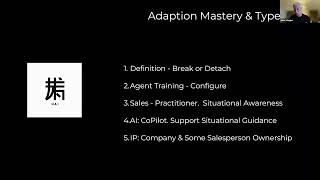
A sales leader explores who should own AI agents as they move between companies. She proposes three levels: company-controlled agents for basic tasks, configurable co-pilots for experienced reps, and expert-built autonomous agents owned by the salesperson. Key questions: liability, IP rights when reps leave, and whether agents should be portable like talent.
Chapters
Instead of telling you all the things that I do know, I thought I'd share today the things I don't know. And since that's a lot and I only have 20 minutes, we'll focus on one thing, and that's AI agent ownership. And I'm trying to make a case for sales professionals owning their own AI agent ip. And the reason this is an issue for me is because as I'm bringing a product to market, an agent called the Compass, I'm wrestling with this, my go to market strategy. Do I sell to companies? Do I sell to sales professionals? A combination of both. And if I sell to sales professionals, there's a number of ownership issues and IP issues that come along with that that I didn't anticipate. So I'm really wrestling with that issue right now. So I thought I'd walk you through how I'm looking at this. I don't have this baked. I don't think anybody does. So I'm hoping to create some dialogue. There needs to be some policies and procedures put in place around how to do this.
So here's what I want to cover is the management issues as I see it today, what some options are, the benefits to sales, profession ownership to company ownership, and then just share some ideas and concerns that comes up. So around AI management, I've broken it into three areas. First.
Who owns a trained AI agent? So a vendor sells an agent to a company, a company then configures that agent to their particular business requirements. And then if they allow it, the AI can be trained by the sales professionals as they engage in their business. Who owns that ip? Who controls the trained asset? The second issue is around autonomy. And by autonomy, I mean how tight are the guardrails that you're going to allow the agents to have, right? Are they tight? Are they moderate, Are they loose? Do you allow innovation? And then who manages that? And then there's the IP issue around. If agents are allowed to be trained by sales professionals and they bring in their domain knowledge and then they leave the company, do they lose all of that IP they left behind or can they take it? And so let me cover a couple of these issues.
Ownership brings a number of responsibilities with it. So there's liability issues.
So say a sales professional brings their own agent to their new company they're working at and that agent violates some company policies, who's liable for that? Then there's privacy issues. As you train the AI and you're collecting and processing data about your clients, about the particular salespeople how is it privacy protected? And then the workforce responsibility. Responsibility. Where does responsibility for training people on how to work with AI and agents in particular lie?
So these are, I don't have the answers here. I'm just bringing these up now. We talk about AI replacing jobs, but if I'm a sales engagement professional, which I'm not, I see a huge opportunity to define these policies and procedures and take a leadership role in your company. So as opposed to AI replacing you, I see your role becoming even more critical. And you'll sit at the intersection of legal, executive management, hr, sales leadership, marketing leadership. So sales engagement is really going to have a leading role going forward. And then for the consultants in this area, what a huge market opportunity. As I said now, autonomy. I'm looking at three levels of matt, I call it mastery. So and this is what I built into the compass. So there's the foundational layer where the agent is constrained and it's actually like a novice. So let me give you an example. There could be an agent that manages a company's sales forecast. Now salespeople are notoriously poor forecasters. So having an agent take that over will be a great thing. The only people worse than salespeople are sales leaders, CROs, sales managers. It's probably the thing that hurts the career of sales leaders more than anything is their inability to forecast accurately. So imagine an agent goes into your salesforce, goes into your gun, looks at all the recordings, gathers other data and does all the forecasting. So that would be a foundational.
Agent because you don't want salespeople messing with that. You can then can have an agent that you allow configuration. So let me give you an example. If I am a professional, I grew up selling in New York. I was really familiar and pretty good selling into the financial service industry. So when I was hired.
I would bring that expertise. So if I have an agent, I want to be able to configure that to the unique requirements of the financial service industry. So, and then the final layer is innovate. Will we allow the agent be to be customized by sales experts? So I looked in some parallel spaces and if I, I looked at Japanese martial arts and there's a concept of called shu Ha ri, which is three levels of mastery. And the first level, foundational shoe means to obey, protect, follow the rules. And in this case an agent, like the example I gave you of.
A forecasting agent, there's minimal training that you're doing. And this is also good for novice salespeople. You use the agent as is what we want is consistency and repeatability. So the AI is really an assistant. And I would imagine in this case that the IP is all owned by the company.
The next level of mastery is, ha ha, means to break or detach. So you could break from the foundation and you start to configure it. So again, I'll use the example of selling in the financial service industry. It's a regulated industry, so there's unique requirements of selling into retail banks, wholesale banks, investment banks, et cetera. I want to be able to configure my agent to those requirements that you would only want done by what I call a practitioner, right? A salesperson professional that has five, 10 years experience, has great situational awareness, domain expertise, industry expertise. And the AI there becomes more of a co pilot, right. It can support situational.
Give you situational guidance. Right. So as you're, I'll give you an example. If I'm selling to J.P. morgan and my agreement is in legal contract.
The agent is going to monitor the market and say JP Morgan announces an acquisition of another bank, well that could slow down legal capacity to review my agreement. So I'm going to get an alert from, from my agent which will then craft an email that I'll send to my contacts saying hey, is this going to impact us? And hey, you should know that my offering is going to help you and position you well with the company that you're acquiring. So that gets you ahead of the curve. Now if I program that agent, should I not own that domain knowledge, that industry knowledge? If I leave the company, can I take that with me or does it stay at the company I'm working for? Do they claim ownership? How does that get worked out?
The third level of mastery.
Is really in Japanese martial arts. So when you get your black belt, you've mastered the foundation, you can then go to the next level where you start to iterate on your expertise. And then when you get to this level, you can create your own spool. You've adapted the and innovated the foundational components of the discipline and you become a sensei of your own school. Sales professionals that are experts, leaders in their field can do that. They take the agent, they transcend or separate and they innovate. You give them full autonomy and the agent becomes an independent resource of insights. And again we have this whole issue of company and salesperson ownership. So say a salesperson. Let me go back to the financial service example. I'm a senior sales rep in the financial service industry. I have my own agent, you Hire me in your company, I should retain ownership of that. How are companies going to manage that? What are the liability issues? How do I allow it to integrate with my company data, my CRM, my HubSpot, my zoom info info? And if the person leaves, how do I manage that separation? So they get to keep their agent but I protect mine.
There is a. I always look in parallel spaces for solutions, hence the going shogun on you. But there's another event happening in college sports. It's called nil name, image and likeness. And here college athletes were protesting universities making hundreds of millions of dollars off their, you know, their expertise. You know, they're top level agents. So instead of them being paid, they worked at this nil name, image, likeness thing. A basketball player at UConn, a woman named Paige Rukers, if I'm saying that correctly, just signed an agreement with Nike. She's putting out her own basketball shoes, has her name on it and she gets royalties on all the sneakers that are sold. Could that be.
A solution for professionals that have their own ip, they've developed expertise around selling a certain type of product. Maybe in an industry like financial services or some other thing, I'm going to go out and claim the IP or the nil. So when you hire me, all of that is protected and I get paid on that. That could also work well into where we, I think pricing is going to be going around agents which is going to be more performance based. So the whole seat based licensing I think is going to disappear. We're working towards usage base but really what we'll probably go to is more of a performance based compensation model. I do that in my work today. So when I go and I work with my clients on deal strategy, I get a retainer and then I get a percent of the deal, one month's mrr. So the more deals I close, the larger they are, the more money I make. And the companies are happy to pay it because I'm bringing in a ton of revenue they wouldn't have seen otherwise. The customizable IP framework I put there, one of the concepts could be, is that companies set up a framework so agents, so sales professionals can snap in their agents and then decouple them when they're done working at that company.
The other issue is AI personalization. So who's going to manage the personalization of agents for the sales reps? They got to be personalized around the reps, names, their expertise, their markets and there could be some co branding opportunities. I'm just putting these out there. I Don't have. These are ideas. Again, I think things that need to be worked out, but we need to get this figured out because I think we're all going get punched in the nose with these issues if we don't get them addressed pretty quickly.
The way I, I work with a lot of very senior high performing sales reps because my expertise is around strategy, not tactics. So these are people that have already mastered how to sell. So I work with high performing individuals that are trying to get good at strategy. And the reason is if you're good at strategy, your income's going to double or triple.
These eight, these high performers are building their own agents today. One of my goals is to help them do that. So if you want to attract eight players, you want to let those people come into your company, you hire them in and you allow them to bring their agent. Now an interesting thing, if I'm going to hire a sales rep and he or she is going to bring their agent, guess what? I'm who I'm also going to interview as part of that process. I'm going to interview their agent. In fact, I want to test it for.
Its ethics, I want to test it for its approach. And it will also tell me more about the person, how their agent performs and how they've trained it that I could probably learn by interviewing the sales rep. So think about that HR process or that recruiting process. How you vet agents that are coming into your company and how you make them part of your interview process. And then if you want to keep top sales talent, you let them benefit from their innovations. Yeah, you could make it, make it containerable, part of your product. We benefit because you sell more. What I want is revenue. If you want to keep your expertise and take it with you to new places, knock yourself out.
So here's the benefits. I don't have all of these to find, but if I own my own agent, it drives investment. I'll spend 25, 50 grand a year on improving my agent, having a train, have it vetted. Because if I, if it's going to help me make a half million a year, that's a small investment. And in portability, meaning if I could take it from job to job, it means that I have a lifetime of experiences. My agent is going to be so rich that it will know how I operate, it'll be able to anticipate my needs. It'll be a very powerful tool that will create high performing sales professions. Ownership also fosters innovation. You keep trying new things, you keep experimenting. And I think this is a win win for employers.
Think of this. If you let's again we'll go back to the if I'm an expert in financial services industry. If you take me 25 years ago I knew all the heads of procurement, I knew most of the CIOs. I knew how to navigate a regulated entity, financial entity. So let's fast forward today and I have my agent, you hire me. What I do is say, hey, give me the products, the product data, what am I selling? Give me my quota and tell me my territory. I load that in to my agent and, and I say okay, tell me how I'm going to go to market and make my number and in 20 seconds that agent is going to give me a complete business plan. You have relationships with these 10 people. Contact them in this order. Here's what your product does, here's the potential value in the financial service industry and oh by the way, I'm going to segment that by retail banking, investment banking, private equity. Because each has unique requirements. Here's the messaging you should use. I'm off and running. There's no ramp up time. I don't really need to know how to demo the product because the agents are going to be doing it anyway. What I need to know is the issues and the value I'll bring and the risk that my current target market has and how I'm going to help them mitigate that risk with my offering. So look at the value of the company and then agents, in my opinion, strengthen human connection. When the agents are doing all the negotiation, the contract work.
It allows more time for me to connect around the intangibles. How is my offering going to help you be successful on your job and for the company? I gave you an example of reducing onboarding time. I can focus more on the human relationship and my productive capacity increases. Instead of handling two or three enterprise deals at a time, I can handle eight to ten with my agent. So you need fewer of me.
So that's my, that's what I'm facing. I don't have all the answers. My goal here was to just put out some of the issues and I'd welcome any input ideas. I think this is a big opportunity that needs to be addressed and thank you for your time.
More from Gerhard



What Selling Looks Like When Your AI Agents Have the Context Your Sellers Do

Better Conversations, Smarter Support: Wearable AI in Business






When Scarcity-Built Systems Meet Abundance - The Judgment Gap in AI-Powered Sales Leadership
