The Agentic Enterprise: Driving Growth Through Human-AI Partnership
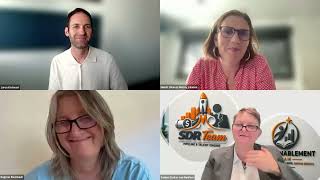
Sales leaders from Siemens, Atos, and Salesforce discuss moving AI from hype to real operations. Atos saw a 10% conversion lift from agents handling pipeline recommendations and SDR outreach. All three agree the next big win is freeing sellers from routine work so they can focus on relationships.
Chapters
Yes, I'm excited to moderate this panel. Jaron Krcznawski, I'm heading Sales 3.0 Enablement at Siemens, and we're really going to be talking about a topic that's moving from a hype to real business impact, and that is the agentic enterprise. It's really no longer if AI will impact sales, but how to strategically integrate it to solve real business problems. And I'm really fortunate to have 3 distinguished guests with me today who are gonna share their real-life experiences in a sales environment. So Niv is VP of Sales Enablement at Merakel. Sabine Stocker von Neuforn is Director of Sales Enablement at Atos Software SE. And both of them were with me at the last panel that we did with Selling Power, and that was about empowering sales in the age of AI, blending technology with the human touch. And I would really strongly recommend to go watch that recording. And today I'm excited to welcome a new guest with us. This is Dagmar Eisenbach. She's Director of Sales Enablement at Salesforce, and she brings a wealth of experience in AI. So welcome, Dagmar. To the round today. Together we're going to explore how to build a future-ready sales organization where AI works as a powerful partner to human expertise. So let's dive right in and we're gonna start with you, Niv. Last time in the panel you said that you were empowering your team through an agent-based enablement system. Perhaps you could share a recap of the evolution, the results, and also what you see as the biggest challenges when you bring together agents and sales.
Great question. Hi everybody. Glad to be on this panel again. And you know, time flies when you're having fun in the world of AI. It feels like, you know, a few months ago is years almost. And yes, last time we spoke, I was saying we were getting rid of our like traditional content management system and enablement and moving to an agentic-based enablement system for our field sales team. And we've done so, we've built that system. And so now instead of, you know, having to search for the information, it's being obviously bubbled up to our sales teams. But I think we've come even farther than that. I mean, we've come from the level of designing those particular point agents to solve one particular problem, whether that be, you know, Medpick coaching on your deal, the Challenger Maestro we set up for our Challenger methodology to to make sure that people's outreaches or messaging in general were in line with that methodology. Things like, you know, pipeline forecasting, all of those like point agents that we built, we've now decided to go a step further and to say, okay, can we build those agents into workflows that trigger each other so that we have a set of agents speaking, talking, working in this flow? And to give you a concrete example, one thing we've brought in in the enablement field is before, and I'm sure my enablement friends on the call will recognize these pain points, you know, we had HRIS systems sending us a trigger to say, or sending us an email saying, somebody new is joining. And then we had to register them for the onboarding program. We had to set up their buddy. We had to make sure that their manager was aware of what training they were going through, what the scores were, et cetera. And now a lot of that is being automated for us. Us as enablers, the interesting thing is we've had to kind of change hats. And so instead of coaching people, welcoming them, which we are still doing, and there's absolutely, and we'll come back to that later on, the human in the loop piece that's very, very important. But we're gaining time, we're being more efficient by having this whole admin logistics workflow done for us through AI. I think that's the big change. The one thing I would say is when we were designing all of those point agents, the Sales 3.0 team were coming back to us saying, "Hold on a second. There's so much out there. We don't know which one to use for what. What is the real use case? And is this going to be a benefit to me?" So, on the point of, you know, impact and business impact, I think we went through a wave of distraction. And that honestly could be felt within the pipeline results and some of the closing results as well. So, we need to be careful with what we're pushing out, how we're communicating, how clear those use cases are, and if it's really going to be impactful for our field sales team. So again, I think, you know, 6 months is a long time in enablement, but also in AI. I feel like we're now on the next wave, which is more of that workflow process piece. And hopefully the results of that in terms of business impact will be really concrete really soon.
Well, what a great story. Thank you for sharing those insights, Niv. Over to you now, Sabine. So last time you were also talking about deploying AI agents and bots to support daily workflows. You also said that you wanted to scale this. So are you now at that phase where you are scaling and are you seeing some positive results?
Well, let's say like this, my ambition ran a bit ahead of the adoption of our sellers. So let's be very clear. Yes, we are using agents, um, especially in the field of, uh, recommendation on like next steps or making sure that a certain step legal is always getting an update on what's going on in the deal. So summarizing this in a legal wording so they know what we are discussing earlier stage in the deal, what is always— it was always a complaint and a process that was broken, but If we look at— it's mainly on the pipeline evaluation and recommendation of next steps within the CRM where the bots currently are used. We kind of broke our salespeople a little bit with this. So, it's more on the, how do we make people feel comfortable with this and not break them with another thing that they barely know how to use? And let's be honest, in most cases, they just use their phone for writing a text. Where we did, however, see a really good impact, and unfortunately it's not measurable, but we see that the conversation prep, so for a customer meeting that sales are doing, where sellers are utilizing information we have in our systems, but also content pieces that we have that can recommend the right customer success story, or elements where they look at LinkedIn, where customer, uh, Individuals basically posted things. That's a really great preparation for the meeting to say, like, we make the meeting more human, more individual for that particular person and not scripted. More something that's not only a real time saver, but also the meeting quality has increased. And it's moving more to a personal consultative sales rather than just like the scripted ones. Impact. Still hard to say. Our sales cycle in enterprise is between 12 to 15 months. We just started something around 3 months ago with this, so, or 4 months, not to lie. So, impact is still not something that I can put measurable like my management wants, but we are seeing that the feedback of customers is stellar. If we look at SDRs, that's my second heart now because I got this team under my leadership now, as well. We see that the calls are getting getting more specific. So, the outbound quality has increased dramatically just by us providing them the right Sales 3.0 outbound sequences, making sure that they are having more tailored information at their fingertips. So, they're onboarding faster, but also we see a 10% higher conversion rate to pipeline from their conversations because on the spot they can react to objections faster. Just by taking AI as a supporting measure. And for me, an enablement— sorry, selfishly— it's more moving into contextual learning for individuals. So, in the past, it took me ages to analyze what a person needs. Now, I can analyze AI skills, role levels, call transcripts, KPI performance, and even compare them to peers and then create a very individual training paths. And that is something that, again, how do you put a measurement on this? Sorry, my dear CEO, but this is something where it saves me time and it gives back actually some real value for the people that we always ignore, what are in the middle and need proper coaching. So, is it measurable yet? Mm, I don't know, but the rest really shows impact.
Yeah, great, great story, Sabina. Thank you. Thank you for sharing that. Now over to you, uh, to Dagmar. You really sit at an interesting vantage point because you're not only driving AI within Salesforce, but Salesforce as a company is also supporting other companies in using AI and adoption. So from that interesting vantage point, what has your transition looked like? And do you see, is there a winning recipe that makes this transition be more successful?
Absolutely. Whilst every journey, of course, is very individual or team-specific, I think you could say that we've had our own journey in the transition. We're not just selling or advising companies in the space, we're also living it ourselves now in our own journey. We call that Customer Zero, and you may have seen some of the success stories in our blogs, etc. So I want to share one that is very personal because, for example, Slackbot now since January, it's actually on the market, GA. But in September last year, when it was available to a small group of pilot users, I've actually started to build agents on this in order to follow up our events. Our Dreamforce event, it was like a question. Someone asked, 'Oh, Dagmar, you've done so much, could you just do that?' And I said, 'Yeah, I can. What exactly should it do?' 'Yeah, well, just do it.' 'Okay, fine.' So I just did it, and within an hour I built a prototype. And this is a story we hear a lot, but I want to share it with my— in my own story. And it took me an hour for the prototype and a week for getting the governance around it. So who needs to give input? What exactly is the content? Who is actually making sure the content gets up to date? Who is actually doing what in the chain? You know, how— who is going to test it? Who is actually— who are the sales leaders who are going to sponsor it? Who is actually in the end going to say, yes, it is ready for primetime? And one thing I've learned in that is really to lean into discomfort, feeling comfortable with feeling uncomfortable, because often specifically when we say it's tested, it's good. Of course it is good, but is it as perfect as we often would like it to be. Well, in an AI, it usually becomes perfect with usage and it's moved on before you've actually made it perfect and therefore becomes perfect with experience. And I think the winning recipe you're asking about, I would actually like to put in that context. The winning recipe is actually in my mind, in my experience, to lean in, to try it out, to make your experience and to be prepared to change it and change it quickly. So don't wait until it's perfect because it becomes perfect over time and it changes quickly again. And that was also with the, with the AgentVid launch for the Dreamforce follow-up. It's since become a global project. You know, it's been used at many different world tour events and become a lot more automated and the technology has moved on since then. But I also wanted to just round up by saying if you're looking for business impact, I think often we are measuring what is our business impact in, in a way that is quite narrow-minded. And I think both Sabine and Niamh related to that a little bit. I think we should really look at the business impact that our customers have with our products for their customers. And for that, I would recommend to everybody, and I hope you forgive me the little advertising spiel, I would recommend everyone to go to a world tour from Salesforce because that's where those customers present. And I can share very specific things in terms of how much time has been you know, how quickly they've built the prototypes, you know, like, and building an agent within like 6 to 8 weeks or 4 to 6 weeks. I mean, it really depends on industry and what you're doing. Similar to how I've built the prototype, I think the expectation should be in how we're measuring our impact is also how quickly can we do things. It's not just how much time we save and the standard things, but also how fast are we, because the faster we are, the faster we'll learn, the faster we will make the iteration, and the more perfect it will become over time. So in that sense, winning recipe, go for it, try it, do it. Would be my very simplified version of it.
Great, Dagmar. And just to reinforce your message, I, I had the honor of attending the Frankfurt World Tour, and this is where Siemens won the Agent Blazer Award and for SDR agent. So Salesforce is really doing some cool things out there.. And I do strongly recommend that you take a look into that. So I'd like to open up to a group discussion, but starting first with you, Sabina, to kick it off. How do we transition to an agentic enterprise while also still keeping human creativity? And what does the right balance of human in the loop and trust look like in practice? Sabine, you're on mute.
Oh shit, okay, sorry. I just wanted to say, like, inspired by Dagmar's story, I would like to share with something that we do with our customers. So our company produces actually workforce management systems. This basically means, like, how do I plan individuals and make sure that they're at the right time at the right moment? And the problem that you see in our industry is, like, everyone plans on, on Excel sheets. So, they don't really know what are the skill sets, what are the abilities, or when a mother needs to basically go pick up her kids in school, what do I do to plan then? And this is where human factor hits actually AI in a very personal manner that we all have, where you basically need to say like, "Hey, you still need to have this human factor of like," OK, I can't pull in this doctor because he already had overshifts. AI can recommend whom you could basically pull in. But there's this other element of smaller details people don't know. And if we bring this now to us in revenue organizations or in enablement, it's very much about like AI helps us to be more strategic. It helps us to actually understand more where we can go for personal needs if it is a more personal conversation with a customer, making them feel valued. If it is a manager that finally gets a real view of like, where can they actually, yeah, coach a person and take the time they gained because the analytics were there for them, recommendations were made to them to understand in comparison where this person actually misses. And AI can help us always to identify the gaps and find suggestions in no time. But it's how we need to learn how to use it and check what is suggested and then be smart and basically use these small nuances of human interaction to go outside of this AI box and bring innovation outside of the books. That's my personal opinion. Great.
Niamh or Dagmar?
I think maybe to add to that, I think the first few months when we were saying to everybody, you know, let's build our own agents, let's go out there, let's roll up the sleeves and like encouraging this innovation and creativity within the organization, we had to reel back, as I mentioned earlier, a little bit to kind of say, okay, well, what is the use case This isn't clear. And actually what came out of that discussion was a little bit of governance around it. So we're now hiring people both in, inside the organization and outside the organization who will be dedicated agent builders for those more complex workflows. So kind of a level 1 we can do ourselves, level 2s and 3s will have agent builders. But the critical thing is that they will work with subject matter experts from the field. We need to have the voice of the Sales 3.0 team, the voice of the Marketing team, the voice of the Customer Success team. We need to make sure that that's a partnership so that what is being built is not AI for AI's sake, but really something that will make an impact. And the third part of that is PMOs for each of the different big functions within the organization to decide, well, when we're building agents, what's, what's the priority, and what will have the the biggest impact the quickest. And by having that governance, but still keeping this like entrepreneurial spirit of like, let's, you know, get our hands dirty, let's make sure that our sales reps and also the managers, and that's a whole other discussion, are able to build their own and to kind of, you know, push AI through their own innovation, but still keeping a governance that makes sure that my big thing is I don't want the sales team to get distracted. So let's focus on the things that are really going to push the needle.
Actually, I'm not sure that there is a single answer for that because I would think what I'm finding is that people are at very different stages in their personal journey and what they think and feel about AI. In that sense, I think we need— and I'm seeing that there's some people who are really advanced and up there and everything goes too slow for them. And there's, on the other hand, people who are saying, oh my God, this is too much, you know, where do I start? Yeah. And they are still actually getting getting to grips with it in a way. Even in our company, we're certainly at the forefront of things, but even that within, you know, a continuum, you always see people and quite strongly on the different ends. And it's not driven by tenure or not driven by any of the normal culprits of where you would be able to say, oh yeah, these people we need to do beginner sessions and these people we need to do advanced sessions, etc. It's often also a mindset question. It's a question of What's the leader doing? What's the expectations? You know, and in that sense, when we, when we talk about balance and how to get the best value, I think what we are showing is we have trailblazers, you know, like people who are experimenting. They lead by doing. They share their experience and take pride in being able to show that and trying to be very practical in how to do that. Because learning is one of those things you can't force people to do it. You know, it's something you need to pull. I mean, you can incentivize, you know, you can excite people about it, but ultimately it's your own choice as an, as a person, as it is in a team. It's always easier, of course, but on how you go about it to make sure that you get the right learning to close the deals you have on your table right now. And for anyone who's got time tomorrow, I recommend therefore my solo session because I'm talking about what we have done in an Agentic Readiness Hub where we actually getting people to pull that information based on exactly those principles I've just outlined. So I think balance— I wish I could say something 50/50, but at the moment it's too early in my mind to say that. I think ultimately I would always say it's a question about humans in the lead. I wouldn't even just say humans in the loop, but I think no matter who is doing the work, there should be one human or however many accountable for that work. And I say this from my board perspective and board experience. Ultimately, you need to be able to, to say who has checked that the right guardrails are in place and that, you know, like we've gotten, you know, we have made use of the technology in a responsible way and haven't just gotten about. So sometimes it sounds a contradiction. You know, you need to experiment, but you need to experiment within safe grounds. Also, as an employee, you know, I don't, you know, you don't want to do anything that could break the bank or so. So in that sense, I think it's humans in the lead, I would say.
Great, great, great. So yeah, to get closer to the end of our panel, I wanted to open up kind of like a lightning round. So just a quick forward-looking statement, 1 to 2 sentences from each of you. What do you think is the single biggest opportunity you see for AI in sales over the next 12 months? And Dagmar, let's, let's start with you.
The single biggest opportunity is that people can focus, our sellers can focus a lot more on the relationship and on building trust. As long as they use the technology they can trust, that they can actually be a lot more customer-focused. And do what's right for the customer that they are working with. That's, I think, the biggest single opportunity. So opportunity in people space, not in the technology, although you've asked about AI. It's, it's a people opportunity.
Perfect.
Or do you need—
to echo what you said, I think it's like, it's looking at those workflows, looking at what are the pieces of my of my job today as a salesperson that are going to be automated, that will be AI-led to a certain extent? And then what can I do? You know, what can I replace that with? And so it's more conversations, it's better conversations. And in fact, I believe that the soft skills piece of the enablement world is going to become even more important than it was before because of that. It's leading with empathy, it's having the right conversations with the right people. I was actually reading an article from someone from Anthropic right before this call that was talking about the new conversation and how we will have sales generalists who will have to have more conversations, better conversations, and that will be our unique differentiator in the market. So that to me is the real challenge going forward and the real opportunity. And again, coming back to the distraction piece, it's about focus and about, you know, knowing where to put your time and not getting, you know, too hyped up by all of the hype that's going on as well.
Great, thank you, Niamh. Sabine?
I couldn't agree more on the, let's find the way how we prioritize on the real strategic things and also to identify process gaps that are holding us back today. I think the real benefit we will be seeing in the months ahead is when we know how we can also connect the impact to something that can materialize because otherwise, well, as said, leaders will ask for it before they move. The more cautious leaders will ask for it before they move into AI. And I want to be in the middle of this whole thing. I want to see the next level in small and larger companies, but moving to humans using AI as a serving partner, or I call it always my personal intern. If we bring people to go away from their fear and go to, hey, I have a personal assistant now, every one of us has a personal assistant, that will basically bring us to the next level and smarter things will come that we don't even know yet about.
Great. Thanks for your incredible insights. The agentic enterprise is really not about replacing people. It's rather about multiplying capacity. What I picked up from the conversation, focusing in on practical use cases that solve real business problems. Also this human element, again, intentionally cultivating new skills that will be complementary to AI. So having both of them in view. And also building everything on a foundation of clear and trusted governance. So a big thank you to our three panelists, to you, Niamh, Sabine, and Dagmar, for your time and your expertise. And thank you to our audience for joining. And at that, I'd like to hand it back over to you, Gerhard.
Dankeschön. Das war sehr gut. Ausgezeichnet. Bravo. Thank you for contributing. And there's something that resonates with me when you talk about conversations that I think that AI will contribute not only to more, to better conversations, but also more productive conversations between all of us. And we are not quite there yet, you know, but I'm sensing it that I'm actually predicting that during a conversation, people will have AI guidance in some form or another that will remind them to stay focused, will remind them what the true objectives are, remind them not to sidetrack, remind them to ask a better question. And use more statements of empathy where people are reminded that we are people and we want to be understood.
There's a massive round of applause in silent. I don't know, I'm still doing this from COVID days, but this is incredible.
Thank you all so much.
Gerhard, I can hardly believe it, but again, there's only 9 minutes and then we're into another incredible session.
Session. Yeah, I wish we could extend that session by another hour. So fascinating. Thanks everybody for contributing. Uh, you made my day, and a lot of other people made very, very great comments. Uh, thanks for your insight, and stay cool in Europe.
We do our best.
More from Gerhard



What Selling Looks Like When Your AI Agents Have the Context Your Sellers Do

Better Conversations, Smarter Support: Wearable AI in Business






When Scarcity-Built Systems Meet Abundance - The Judgment Gap in AI-Powered Sales Leadership
