The Agentic Sales Era: Unlock Revenue Without Adding Headcount
Sridhar Peddineni and Ron Baden argue sales enablement must shift from training repositories to "activation": delivering the right content and coaching inside the rep's workflow when they need it. They outline five levers including ramp readiness, objection handling, and coaching at scale, and show how AI augments human sellers to do more without hiring more.
Chapters
So hello everyone. Thank you so much for being here. Super excited to to share our perspectives and I was on the sessions that were happening earlier. Super enlightening. Thank you for the opportunity. Again by a little bit more of introductions about ourselves. My name is Sridhar Pedine, I'm the founder and CEO of GTM Buddy and I've been a serial entrepreneur. I have previously co founded a company called Gainsight in the customer success space. Prior to that a company called Planful, earlier known as Host Analytics. The co founder and love to introduce my partner Ron Baden. Ron, do you want to say a few things about yourself?
Yeah, absolutely. So I'll say echo Shooter's comments. Great to be here. Thomas and Gerhard and team. Thank you as always. It's great and I'm super excited for the Shooter. Anytime we can present together. Super, super fun. Streeter mentioned his background. We overlap a lot in terms of background. So I worked with Shooter at Host Analytics Planful in the early days, fell in love with his entrepreneurial spirit, followed him what he was doing at Gainsight and then when I was looking to buy a product for myself and my team went back to the market and found that shooters always had found a way to, to, to change the status quo and solve some new previously unsolved problems. So excited to be back with you again and Niko present with you.
Thank you so much Ram.
So diving into the topic for today. So start off with the elephant in the room. We know that this conference, like most other conferences, there's no conference that goes by without talking about AI. Yes, there's a lot of excitement about AI and cautious optimism, excitement, fear, all of that happening. Along with that, we're also starting to see a level of skepticism that's starting to come into play. So these are just illustrative reports, McKinsey talking about 8 out of 10 companies are failing to show any bottom line impact with AI. Yep, AI is great, but where's the bottom line? And economists talking about, okay, what we need is not an AI model that's really, really smarter, that's going to replace a human, but we need ways to make the AI technology useful in getting our jobs done. That's the premise of this conversation today. And we're going to be focusing of course, applications of AI in the context of enablement. That said, a little bit of context setting. So today's reality, and as a founder CEO, this is my reality and I believe it would resonate with many of you today and like it was before and more than ever before, I'm Stressed upon by my board and investors. You grow revenue. No, you can't spend more money. You have to do with what you have. You have to do more with less. We don't care if the buyers are changing and the buying committee has expanded to 22 people. We don't care. But do more with less. Look at OpenAI, how they are growing, right? Why can't you do the same thing? That pressure is real. Every company out there is looking for how can I do more with less? How can I grow revenue without growing headcount? And the second aspect of it is like everywhere. No conversation in the boardroom or within the organization.
Watercolor chats, Nothing happens without somebody talking about AI. Yes, AI is changing the world. There's a lot of excitement out there and there's also a lot of disillusionment that's starting to crop up. I would not say a lot of disillusionment, but people starting to question about I thought AI is going to change my life, but where is the change that. Questions are starting to come up now given this context, let's consider it. What does it mean? What does this changes that are happening? Doing more with less grow without headcount and what's AI doing for us to what does it mean for us in sales enablement?
So we all know that this change is quite exponential. I've been around the block for quite some time. I was part of the very early wave of SaaS companies back in 99, 2000 time frames. Having co founded Host analytics, we were the first SaaS company in that category and we went through how do you change from on premises to SaaS subscription based business model which we take for granted today. That was a pretty big change back then. Then we have seen the evolution of the smartphones and multiple things, social media and all of that. Big changes, no questions. But the kind of change that we are seeing today is exponential. What's happening in the past two years is a kind of a change that I've never seen in my life. And that's true for many of us people in my generation in this world, we see that the people who are AI natives that are really adapting faster. And in the world of sales, what we are seeing when we are working with our customers as well as talking to people, we are noticing that there's a new kind of rep who is emerging. A rep who is a human but augmented by AI. They are really proficient or they have that curiosity in their mind to figure out, play with staff and do things.
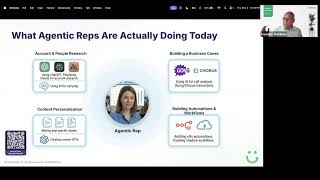
That were like science fiction. A couple of years ago. And to be clear, when we are talking about an agentic rep, we're not really talking about AI taking over the jobs of salespeople. We are talking about a human seller who is leveraging AI in very creative ways and leveling up their own performance and propelling the organization performance.
And they're doing many different things. One slide is not sufficient for that. They're doing it for, you know, we all want our reps to be doing account research. And there was a world where we want everybody to do the account research. Some do it well, some do it okay. Many don't even do it, they just wing it on a call. But these reps are leveraging and they've created their customized prompts in terms of, okay, I'm not researching and selling to Procter and Gamble. I don't want to know everything about Procter and Gamble. But here is the aspects of their business that I want to know that's relevant to what I'm trying to sell them. Right? Very customized prompts for driving account research the same way driving people research. How do you, as you are going through your sales process, you're getting into conversations. How do I prepare artifacts for.
Content that's personalized for my prospects? They're creating their own notebook alums, they're leveraging videos to personalize videos based stuff of the call transcripts, the building out business cases using AI. Take the call transcripts, put it in a custom GPT or create a ChatGPT project and they're building out business cases. These are like desperadic acts of, you know, heroism or you would call innovation if you will. Some are going even to the extent of building out their own automations on N8,10 using agent builders that are available in almost every LLM these days. Now as this is happening, we're observing that there is a great divide that's coming up. On one hand, we have people who are AI natives. They are experimenting and they're really leveraging AI to their advantage. But at the same time, yes, everybody in the company, in the organization is using AI. But a vast majority of them, we find that they're using it for the most trivial of tasks. I call it trivial based on the advancements in AI. How do I write this email copy that's really resonant? How do I personalize email subject line, how do I fix my grammar and stuff like that? This divide does not seem to be shrinking, it's widening, especially with the newer releases of AI which seems to be happening every Other week. That gulf is widening. Now as a consequence, there are many challenges that organizations are going through. One, how do I deal with this divide? AI natives leveraging AI wow. And the rest of the organization. What does it mean for the consistency of execution? What does it mean for. Okay, we see that every other person that I look to, they're using some AI tool in the company. We're probably using 20, 30 different tools, AI tools in the company, many of them overlapping. And it doesn't know clearly in terms of what's approved, mandated versus what's getting purchased by a rep with a credit card. And this is leading to a lot of governance issues, concerns around data getting leaked out and so on. These are organizational challenges. Now as this is happening, when we look at internally in our world of enablement, our systems have remained the same. A lot of us use the legacy platforms for content, for training. We would organize all of that content. On the other hand, we might. There are so many. If you're at any conference, you would have seen There are probably 30 companies that are promising the move. A lot of AI tools that are emerging, we are one of them, of course. But there are many, many companies like us and many point solutions that are emerging. And reps are using this without proper governance. And these systems don't talk to each other.
At this point in time, we do need a rethink. What does our system architecture look like in 2026 and beyond? Are we laying a foundation for that? That requires a systems rethink.
Parallel to that when we look at our own function in enablement. Enablement has a charter, though not written down charter. Many teams do report that they don't have a written charter. But we all know that traditionally we all have focused on creating training.
We have focused on creating content, we have focused on tool administration. Where do I host this training? Where do I house all of the content?
That's what we have been focusing on, training, content, tool administration.
Now, the perception that we are dealing with in the enablement world, that enablement is a cost center, it's good to have. We don't have a seat at the table. All of these perceptions that we are all well aware of, those continue.
Now the question really becomes what's missing here? How long do we continue to say this? This is time to rethink enablement. What enablement should be. Think about what can AI do for you in the service of you and for your customers? It's not AI for the sake of AI, but what does it mean for you?
Now with that one Thing that I would want to talk about is, okay, does AI mean that all of the training is not necessary? Now we have this AI role play tools that are coming up and that's going to negate the need of any training whatsoever. I just do a role play, I'm learning everything.
Is that going to happen.
Or what's happening to my content and is the content being used? Peter also made a very good point in terms of when you're executing on a deal, how do you surface the right information at the right time?
What's the role of AI in that? Can it be done manually? Can it be done with a legacy system? These are some things to think about. And this construct of taking all of this training content and delivering it to the rep in their workflow is something that we call the missing piece of enablement. Today in the enablement technology we call it activation. With that, I'd like to turn over to Ron. Would love to share your experiences and learnings in activation of enablement.
Yep. Awesome, Sridhar, thank you. So I'm gonna guess the 30 minutes leading up to this presentation for me was slightly different than Streeter, slightly different than what most people do. Most people probably practiced and rehearsed and went over the slides as a last minute thing. That's not my style. So I got amped up and excited and the shooter knows I played guitar right beforehand. So I got super excited, built up my energy and so why don't I tell you the story about playing guitar as a lead into activation. So I started playing guitar later in life. I picked it up early at like 15 years old, just made noise, was terrible at it. And then later in life my kids decided to buy me a guitar. It's sitting right next to me. And so I started picking up and like most people I took YouTube is my way to go learn it. And yeah, I learned a song, but I didn't know how to play guitar. I just knew how to follow YouTube. So that was like traditional enablement in terms of what we were doing. And then I hired a teacher. So I hired a guy who knows music theory and it was great. The 30 minutes I practiced with him once a week. So shout out to Ryan. The 30 minutes I practiced with him once a week was absolutely amazing and I was getting better. But it took me eight months to pass my first level proficiency exam, which was like, how do you play a few pieces of the fretboard? And then we started talking about practice. So he said your practice has to get better. But I was practicing all the Time. But I would record a video, I'd send it to him. Day later he'd send it back to me. He was busy, taught nine people a day. And then I stumbled upon a few from different boards. I stumbled upon this, this AI for guitar which was bizarre to me. So there's an app from Gibson and there's an app from Guitar Tuna. And literally you're playing and it's listening and giving real time feedback. That moment of, of playing, you're playing the wrong key, the wrong chord, your finger positions wrong, your strum patterns wrong. And using that and layering it in with good practice and the tools with Ryan and still my YouTube I was able to pass my second level proficiency in three months. And so that's the same in enablement is that moment of activation for the folks where it changes it from just practice to into really learning it and really getting it at that that moment. And there's a bunch of different ways that we can talk about activating things. I'll give you my least favorite. I shared this with Shira earlier. I was a 25 year baseball coach and I coached 9 to 12 year old kids. And I can't tell you the number of times that parents wanted to give their feedback on how the kids should play during the game. As a ball was in the air and a kid was ready, getting ready to catch it, they were activating very bad behavior by screaming two hands or get down on the ball or throw to the right base. And what we want to do is we want to make sure that we activate the missing piece in the proper way. And so what is activation mean? It means that when the reps are about to face an objection or a critical area where they need an answer, the old way, just treat her. You can hold here for one sec. Yeah, either way it's fine. But the old way of doing it was I'll just get a pre salesper to join the call, get a sales leader to join the call, I'll get a technical person to join the call. And all of a sudden we had 8, 10, 12 legged sales calls. We can't do that anymore. Shreer made some great points on DO and it was really good to watch do more with less. That was awesome. And so what we need to do is activate this learning, activate the training in the moment where they need it and teach them how to practice. Another great point is if I just went and did the AI role play. I'm not learning. I did this because I do the role plays myself. One of the Big learnings for me was I was failing them because I didn't actually know the objection. I didn't actually know the messaging. I didn't actually know the Persona based information. And so how could I go past just because I was doing it? That's like sending someone into a game without actually practicing. So activation is about getting it to them at that moment and making it something that they can learn and work with and move forward. So let's talk about some different examples of it. So sure, if you move forward.
Okay, so can we go to. Yeah, so sorry. Let's just layer onto that. We could say on this one. So for us in the enablement world, getting away from the analogies, it is about how do we get that training to them when they need it? How do we get them the right content? How many times have people said, what's the sales play I'm supposed to run? What happens after the discovery call? What do I send as a follow up? All of those things. Plus how do we roll out new sales processes? Part of what's happening is it's not only do more with less, but the time has shrunk. The buyers want information faster. We need to change our sales processes. How do we train people on these new sales processes and get them done now and then how do we roll out new methodologies if we're wanting to do that? So all of these things go into it and it's about that middle one right there is delivering it at the moment of need. But we can't deliver training that doesn't make sense to them or isn't the right level of training. So we need to align that fully with what folks are needing to go work on. So let's go forward and show some examples of it. So one would be like objection handling. And this is, this is probably the single biggest thing that I find in sales is whoever handles the objections best wins. So what we are at the basis of sales are objection handlers. And frankly, we record every call. We know every. I would say we know almost every objection that comes up from our buyers. We, we know them. But what we don't get on a, on a regular enough basis is what did my peer say? What was the right answer? What happens when I get that objection in that moment and I'm not like in a cool state or a Zen state and I'm like, oh no, pause the zoom. I got to figure out what to say. And so this is real example of what happens to the reps is we can automate this objection Handling by first taking all these calls, we record and extracting, using an agent to extract this really good information so that it's usable for the different folks. Now what do they do with it? Well, they by God better train on it and they better prepare. And Shooter and I were having this discussion yesterday and he said proper practice is, is one of the things we need to harp to people. And I said perfect practice leads to perfect precision. Somewhere in those lines is what we were talking about. So they better do role plays, they better do them really well and get prepped on them with these examples. But what the software needs to do and this is one of the areas that's lacking. We'll talk about how to fix this in a minute. But managers aren't great at identifying micro skill gap in, you know, problems. So they listen to role play and they'll say, thumbs up, I'm running my next call. You did great. But how do we tell them you weren't empathetic? How do we tell them you talk too much? How do we tell them in a consistent scaled manner that.
That they didn't answer the objection? The graders aren't doing a good enough job on that. So that's one is objection handling. It's a big one for sales. The other that our buyers are demanding right now is this next one which is Persona.
Thank you. So what are we, what are we doing when we go into calls? Another area that we're wanting to activate is, I would argue the first two to three minutes of any discovery call is about the most important part of the, of the, the kickoff that we're doing with folks because we're building our credibility, we're building our rapport with these people. And there is no question they've done a ton of work to come to that meeting prepared. And the reps, in order to build good credibility, they have to be more prepared than, than, than, than the people that are coming to talk to them. And that's what they want. If they could just find all the answers, they wouldn't have salespeople go on calls. And so what we need to do is be able to take the information on these people. We need to start them thinking about. When I ask, you answer. When I ask a good question about you, you answer my good question. But you know, how can we go into these calls without doing the very basic I know who you are, I know your company does. I've read your 10K or Q. I've looked at, you know, what industry are. I know a couple competitors that's not what we're talking about here. What we're talking about here is who is this person? What level are they? What are their goals going to be? What do they care about? And who else do we know that are doing that same thing that we can name drop? And then based on that, do we infer that they're in active buy mode, or do we think they're in education mode? Because we're going to treat them differently on how we. How we do that. And so our talk track has to be a little bit nimble. But we don't expect the reps to go, okay, I'm in active buy mode. I get to the call and I start talking to them and they say, well, this deal's in May, and all of a sudden they go into, you know, education mode. They need to still be able to have enough information on the Persona via these battle cards to. To have a really good discussion and a concrete discussion with these people to then add value. But, man, one of the things that really trips people up is because it is a lot of work to do is I got to read through all the other calls I had. I have to go back to my CRM note. I need to make sure I understand, you know, if I talk to anyone else at the company, I mean, that's like the most automated thing we can do. And so we need to give these folks information about if somebody says, well, I've already spoken to you, I know. Or I know something about gtm, buddy versus I know nothing. We need these battle cards at their fingertips. But one thing I want to add is it's very important to make all of these things happen within context. And I'll use one more sports analogy. In football, if it's 4th and 14 and the coach calls a running play, that quarterback needs to get 14 yards, otherwise they're going to turn the ball over on downs, that context matters. They're not going to run, they're probably going to throw. But we send reps out with so little context, who am I talking to? What are they going to care about? Where is that information? And reps are truly stuck in. I'm doing all the research, I'm doing all this stuff where the new agentic rep is going to have the ability to. To have this stuff delivered to them and they're going to just like I had to take on the role of an agentic guitar player by allowing these things in to make me better. The reps are going to take these things in and leverage them in every call. So I might get information on my disco call. My next call, I might get even more information on what I need to do for pricing, like, with like, customers.
And as we move forward, this one I just like to talk about as the formula. And so there's been this raging debate in sales for a million years of is it art or is it science? And frankly, small companies, a few reps, you can make it art, you can hire artists. But eventually, when you're trying to scale, you 100% need to move from art to science. And this, this right here to me is a formula. And what do I mean from a formula? When we go into school, we have a beaker and people give us, you know, here's the formula, put this in, put that in, this amount, put it in this order, and we get a reaction, right? If we activate it the proper way, by stirring or shaking or whatever, we get this really good formula, but we get an expected result out of it. And so one of the things that that activation is truly doing is giving us a repeated scientific way to take these inputs, deliver them as outputs, as a scientific formula, so that in the mode of do more with less, we know what the outcome is going to be. Why do I worry less than Shredder does? Because see the results of this formula, I can see we've given them the plays, we've given them the tools. The reps take them in, they execute them, they make the formula. What they're not doing is I'm going to add a little more of this, I'm going to add a little more of that. And all of a sudden the lab is filled with smoke and everybody's coughing. I don't want that. We've all had deals where the rolling hair balls or they don't close because reps are not following this formula. Now let me give you some inputs to this formula. And we call them the five levers that are for activation. And lever one is ramp readiness. Now, I actually think that a lot of people get this one wrong. So what do we think of when we think of ramp? Very basic. I can get a rep to do this deal in less time than the rep before them. But we're not always hiring reps. I mean, that's one example of it. But think about that's onboarding. There's going to be ever boarding opportunities where somebody comes and says you're going to roll a new messaging, a new sales process. How quickly can we get them to ramp on those new things versus just onboarding. And if we're not making them faster and we're not getting them ready on these new things, then we're doing them a disservice and we're doing our company disservice on activating the information because we're not doing it. And especially at scale, when you're trying to get over 25 reps and trying to scale, the ability to roll this stuff up and change that muscle memory is incredibly important as the number one lever, the number two lever, and we've talked about this a lot, but we're going to keep doing it, is is the ability to do it in the reps workflow. But I often make this joke. If you tell a rep to go to another tool, they're going to tell you where to go as well. And it's not going to be nearly as nice is go to another tool. And so why like why, why are they so fed up with tools? Because there's just too many of them. We have people all the time are like do I go to the CRM? Do I go to my CI tool? Where do I go for the book of record? The reality is the reps don't care. They want to know it's good, they want to know that it's going to work. But what they want is to work where they walk, where they work. And if you look at a rep, you want to leave them there. They work in calendar, they work in inbox, they work in their slack tools. Those are the places they work because they're not going to context swap. Like think or con. Yeah, context swap. I mean think about someone who's looking at a CRM that's consecutive and all of a sudden they got to go to a CI tool that's now calls and then they got to go somewhere else for forecasting. There's a lot of wasted time in that. So we believe the, the lever number two is work in the flow where the reps work and make sure that they're comfortable being in those areas. Number three is content delivery. Now for years our brother in arms in this industry have done content storage and content management. The reality is most of those systems are more like content graveyards. Stuff goes in, it hardly ever comes out. Reps struggle finding it. And there's a number of reasons that that's the problem that those things are like that. But in the today's age with the ability to have these agentic AES, they expect information delivered in that flow of activate or the, the inflow of work. They expect that the content is, I'm not going to search. If I have to search, I will. But it's got to be delivered to me and it's got to be crisp and it's got to be right. I want to know who's using it. I want to know does it match? And so it's not just about did I find a document. It's got to be the right document. But right now they're getting asked questions, they're not getting asked for content. So way more now it's about content delivery and questions answered. So what do I say about this competitor? What document do I use so I can get my answers quickly? Number four.
Is coaching at scale. And this is so important because I've watched people, I use an. I use a role play and man, are my reps doing them. Like I can hear the words already. They're hours and hours of doing it. I'm like, great. Are your numbers going up? No, not yet. Well, you're not coaching the problems, you're just coaching to practice. And so you've got to identify the gaps. And this is what this next one is, is the ability to take all of the learnings they do the different ways they do it and then identify them and then take that and again back to delivering it in the flow. So as anybody thought about, can we do this role play right before dynamically by getting it in there. And then as Sridhar brought up, here is the last one. This is to me a lagging indicator but it's revenue proof. And this is what gets enablement. A seat at the table is we pull these four levers, we get this next one of revenue proof and now we have a seat at the table. Go ahead and move on Streeter. So I love this. I didn't put this in. I'll give full credit for shooter on this one, but I thought this was great and I watched the video of it. I read the books when I was a kid. I did not watch the videos but I thought this was great. And it was a very, very powerful speech from Samwise about, you know, that they were so close walking up the Mount Doom and Frodo didn't have anything left and his offer was I can't carry the ring. I can't carry that burden for you, but I can carry you. And he picks them up and he throws them over your shoulder and they get up to the top and then I won't ruin the end if you haven't seen it. But it's such a great video because that burden that he's talking about it's not the same of the ring for us, but what is the burden in sales is quota and enablement can't carry the quota, but they can darn well carry the sales rep. So I love this. This was a great analogy, and I think people should start using it as an example. With these five levers, there's no question that enablement can get a seat at the table, can carry these reps and, and help lessen the burden of quota and get to real revenue, enable revenue attainment. And as we get to the last slide here.
This bubble represents here what enablement's doing today. And as we get asked to do more with less, the reality is, where do we end up with here and that activation, Those five levers we're seeing is this incredible push of more with less, more revenue. So we invite you to click on the barcode, follow the links, and we'd love to talk more about activation strategy. And thank you for your time.
Wow, that was incredible. Ron, I love your personal stories, your learning journey that was enhanced by AI, and I'm totally getting a much clearer picture now how you can use AI as a partner to improve your performance.
Awesome.
Yeah, I could, I couldn't agree more. I mean, at the end of the day, it becomes your, your, your co partner, right? So it's, it's with you in everything that you do, and it helps you make sure that you're ahead of the curve and that you're on, you're on schedule. And the way AI can now fill a pipeline allows the proper use of time in this context so that it's impactful. Most agents are still spending and wasting so much time in so many different areas, and this allows the team to actually manage their time and be much more productive and get better results. So I love this, and I can't wait to try it.
And Ron, you love to play, so.
Without warning, I'd like to play a little game with you.
Okay.
Oh, all right. Your price is too high.
Yeah, Fair, Fair comment. Compared to what, what do you, what, what are you comparing that price to?
Okay, so next customer, Ron, your price is too high.
Awesome. So I'd love you to talk to folks who've looked at our solution against other folks in the industry, and they'll share with you their experience of how the value they get from it tells them it, it's, it's actually not too high.
And what's, what's the value of the lost deals that didn't use this process? That's, that's your Answer.
You got it.
I. I have a line for you that you can use in your. Feed it to your AI. Okay, Ron, the sweetness of low price is quickly forgotten when you have to deal day after day with the bitterness of low quality.
Love it. That's awesome. So we are recording this and we're going to feed that in and you'll hear that on another call.
You know, the bitterness is maybe 10% now, but the enjoyment of the high quality is 90%. Whereas you go with the other solution. You have 10% sweetness when you buy it and 90% bitterness when you use it.
This is all about the cost and the loss of opportunity.
Got it.
Full stop.
All right, so you guys can join me on the. It'll be two on one activation review sessions.
Had a text message from Alex, who is going to follow you, and he says, I wish I had Ron in my session.
Okay. Love it. That's great. Does he mean playing guitar or talking about enablement? I hope it's enablement.
No talk about enablement. Talk about the science of learning and the science of achieving peak performance. By the way, there is a term in Japan called Don tatsu, and Don Tatsu is defined as better than the best.
You want to look it up because it. It's so apropos our field because we want our sales teams to be better than the best in the marketplace. And you said it earlier, really, my ears perked up when you say.
You found that salespeople who are comfortable with handling objections and are the best at handling those, you know, difficulties and sticks and stones, they are the winners. They are the top performers.
Amen. Yep. 100%. 100%.
Yeah.
Yeah. And I would think the confidence level of those using this effectively gets pretty high and allows them to do things that they just wouldn't be comfortable doing otherwise. By way of closing and asking the right questions and moving people to the part of the sale where the results live.
Yeah, I can see it. I hired a rep here and senior rep, new the industry, no SaaS. He just had to learn our product and learn what we say. Every discovery call, he was asking the right questions of the AI. He was getting fed the stuff that other reps had said before, and he's closing deals in a month and I could see him just building pipeline and he tells everybody. He's like, this is the tool that helped me scale, helped me get to this point. But, man, was he comfortable with AI. Like, he really embraced more than anyone else the ability to take it all in, have it in the inbox. On how to write the email. What would we say, listen to this call, do this. And embracing that. Amazing.
So I invite the audience to visit GT Embody AI. That's your destination for better revenue enablement. And thank you both. Sridhar and Ron, you were exceptional. Love it.
Thank you for.
Thank you.
More from Gerhard



What Selling Looks Like When Your AI Agents Have the Context Your Sellers Do

Better Conversations, Smarter Support: Wearable AI in Business






When Scarcity-Built Systems Meet Abundance - The Judgment Gap in AI-Powered Sales Leadership
