The AI Advantage: Transforming Customer & Sales Interactions into Strategic Insights
Helen Fanucci’s presentation explains pragmatic ways sales teams can use AI to boost productivity, build proprietary targeting data, and improve seller coaching. She draws on EPSTA’s 2024 B2B benchmark analysis (CRM- and conversation-linked data) to show industry headwinds (lower win rates, longer cycles, smaller deals) and highlights concrete use cases: using Connect and Sell to scale conversations (81,000+ conversations; dramatic jump from 1–3 meetings/week to 1–3 meetings/hour), doing call blitzes to generate attributed pipeline (example: $4.1M from >$1B companies), and applying ChatGPT to analyze 239 call transcripts for seller skill profiling and objection-handling patterns. Tools mentioned: EPSTA/EPSTA Insights, ChatGPT (for transcript analysis and profiling), Connect and Sell (outbound conversation platform), and RightBound (contact data). The talk closes with a Q&A on targeting senior accounts, data quality, and tooling choices.
Questions this video answers
4.2 million opportunities.
$54 billion in revenue and pipeline.
530 companies and over one million hours of conversation.
Win rates down 18%; sales cycles up 16%; deal values down 21%.
About 69% of sellers aren't making quota; 17% of reps are generating 81% of the revenue.
Chapters
So AI today really about productivity and personalization. So when I think about AI of the past, it was about really for big companies to analyze lots of data. In fact, Amy heard that Microsoft has been forecasting using AI for over 10 years. She's the CFO. And tomorrow AI is going to be all about bots and the proliferation of bots beyond what we can imagine. But today a lot of the personalization comes through via emails and LinkedIn. In fact, I've gotten seven emails today and given the spamming I get, click, click, click, delete. So as Jeb Blount and Anthony Annarino wrote in their new book the AI Edge, which I recommend.
It'S going to be the case that because of the proliferation of asynchronous communication like email, LinkedIn, et cetera, there's going to be a lack of trust. And the business to business is built on trust. And the only sustainable effective way to build trust is actually having conversations. So while it might seem effective today to personalize and send out emails through using a bot, it's really not over time going to be the way to go. And in fact some would argue it's already not the way to go. Pre call research is a great way to use AI and I recommend that. And then target market list development. Let's say you're winning with a company and you ask ChatGPT, give me 20 more companies like that company. It's a great way to get a new list. So there's a lot said today also about using intent. And ironically sellers don't want to talk to people unless they're in market and have an intent to buy. And I found really the most effective way to gauge intent is having conversations. So it's a little bit of a chicken and egg thing.
What I'm going to focus on today is beyond productivity, data driven sales, improved targeting and seller coaching. So data driven sales. It's really hard to create a strategy unless you know what your data says. I'm going to start by providing you with a couple slides of benchmark data and this can provide a baseline for you to measure how you're doing.
So this data, 2024 B2B sales benchmark data is from a company called EPSTA and it's based on their analysis of 4.2 million opportunities, 54 billion in revenue and pipeline and 530 companies and over a million plus hours of conversation. So this is not survey data actually they hook up to CRM systems and if you, if you haven't looked at the.
That you reach out to them and get on their newsletter and look at the report. So one of those things they're saying there's a lot of headwinds in 2024 for sellers. A lot of it's due to budget constraints. Win rates are down by 18%, sales cycles are up by 16% and deal values are down by 21%. So this is the result of this is really impacting companies revenues and a result of that is many are struggling for survival, even well funded companies. And then talking to Guy Rubin, Excuse me, the CEO of EBSTA, he told me that this year about 69% of sellers aren't making their quota and shockingly enough, 17% of reps are generating 81% of the revenue. Let that sink into our minute.
So my point in bringing this data to you is where do you stand and how does your data look? And if you need help with that, EPSTA has what they call EPSTA insights and they'll hook into your CRM system and also they can do email and look at your recorded conversations and do an analysis for you. Takes about three hours to do that hook in and this data I'm going to show you a couple examples of the kind of information you you would get if you go down this path. This Information is from Q3 of 2023. That's a company that's doing pretty well at the time. And if you look at it, their Win rate is 17% up from 12% last quarter. So this is one year worth of product quarterly data. Their sales cycle is up a bit. 184 days up from 145. Deal value up 84k from 73k et cetera. They offer a pipeline creation, they have flip deal rate, et cetera. So they have probably about 20 slides of different data for your data and if you'd like an introduction to edsa, just let me know. Helenipelinepower AI.
Another set of data looking at your data or their data is it shows where they're winning from the Personas that they're targeting. So they're doing better in terms of win rates and deal velocity with VPs of operations, marketing and sales as opposed to finance and managers of it. So something a tool. This is all done through AI analyzing data the benchmark data, AI as the report as well as this. So if you don't know xdai, I recommend you check them out.
So improved targeting one of my favorite subjects. There's nothing that matters more to a company, nothing more strategic than targeting. It's super important why would you leave it to sellers in a territory to determine what companies to approach and what people to target? It's counterintuitive to me that companies do that, but many do. And it doesn't matter how straight you shoot, if you're targeting, if you're aiming at the wrong target. So I want to give you a quick story. So there's a company I'm working with, they sell equipment to manufacturers and they're doing. About eight years ago, they looked at their business and they were growing revenue year on year. It's pretty good until they looked at a territory and a sales team level and they found that some of their sales teams were losing share while others were doing better. And this unevenness bothered them. So they decided to change their approach. They decided strategically they wanted to gain market share. And what they ended up doing is they ended up five years ago bringing in a AI driven selling platform called Connect and Sell. And Connect and Sell enables you to speak to more people with less effort.
So over the last five years, they've had over 81,000 conversations with prospects. Their strategy is to get to the prospect first before their competition. And frankly, they're not concerned about whether that company is quote, unquote, in market. They follow up with them through the Connect and Sell platform. And so when that customer or that prospect is in a sales consideration process, they're there. And they went from having from setting one to three meetings a week per seller to setting one to three meetings per seller per hour. And so huge, huge difference. And the thing that they told me is that there's no way to create a sustainable competitive advantage unless you're talking to people first. But also then you have all of this proprietary, proprietary data that only you know about who's ready to buy, what they're, what the deal is with that company with their target market and that, that gives them a leg up. And frankly, they're smoking the competition. So I want to move into how you can use conversations to actually improve your target.
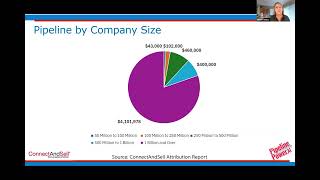
So about six months ago, I did a call blitz for a company and they wanted to go up market. So they intentionally, during this call blitz, it was about a three hour blitz, they intentionally focused on companies that were 500 million in revenue and over a billion in revenue. So you can see that, well, 80% of their conversations happened with companies over 500 million in revenue. They set meetings and they got insights into their target. So I want to go jump into. And they were using Connect and Sell. And Connect and Sell enabled me to use this report.
So again, I said the blip was about six months ago and this is an attribution report. So in the intervening six months, not surprisingly, companies with over a billion in revenue have generated now 4.1 million in pipeline. And I say not surprisingly because they were really targeting the bigger companies. And I know a lot of people think, hey, you can't cold call into large organizations. I know that not to be true. I know that you can. In fact, I've done it myself whole call in some of the largest organizations. The other thing related to this blitz, you can look to see how they did in terms of some of the roles they targeted in some of the industries. And what was surprising is 1.5 million in attributed pipeline was when they had a conversation with an account executive and they were able to parlay that account executive conversation into conversations with more senior leadership and be able to have qualified pipeline. And similarly, if you look at the magenta slice, about 500 million in attributed pipeline is from hospitals and health care providers. And they did not think that was an industry that was right for them. Granted, it's not the largest slice of the pie. The largest slice of the pie is IT services and IT consulting and in software development. And that is actually where they are focused more specifically. But unless they were talking to the companies, they wouldn't have these results. And if you look at data and you buy contact data, it is privately held data, if you will, but it's not proprietary to you and only through building up your own proprietary data and insights, like I mentioned with that company that sells to manufacturers is where you can generate sustainable competitive advantage. One of the things I forgot to mention I think is super interesting is that again, that manufacturing company that sells to manufacturers, they never use mobile phones, they don't ever call on mobile phones because it's considered very rude in the manufacturing industry to interrupt someone's day on their mobile phone. So think about that as well, because I know some people think that's the best way to call people, but the data doesn't show that this is an example of targeting.
Now, inevitably, if you're going to do cold calling, you'll have some sellers who are doing fabulously well and some not so much. So the prevailing wisdom is that you should use conversational intelligence systems. In my experience.
You don't actually. Managers don't actually coach at an individual conversation level and they're not adequately using those systems. So one thing that I did, again remember that Blitz, there were 239 conversations. So I took all of those conversations the transcripts of those conversations, I put them into ChatGPT and I asked Chat GPT to give me a profile of the sales skills for each seller. And here's what I got.
So I asked for high, medium, low, just kind of relative skills. So the sellers are down in the left hand column. Chat GPT came up with the skills, the cold calling skills, but it didn't include in the initial iteration it didn't include asking for the meeting or handling objections. So I asked it to do it again and put in ask for the meeting and handling objections. So this gave me again 239 conversations. So there's multiple conversations per seller that are being analyzed and it gives me something to go talk to sellers about. So I would talk to a seller about what they did well and maybe one of the, you know, skills, skills that they didn't do so well, particularly early in the conversation because that can set you up for success or not. And seller 7 doesn't look like they're doing very well at all. So it might be a deeper conversation whether they need more training and support or maybe it's not the right role for them or maybe it's an off day. The other thing I did after looking at this skilled is I asked Chat GPT because it has all the recordings of those 239 conversations, what are the top objections? What's the best way to handle the objection and who did that well. And so here's what I got. So here are the objections. I'm not the right person. Best way to handle it, ask for a referral. Seems obvious. I stripped out who did this best for privacy reasons. I don't have time right now. Acknowledge the time constraint and suggest scheduling a follow up call. So you know, this might seem pretty simple and straightforward, but imagine you're doing that with discovery calls. Imagine that you had much more complex sales, a big sales team and you were doing it for discovery calls and you needed to train people on the most effective way to handle objections. Additionally, maybe you have a star seller who is amazing. Well, you can use that person as the benchmark and then compare all your other sellers to that person's skill level. Again, all in ChatGPT. It's kind of a quick and dirty but I really like it and it's effective.
Here's a discovery call analysis and in this example these are all different calls or one call. In this example, in addition to the skills, I asked ChatGPT to create a column that identified the next steps from that call. The reason I'm showing you all of this is I want you to feel that using AI is really accessible to you. And frankly, if you're not using and playing around with AI chat, GPT, generative AI or another version of generative AI, I think you're going to be left behind. And I do think that it's really just up to our imagination what we can do. So, as I said, this was kind of quick and dirty. And because some of you may not want to go through this process, I am offering to the first two people who email me at helenpipelinepower AI to receive a complimentary sales skill evaluation for up to 20 recorded conversations. So they have to be recorded. So HelenPipelinePower AI.
Now connect and Sell, who I talked about the calling platform. They've developed the team coaching center. So that's built right in. So that's another way to go about, you know, really seeing how you're doing with skills. And it specifies the skills at the top and then you can click into it and it will bring up the reason for a skill assessment, what, why that person scored well or, you know, the rationale for the skill. And then you can click in further and you can look at all the recordings you can or conversations. So that's another way of doing that. And if you're interested in trying out Connect and Sell, reach out to me for that as well. I can help set that up as well.
So why use AI now? Because you can. It is an unbiased, you know, by the unbiased analysis. It has no career ambitions and I believe it is the only way to really build competitive advantage.
It's remarkable. So my intent today was to show you some AI tools I consider really cool, Epstein as well as Connect and Sell, but also show you pragmatically how you can use AI yourself to.
Get more insights from your data to build competitive advantage. So I'll now take. I will now take questions. Mark, do we have any questions?
Yes, we do. A couple questions, little on the side of what you were talking about. The data that you showed, a couple of those pie charts really show that the entry level was through the user, not the decision maker.
Ah, yes.
Does that surprise you?
No, it doesn't. Particularly for large accounts. So I used to run a global sales team for Microsoft with like Honeywell and Boeing and HP and Intel, et cetera. So it's often difficult to get to a decision maker unless you have the ability to bring in other folks from your company. But a seller calling in, sometimes they have a challenge gainer decision Maker, sometimes not like a CIO is pretty hard to get to through a cold call. So one of the skills I believe that is fundamental to enterprise selling is you've got to find a way to ladder up in the organization, starting at lower level titles and then moving across and moving up at the core skill of being a large enterprise seller. So there also.
You can get lucky. You know one of the best days of the year to call an executive is actually the Friday after Thanksgiving. They'll pick up the phone. They're there, right? Their admin's not there so you can get them. But.
I'd say don't be afraid to call in at all titles and see, see who you can get and I will tell you connect and sell knows what the best phone number is for folks. They do like, I don't know, 54 million dials a year, I think or something like that. And 5 million conversations. So you can work with a company like that to help hone your target list. But no, it doesn't really surprise me because some titles really senior executives are hard to get to.
Helen, I love what you said when you said the day after Thanksgiving, I thought that's where you were going because I say Thanksgiving week is a great week to prospect senior level people because so many other people are out and the week is kind of a rye and it's amazing how they take your phone calls. I love, I love that. Thank you so much. In fact, it's why I say Fridays is a great day to be making phone calls because again, Friday. But I want to come back to. This is something very interesting. So many people struggle. How do they break into that enterprise account? How do they break in and what your data clearly showed. Go to the user, go to the user first and work your way in because you're not going to get, you're not going to be able to call up the CISO and suddenly get a meeting, the cio, the cfo. No, sorry, it's not going to happen. But you start with that decision maker and work your way through that is absolutely outstanding. Versus coming from you who has led enterprise teams. Clearly you clearly know the difference.
Here's another question I want to ask you. You very much simplified how to use AI. It wasn't complex, it wasn't rocket science. So many people get caught up. Do you feel people need a litany of tools, litany of AI tools to be able to use AI?
No, I actually don't. I think that, I mean you need some platform, you need obviously a CRM system to take. There's some things that the company needs to provide for you. But if you're a user, I think you can go a very long way with ChatGPT and, and it's just remarkable. I mean, that's what I use. And so I use it for message development, for cold calling, message development. It's a great starting point. I use it, I put in, you can attach spreadsheets and ask it to analyze your data. One of the things I could do, but I didn't, I probably should have, is all of those titles that they called. I can add another, I can add another column called Seniority and put that into ChatGPT and ask ChatGPT to specify the seniority of that title using its best judgment. And then I could have done a pie chart with seniority levels instead of titles so it will fill in and then you can, you know, use a pivot tool or whatever to create a table or have it create a pie chart. So I haven't done that. So I need to remind myself when there's a lot of data and it's not good for a human, if you will, to do it, I need to remind myself to rely on Chat GPT more.
What I love what you're saying is get off the sideline, get in the game and get using AI tools because they're there for you. So many people are hesitant to do anything because they can't buy everything out there. No, just get started.
I love that.
And I'm going to throw one other twist out there, what you put together. I was thinking you could probably reverse that and use that to create your ideal customer profile. Hey, let me put all my customer data into, into ChatGPT or any tool like that and it'll come back out and say who your ideal customer profile is. Absolutely fantastic. Gearhart, I know, I know you've got some questions for Helen, so jump in.
Well, I want to comment a little bit about what you said about the Connect and Sell because to me this is a hidden gem. I think it's the best kept secret of business development reps because when you normally make phone calls for five hours during the day, you may talk to four or five or maybe six people. And for many sales organizations that's a good day for cold calling or for follow up calls. And when you use Connect and Sell, you upload your prospect list or your follow up list and, and then hit the button that starts the calling and you have at least four or five conversations in one hour so you can improve your sales productivity by 500 with 600% by using Connect and Sell. And I don't know why not more sales organizations are using that. So my question to you is, if it's so simple to use and so effective and so productivity enhancing, why isn't Connect and Sell like a company like IBM or ServiceNow or Salesforce?
Oh, I think that might be a bit of a loaded question, Gerhard. But I will say that many organizations that use Connect and Sell do not allow their executives or their employees to talk about it because it's such a competitive weapon. And so I am aware of at least one executive who got fired for talking about it in a conference. But that was a very obviously strict rule that they had. So it. So there are some companies talking about it. Matt McCorkle from Kaiser Compressors talks about it. You can go on to Market Dominance Guys podcast and hear more about people using Connect and Sell and what they're doing that the CEO of Connect and Sell, Chris Beal and Corey Frank from Branch 49 got, our host of that podcast. In fact, they just had me on as a guest talking about using AI for conversations, but also using AI to analyze your own company's data. So that's another resource to learn more.
When it comes to data, what is your philosophy? Because I sort of compare data to water. If water is pure, then it's safe and it's healthy. If it's contaminated, then it's not healthy. And if your bottle leaks, then it's useless. So there are a lot of data leaks in companies and there's a lot of dirty data in organizations. So what is your advice to sales leaders to create that data ecosystem that nurtures everybody?
Well, I really think you need to consider what data do you want to be proprietary to you for your own competitive advantage? If you're buying the same data, you know, zoom info data or whatever your favorite data source is, everybody's buying that data or they're trying to get better data. So that doesn't really give you a suspicion, sustainable advantage. And as you say, the kind of dirty data doesn't really help you, so to speak. The other thing is there is such a reluctance of people to just call people. What if they reach the wrong person? Well, it's not the end of the world. And you're not going to ever reach the right person unless you have the courage to reach somebody that might have left their company already because the data is not good. I had somebody, a client, say, I just want, you know, a rifle shot to target just the right person. To talk to. Well, that doesn't exist. You've got to be able to navigate the marketplace to build up a competitive advantage, to talk to people, to know who are the right people to talk to. So I think it's a super hard. Data is hard and it's not perfect. And you've got to also have some grace and flexibility and get started and move forward as best you can and then take what you learn and improve.
That's really interesting because people talk about data science, but you speak of data as if it were a work of art that smart people are creating.
I think it's a tough. Data is a tough problem, particularly if you're trying to get the right contact data. Super tough. So I will, I will say if you're talking to people, you get the first insight into who's left the company and then get a referral. You get, you're much better off then.
If you just rely on someone else data and then you get frustrated because you're not reaching the right person.
Okay, so I have another question. We had somebody present about LinkedIn as a sales tool. And you know, Navigator is a must have for every salesperson. My question to you is what tools do you use when you. Let's say you discover. Mark Hunter is a great prospect, but I can't find a phone number the LinkedIn. He hasn't published his number on LinkedIn. So where do you go?
I like Right Bound. So I use Right Bound and they have a lot of different data from different sources and they consolidate it. They use AI and provide the best phone number. It's not perfect. And so I was doing something and then I had it. It's not perfect. No one's perfect. But I like writebound a lot. Again, if you need a referral, I can help give a referral there. So that's what I use.
Hundreds of people have already just gone out to check out Right Bound because of what you just said. So thank you.
What do you use, Mark?
You know what? I'm going to check out Right Bound. I use a proprietary tool that I developed with a friend of mine, Sam Richter, and it works. But I'm going to check out Right Bound because I'm always looking up the game because the telephone works. The telephone does work. Contrary to what everyone believes.
Exactly. Well, we, at the end of our session, Helen, thank you so much for putting in all this hard work to make selling easier for us.
You bet. It's my pleasure. Thank you for having me.
More from Gerhard



What Selling Looks Like When Your AI Agents Have the Context Your Sellers Do

Better Conversations, Smarter Support: Wearable AI in Business






When Scarcity-Built Systems Meet Abundance - The Judgment Gap in AI-Powered Sales Leadership
