The AI Habit Trap: Avoid The Fatal Flaw Sales Leaders Never Saw Coming
Jeff Bloomfield and Gerhard Gschwandtner discuss how AI is changing sales enablement and why evidence-based training matters. They explore the neuroscience behind effective sales communication and how AI tools can improve it, while warning against common pitfalls sales leaders miss.
Chapters
All right. Hello to everyone from around the globe. I know you're dialing in from all parts unknown. And we're going to put our track shoes on today and talk a little bit about everyone's seemingly favorite topic, AI and what the, the impact it's having on us as sales leaders, as business leaders, and just our organizations in general. So I'm just going to dive right in. There's going to be no connection. There's not going to be any great papaw story that I'm going to start telling you about growing up on a farm. We're going to go right after it. Today, because of our limited time, we hear this term enablement. And I'm curious if I ask you to define enablement, how you might define the word enablement. Here's a couple of options for you. The act of making it possible for something to happen or for somebody to do something, or more simply the process of giving a person the power or ability to do something. So in our world, let's look at it through the lens of sales enablement. So the act of making it possible for something to happen or for somebody to sell something, or the process of giving a person the power or ability to sell something, isn't that really what sales enablement really is all about? And for all of those thinking through this, when you really start to think about enablement, we tend to think about tools and technology, maybe some training support. There's entire departments with millions of dollars of resources invested in this concept of sales enablement. But at the end of the day, what is enablement actually designed to do? So here's a really important question. What's the number one determining success factor of any sales professional, regardless of the industry you're in? And there's a lot of, you know, a lot of success factors out there that you can measure. But this, by far, looking at this over the past couple of decades, is the number one determining success factor.
It's actually effective communication skills. Now, before you give me the old oh no, duh, Jeff, it's like the Geico commercial, everyone knows that. Think about this for a second. Nothing else matters. If our sellers, in the moment of impact, when the pressure is the highest to perform, whether the camera got turned on or they're sitting across the desk, or they're sitting across the lunch table or the, or the coffee, the coffee bar, if they cannot communicate at a world class elite level, nothing else matters. None of the other investments you made in enablement matters. So is there a shortage of enablement tools today? I think not. And if you look at a list like this and we won't spend much time on this slide, by the way, I'm sure you probably have maybe all of these things and some of them may still be in a junk drawer from three years ago and some of them are maybe a new initiative that you have going this year. But what's your intent behind it? When we invest in these types of enablement tools, what is our intent? Our intent is to actually support our seller in such a way that it dramatically improves the likelihood that they can have a more effective conversation with a customer in order to influence them to say yes to us. Everything points back to that singular conversation. And when I say singular, I know, call continuum. And it might take, depending on your sales cycle, a lot of different calls with a lot of different people, it really comes down to their ability to navigate that conversation effectively. So then why am I talking about this with AI? What does this really mean? This is important for us to understand.
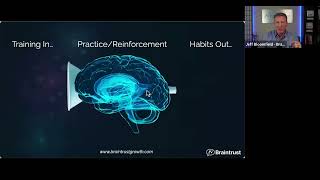
Now I've been studying the brain for the past couple of decades and prior to that, a couple decades before I came out of biotech. And when you look at how people perform under pressure, and specifically sellers, under stress or under pressure, sellers will naturally communicate from their habits that have been formed by their highest level of training and knowledge. So now rewind the tape on your sellers. How have you trained them? And we can't help this because we know they have to be experts in our products, our services, our solutions. We know that the problem is we have so over indexed on training them on products and services and features and benefits and speeds and feeds that it has become their highest level of training and knowledge. So under pressure, when the lights are the brightest, when the camera's on, that's what's going to come out of their mouth because that's how the brain's built. We're built for self preservation and that's what their unconscious brain's behavior thinks it should do. So now what does this have to do with AI? Is, is AI actually helping enable the right sales habits or is it amplifying bad ones? Now this is a pretty important distinction as we're going to go through this a little bit today. When you look at McKinsey and a lot of others are doing research on adoption of AI tools inside of our companies. They started measuring this back in 17. It's gone from 20% of at least one business function using AI to now 88% in their most recent data. So it's here, it's here. To stay. And when you think about AI tools, that's where it gets a little bit murky. Well, there's a lot of different variations of AI tools out there on the market. There's over 18,000 business related tools that you could choose from. Think about that. Business related AI tools, over 18,000. And over 83% of companies that have sales teams say they're experimenting with or fully embracing AI. It is literally the wild west right now with AI and what sales teams are doing. And we're trying to standardize these things, we're trying to figure out how to make these the most effective. Now when you think about your world today with your sales process now, you might have not have the exact definitions that I have here listed, but you probably have something fairly similar. Here's what I want you to think about. Do you have AI tools built into these stages? You probably already do, depending on the size of your company. There's a lot of different AI tools and you're hearing a lot of noise from all these different stages. The majority of these AI tools are built for intelligence, data collection, efficiency, automation, things like that. And they can provide tremendous value to us. But it's also creating a lot of white noise around AI. Now there's one more category of AI tool that I want to talk about today that has become really popular over the past, I'd say year to 18 months. And this tool is actually the AI roleplay tools, those sales bot coaches. Now you won't be able to read this and it's on purpose, this, these companies are popping up all over the place. And what they've done is we figured out that hey, we can create an interactive LLM based sales coaching bot. We can throw a really cute user interface website up and we can get people to sign up and go practice against avatars. And all these companies do that and they all do some version of it. And so all this noise and speed is happening around now we can actually go use AI to practice. Wow, this is amazing. Well, what's the problem with that? Practice doesn't make perfect, it makes permanent. So this is what we're going to start to get into a little bit of this idea of what is the AI habit trap. Now what I want you to think about for a second is we don't need more tools, we don't need them, we don't need better tools. More than likely, maybe, maybe some of you do. What we really need to do is think about how do we equip our sellers with better communication habits. Now here's the thing, we said it at the beginning and I want to underscore it. Under pressure, you don't rise to the level of your potential. You fall to the level of your habits. And every single customer conversation your sellers have, that's a pressure pack situation that they will fall to the level of their habits. So when it comes to AI, here's the issue. What are you training folks on now? Think about the AI tools you have. There's garbage in, garbage out. We use that phrase all the time. The difference now is it's going to be amplified garbage. This is the challenge that we're facing. It's the challenge that all of us are facing. I run a company that specializes in the neuroscience of behavior, in behavioral psychology of effective communication. Relative to sales and coaching, we still struggle with the same concepts internally. So we're really evaluating now in the new world, how are people using and leveraging AI to be more productive, more effective because it is an amplifier. So this is interesting.
At last look, there's somewhere in the neighborhood of over 4,000 we'll call sales training content providers on the market. That's just in the US by the way. It's not even global. Here's the question I have, and this is a big question we have to answer.
Is it evidence based content?
Now I get a little bit up on my a little stump speech here in this category because coming out of life sciences where I got the privilege of actually taking to market monoclonal antibodies to treat cancer, ultimately led to my work with brain cancer drug, I was very passionate about evidence based medicine because obviously we don't go to market with drugs unless they've been tested rigorously through an evidence based protocol and an evidence based pathway. And then yet when you look at how we pick and choose our providers and our suppliers and our partners, have we ever thought about putting that kind of scrutiny on our sales training content or leadership development content? Because it exists, but it's less than 1% of what's out there. So you have a lot of folks that are pushing a lot of noise into the market with a lot of acronyms and a lot of infinity wheels and a lot of stuff based on their level of experience and years in selling. And some of it's good, but rarely is it evidence based. And so now we're training our folks on these things and now you're amplifying it. So AI roleplay reinforcement at scale is going to get you what it's going to amplify whatever it was you're putting In I was at a conference speaking to a group of CROs in Miami last month and one of the gentlemen who spoke before me and he was representing one of the companies probably similar to yours, he from the stage said, traditional sales training companies of old and we know them all are dead. And I was like, whoa, that is a bold statement. And I think what he was referring to, really trying to get to the root of is we can't keep doing things the way we've always done them or we're going to keep getting what we've always gotten. And now with AI, we're actually amplifying those bad behaviors. So when you think about how you're training your sellers today, what content are you pushing into one one Earth that's getting amplified out the other. Our goal is we must come up with the right information on the front end. Then we have to do the right activation, so the skills training, and then we're not done. Because the way the brain best creates new habits and habit formation is through that spaced repetition reinforcement. So let me back up here to the right information. And this isn't just about the sales training content that you're using on your sellers. It's the entire ecosystem of how well you're training them to understand your buyer from your account management territory, planning, all those things. So one of the questions that I frequently ask a lot of folks when I'm meeting with high level sales leaders or executives is if I went to your best 20 sellers and I gave them all a marker and a blank whiteboard and I said, can you get up and in less than five minutes, draw me the day in the life of your ideal prospect. How they think, feel, act, behave, how they make decisions, their top three to five goals and objectives, the top three to five problems or challenges that prevent those objectives from being accomplished, and the quantifiable impact those problems have on them, their role and their organization, can you do that in under five minutes? And they look at me with blank stares and go, I don't think so. Then you don't understand your buyer. So this right information stage, this training in stage, you have to understand your buyers in their world in such a way that you can actually go in and tell them a story about them to where they start nodding along and they can't believe that you know this much about. How do you know this much about me? And we call that the prospect and problem story. And there's a secret to making your prospects believe that you care about what they care about. It's a neuroscience Based evidence secret. You know, the secret is you actually have to care about what they care about. Well, how do you know what they care about? You got to do the work and you have to understand what they care about. And you might be thinking to yourself, well Jeff, it's so nuanced. That's very generalized. Well, here's what I would argue. If you call on VPs of sales, if you call on a COO, if you call on a CFO in the segments that you call on them, their top level company goals, objectives and their role goals and objectives are very, very similar. And you don't have to go in with a lot of specificity. You have to go in as a generalized expert in their role in their company and then just tell them a story about, about what you believe to be true about their role before you go into your dreaded needs analysis. See, when we look at the needs analysis effect it has on buyers, what we find many times is it's interpreted in the brain more as an interrogation than as really an empathetic curiosity for more information. So the order is wrong. And at the end of the day, this is what we really learned from a neuroscience standpoint is many of you know the right information and sometimes you're even trained on the right information the right way. It just gets delivered entirely in the wrong order. So it actually activates the wrong part of the brain. And because we don't understand those parts of the brain, we don't really know whether the information is hitting or missing. Therefore what happens is sometimes we think it works, sometimes it doesn't. And so we operate out intuitively well, but not intentionally well. So therefore not consistently well. Now we take all that information and we train our reps and then we put AI in now and the AI amplifies those behaviors. So my challenge to the group today out there thinking about this is you look at moving into 2026 and you look at what the AI adoption curve is. The most important thing you can do is invest in the tools, training and techniques that are going to amplify the best ability for your seller to be an elite communicator, period. Full stop. If the work and the investments you're making are not leading to elite communication skills at the end of all of their training, onboarding, the whole nine yards, even experienced folks, you're wasting your time and you're wasting your money, you're wasting your efforts. So we started investing in this years ago, obviously through the research and you know, neuro selling. Many of you read the book We've gotten great reviews off of it. You've heard, heard how it's being incorporated now in a lot of Fortune 1000 companies. It is evidence based to the rigor that you would bring a drug to market. So this is an opinion, it's decision science that's rooted in how to create the conversations that lead to a buyer saying yes faster. This is what you have to lean into. Some form of this by the way, it doesn't have to be neuro selling but you have to challenge our partners out there to bring the evidence based content. Now how does this affect the AI effect? Because we started drinking our own Kool aid here about a year ago. A year and a half ago we started building out our AI amplifier with the neuro selling baked into it. Now I'm going to get a little vulnerable with you. I wrote the book, I've been doing this for 15 plus years and then again I said before 20 prior to that I feel like I should be a pretty good expert as an elite communicator at what it takes to activate those areas of the brain. So I started practicing with our AI tool and I want to show you what happened. Now if you look and see here, it's coaching me against all these neuro selling behaviors of which I am supposed to be an expert at. And then you look up here around the role play complete and you'll notice my score. You have to get a 70 just to pass. I got a 75. It was a bit humbling. So what it did though, it caused me to realize that none of us are immune under pressure. Our habits come out. And when I went and read all the coaching I was being given off of this, what I recognized was it was spot on. I didn't even realize and recognize unconsciously these behaviors were happening. So then I did what every great seller is supposed to do. I went in and I practiced and I practiced and I practiced before I had the next conversation and the next conversation with the prospect. Because of that it changed and it went to a 96. Now this isn't because I'm great. It's because it amplified the right behaviors. So this is what I'm challenging you all to think about today. From the content that you're training your folks on to the tools and technology that you're using to amplify from an AI standpoint and verify, validate and justify. And then your ROI should be in that, in that reinforcement, that habit reinforcement phase. You should be able to take, invalidate, verify and then from an ROI Standpoint, show the incremental lift not just in skills, but behaviors. That's easy to do with the AI but with the actual sales results and then tie that all back together inside your ecosystem. That's sales enablement and that's how you take sales training. And you amplify the right content and the right training, the right coaching into the AI system and then that gets you the results you're looking for. So what are our three big takeaways today? Because I know this is probably a lot of fire hose for y'. All. Number one, the tools don't change behavior. We know that it's training and coaching that does. Your enablement stacks, your tools, your training, they're only as strong as the communication habits that they're reinforcing. Really important. Number two, AI is only a force multiplier if what it's reinforcing is proven otherwise. And we see this a lot and it's expensive. Automation of sales, mediocrity. We got a lot of digital paperweights sitting around inside of our ERPs and our, our systems. The third is AI is only as smart as the content it's trained on. Most sales training is guesswork. You have to have these evidence based frameworks. It's the only way that's safe, predictable, for foundation, for scale. So here's what we want to do and this is pretty important because I want, you know, to add value. Gerhart's been such a great advocate for this professional selling industry and organization and we think so much of him and sell power and what they're working on. We want to give all Participants of Sales 3.0 conference access to complimentary copies of both neuro selling and neuro coaching. Because the same principles that apply to what we just talked about, amplifying our selling behaviors are also the same principles that apply to our coaching behaviors. I was talking with a client earlier today in fact and we were really focusing in on a large global pharmaceutical company. They have a lot of managers, not coaches. And there's a big difference. See, coaching is this ability to help someone self discover what action they should take next to accomplish their goals and the goals of the organization. Helping someone self discover that, that's an art and it's a skill that most of us don't possess because we manage to compliance, we don't know how to coach to competence. Same principles with AI you should be able to amplify those coaching habits faster. So here's the net, net of it all. We have an amazing opportunity in the culture we're living in today in in the world with technology. Amazing. Never before have we had so much technology. If we use it correctly, what it gives us a chance to do is create distinct competitive differentiation. The speed at with which we can adopt and scale technology that works for us today is going to be ubiquitous 10 years from now. So the companies that can adopt these things, put them into their workflows, create the partnerships that are driving results, they're going to differentiate themselves and they're going to eat their competitors market share for lunch. And I think that's the challenge today. So the AI habit trap, in summary, the AI habit trap that most of us, myself included two years ago didn't see coming was AI is going to amplify something. Are you amplifying the right behaviors and habits or are you amplifying mediocrity? Because if you do that, you're sunk. Thank you for letting me be a part of the event today. And hopefully you took a little bit of value from this today and if you didn't take any value from my talk, surely hopefully you'll get some value out of these books and resources. And thanks again. Gearhart. Let me know if you have you want to I saved a couple minutes for a Q and A. If you'd like to do that. I'm happy to do that as well.
Well Jeff, I want to thank you for a powerful and eye opening session. I think that you reminded us that sales training is not about slogans, hype or one off inspiration. It's about evidence based solutions that actually change behaviors, habits and outcomes. And I like your opening. What stood up to me is that you talked about 4,000 sales training providers and only 1% delivers evidence based approaches. It blew my mind and I, I think you're right and I think that your background in selling pharmaceutical drugs where everything is science based and everything is regulated. The sales training industry has no regulation whatsoever. And anybody can say I, I am a sales training consultant and I can improve your salesforce. So.
That really explains that state of mediocrity that we are suffering from. So many organizations struggle from improvement. And your guidance on avoiding the AI hybrid trap, on grounding our coaching messaging and our enablements practices in neuroscience, it gives us a much clearer standard for discerning what really works and I commend you on that because.
You understand best that selling is an art in the science and you need the science as a platform upon your build which you build your your art the and what you're doing really works. And the other thing that I liked about it is you challenged us to think more critically and to design more intentionally and lead with models that are validated in your books and your books are popular and people should read them. And there is so much wisdom in neuro coaching because coaching is such a weak element in any sales organization where most sales managers, they think deal coaching is a numbers review and it isn't. You were.
I mean I can think of many, many sales leaders that are the exception. You know Bill McDermott who is the CEO of ServiceNow and was the CEO of SAP, he started as a Xerox salesman and he knew how to persuade a customer and allow customers to make the right decision. And he kept records. And when he stepped up to the role of sales manager, he did not impose his will on salespeople, but he asked sales encouraged salespeople to teach each other and learn from each other. So there are notable exceptions, but those are very really, really rare. And what you are doing is you bring science back to the profession of selling and help everybody grow. So that's, that's sort of my, my rant or my, my summary of what I'm absorbing from you and I wish you would do more on stages and, and helping people grow.
Well, 26 is going to be a busy year for me speaking already it looks like. So thank you for that encouragement. That's the plan. And I really do believe so strongly in this. And the other thing that I want the listeners out there and watchers to take away is we're not isolated and confined to our role as a seller or as a sales leader. We take these things home with us. So how we communicate with our customers, how we communicate with our co workers and our managers, it becomes a part of who we become as a communicator brand. And we tend to take that stress positively or negatively home with us. And if we can learn skills that allow us to ask better questions, to be more empathetic, to know what parts of the brain we're activating, guess what that translates to? I can have a better conversation with my wife. I can respond differently to my kids. So I know this sounds a little Pollyanna ish, but our mission and vision at BrainTrust is to help people become more be better Communicators in a 360 degree view of their life. We know that if we can teach them how to be better sellers and learn how to brain work, they're going to take that home with them. Now we're changing the world, we're not just changing the company. And I Think that's what we're actually most excited about.
So you earlier talked about giving a presentation to CEOs and I want to hitchhike on that. What advice do you have for a CEO or a sales leader who wants to redesign their entire training ecosystem around evidence based principles? What will be on the 90 day roadmap?
Yeah, that's a great question. And first thing is in first principles reasoning, let's go all the way back down to the root cause here and figure out what is that primary driver that's gotten us where we are today. Because we tend to keep trying to justify decisions the brain wants from a confirmation bias standpoint and from a choice supported by a standpoint. We want to keep justifying decisions because if we say that what we've done in the past doesn't work, then we say we failed and our brain does not like to admit it's failed. The first thing you have to do is say there is a better way. The second thing you have to do is then say let's reimagine our entire sales enablement sales training and go to market messaging ecosystem committing to evidence based and starting with our buyer. Starting with the buyer. When I mentioned that a little bit anecdote around, can you get on a whiteboard with a marker and tell me the day in the life of the buyer in five minutes or less tell me their story without ever mentioning a single thing about you or your product. Start there. If you can't do that, you're already face down in the pool. Right? We, we got to start with the buyer and then work on how do we teach our folks how the brain actually works and then give them the skills to implement those in conversation with customers. The last thing I'll say on that is the greatest irony in sales is we want our prospects to change their behavior. But we've never given our sellers an evidence based reason to change the way they're communicating with them. That's what will change everything.
And add to that, what would you advise be to the frontline sales manager who wants to apply the principles of neuro coaching? What habits should they practice starting today?
This is a really, really important question and I know it's bigger than a breadbasket, but here's what I would say is first of all, you've got to step out of the role of senior sales rep. Your job is not the senior sales rep when you're out in the field working with your sellers, but the pressure you feel to perform to hit the number. Now as a team, you Feel it. So when you're out there, you want to go ahead and just do it for them because you know it matters that much. It's the law of diminishing returns. So the skill most required by coaches is how to have empathetic great conversations by asking great questions and knowing that they have to get their sellers to actually self discover what they need to do next. If you start telling me what to do, I'm going to resist it. Leading me to the water and teaching me how to discover to solve it for myself. That's what great coaches do. So asking great questions is the number one skill of a great coach.
Somebody says we need chef's email to connect on LinkedIn.
How? I. I think you can be easily found on, on LinkedIn by typing in.
Jeff Bloomfield, I think, and Abby's on here. I think you can follow me, but I don't know that you can connect directly with me. But for this group here, let's just. I'll go ahead and give out my email so we can, we can kind of monitor that. So it's. It's jeff.bloomfield braintrustgrowth.com There's a dot between Jeff and Bloomfield. Jeff bloomfieldraintrustgrowth.com Wonderful.
Yeah, we just dropped it in the chat. And I want to reflect on something else. You showed us your score 76, and you were the expert and you didn't score a 95. And that must have been a humbling experience. And the question I have in my mind is, what would advice would you give to.
Other sales executives to put themselves through that test and challenge themselves to be better? Because that is where I think the rubber meets the road. If the sales manager does not challenge himself or herself, then you get the same response from everybody on their team.
That's exactly it. And that's why I did it, because I didn't want to ask myself, my sales team, to do something that I wasn't willing to do. And so I wanted to put myself out there first. And so it requires a little bit of humility and a little bit of, like, risk. But at the end of the day that, you know, leaders do go first. And if you can put yourself out there and show them that you have enough humility to recognize that you have not arrived. We're all on a lifelong learning journey, and even the experts you see in the media and on stages all the time have gaps and skills that they can continue to improve. And by the way, they're the first people to tell you that they're trying to improve them that's the brilliant of great brilliance of great leaders, is they're always trying to improve and they don't think they've arrived. That's what we need to see from more leaders.
Yeah. And a lot of leaders have excuses to say, I don't have the time to do that.
Right. Well, there's two quotes that come to mind, Gerhardt. One is by the great John Wooden is if you don't have time to do it right the first time, when will you have time to do it over again?
Right.
That's one of my favorite quotes. The other quote is you can make excuses or you can make progress, but you can't make both. You have to choose.
Is that from John Wooden as well?
No, that's. I don't even know who said that one. I've just been repeating it for so long I can't remember where I heard it.
Well, this was a fantastic session, Jeff. We have to do this more often. I'm learning so much from you and I wish I could bottle your desire and passion for learning and teaching.
Thank you very much. And I admire you just, just as much. In return, thank you for what you're.
More from Gerhard



What Selling Looks Like When Your AI Agents Have the Context Your Sellers Do

Better Conversations, Smarter Support: Wearable AI in Business






When Scarcity-Built Systems Meet Abundance - The Judgment Gap in AI-Powered Sales Leadership
