The Hidden Bottleneck: An Overlooked Catalyst For Sales Growth
Lauren Bailey argues that frontline sales managers are the real bottleneck to revenue growth. Most fail in three ways: inconsistent hiring and performance practices, focusing on deals instead of developing reps, and weak coaching skills. Companies that fix manager fundamentals see double-digit conversion lifts.
Chapters
You.
Thanks, Gerhard. Hey everybody, this is Lauren Bailey. My friends call me lb. I've spent time in my career as a revenue leader, as an enablement leader, and for the last 16 years, as an entrepreneur. My company helps revenue leaders grow their team so they can grow their revenue. Every month I do free monthly sales shots and I'm going to do this in that format. I've got four shots to share with you over the next 20 minutes. If you don't remember them all, don't sweat it. I'm going to give it to you in a download in chat that you can get for free. Here's a quick look at Factor 8 and here is a QR code if you'd like to come to our free monthly sales shots. Super tip rich. We do them for reps, for leaders and for enablement leaders. So send it to your team. Awesome. Here we go. I'm talking about this hidden bottleneck I see over and over again as I work with revenue teams around the world. It's the frontline managers. Frontline managers balance everything. Okay? And I'm here to tell you I've done the sales manager job and it's harder than running three companies at once. True story. We also know as leaders that a high performing revenue manager, their team's going to perform no matter what bad economies change in the company, they keep performing, hitting an exceeding quota. It's the underperforming managers that are quietly hijacking our opportunity to grow. And their influence can't be understated, right? Every manager has an average team of 10 reps. Think how many customers that represents. Think how many deals that represents. If you've got a weak manager who doesn't quite have everything in balance, if they're underperforming, how does that spread across the team? Right. On the flip side, if we could get every manager performing there with their teams 10% higher, look at the exponential impact that that has. Working with managers does translate to revenue results. I've got case studies showing between 26 and 47, 7% lift in conversion rates without touching the reps. We also know that when managers drop this pile of rocks, it gets very, very messy, right? If they are disengaged, they're costing us money. And not just with what they control, but through the whole span of hundreds of customers and thousands of deals. It's a really big deal right now because a recent poll from LinkedIn last year said about 50% of managers are burned out. We did a manager sales shot just this last week and the poll we did live said it was closer to 70%. So supercharging this group can supercharge your growth. So let's jump in and show how. I'm going to share with you the three biggest issues. I see where managers are hijacking growth. I'm going to share one thing that US leaders own as well. And like I said, you can get all of it in a free playbook at the end. Bottleneck number one, the firefighters managers really lack consistency. Let's face it, especially if you're growing, there's going to be shifts. Reps will change managers territories and account books shift comp plans. They change. And during periods of change, it's critical that your front line toes the line. But what's really happening is 5 to 10 totally different versions of your vision. If you're seeing a big variance in performance, attrition and forecasts across different managers, this is likely your challenge. Here are the four areas where consistency is usually at its worst. Hiring. You may know exactly who your right profile is and your recruiting team may also be locked in. But you're going to be shocked when you see what's actually happening in reality. The discrepancies we see are very, very real. And of course they are. It's often the first time these young leaders have ever hired anybody. Growth means that reps are moving teams and managers wind up hiring for each other. So even if you have a profile, standard managers need the opportunity to collaborate and contribute on what good looks like and training on how to uncover the right answers in those interviews. The role plays are shocking the first time through, folks. So getting on the same page can mean a really big difference in reducing your attrition. And we all know that the green rep and the empty seat are sucking the revenue growth dry. All right, let's talk performance. Last year I interviewed Tony. We'll call him at a SAS company. All right? We were there doing training. He. His manager didn't hire him. He's had three managers in as many months. I asked him how he was measured and his answer, honest to God, was I don't know. As I jumped in and started trying to solve this with him, he says, don't bother. I'll be moved to someone else soon anyway. This is what happens in growth periods, right? Hmm. So this is important. If a rep is crushing quota and maximizing every customer touch, I don't think that Tony is. I think you get it. Let's talk about rep engagements and how our managers are touching them. Right? Even if we have one definition of Good. And a lot of help translating good and direct daily actions and touches. It's not always happening. In fact, I'll tell you that if we're not managing reps with consistent touches and we have the same playbook or cadence that managers are using, they're all doing it differently. That means a drastically different rep experience and the right touches in the right ways. That's what lifts performance very quickly. The last one I want to talk about here is pipeline management. Boy, that's. Every manager has a different standard, right? If. If it converts from stage one to stage two with these standards with one manager and these standards with another manager. It's really frustrating with when people are moving around. It's why your forecasts have such great big variance. So without crystal clear stages, forecasts, hygienes, all of that is just a bit of a mess. These are the four areas we see the biggest inconsistency. And I'm telling you, even tenured managers. We were training a team of managers at a Fortune, we'll call it 500 company just last month, and these guys had an average of 10 years on them. We went through a driving performance with goals exercise where we took the big goal and we practiced. How do you break it down? How do you translate it to your reps? How do you find leading indicator KPIs and actually drive revenue performance? Massive AHAs even in this tenured group. So consistency is key. Here's how we fix this, right? Let's fix the hiring. So we have a definition of good performance management. Learning how to break down the goals, identify the key leading indicators, and you got to role play setting those expectations, folks. Managers aren't comfortable doing it and it's not happening as often as you think it is. The next one's about rep engagement, and that's around a management cadence, something that is standard. When managers develop it together and they agree on it. Oh, now we're singing from the same hymn book. And not only is the rep experience consistent, we're doing the right touches. So often a manager meets with a rep once a month. Quick pipeline review. Talk about how they did last month. Check that rep's engaged. And they're not folks, they're just not. So a team calendar is huge here. As well as leaders. You check in on that. How often have you done your coaching? How are the pipeline reviews going? Talk to me about the touches you did with your reps this month. That accountability is key. Pipeline, of course. Get the fundamentals to your managers. Just because they were a great rep doesn't know they understand how to really manage pipeline in mass, especially when they're assuming all the reps are doing it right. We got to use real scenarios. And I encourage you to do your forecast and pipeline meetings as a group. That's going to drive a little tension and a little accountability with them.
Without these deep dives folks, managers are out there figuring it out on their own. I got bad news. They're not necessarily figuring it out the right way. 60% CEB says are failing within two years and it's because we're not teaching them this new job. Right? I've stood in front of thousands of sales leaders and said, raise your hand if you've made the mistake of hiring your top performing rep. All of us raise our hands. We've all done it. But they don't know the new job.
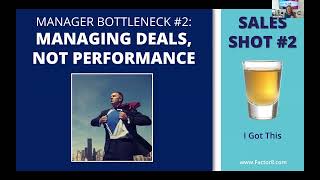
Right? What the reps understand about the manager job is in the green, right? That's probably what they saw their last manager do. Maybe that in the yellow. Oh, I know what I don't know, but I've seen it. But look how big the red is. This is where managers fail. This is where managers quit, underperform, and bottleneck growth. It's also why they fail at our bottleneck. Number two, managing deals, not performance. As a rep, your frontline manager's entire former world were deals, right? And it's no wonder the majority of new managers we see stay focused here. It's the green area, right? It makes them the deal hero, not a rep, coach, trainer, mentor, or performance driver. In fact, it does the opposite. If your managers are in a consistent second voice or takeover. If they're out there closing deals, you've got this problem. And I'll tell you, it leads to a revolving door for reps. Because when reps aren't performing, they leave. When reps aren't learning, they leave. When they don't feel developed by their manager and get the face time, they leave. And a revolving door crushes our ability to scale. An empty seat and a green seat are a huge drain on your revenue forecasts. All right, how do we fix that? First and foremost, we got to teach managers the job, what it is and more importantly, what it isn't anymore. We've got to use an interaction framework for them. We use one called the coaching model. And man interactions with reps drastically improve. It helps them prep faster. It helps them ask questions and act like a coach. And it helps them drive accountability. We also have to teach our managers how to measure performance and set those expectations. You heard me talk about that in the last one. Finally, we gotta lead by example. How often when you're meeting with your sales leaders, are you talking about deals instead of talking about teams? Engagement, reps. Right. The bigger picture, if the whole company is there trying to win the next deal, that can be great in terms of collaboration and, and it's a fun startup feel. But if you're looking to scale, it's going to hold you back. Here's another stat on why this is so important. Right? Reps don't care how much potential they have and how good your AI tools are. They're out and then you're starting over with a new rep. Our third bottleneck piles on here. This is undoubtedly the hardest skill to teach every single sales manager out there. Seriously, 1 in 100 is naturally good at this. And we've all heard that coaching is a silver bullet. Right? The stats about the uplift. Look at it on the screen. Pretty big. That's a decent lift if you can get it right. Shrinking attrition. Oh, that's great. But it only works if you have a solid coaching program and solid coaching skills. And I see very few who are getting this lift. It's a huge gap for managers. Looks like the SEC agrees with me. I'm telling you, we have a coaching course. It's now a series. It used to be a two hour workshop, now it's a three part six hour workshop because it takes that long to shift the behavior of managers. Not kidding by the way. Their number one mistake in call coaching the mini me. This former big winning rep. They see how to win the deal. So they coach the deal, not the rep. This doesn't make room for other styles. One or two people on their team will excel because they have similar styles and the rest of the team is disengaged. And let me tell you, they're not looking forward to coaching time. And frankly, the manager's too busy closing deals. They're not spending the time coaching. Go and check this. How many coaching sessions did you have? And then double check. Were you talking about skills? Were you listening to a recorded call? Were you talking about how to close the deal? Sit in on one, you'll see what I'm talking about. Here are the four other most common coach astrophys that we see. Listen in. If the manager is doing all the talking or the rep walks out with three action items or the rep looks like he was just called to the principal's office the whole time, your coaching may be doing more on harm than good. What does good look like? Thanks for asking. It looks like this reps should walk out of a coaching session feeling like a superhero, right? When's your best sales call? Right after a win. Why? Sales is a confident sport, so a coaching session should lead to that as well. And I'm telling you, it takes a long time to get managers there. We're coaching deals in instead of reps. Invest in this. I've seen the uplift. All right, let's talk about something that we do as leaders. And boy, I have absolutely fallen into this trap. It's our number one mistake. As leaders, we've skipped giving managers the basic skills. Yeah, we skip it at the rep level too, sometimes. But remember, our managers, they don't have the experience, the skills, or the work ethic that we did. Coming up as leaders, we have three main levers, right? People, process, and technology. Allow me to translate these into what it means for our sales outreach people. Our people. It's about the quality of that connection with the customer, right? The conversation, our process. That's about consistency and it's very important. Our tech, these awesome AI tools, that's about efficiency, right? It automates. But if you want to have a magic wand that is going to make the biggest impact on your customer's experience in the buying cycle and the reason they say yes, what are you going to choose? Better conversations? More regular conversations or more efficient conversations? Yeah, of course it's better. And the truth is, it's all three. Right? But are we investing in all three? And the answer to that is no, right? Oh, boy. About 5x on tools. Rather than our people, our skills, and our quality, we're investing in tech because it's faster and it's sexy and we know it and we trust the vendors. And most of us, frankly, we weren't brought up with great training. We figured it out, but the reps and the leaders we have on the front lines today are not the same from our generation. We want fast results, so we plug in an AI tool, but we're fixing a quality problem with an efficiency solution. You know, the big tool, five, six years ago were our cadence tools, right? The outreach. Let's automate our email. Let's make that more efficient, which is great, but when's the last time a customer bought something over email? The number one thing I hear from sales leaders is that their reps are afraid of the phone. That's the generation. They don't have confidence in the conversation with the customer. And that is where the customer converts. More deals in the pipe is great, but only if Your team is converting what's in there. The most common mistake that leaders make is not investing in developing their frontline managers. This study shows about 60% of new managers get no job training. We did this poll in our sales shot last week and the numbers came out about the same. Only 10% said, yeah, we do it and it's great. About 70% said, Nope, nothing's happening. And the rest were in between. I get a little, but I'm looking for more, right? It's not just the reps that needed the development. Our managers are burning out and they own everything. There's also this one last very real fact, folks.
Tech is getting smarter. Our reps are not. I'm going to give you an analogy. Listen, I don't hate tech. I just want folks to have the basics first. Here we go. Let's talk about AI. I've been asked recently to be the voice and the content source of a generative AI coaching tool. It helps reps in real time. It's pretty cool, right? The whole concept is we're going to replace the manager who's not doing any coaching. And it made me start to think about the possibilities, right? AI supervisors and AI coaches. And AI is like real time calling the place. And they can be infinitely more knowledgeable than we are. I don't know if I'm going to say smarter, but more not right. They have the deal history. They listen to the calls. So I started to think about a sports analogy, right? Imagine the power if AI could whisper plays into the helmet of the qb, right? They've read the D. They've done thousands of hours of game tape. They know exactly what to do. Hey, juke left, run the screen. I don't know that those actually made sense.
But as soon as I thought of it like that, I said no. And here's why. The only guys in the game that could handle it are the ones on this screen. The best QBs of all time because they spent decades in the game and they've mastered the basic skills. Man, I wish I had a team full of these guys. My team looks more like this.
We're still working on blocking and tackling. Our sellers today are not masters of the basic skills. Our managers aren't either. How the reps are afraid of the phones. They get about 10% of what they ultimately to new hire training. And right during that time they're getting an average of 5 tools to master in a few days. My friend David Waste Management says, you know, we put them through three weeks of training and then we let them loose to practice on our customers and that's what we're all doing. Right? So the person who owns the rest that gap, it's your frontline managers and they're struggling. Let's make them the strongest defensive line that we can. Let's protect these kids so that they can grow, so they can close the deals. Let's protect our our revenue and our customers and let's make sure they're not all running their own plays and keeping your team from driving down the field again and again and again to score or grow revenue. I think my metaphors may have gotten a little bit mixed up there. All right, the extra shot, how we fix it. I've covered a management system pipeline, clarity and training together in a workshop. So everybody agrees. A coaching cadence and skills performance management. Teaching the land between dials and quota and helping managers break that down for reps. Regular performance management training and help at setting expectations. My ask of you is that you don't do this just once. When we go to the gym over a weekend, we don't get results. When we train our regular, pardon me, our managers regularly. Magic happens. We develop our managers. They grow, they perform, they lift the teams under them and we create a learning culture that keeps reps on the team. This is the key. You're going to get this. Amy's going to chat it for us in there in our playbook. Free for you. Thank you for having me. Two last QR codes. If you'd like to get your manager started thinking about this, we created a fun quiz. What type of sales manager are you? Then we're going to drip free content to them about the different things that can help them in their role. And I'm also part of a wonderful community called Girls Club where we help get more women on your revenue teams. Find a high performing woman rep. We're going to turn her into a high performing manager with our training and our community and our mentoring in six months. Applications for that are open now. It's been absolutely my pleasure to join you here today. Thank you so much for having me, Gerhardt and the rest of the team. I hope you guys call if you need any help and you'll make sure our contact information is there. I'm happy to answer questions, share free resources, talk it out, help you analyze what's going on with your team. If you don't have the folks in your own company who can help implement this playbook and bring the workshops to you, that's what my team is for. Send your enablement team to me or book a meeting yourself. Thanks so much.
More from Gerhard



What Selling Looks Like When Your AI Agents Have the Context Your Sellers Do

Better Conversations, Smarter Support: Wearable AI in Business






When Scarcity-Built Systems Meet Abundance - The Judgment Gap in AI-Powered Sales Leadership
