The High Achiever’s Achilles Heel – Overcoming Blind Ambition
Kerry Calendra, director at MTA Mortgage Brokers, describes how blind ambition led to addiction, depression, and suicidal thoughts, then shares how meeting Todd Duncan and coach Jonathan Roach changed his path. He outlines practical shifts: recognize burnout early, build sustainable routines around sleep and exercise, and reframe ambition toward purpose instead of endless achievement.
Questions this video answers
March 11, 2025
Approximately 3.5 minutes
A 30-minute complimentary coaching session for each registered attendee
About 2,000 people (and over 150 waited in line to report suicidal ideation in the prior 12 months)
38 kilograms (approximately 84 pounds)
Chapters
Hi, my name is Gerhard Schwartner. I'm the founder and publisher of Selling Power magazine. And welcome to our masterclass. We have done over the last few months about 10 of these and I promise you this is going to be the best ever because we have Kerry Calendra in the house. He joins us from Australia and he is a director of a mortgage brokerage firm.
It'S MTA Mortgage Brokers. And he has a fascinating story that he wants to share. Kerry, welcome for joining us. Why do you wear a Fuel shirt?
Why do I wear a Fuel shirt, Gerhard? Well.
You know I, I, I have an amazing story and who, who would have thought, you know, if you asked me 10, 10 years ago would I be wearing a Fuel shirt? I would have gone why would I be wearing a Fuel shirt? I'm wearing a Fuel shirt because I'm part of a, the most amazing, you know, platform that has been launched to, to help people in their, strive for personal and professional development and, and be able to help them with things like what we're going to talk about today. So, so I'm fortunate to be one of the instructors on the fuel platform which hopefully we're going to maybe share a little bit towards the end about what ATRI Fuel is awesome.
So I'd like to get to know the participants today a little bit better and maybe you unmute yourself and show your face on video and let us know where you're coming, where you're located.
Oh, Bob, Wonderland. How are you doing?
Doing great. Good to see you.
It's good to see you.
What, what brought me here today, Bob.
Anything that you do now, I'm joking.
Confidence.
I'm always looking to gain some more knowledge that I can transfer to the sales teams here, account management teams and the BDR teams.
Right.
Pretty much a one man show over here. Director of sales training and I, I work with all of us and we're a decent sized company. We're at Data bank, about a thousand employees now and we have a good, about a hundred, one hundred twenty so people that have some quota.
Yeah, a lot, a lot of pressure.
I don't know your first name. M. Kendrick. Welcome.
Thank you.
My name is Megan Kendrick. I'm with Loan Depot and I'm in Sarasota, Florida. Manage a team sales team and I received an email yesterday from Todd Duncan and just the bullet points of the content really interest me. Been in the business for 30 years.
So burnout and kind of being in the same ruts of the routine of.
The way I've always done Things.
This is how we wash our clothes. Wash our clothes.
Guilty of.
So just looking for some fresh perspective and motivation.
That's awesome.
Is there anybody else who wants to unmute themselves and chime in and let us know where you're from and.
How we can help you?
Yeah, I want to, I want to know where everybody's from. I really love to hear from everybody. I want to know what parts of the US you're from. From that. That would make my day.
It's 5am in the morning here in, in Melbourne, Australia.
Early riser. Maybe you can put it in the text.
And chime in and let us know where, where you're located.
I'm Jennifer Cooper and I'm actually with a cred in Battle Creek, Michigan. So I'm looking forward to getting some new.
You know, help.
Right. Yeah. Wonderful. Excellent. Oh, that's good. That's good. Excellent. Cool.
Jennifer, you live in a beautiful part of the country and it's cold. Yeah, of course it's cold. That's, that's why some people move to Florida or.
Yes.
Right.
I just came back from Florida a couple days ago, so. Nice. Yeah, I'm a little jealous of all you Florida people.
Right.
In Arizona, beautiful part. Sarasota, of course, New Jersey, so all over the country.
And.
I, I want to say something before we start.
When, when I first spoke to Kerry and heard about his story, I was really blown away. And I asked Kerry to create a video as a way of introducing his story. And what, what I was reminded of is an interview I did with Dr. Abraham Seleznik. He was a Harvard Business School professor. He wrote several books on management, but he was also a psychoanalyst. And what struck in my mind, what I'll never forget, is he talked about disappointment as the fuel for success. And.
When I first called him, he says, I don't think this is going to be a good story for sales executives. And I said, well, they suffer from disappointment all the time. Customers say no, and some get desperate. And, and then he says, well, come on up and travel to Boston. And he, in his paper wrote that it is not the focus on success that makes you successful. What makes you successful is how you transform your disappointments into.
A more positive outlook where you transform disappointment into the cradle of ambition.
And that's what Carrie is all about. And I want Amanda, wonderful tech support, to play the video now. So we hear Carrie's story condensed and we save us hours of discussion in a quick 3 1/2 minute video.
Back in 2014, 2015, I felt like I was unstoppable and I think I'm maybe invincible. Nothing was going to get in my way. Determined high achiever. I was successful what I thought was successful. I earned a lot of money doing something that I loved at the time. I was at the gym twice a day. I'd be doing spin classes at, at 6:00am, a weight session at around 5:30pm But I had a big circle of friends and everybody wanted to be around me. Life was grave and yeah, I can't really picture any part of that time where things just didn't feel good. Everything was great.
Once I knew that my partner was going to be leaving the country and there was a deadline to that, there was a little hole that started to appear I didn't want to ignore, acknowledge it. I tried to pretend that it wasn't going to happen. Tried to pretend that everything was going to be fine. But deep down I knew that actually it was going to be messy. From the moment that I got back to my apartment after coming back from the airport, I just felt this total feeling of emptiness like I'd never felt before. First thing I did was crack open a bottle of wine to just have a few glasses, glasses and just let that horrible inside not tying feeling go away. And the next morning I got up, I felt totally alone. I felt miserable. I was devastated. The reality was setting in and I didn't go to the gym. I just got up and went to the office. One bottle turned into two bottles turned into three. This just kept happening night after night after night. I was in denial. Denial about the fact that I was putting on weight. Denial about the fact that I started to look dishevelled. I was in denial about the fact. When the phone stopped ringing, I wondered why, what was wrong with me. But it was how I looked. It was my behaviour. I was a ticking time bomb. I remember waking up in the morning one day and going, I'm done. It's too late.
I learned to be very good at masking everything. So I was lying to everybody, you know, in denial, but lying, covering my tracks about, you know, why I was late, why I didn't turn up, why I didn't come in today. I got an email. There was this big event happening in Melbourne in the mortgage industry and there was a big speaker coming from the us. Something told me that I needed to go to that event and I needed to actually meet this speaker. And he knew I was in serious trouble and I told him everything. Two complete strangers from the other side of the world. That was when I got a different perspective about life. The key things that really impacted me and changed the way that I've started to think after that moment was around giving rather than receiving and also purpose and how fulfilling it can be for not only yourself, but for others. It was the turning point. It certainly wasn't the beginning, but I still was on a roller coaster when it came to food and alcohol until I went to another event in October 2019. This was a pretty full on event and at the start of every day they had a mindset coach. His name was Jonathan Roach. And Jonathan decided to organise a group online webinar for people from all around the world to join who wanted to do what was called a permanent weight loss academy. And one of the ladies from the US who was a mortgage broker, she worked a lot, she was stressed. To cut a long story short, she died of a heart attack at her desk. I got the news from Jonathan that she died of a heart attack. And he said to me vividly, he said, if you don't change the way you're behaving, he said, you're going to be the next. That's when I started to take things seriously.
It's a combination of things as to how you recover. Mindset is one, commitment is a huge second, because if you're not committed, then it's not going to happen. Diet in regards to nutrition, sleep and also alcohol, if you're committed to all of those, feel just better and better and better. And then obviously we got to the point where the pandemic finished and it was time to get back out into the real world and get into a routine which incorporated everything that I'm doing today. So if I could give the great 2015 version of myself some advice, that would be to don't overdo it. Don't go and burn out. Look after yourself, yourself and make sure that you've got some purpose in your life. If there's anybody that's struggling in silence, you're not alone. Life can be amazing. And it is.
Gary.
It's almost.
Leaves you speechless, right?
Yeah.
I had a few tears in my eyes when I, when I first saw this.
I want to, I want to say something else about the, the video. When I. I spoke to Todd Duncan, who was the speaker at your event.
And were.
And he texted me, he says, In 2022, our sales mastery event with 2,000 people in attendance, and those are all sales executives, we had over 150 people wait in line to tell Carrie and me that they had been suicidal in the last 12 months. And this session gave him a new season of hope and possibility. I had no idea that so many people in sales that are high achievers, that are actually suffering. And I want you to tell us on how to.
Transform the situation and lead a healthy and more productive life that's more meaningful than the lure of drugs and alcohol.
Yeah. And that, that's.
The drugs and alcohol and things like that.
They're interesting because they're just, they're things that so easily, in today's society probably more than ever that people, you know, just want to turn to because they're just such a quick fix. Right.
But first of all, it's important that, you know, we're going to talk about some pretty heavy stuff here, right? And you know, and people are going to get some, some, some feelings and emotions, you know, throughout this. So, you know, there's no judgment, there's no stigma. Everything here is confidential. This doesn't go out, you know, to anybody except, you know, the people, you know in this, in this room today. I want you, everybody to learn, you know, from each other and I really want you to share. And I'm gonna give everybody who turns on the camera and participates, but you got to turn the camera on. I want to give everybody, you know, a 30 minute coaching session, you know, with me my compliments for, for really joining in and sharing your stories with, with us today. That's really, you know, important for me.
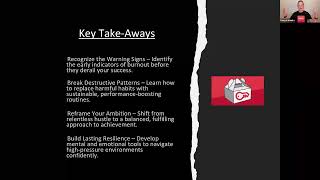
So let's go, some key takeaways. If we can just move to the, to the next slide, that would be wonderful. Yeah, great. So we're going to really cover, you know, four, four things today. This is what you're going to get, you know, by the end. So we're going to recognize the warning signs and those early indicators of burnout before they, you end up happening with what happened to me. I'm going to tell you that right from the start. We're going to, we're going to cover off on the destructive patterns and how we break them and, and as Gerhard said, replace them, you know, with sustainable performance boosting routines. Not the food, not the alcohol. We're going to, we're going to delve into reframing that ambition from, from that blind ambition to something, something more fulfilling. And we're going to shift from the relentless hustle and we're going to have a fulfilling approach to that achievement. And with that, the, the last one is key, which is how do you build a. And I'm going to, I'm going to highlight this. How do you Build a lasting resilience because that's the key, lasting resilience in this, when you're in this high powered environment, you've got to have a lasting resilience. So we're going to talk about how to develop the, the right mental and emotional tools to be able to navigate these high pressure environments that we're all in as salespeople and do it confidently.
So I'm just going to give you a really, you know, a real quick story. I know you've seen some of it in the video but it's important for you to really, to really feel at the moment and how this all started. So it was April of 2018. I remember it was 10am in the morning, you know, I pumped myself full of, you know, three large cups of coffee and three massive almond croissants as I did every morning to, to, to recover from, you know, this alcohol fueled evening of three bottles of Kendall Jackson Chardonnay from Kendall, California, which was my favorite. And I felt like I didn't want to be at the office but, but I had to because I was drowning in, you know, in, in, in business which just was flowing in the door and I was, I was checking the emails. Outside world, everything looked great. Looked like I was living the dream. I had, you know, money, money, you know, commissions were coming in. I appeared to have what was called success, you know, whatever you want to call that. I had the social status, I had the works. But in reality the only thing on my mind, all I could think about and at that very, very moment I remember it vividly. All I wanted to do was suicide. I wanted to take my own life.
And then there was this ping and I saw this email about this mortgage broking event. And look, we all get these emails about all these event, there's a million events but they had the photo of this guy Todd that, that Gehard talked about and I saw his photo and I just thought honestly and I'm. I, I will say I was never a religious person but I, but I, I am now.
When I saw this guy's photo, it's like I had met him in a previous life. I know, I don't know if people get that but anyway, so I, I just had to go and I had to go and meet him because he was the guy that was going to stop me from taking my life.
It's a very hard thing to describe.
So I think now what I'd like to do, Gerhardt is really let's go into, let's go into this blind Ambition. And. And, you know, what is your Achilles heel? Achilles heel of people like us? The high. The high achievers. So if we can go to that next slide, please, that would be amazing. Yep. Actually, before we do that, is there anybody that wants to share? We sent out a few questions. So would anybody like to share a memory where you actually felt it was all lost or you just found yourself in a very dark place? Does anybody feel comfortable to share that? Or.
Maybe they can talk about what resilience looks like for them. Would anybody like to quickly, you know, hop on and talk about that? Love to hear from you.
Hey, carry out. Chime in.
Thanks, Bob. Thank you.
Yeah, I'll be vulnerable. I'm going through something now with.
Let me make it a short story. Basically, I have a. An eye. Eye floater situation going on. I don't know if everyone's experienced it, but I had a PVD post vitreous detachment happen to my eye out of the blue and started in January. And since January, I've just been waiting on this waiting thing. Supposed to go away magically in the next three to six months. They. They said, so I'm in. I'm in month, like two to three, but it's very anxious, so I wake up anxious. I'm not used to that. I'm used to being very positive. And all I basically see is circling floaters in my eye. And supposedly it's supposed to settle down in three to six months. Of course, I can't see that at this point. I'm not that three, six month. So I've done my research. There is a surgery you can do to take out the gel of your eye. Put in saline solution and clear out the floaters if you. If you need to do. But I've been told that most people, only 5% of people elect to do that. 95% live with it. I know for. For a fact I cannot live with this. I don't like the way I feel, but in the damn exhausted just seeing all this and I can't wait for nighttime. Nighttime's my best part of the day. So since January, I come off the high of. I'm an Eagles fan. Come off the high of a Super bowl win, the holidays and everything. And then this hits. So I'm a positive person. Always like that. And it's affecting relationships, it's affecting my work. I do my work. You know, you put on that happy face to get through the day. And then when work's over, the purpose is, okay, shut my eyes and go to the next day. So I guess I'm not in a good spot. So that's why I'm exposing myself because I'm looking for other people too, if they ever had know somebody or has had somebody. I haven't really talked about it. Had it and then went through with the surgery and did that. You do guaranteed to get cataracts in the next two years if you do this surgery, which could be a plus for me because my eyesight is really bad and supposedly cataracts, you get new, new eyesight. So that's, I'm looking at the positive as much as I can that if I go through that, clear out the floaters, it's a surgery. So there's risk knowing that cataracts, I do that and then I have actually better, better eyes. But to me it's just like a long process and it's one of these things like waiting for that to happen but not enjoying the day. So that's a summary. Hopefully I kept it short enough.
No, you know what? I, I resonate on a couple of points there. The first is that this wasn't going to be part of my story today, but I'm going to share it with you now. But back, back in a, you know, a little bit of a still a period, you know, where I, I hadn't got my alcohol under control. I was actually in New York and I got, I, I was so drunk that I, I got punched out and ended up being rushed to, you know, hospital in New York. And I had floaters for, you know, for a good few weeks and.
Scared, it scared the hell out of me because I was worried I was gonna, you know, I was gonna lose my eyesight. So, you know, and that was in one of my eyes. So I, I, I totally resonate, you know, with what you're saying. And the other thing that I resonate with is.
I, when I was at my, in my darkest days, my best friend was, was also what you said, and that was closing my eyes and going to sleep. And you know, in my case, I, I, I was hoping that I wouldn't wake up. So I, I, you know, I, I, I really, you know, my mission now is, is really to, to really help people, you know, who are in, you know, dark places. Because, you know, it's, it's, it's so nice to be able to have lived through something and, and be, be there to, to help people get some, you know, get some, some peace or, or just know that, you know, there are people out there who understand what, you know, what people are going through and you know, losing your eyesight I can understand would be a, you know, it would be a devastating thing and hard to struggle with. So thanks so much for being so vulnerable.
My thoughts, Bob.
Yeah.
First of all, floaters are not life threatening. And floaters are not a sign that you're going to lose your eyesight.
And floaters often come and go and disappear and resolve themselves. Why? Because the brain is retraining itself and tuning out the floaters. Would.
You want to do is how do you think about the floaters? Because how you think about a situation impacts the healing process and the body is designed to heal itself. And by shifting your perception of what it means to have a floater.
You know, you may say to yourself this is bad, I'm doomed. This is the worst. And catastrophize. Whereas you can say something different and say my body is designed for self repair and my brain will figure out ways to look past that and all life is blurry anyway. You know, it's just a symptom that things are not clear for many people. Nobody has clarity in life. 100 clarity. So there are some floaters that are part of the human condition that you want to accept that condition. I had floaters and they disappeared.
And I also noticed sometimes when I'm in a stressful situation, then all of a sudden I become aware, oh my God, I have a floater. I'm not only having a problem, I also have a floater. And then I need to remind myself come down, that's not the end of the world. The sun is going to come up tomorrow and they eventually will resolve itself. And.
The way you.
Call a Carl Dupont Dupult just said an attitude of gratitude, you know, meaning that you actively and consciously choose to focus on appreciate the positive aspects in your life. So what Carl is saying to you, Bob, is start a gratitude journal.
And not catastrophize.
Thank you.
Does it help?
It does, yeah. And actually it's funny. I have like a five minute journal I do each day and that's one of the things I do feel better when I do that versus putting it off someday. Some days I miss. So I appreciate that. Thanks Karen Gerhardt.
All right, well, good. Carl. Carl Duke Poll. Have you been like, did you somehow get hold of my, you know, my script for today? Because I, I love what you're saying here, Carl.
I've just got to read it out. To stay positive in a negative sales environment, salespeople have to surround themselves with positive people. Practice positive self talk, focus on Their success, set realistic goals, cultivate gratitude, identify and challenge negative thoughts, reframe situations positively and prioritise. I love that word, prioritise. Their overall wellbeing by managing stress and taking care of their physical health. Honestly, I love that. Thanks so much, Carl. You know, where we're salespeople and you know, it is stressful. Yeah. And people, people who don't, you know, are probably not in, in our environment, they, they just don't, they probably don't get it. So, you know, so thanks for that. Yeah, yeah.
Anybody else would like to.
Yeah, yeah. Anybody else like to, to share? You know, it doesn't have to be a real dark day. It can just be, you know, what are you going through? What are, you know, what, what?
Yeah, I'd be happy to.
Thank you. Thanks, Mike.
Yeah, about eight years ago or so, I was at the point where, you know, if somebody were to start to go in my lane, I just keep going. But I started working with a, you know, a mindset coach and actually turned that got the kind of the job of my dreams. But then four months later I got diagnosed with tongue cancer and they end up taking two thirds of my tongue. And because I was new to the position, I wasn't guaranteed to come back. So I took all the mindset and coaching stuff I've learned in the past and then doubled down and went into the somatic side of it, the unconscious side of it, the emotional side of it, as well as mindset and behavior. And you know, kind of what Bob was saying, he's like, how's this happening for me? And Stuart Weil said, if it rains muck and bullets, first do muck, then do bullets. So turning that around, I ended up not only coming out of it good but thriving. So I was in the upper six figures selling it was great. And then a couple, three or four years later, I actually got a new boss and was bullied out looking at more of a redirection. So now I'm actually taking all the stuff I learned on the mindset side, on my sales side because I've been in sales for 30 plus years and for Microsoft, I sold AI. So all the AI stuff I have and I'm helping.
High achievers, similar to what you're saying, do the same thing. How do you reframe your situation and look at it and thrive?
One of the things I work on first is lifestyle goals with someone versus these ambition things and just help them kind of of relook at their life. So I'm very happy that you're you're doing this because I think there's a big need for it out there.
I 100% agree. Yeah. Yeah. And, you know, again, you know, I'm going, going through something like, you know, as, as major as that, you know, and having that, that, that surgery without the right mindset, you know, there'd be a lot of people that would, you know, would head in the other direction. They'd head south. Right.
Yeah. Part I left out was while I was being bullied, I actually got diagnosed with a bicuspis valve. So I had open heart surgery at the same time, too. So it's like, again, it's all happening for you, and how can you make the best of it and leverage it with yourself and the people around you and other people?
Yeah, yeah. It just reminds me briefly of an event that I spoke at in Sydney about six months ago, and one of the other guys on the panel was a quadriplegic. And he literally one year prior, was, you know, having the time of his life on a holiday in New Zealand, got in the car with a, with an old friend who decided that, you know, he thought he'd go back to his teenage years and go a little crazy in the car. And, you know, next moment, you know, there's a, you know, a massive, know, a vehicle accident and this guy ends up, you know, losing a leg and he's a quadriplegic and he's, you know, and now his partner, you know, has to, to feed him and, and, you know, help him drink. And, you know, this guy could have, he had two, two choices, right? You know, he had the choice of, you know, just becoming a bubbling mess and, and, you know, going into a, you know, a really bad whole or he could do what he did do and, and, you know, look on the bright side and you know what his bright side is? That he's still alive. That is his bright side. My God, you know, it's the, Honestly, I've learned so much about the mind. So much. So, yeah, no, thank, thanks, Mike. Great to meet you. Really, really. I, I, I love to love hearing that story.
Thank you, Mike. I also want to reflect on that. I read a study from the University of Michigan where women that underwent breast cancer surgery were sort of tested on an attitude scale towards their disease, towards their surgery, towards their ability to recover. And the percentages of survival.
Was infinitely higher in those patients that had positive mindsets versus negative mindsets. So the, the mindset is really a survival tool. And your shift in mindset and your attitude towards the heart surgery and the tongue surgery was a contributor factor to your healing process.
Yeah, absolutely. I saw something similar with 18 things that people had spontaneous remissions for. You know, having something to look forward to, people, nature, all those things. And the thing that was funny, it was about food. Are you eating out of fear because you don't want something to happen, or are you eating to love your body? So it's just, are you doing something out of fear or love? It was. Big difference where you're coming from.
Yeah.
Awesome.
Yeah. Love it.
Love it.
Thank you. Yeah. Cool. Okay. Sh. Should we. Let's, let's crank things up a little bit, maybe. Let's look at blind ambition and the, the Achilles hill, if we can. We can go to the next slide. That'd be awesome.
Beautiful. Going to close down the meeting chart. Cool. So. So how do you, you know, how do you define blind ambition? And what is the, you know, what is that Achilles heel of, of, you know, ask the high. The high achievers. Right. I, you know, I, I really didn't, I didn't know any, any of this. You know, I've been in mortgage broking sales for 22, 22 years this year. And, you know, I just, I went in blind. Absolutely, you know, went in blind. And I just, you know, I was on one mission and that was just to work really hard and make lots of money and, and, and, and make sure that, you know, I looked after people. I came from a customer service background, in fact, bit of history. My first career was a policeman. I don't know if I told you this, Gerhard. I was a policeman at the ripe age of, of 19 years of age. I did nine years in the police force. Then I went and flew for one of the airlines, Qantas, which is the Australian airline. And I did that for another nine years. And so both of those things, you know, gave me the most amazing tools when dealing, you know, when dealing with people. And so it really was a match made in heaven when I went into mortgage broken because I got to look after people, I got to help them get into the, you know, to the home of their dreams. And I was, I got to make great money. So, you know, I thought it was. Everything looked like it was just a match made in heaven.
So, you know, basically, blind ambition. When you have blind ambition, sometimes, you know, it's probably not my story, but when you have blind ambition, you often turn a blind eye to deceit. And what it's going to do is going to override your sense of what's Right. And what's wrong on the other. Another example of blind ambition, and this is me, is that they stop taking care of themselves because all they want to do is reach that lofty goal. And then in a twist, they become their own worst enemy. And that was me.
So, you know, blind ambition, as I now know, is really defined as a, you know, as a desire. But you have no direction, you have no clarity, and you have, you know, you have no preparation. Yeah. It creates confusion, it supports bad choices, and it makes the process of achieving an exercise in the most irrational behavior. And boy, do I, do I know that.
The Achilles heel of the ambitious, it's perfectionism, right? In the attempt to be perfect. The issue is that high achievers, and I'm a high achiever, I don't deny that. That, you know, well, I used to. But the Achilles heel of the ambition is perfectionism. And when you try to be perfect, you end up. You can limit, you can limit yourself, and you strive to appear flawless. You're afraid to take risks because you're so perfect. And you want to be flawless or you'll try new things that you may immediately not be good at. You might be afraid, you know, you may be afraid to take. Try on new things. And that was me, right? I was a control freak. I had one staff member. I didn't, I didn't want to, you know, I didn't want to pay for any more staff because that meant that, you know, I was, it wasn't going to have the money and the lifestyle that I was used to. I wanted to do everything myself because I wanted to make sure it was done, you know, properly and no one else could do it as good as me, you know, And I was, I was, I'm not going to lie. I was focused on, on money, right? I'm going to say money to a certain point, was, was one of my addictions. And God, it just, it's wrong. It's totally wrong. You know what Tony Robbins says, and I'll never forget this, I went to his, one of his courses once, and he said.
Money can't buy you happiness, but at least you can arrive at your problems in style. And Gotti. That is such a, you know, such a classic, that one. But it, but it's so true. All right, I, I, Peter, I peered.
Yeah.
Trust me.
Ziggler said a similar thing. That money can buy you the best bet in the world, but it cannot buy you a good, good night's sleep.
Love that. Absolutely love that. Yeah.
I've had the pleasure of actually meeting, you know, meeting Zig Ziglar's son, you know, Tom. And, you know, great to see that that legacy is, you know, continuing. Yeah. Yeah. So, you know, that, you know, perfectionism, you know, was my, my Achilles heel. And, you know, in the end it became my, you know, my detriment along with, you know, this blind, blind.
Is there anybody that wants to share their story about their blind ambition or their Achilles heel? You know, it's good when you can, you know, that you can identify these. I, I, I really had no idea about these. You know, I, and they're, I, I love it now. I, I, I just love to be able to look back and just see, you know, what went wrong and how, how I've corrected and, you know, and, and, and have these tools. I'm going to say. So. Yeah. Does anybody want to share?
Well, I recently interviewed a financial consultant and he said that he had a case where of a lawyer who made like $20 million in as a percentage of a lawsuit injury claim. And he immediately went out and bought a new house, got himself a Mercedes, got his wife a sports car, he got bmws for his two children. And by the end of the year, he had almost declared bankruptcy because he forgot a minor thing, which is that you need to pay taxes on that windfall profit.
And he said, a lot of people make you in the brokerage business and you are savvy with financial decisions, But a lot of people have blind ambition about money. You know, when they make 10 million, they want to make 20. When they make 20, they want to make 50. When they make $50 million, they make a hundred million and a half a billion. And then they want to be a billionaire. And when they're a billionaire, they want to be the biggest billionaire. And that's blind ambition. And then I said, what is the guiding philosophy? He says, the philosophy of, of more is the philosophy of the cancer cell.
And I said, what's the opposite? Is it less? And he says, no, it's the philosophy of enough. You gotta find out what is enough.
For you, what makes me happy enough. Yeah, I totally agree. Yeah. Yeah. Perfect. Great. So can we, yeah, let's, let's move on to the, the next slide there.
Beautiful. So I'm just going to briefly just share a little bit about a little bit more, you know, about my, my story, my story of the, you know, blind ambition, you know, my quest for that perfection and its ultimate downfall. And I love this, you know, the person that, you know, helped me create these slides where you decide to do this. And I love it, actually. I'm going to keep this slide, but, you know, if I write a book, it's going to become a bestseller and then probably a movie. In fact, one of my best friends, he said that he could write at least 10 books about me in, you know, what I went through. And some of the stories that, you know, I could tell you would, you know, would make your hair curl. And I know, and I actually know when I first met Gerhard, I could see his eyes rolling and I could see his relatively straight hair starting to curl when, you know, when I told him some of the things that happened, you know. Yeah. So, you know, as, you know, as you heard in the video, right, I was, I was focused on perfectionism. I was focused, you know, on my, on my work. I, I was focused on my health routine. You know, up at 5, you know, 15, doing a cycle class every morning without fail, at the gym at 5:30pm without fail. I had a routine. I had a routine for my whole day. Coffee at 7am, read the financial Review, you know, in the office by 8, checking emails that I had this, you know, it was so, it was so repetitive that that's part of, you know, what, what, you know, what, what leads. Repetition is great in some respects, but repetition to the point where you continually doing the same thing, in the end, it's gotta, someone's got to give.
So, you know, I was, I was a control freak. You know, business was out of control. Business was out of control. And I remember my friend telling me, he said, why don't you just slow down? And I said, how do I slow down? The phone keeps ringing. I, I, you know, I've got to help these people, you know, but let's go back to it. You know, what it was, it wasn't there. I could have slowed down. It was the money. I was after the money. It's as simple as that. And you know, yeah, boy. So, you know, apart from that, you know, you know, I had a, the time I, you know, I met someone, I had a great partner. And unfortunately, due to visa, visa issues, you know, my partner had to leave the country. And you know, it was, it was looming and it happened. So, you know, things were pretty bad. I, I, you know, I felt miserable. I felt alone. He, he left the calamity events with that. My excessive work life, my insane workouts, partner leaving. I started to get depressed. And then there was just this slow spiral. And that exercise that I talked about, it went out the window just like that. And I just Stopped exercising. Then came in the, you know, the wine, and it became, as you saw, you heard in the video, became, you know, a couple of glasses. It became a bottle of Kendall Jackson. Two bottles of Kendall Jackson and three bottles. And you know what? When you get addicted to something, I've. I, I'm an expert in addiction.
I haven't. I actually have an addictive personality. And so.
You know, my, My. My taste buds, my addictive taste buds crave things. Chocolate, kfc, wine. And when I, When I have it, the. The body just craves more and more. I could just keep going. I honestly could just keep going. So. And that's what happened. So I stopped exercising. And then before I know it, I gained 38 kilograms, which in US figures is 84 pounds. And literally it felt like it happened overnight.
So suddenly, you know, I was. I was overweight. I looked like I was. I just. The, The. And. And I was. I was depressed. And so what I did was I kept working harder and harder because it. It basically took. Took. It took that off my mind. And I come home, there's no one to come home to. I was. And I suddenly became really lonely. The food got worse, it got worse. No exercise. And the next thing, depression turned to anxiety. I had gut issues like I'd never experienced before. Gut issues.
It was, it was. I had. I had a reflux coming right up my neck to the point where I was feeling like I was going to choke and die. And it. And it. And by that, by that point, that black dog. That black dog took over and all I could think about was suicide. That's the only thing I could think of, was suicide. I didn't want to wake up in the morning. I would drink myself to sleep so that I would eventually fall asleep and I would pray that I would not wake up. And when I wake up, I just want to kill myself because I just. Yeah, honestly. So that was four years. Four years of rampant insanity and an extreme recklessness.
And then, as I said, I was at the office and then I ping and I got that email that, that. That meeting with Todd and his absolute beautiful wife Deb, that that would set the course and change in. In my recovery.
So there's one element of the story that I think that deserves a little amplification.
What Todd did on stage that day, where you were in the audience was something that you were not familiar with, which was self disclosure. Talk about. Put yourself in a position of vulnerability where you talk about. Where Todd talked about his stark moments. And that was an encouragement to you to talk about your dark moments to Todd after the speech.
And that, that ability to self disclose, the ability to open up, the ability to put yourself in a position of vulnerability is the first step to healing.
Absolutely. You know, like, I, after that one hour, like this, this like, weight, like it's like these, this, this, you know, this cement weight on my shoulders just, just, just flew away. I remember walking out of that, you know, that, that event and I felt like it, I felt like, I'm not going to say a million bucks, but I felt, I felt relief. I was so relieved. You have no idea. And yet I couldn't tell from friends, I couldn't tell family, I couldn't tell work colleagues, because this, you heard in the video, I, I mastered all. I lied. I was lying. And yet I could tell this guy from the other side of the world who today is, you know, is, Is, you know, one of my best friends. And that, that, that journey in itself has been one of the most beautiful things that. That's ever happened in you, my life.
And yeah, you know what? One of the other things that I said, I remember, you know, and this, this really all, you know, relates. But I remember saying, you know, I, you know, I've got all the money in the world, you know, I can do, I can afford to do literally anything that I want. Any, anything that, you know, comes my way. If it's something that I want to do, I can go and do it, you know, and that's great. I said, but you know what? I've flown economy class, of course, you know, in York terms, I'm going to say I've flown coach, right? I've flown business class. And, you know, and, and now I fly first class, right? Could be, because I can, I can afford it. But it's like that. There's nothing after first class, like, and so there's nothing more to look forward to. I feel like I've done everything. There's no, there's no, nothing more in my life. There's no more first class. And he turned to me and he goes, he goes, you know what? He goes, I own my own plane and I fly that plane. Sometimes I fly it, sometimes I sit, sit back and someone else flies the plane. He said, but he goes, you know what? He goes like, he goes, sometimes he goes, that can be a very lonely experience back there by yourself. And you know what? I had to stop and I'd stop. It actually stopped me in my tracks. So, you know, he said, you've got to find other things beyond first class that are not material. So and, and philanthropy and purpose were the two things that, that he taught me that day. And they were game changers, Gerhard. They were game changers.
That's awesome. I was just wondering when people want to have a chat with you, how can they connect with you?
Hopefully we have my details here.
You know what I'm gonna. Everybody that is on today, Gerhard, I'd love it in afterwards if we could send out these contact details to everybody. I want to offer 30 minutes, you know, complimentary coaching session with each and every person that's, that's registered and on this call today. You know, I, I want to be able to share, you know, my journey and you know, give you some, some great tools for you to be able to put all of this in, you know, in practice today. And if there's anybody, you know, that, that, you know, is with a company and would love to have a webinar like this, you know, for their, for their team or their, you know, their group of employees, I would really love the opportunity, you know, to be able to do that, you know, with people that, that would give me the most joy. And you know, if you've got a, you've got a conference and you know, I'm often, you know, coming over to the US for different things. You know, I would love to be able to speak at a conference and share my story because the more people that I can share this with and get this message out, the more that we can, you know, give people, you know, help. And the, And Gerhard was right. You know, I was talking on stage with Todd to 2000, you know, people in the mortgage industry. And you know, I don't want to take up too much time, but you know, I spoke to two people in depth. One was a guy in his 40s who was going to jump off the, off the top of a 20 story hotel building. And the other was a 22 year old guy who at the age of 22 could not handle the stress that, that was being, you know, he was surrounded in this mortgage industry and the pressures of sales and targets. And so he turned to, to some pretty serious drugs to be able to, to be able to cope, you know, with that stress. And, and I'm not going to go into it, but it was pretty bad. In and out of rehab three times.
Well, I'm. I want to say something else to put this in perspective. What.
Just read this book about the sociologist about American society and I'm sure that there are similarities to Australia, but.
And the book is Called Bowling Alone. And what this sociologist says, that there are fewer communities, especially post Covid, that support one another. So there are a few fewer memberships, far few memberships for girls clubs and boys clubs and women's leagues and men's lodges.
And there's less contribution to charity, there's less community work. So what is happening is because of that we are addicted to the screen and we are not communicating enough with other people in social settings that are informal, where you can listen to other people's challenges and engage in problem solving so that the community fabric is atrophying, which leads to isolation where more people are anxious, anxiety has gone up and suicide rates have gone up as a result of that. So we are really talking about a social disease. And when, you know. Bob, let me ask you a question. What percentage of your workforce is actually in the office at this point?
In the office? About 10%.
Wow.
And what, what does it do in your opinion when people are not together on a regular basis?
Yeah, it's. Well, it's interesting too because we just had our sales kickoff in Vegas recently and that's an annual event and that's the only time people are together as a, as a whole, as a company. And that's. You can sit. People suck, suck that time up. Like they can't, they can't get enough of that time. It's like they're up all night. I mean, it's Vegas too, so it adds to it. But. And the purpose of that is the connection. Like it's good, we're doing sessions, we're teaching things and doing that stuff. But the connection is the most important part of that.
But so what I recommend, Bob, is that you come up with the maybe weekly huddle where you have no business agenda and let the people.
Just speak up and share what's going on in their lives on a personal or professional level where you have that community where people support each other and understand each other. And.
You know, where you, you, you, you rebuild the team that has been, you know, that team feeling has, has evaporated after Covid.
That's a good idea because I, I do, I've coined something here when I came here almost two years ago. It's called wwts. It's a weekly Wednesday training.
Right.
So it's an hour training that all the sales are part of and I run it.
Right.
It gets. Because I do some sessions, but that I may be the one of the sessions is that it's like a non business session.
Right.
People just care thing, right?
Yeah.
Vivian just messaged. You know, this is why remote work is not truly healthy. It's a convenience. Jamie diamond from JP Morgan is right.
So my mission is this, Bob.
I want Kerry's message to resonate more in American boardrooms and meeting rooms. Is there a way to.
Find him a speaking gig so he can make a name for himself in the U.S.
Yeah, the speaking would be.
I don't know how they vet that out, but they vet out the speakers for the next skl. We typically don't have, like, speaking events during the year, unfortunately, because now people are all together.
But the next sales kickoff, something like that.
Yeah. Or maybe in a huddle where you can get in virtually first.
Yeah, virtual is great. Let's do a virtual.
Okay.
Yeah. Cool.
Awesome. Sorry to interrupt, Gary. I'll let you get to.
Yeah, just, Just, you know, on. On that, you know, Bob, and, and thanks for, you know, the other couple of people that, you know, wrote about how unhealthy it is, you know, being in isolation. You know, I get that. We, we now have a team of seven, and, and we're rapidly growing because, you know, I'm, you know, my mindset is really going like this. And you know what? We. We have basically no turnover of staff. Everybody wants to come to the office because we create the best environment for them. The first priority is not about how much money the business is making. The first priority is about our team. We. We have it. We have a 10. We have a 10 at 10 every morning, which is each person takes it in turns to put on a motivational video that they feel is going to help or uplift the rest of the team. And that's 10 minutes of each day. And we all have a coffee, we have a chat, and you've got no idea what that is doing to the team, because at the end of the day, the people just want to look. Yes, people want money. Yes, people, you know, you know, are there to, you know, earn. Earn big bucks or earn a good living or whatever. But you know what? It's. It's really evident, and there's been a lot of surveying around this. People just want to feel valued. They want to feel value. They want to. They want to feel like the, you know, that their contribution is making a difference. And we make them feel like their contribution is making a difference. And that is my number one philosophy. And then, you know what, the rest, the money, the profit, it'll all flow.
And, you know, we have a philosophy that we will give people whatever coaching, you know, they want. Right. We've got three of our team now on one of Todd Duncan's, you know, weekly calls. They're up at 5am learning from, from the guru, you know, Todd and his great coaching team. So let's move on. Let's, let's just look at the, I think the warning signs, actually. Let's just look at the warning signs. Yeah. So I know we're all high, high achievers. I think, you know, I think we've, we've sort of talked about it, you know, already. I'm just going to quickly, you know, go over them. So Mercy University in New York just literally published a report only late last year and they basically did a report on the top eight things or the top eight ways to be able to spot that you're actually burning out before it derails. And honestly, if I look at this list, I feel like.
That I help them write this. Constant fatigue, reduced work morale. Right. We all have periods where we just got low morale at work. The tiniest small task feels so over overwhelming. Frequent headaches or stomach issues. So, you know, as I talked about the gut, right? The mind talks to the gut. The gut talks to the mind and they just keep going back and forth. Increased irritability or mood swings. I have the worst mood swings. Trouble concentrating. I lost my concentration. The big one for me or the last two big ones. Withdrawing from your friends and family. I isolated from everyone. And that last one I talked about, as my friend said, slow down, don't take as many clients. I couldn't do that. I was trapped. Feeling trapped in your work, Number eight. So while, while I was in my state of self destruction, I never saw any, I, I never saw any of those warning signs. But I now if I look, they were all there.
So from my own experience and from receiving the most amazing coaching and I'm going to emphasize coaching, it is so important.
I can now easily identify when I'm out of balance and if I'm, if I'm really heading in that direction towards burnout and how to get back on course. I know, you know, I know how to correct it. So let's move on to the next slide, which is, which is really trying to break those destructive patterns. Now everybody's going to have a destructive, you know, pattern. I'm going to put my cards on the table here, right. Gerhard hasn't heard this. So it was 2018. You know, I'd met Todd. I'd had this divine intervention that stopped me from taking my life. But the destructive patterns, they were still there.
I just turned 50 and my tree, my 50 year old birthday tree was to go on a three month bender through South America, Central America and North America, finishing off in New York. And let me tell you, there was a lot of self loathing. I was, I was out of control. Like if the stories that I could tell you, Gerhardt would fall off his chair. And as I said, the book, the book that's going to be written about me, you know, it would be a bestseller if I told you some of these stories. So you know I, I was destructive. I was absolutely destructive.
There's one thing is wanting to take your own life and eliminating that, but then there's another where.
That part of it's gone. That's great, okay, I'm not going to kill myself anymore. But I've still got this reckless and destructive behavior that I need to fix. So it wasn't until really late in 2019 that I got to meet, and some of you may have heard of him, I got to meet a mindset and peak performance coach. His name was Jonathan Roach. And I took on Jonathan's coaching because you know what? I knew that I still needed help. So we worked on three simple, three simple things. And they were, they were, there were 24 key habits and there were three distinct areas and they were eight key mental habits, there were eight key exercise habits and there were eight key nutritional habits. When you combine all those together, you're then on your way to actually replacing those harmful destructive habits with sustainable performance boosting routines.
But yet I was still, I'm going to say in Australia, you got to think I'm an Australian. I was still dicking around. I wasn't committed to what I was doing yet.
And so as you heard in the video.
Jonathan Coke, this thing called Covid hit. And so in May of 2020, you know, a few months in when we're all, you know, locked away, Jonathan started this online, you know, weight loss academy for professionals from all around the world actually. And, and, and this lady, you know, Penny, she was on every, every week. She had the most amazing vibe. But what I really loved about Penny was behind her, she had a, she had this big TV and she had all these motivational quotes just keep, you know, rotating. And I love, I loved her energy. But she was, she, you know, she, she was, she said she was tired. She, you know, her score, everybody had to give themselves a score. Her score was really bad. But you know what? She looked great. She looked great.
And then three months later I'm on this call with Jonathan and he Goes Kerry. He goes, that lady Penny that you love, she got, she died, she died of a heart attack. Her husband woke up at seven in the morning and she wasn't in bed. He goes down to the office and there she is, slumped over her desk, dead as a doorknob. And I'm going to read you the text message because this is, this really hit home. Her husband sent a message to Jonathan and it said she literally worked herself to death from the stress in the mortgage industry. And the message went on to say, please, Jonathan, Jonathan, share this message with everyone in the hope that it can save someone else's life. And as I, as I said in the video, Jonathan then said in a sharp tone, and I'm never going to forget this till the day I die. He said, kerry, if you don't stop this reckless behavior, you're going to be next.
And honestly, I feel like he's telling me now because I just went into complete shock. And it was at that moment that I realized that I had to make some drastic changes and I had to make them fast. And the thing is that I realized at that moment that actually I didn't want to die, that there was so much more to look forward to.
So is there anybody that's brave enough to share one of their destructive patterns? Something, you know, something I would really, really, really love to hear. You know, we're all in this room together and, you know, we're allowed to be, you know, open and honest. So I would love to hear from someone.
We've got silence. It's like being in an auction.
It's, it's denial. And as 6eigl said, denial is not a river in Egypt.
Yeah.
How about a performance boosting routine? Is there anybody that can maybe, you know, talk about how they've replaced some destructive patterns maybe with, you know, you know, what, what Jonathan helped me do was, was, you know, replace those harmful habits with sustainable performance boosting routines.
Has anybody got, I, yeah, I, I wanted to say something about the starting your day. Right. You know, those are.
Amazing ideas. Seven really great ideas. And.
And for every one of them, people make excuses.
Absolutely. I, I, I, I 100% agree with you. Absolutely. Yeah. You know, this is, you know, how I talked about.
That, that, that whole day, you know, spin class, you know, shower, coffee shop, paper, you know, like, so, you know, I, to a certain degree my day is, you know, restructured again. And, and, and this part is important. But what you'll see here is that for me, I do this with, I, with I net with now have a purpose. And if there's any point in my day where I feel like you know I need a break, I take a break, it's okay, you know like you put pull back, you need to go and have a sleep for an hour, have a sleep for an hour. You know like.
You know like.
You can change things around. But these are the principles.
Carl is mentioning that AI powered workplace huddles can benefit teams by improving collaboration, facilitating faster decision making, boosting engagement, providing data driven insights, streamlining information sharing.
And enabling more inclusive participation by automatically summarizing key points and any thoughts. So.
I, I love AI and I love the, the ability of AI to analyze things very very fast and.
Have reminders what you need to do next. You know and I love using AI for huddles as well.
I think that here's the way I would use AI.
Think about how many thoughts you experience during the typical day. About 80,080% of those thoughts are negative. Why? Because we are wired that way. And what I would suggest that you do to at the end of the day or at certain points of the day you just put in chat GPT your 5 negative thoughts that you have been repeating all day long and ask CHAT GPT come up with seven positive equivalents to each thought negative thought. So you have 35 thoughts to look at. And.
Dr. Lozarda did a study of high achievers and she realized that the mindset management that those people are practicing.
Is the equivalent of a ratio of 3 to 1 between positive and negative thoughts. So for each negative thought you need three positive thoughts to neutralize the negative thoughts and the higher achievers had five to neutralize. So that's what I would use AI for. Put your negative thoughts in there and get at least five or seven positive.
Ideas on how to combat that negative thought and how to right size your mind. It's not just starting your day right but it's keeping your day right. Keep on the positive track. Look at the bright side and use ChatGPT AI to help you generate those ideas that don't come from your brain.
Correct? Yeah, yeah. Do you know Gerhardt that, you know I've got a big speaking engagement you know in, in October this, this year. 3000 you know, people that I'm going to be speaking to in, in Dallas and you know I'm already planning for that, for that event, you know what. And I made a decision and a lot of people think I'm absolutely crazy but I made a decision that my television will not be turned on From. From late January just gone until. Until I get back. That's how committed, you know, that I am to, To. To eliminating the negative voice. And I. I had the CEO of a. Of a. A huge company here. Even someone as successful, you know, as him said to me, he goes, man, that's serious. He goes, you're really going next level. I said, yeah, absolutely. I said, I'm all in. Like, I, you know, I've got to be at my best, so I can't. I can't have all this negative, negative the news. And, you know. Yeah, I don't, you know, like. Yeah, it's. It's so, you know, I have to focus on my positive voice, and it's working.
I think that the screens to me, can be toxic, and detoxifying by not watching TV is a wonderful idea. I have a friend who is an Indian entrepreneur. He has five homes in the. Across the United States, and he never spends more than six weeks in any one of them. And I visited three of his homes, and in each home, he has, like, eight television sets. You go room to room to room in.
In.
In the living room alone, there are three TV sets, and they're all running.
Oh, my God. Jeez. Crazy. No, it's.
It's.
It's just. It's. It's garbage going through your head. Through one ear and out.
Yeah. And. And Mike says, I give up the news after my surgery.
Good on you, Mike. I love it. Yep. I'm all. I'm all yours. Yep. Yep. Get rid. Get rid of the news. Yeah.
And. Excuse me. Carl is sharing seven ways to get your mind back. That's a. An article in Psychology Today.
Where they say, feel like you have lost your mind. You know, use those seven strategies. So there is an antidote to the toxic media culture that we live in. And. And a lot of people have a sense that they live. Live in fog and chaos and the world. When you go out for a walk, you go in nature. Everything is in order.
You know, every. Every tree is a reminder that you want to feel rooted in life. You want to feel connected to the earth. And digital media disconnects us. It's apparent.
Yeah, absolutely. Yeah. Yeah. I have a. I have a rule down at my beach house. You know, when my friends come for the weekend, I'm like, no news. The. The news that is. That's the only. That's the only rule I have. No news. Do whatever else you want, but I don't want that. I don't want to see. They'll hear the News. Yeah.
So of the time.
Gary.
You in charge?
Yeah. Let's take it home. Wrap it up. Let's wrap it up, shall we? So let's just quickly look at reframing this ambition from blind ambition to just solid ambition. And with that, you need awareness. And this can only come from what we just sort of talked about, really. Positive changes and influencing in your life and actually, you know, slowing down. Right. And so I just want to say, you know, by 2023, I'd had three amazing years with, you know, coach Jonathan and he turned my life around. But it was at this point that I felt like, you know, like any athlete, sometimes they need to change coaches. So I got to, you know, I've started working with another mindset coach for high achievers like myself. And you know what? He gets me. And we all need someone, you know, that gets us. And so with Simon, coach Simon, he actually is based out of Bali. He's actually 20 years younger than me. And so I've got someone 20 years younger than me coaching me. And you know what? But he's been where I've been, so he gets me. And it works. Doesn't ages. You know, ages is just a number when it comes to, you know, you know, what we do and you know, how we, how we think and, you know, how we are. And so how I now work with Simon is Simon helps me to reframe, you know, this ambition from that relentless hustle to a balanced, fulfilling approach to how I still achieve. Right. And I've got to say, I still have insane, lofty goals that are going up here, right? But they've got to be balanced with, you know, other things over here, which are philanthropy, exercise, nutrition, mindfulness, meaningful connections with the right people, not the wrong people. Get rid of those wrong people. And the biggest one that he's helped me work on, which I'm beginning to actually discover, is me, my self, love and to be able to love myself.
So let's wrap it up, let's move to that next slide, which is really.
The final thing and that is building a lasting resilience. So if we're going to be doing this for a very long period of time, it needs to be lasting. This resilience has to last. So it's about developing the mental and the emotional tools to navigate high pressure environments. Like I'm sure majority of you on the call are in as far as your work goes. So, you know, we need to cultivate a positive mindset which we've, you know, just talked about. We have to be optimistic and we have to surround ourselves with positive self talk. As Gerhard mentioned, we have to have strengthening emotional regulation. So we really need to really understand all about emotional intelligence.
We need to make sure that we have those stress management techniques. And they're not food and they're not the alcohol. Right? We're not talking about those. We have to have strong support systems. We have to have, you know, which are nurturing relationships and developing, you know, better communication skills. We need to be able to problem solve on a more effective level. And we need to make sure that we're promoting this physical wellbeing that I talked about. So, you know, exercise, diet and sleep. Sleep is the, is the, you know, the biggie and the last one that, you know, Todd taught me about and that is fostering this sense of purpose. So identify what your values are and engage in meaningful activities that, that give you joy and give you that sense of purpose. Thank you.
Beautiful. So I'm just going to summarize it here. If we look at, if we look at this, you know, this surviving mode that I, that I was once in and now if we look at this thriving mode that, you know, I'm in now, I've, you know, I've gone from blind ambition to ambition. We're just going to call it ambition. There's no, there's no blindness with this ambition now.
I've gone from unbalanced to my, my life is now totally balanced. I've gone from being, being this repellent person where nobody wanted to come near me to this magnetic version, a better version of the one that went before. It went downhill. Like I've got everybody again wants to be around me. I go to my wellness club and I've got people coming up and saying, hi, complete strangers.
We're going to get rid of that confusion and we're going to replace this with the, with the clarity and the last. My favorite is, you know, anarchy. It's disarray moving over to structure. And when you've got structure, you just, you, you just feel so much more happy.
So, you know, that's the difference between, you know, survival mode and thriving mode. So is any, you know, if anybody can relate to that, you know, I'm sure you've all related to that. So these, you know, these key takeaways again, you know, we talked about these warning signs, talked about breaking these, you know, destructive patterns and we all have them. I still have, you know, patterns that I still need to work with. We all, we all do. We talked about, you know, reframing our ambition, going from that, you know, relentless hustle to the fulfilling approach. And we've just talked about lasting resilience and those tools, they're mental and emotional, not, not, you know, the, these bad, bad habits of, you know, excess food and alcohol and all the bad things that we put into our body. So I, again, I just want to say, you know, thank you. I'm, I really would love to be able to, you know, do a 30 minute coaching call with everybody that's on here today and let, you know, let's, let's wrap it up.
Yeah, I want to read what Todd said. Carrie Calendra is a testimony to the possibilities of unleashing potential impact and making an indelible difference in his own life and the lives of his clients, community and the world. I personally watched Kerry go from being clear from not being clear or certain on his purpose to becoming laser focused and getting the best personal and professional mental, emotional and physical space rare for anyone to achieve. Through his transformation, Kerry and his team have made a profound impact not only in Australia, but, but abroad. His story saves lives, transforms hearts and energizes humanity. Gary Kendra is one of the greatest thought leaders ever and I know he will continue this path and put a dent in the universe for good. And that's Todd Duncan. He's a New York Times bestselling author. And a minute ago, while.
Carrie was speaking, I tried to put my own advice here in in chat GPT and I picked one comment that Bob made earlier. I'm not good enough. And when you have negative selft talk, I urge you to go ahead and test this out. So here are seven ways to handle to talk back. I'm good enough. And what I'm thinking about is on your left shoulder you have your inner critic. On the right shoulder you have the inner champion. And ChatGPT can wake up the inner champion by saying, I'm enough, exactly as I am. And my worth is not defined by external validation. I trust in my abilities and know that I can handle whatever comes my way. I'm unique and valuable, bringing a perspective that no one else can. I'm a lifelong learner and every experience helps me grow stronger and wiser. I am kind to myself. I treat myself with kindness and compassion just as I would a close friend. And I'm worthy of love and respect and happiness regardless of my perceived shortcomings. So ChatGPT can help you improve the self talk and I urge you to reach out to Carrie, 80K, a US that stands for Australia, Carrie cadlandra usmail.com easy to remember.
And eight turned sideways is infinity. That's a reflection of Carrie's infinite, infinite, infinite wisdom. I can't talk anymore. But.
Gary, it has been such a pleasure and privilege to know you and.
I, you know, we share something which Americans don't know about, which is that we are both from a country that gets confused with each other. I'm from Austria, you're from Australia. And most Americans don't know which one is which.
So true.
Yeah, yeah, yeah.
And I want Bob to say the final word because you're a guest of honor today.
Wow. Some pressure there. Let me put my camera back on.
Thanks, Paul.
Final words. I think it was a great session and a lot of good nuggets that came out of this that everyone should use. And I really like that balanced wheel that you put out there, the morning routine and all seven other things or eight other things that you should. You should do. So just start with something small, right, and just change it. I'm going to take away this and change my mindset. Thank you for that. And here's to better, better vision with clarity.
That's. Thank you. Thanks, everybody. That's been, you know, listening, watching, you know, reach out to Gerhard. Take down my email. Email me, please. And, you know, I really, you know, I want to. I want to be able to, you know, chat with everybody. Well, you know, let's.
Let's get a home for Kerry to speak either virtually or live in the U.S. i'd love to have you share your message with U.S. companies because we need you.
Yeah, look, you know, it's, you know, it's a great thing, right? And we're here to help people. Yeah.
Well, judging by the text, people love you.
Thank you, Bob. Thank you, Carl and Mike.
Jennifer, for sharing your story. And thank you, Vivian. Thanks, everybody. And join us soon again at a new master class. And we will send out an email to everybody with a link to this recorded masterclass so you can share it with your team as well.
Yeah. Thank you. Thanks, everybody. Great to meet you all and love the U.S. thank you.
Thank you.
More from Gerhard



What Selling Looks Like When Your AI Agents Have the Context Your Sellers Do

Better Conversations, Smarter Support: Wearable AI in Business






When Scarcity-Built Systems Meet Abundance - The Judgment Gap in AI-Powered Sales Leadership
