The Human Edge: From Managing People to Shaping Destinies
Tricia Benn, CEO of C-Suite Network, argues that leadership means shaping destinies through trust and empathy, not command. Companies with high trust see up to 400% higher engagement. She promotes a lead-support model where everyone leads and supports others, built on delegation and personal relationships.
Chapters
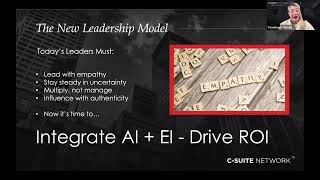
Thank you so much. You know, I am usually in the seat of elevating everyone around me, and it is such an incredible joy, honor, um, and, and certainly a mission that I've taken on with incredible, you know, love and passion for seeing things differently, for doing things differently, to, to create the, the, the courage and that foundation that we all need to do something that really is beyond what we know we could do, uh, alone. And so it is absolutely my pleasure to share a little bit. Now, there have been so many incredible insights today, um, so I decided that I would start out in maybe a little bit of an unusual way. This title was beautifully and brilliantly given to me by none other than Gerhard. And that human edge, managing people from that into really shaping destinies, is something that rings so true for me and is really truly core to how I've approached everything. And as we look at everyone who spoke today, trust, how we build and use our authenticity and our relationships and our insight and our expertise and our data. All of it is really truly about how we're shaping destiny. So in this deck, I am going to share some things that I think are important, and, and I'm going to share some things that I think I know, and I'm going to share some things that use me as an example. And by doing this, I hope to live the promise of delivering value and also exemplifying what I think is important that we can call on all of ourselves to do. And I truly believe that every speaker today addressed in such powerful ways. It's just incredible. So first, confessions of a CEO. The first, and we talked about this first thing this morning when we were talking with Jeff Bloomfield, And that is that I want to be useful. And this comes from being raised on a farm. And I've shared this story with Gerhard, I know. And if any of you know me at all, the story of on a farm, things are very simple. Don't we want to simplify things in our lives? So the simple thing on a farm that you learn from day one is be useful. Or be dead. There are no other options, just being useful. And that simplifies things a great deal. So level setting. My goal here today is to be useful. It always is to be useful. And I think that creates a bar where maybe it needs to be so that we can really truly look at how we fly past what those basic bars are to the impact that we want to be able to have. So the second confession is absolutely about impact. And impact is everything. What are the results that we wanna be able to deliver? And maybe even more importantly, how are we looking at what we as business leaders can bring to the table? And the key here is, and this is why I am so focused on the priorities of impact in business, is that our capitalism, our approach to financial modeling, if we just take that out to the very basics, means that we are the ones who can lead to create sustainable financial models to deliver the success that we want to see in our businesses, in our lives, in our communities, and far beyond that, of course, in terms of the global reach that many of us have with our businesses. So what kind of leader does this moment require? And I think this speaks very much to the human edge that we've addressed in so many different ways today, even to the point with Helen of love. It means that we cannot be the kind of leader we were 6 years ago or more. Not since, and I will say for the not since 6 years ago, that's pre-COVID. Not since just the 3 years ago with the sort of proliferation of AI and of course the first subscription availability of ChatGPT. And we know how the world has exploded since then. What is it right now? So as we look at the, the now, I want to move us to what do we need? I have always been focused on a model of leadership and support, and in C-Suite Network, that's what our focus is. Everyone's a leader, everyone's a supporter. And I've had many discussions over the years where some people believe that not everyone's cut out to be a leader. And I would challenge everyone, and maybe you won't agree ultimately, but I would challenge everyone to think to where is the leadership that's shown at every level of our organizations, every level of our communities, every level of the other not-for-profits or other organizations that we're part of. We take on different roles, and I don't believe in followers. We're leading and we're supporting. And really truly, the more leadership we have, the more, more we're supporting. So at the end of the day, always is true that we need to be able to provide a vision, a mission, and values that are creating what we talked about earlier today, the trust, the agility, the focus, and ownership in SOPs certainly, but even more importantly, the decision-making power, that leadership capability that everyone within the organization if they know the mission, the vision, the values, they've got those other pieces of information, maybe job descriptions, et cetera, they have the values alignment and they can act. They're empowered to act and move things forward. And in terms of leadership, I believed this many years ago, leading all kinds of different teams in enterprise-sized organizations as an executive all through my career. And as I said, in coming into C-Suite Network as an owner and a partner, and the CEO of the network. So one of the other topics that we talked about, and it cannot be missed, I think it came up in every conversation we had today, and that really is the currency of the future being trust. And we are so proud in C-Suite Network that we made our tagline 12 years ago, the most trusted network. And come full circle to last year when the New York Stock Exchange early in the year announced us as their media partner. They said trust is the currency of the future. And this was just such a delight because when you are carving out new territory, when you're building new platforms, you don't know everything that the future holds, certainly, but you believe in what is important. And that's a value that we hold very near and dear. And In terms of the, the logos you'll see on the side of my slides, I've got the New York Stock Exchange, that experience. Desert Financial, the president and CEO of Desert Financial is Jeff Mishi, absolutely incredible. And I've worked with him for years. Everyone in his organization, as it's scaled incredibly, by the way, a financial institution, one of the largest credit unions in North America, and everyone in that institution knows they are empowered to do the right things by their members. And That is incredibly powerful and absolutely a huge credit to his leadership and his team's leadership, as well as all of those levels activating against the values of the organization. And if you speak to Gary Ridge, who was the CEO of WD-40, very much a leader in the organization to this day, he absolutely would speak to the same thing in terms of the values being delivered across the entire organization and trust of delivery, trust to deliver, um, against what are— what their customers need and a consistent experience, etc. So in terms of trust, and I'll just touch on this very, very quickly, when we look at data, and this is just one piece, those that are engaged, these are the companies that are outperforming, and that's up to 400% more engagement when there is trust in that higher level within an organization. And obviously you can't have trust that's not reciprocal, so this is a very powerful result and one that we are obviously working to every day. Now, as we look at the shift in leadership, I think this is something we keep coming back to. And those of us who've had leadership through the major crises of the last 30 years can absolutely say this. The old model of the leader having the answer, the only answer, the authoritarian is absolutely not what we need today. We don't have all the answers. We do not have authority. And this is something I find absolutely fascinating. And if you wanted to write down a book that would be very valuable to read, Leading Without Authority by Keith Ferrazzi is so powerful. It was the first book that I read that really focused on the fact that our influence is so powerful and something that we rely on at all layers of the organization. So we are absolutely needing to move forward to that influence and how we lead with empathy, how we stay steady in the uncertainty, and we multiply our leadership and, and certainly use that influence and authenticity. So now it's really time to be leading with that empathy and the delivering of that with our AI and driving the ROI of our organizations. And Gerhard, I know that is absolutely near and dear to your heart. And, and this is truly what, what we need to be doing and how we need to be thinking about how we're empowering our leaders. Now, just really quickly, the next slide I'll show you is, is about how our, how our empathy is really a strategy. And, and we know, and we've talked about this earlier today, it— empathy is not a soft skill. It's about how we're driving performance, we're unlocking engagement, and we're building trust that scales. And of course, that means that we're anchoring the whole entire team to delivering our organizational success. And that's again all about that influence, the empowerment, and decision-making, where everybody's aligned with that success and what it means. So vulnerability— now this is something I find fascinating in the everyday. I'm frequently complimented that I am very authentic, and I think it's really important that we share the truth of our experience, to share the truth of what we know. And each of us has our own truth. In sharing that without a spin, without manipulation, we empower others to be successful faster. So the simple solution, the simple example of I don't have all the answers, There are lots of ways to deliver that in a way that means that you're empowering your team and all of those around you to be able to get to a solution as a team faster and obviously more in line with what the whole team or the whole organization needs for success. Now, moving forward from there, it is, uh, it goes without saying We are the bottleneck frequently. So how do we ensure that we're opening up that aperture and as many decisions are being made along the way as humanly possible is absolutely critical to our everyday. Now moving forward from there, we need to move to the manager being the multiplier. And this is something where we, again, we can't control everything. We need to be looking at how we expand that capacity and really build leaders. And here's another thing that I think is frequently forgotten is that Everybody who's aligned with our mission is actually on our team. And sometimes, you know, we think everybody we pay full-time is on our team. That is not necessarily true. And those that we don't pay who are completely aligned with our mission, that could be collaborative partners, that can be mentors, that can be so many people in our extended communities and networks and so on that are aligned in that mission and there as part of our team to see our success and our success delivering on the mission and the vision we have for the impact we're going to have with our organizations. This is just a really simple outline that I created to help empower our whole network and community when COVID happened. And it's just simply that we're trying and innovating and innovating and innovating, and we're letting things drop. And I think also being authentic about the idea that we don't want to fail fast, we want to succeed fast. The only real failure is falling down on an important mission and not getting back up to deliver on it. This model allowed for all of us to see or visualize what that looks like and how we create success and support it. Now, the influence and authority. Again, influence is absolutely what we want to be building on, and it's not just yours as the leader. It is about everybody on the team and the influence we have to make things happen and have them happen faster and, and to greater value. And that's part of the multiplying factor as well. So where do we need to lead differently starting today? I'm asking this question to everyone in this room. How do we think about where we are now, what it means, and how we lead forward successfully? And Gerhard knows, and, and I'm so grateful for Gerhard's participation and leadership in C-Suite Network. We always have a give, so I have a give here. If leading and being around an authentic community of leaders and the conversation of executive decision makers creates value for you and you wanna lead and support in the community, this is a give. It includes being a C-suite insider, but it also has 3 months of our membership and all kinds of different tool sets and so on. So I wanted to put that out there, but that then follows with another share that I wanna do. And again, just making myself vulnerable, we are in a scenario where, The biggest takeaway, I hope, is that this is the journey our avatars are living, your avatar is living. So how do we sell into their success? And I want to just put myself on the table and use myself as an example. And so as we move forward to the next slide, this is C-Suite Network. And as a CEO, and decision maker on a great deal. I am working against these 4 pillars. I'm going to say working against, working with these 4 pillars. We believe community develops content, content develops community, and eventually with the proper counsel, we get to commerce that matters, commerce that moves our organizations forward. Now frequently I will have people come to me and say that they are wanting me to sell their product. I will benefit from selling their product or service. And what is completely missed is what success looks like in terms of how I can deliver success against my business model. So it's, it's a, it's a, it's something I'll just leave out there for the moment. But it does drive this next question, which is— oh, and Kara, if you can go back one slide, please. There we go. This is the journey your avatar is living, one where I am the CEO and frequently, frequently offered to sell things for people that does not fit my business model at all. Now, if someone's selling into my success or our success, what would that look like? And how do we ultimately deliver value, deliver impact that shapes destinies? And I think this allows us to sit in the shoes of our avatars, mine included, but just putting myself out there as one of the avatars that many are selling into as well. So with that, Gerhard, I do have, uh, of course, my contact information that I'm happy to share as well. But I'm very happy to jump into questions and conversation.
So obviously you have natural gifts and abilities, and people are attracted to you because of those gifts and abilities. How do you go about sharing those talents with the next generation of leaders?
So I shared, Gerhard, that I am just a massive believer in leadership and support. I think of it as a leapfrog. So the more I'm leading, the more I'm supporting. So if I'm leading here, I'm supporting the person who's supporting me. And so this person's able to leap forward and then I can leap forward because I need to do the things that only I can do. And so for me, the younger generation, I truly believe they want the same things we all want. It's just that we didn't dare to say it, and we would have been punished greatly for saying the things that we want to be able to have out of our lives. We want to be loved and respected, like Helen said, like Lance said. We want to know what our capabilities are. We want to be coached to our capabilities. There are so many things. We want to be valued. We want to be seen. We want our data to matter. And that is not a young or old issue. That is a leader issue and being in alignment with a mission that matters. And, and, you know, for me in C-Suite Network, for all of us that support the C-Suite Network community and lead in the C-Suite Network community, it's about accelerated success for values-based leaders, people who genuinely care that what they deliver will create success for the person receiving it. And that's going to have great impact of success that will now deliver it back again. Very simple.
You are also a master of delegation, and a lot of managers have a hard problem letting go. What's your advice?
I understand that it's incredibly challenging. I don't know any other way to do it, Gerhard. And so I understand, and I've understood much earlier on in my career that I like change. I like challenge. I'm excited about what we can do that's different. I love disruption. I've been corrected. I have my podcast and TV show, um, C-Suite Success with Tricia Benn. I've been corrected by people I've interviewed that I shouldn't use the word disruption. It's too much, you know, it's too threatening. I love it because we all know things. So We serve an executive audience, VP and above. We all know, Gerhard, you know, I could ask you right now and you'd list off— I'd have to ask you to stop— how many things are wrong in the industry, should not be done, either because they are illegal all the way through to just unethical, just wrong to do. And we all know those things. So disruption to me is how do we create successful business models that take advantage of doing the right thing? Right? It— you, you streamline, you cut out costs, you, you know, you do things that make it so that you can create a successful business model to have that impact, to create that, um, impact that you want to be able to see with what you're doing. It's great business and it's great fun too.
So share the role models that you have had benefit of learning from? And what advice do you have to future leaders for finding the right role models and mentors?
My goodness. So I would say everyone is a role model or mentor. And it really truly is about who you connect with. And Gerhard, you and I have seen, you know, people will stand up and they'll say, this person was my mentor. They've never met them. They probably never read their book or even an article. Doubtful they saw a video and they're just saying it. Then there are those people that maybe you haven't met, but you've listened, you've learned, you've grown through or from. So first I'd say every opportunity where something is pouring into you is something to listen to, something to connect with, something to empower you to do whatever is great that you're, you're committed to. For me, I always say, and this was really strange for me, I was in a room with my sister who owns 2 construction companies. And I had to share this, and I hadn't okayed it with her ahead of time. I said, I am third-generation crazy woman, and I guess that makes my sister that too. But my grandmother started her own business in the '50s. My mother is a world leader in her space to this day, and I just didn't know otherwise. So that's one thing. And I think coming back because I shared the farming example, I'll share that. My father, absolutely incredible man who was a contractor, an electrician by trade. And to this day, when I visit him, I might get handed a jackhammer, I might be driving the big tractor, I might be doing plumbing. Whatever it is, there was just no doubt that I could do what he set for me to do. It needed to be done. It was useful. And on top of that, there was a trust that was everything on the line and totally calm. So you understand the steadiness of where you stand. And those people in your life, again, absolutely invaluable for him. With me, I really got that shown to me as an adult, uh, where I hadn't thought of it because it would— I just was born with this. I was raised in it. But my husband was not. And my husband is 6'7", a very large man who happened to be holding our brand new infant baby girl in the back of the tractor that I was driving, just a few inches from a 6-foot drop. And what he couldn't see, what my husband couldn't see, is my father was just doing this. And that just meant— and I didn't— no words were exchanged— move over an inch. I couldn't see the 6-foot drop. I had no idea where it was. But I knew my father was saying I could go over an inch. And of course, the story goes, and it's absolutely fact, I had to stop the tractor because my husband thought we were clinically insane. I had to let him out with the baby. And my father and I carried on up the road to be able to level a, the conservation driveway that people needed to go into the conservation area near his home. But that trust, you don't have to go a million miles in one moment, just, just an inch, an inch, an inch. And when you have those solid, those solid foundations, you know exactly, even as scary as it might look, It's no more than an inch.
That's amazing. What a great story.
I was going to say, I know that's true with you and your daughters. That's solid ground.
Yeah, I think the word trust is, in my opinion, the secret sauce. And it— there are almost 3 ways to look at it. Trust in yourself, which takes a lot of work because a lot of people don't have the confidence they need in order to succeed. The second level of trust is trusting other people and letting go and delegating and let them shine. And I think that I'm going back to Bill McDermott's book, Winners Dream. I think we need to learn how to trust our dreams because dreams are not real, but our talents are the tools, provide the tools to turn dreams into reality.
Yes. It's so— coming back to your delegation point, Gerhard, you can't have a big dream and not delegate responsibility and shared credit, shared celebration, shared excitement for delivering that impact and then seeing that impact. It's— yeah, so I, um, and then the trust in yourself, I will say So you fell down, so what? Who hasn't? You know, I think we're so focused on success being I somehow do the perfect routine. You know, there is no perfect routine because as soon as you do it at this level once, then you want to do it at this level the next time. If you have a positive impact in someone's life today, don't you want to have the positive impact in 10 people, 100 people, 1,000 people? You know, There's never enough of having great impact in people's lives.
Absolutely.
More from Gerhard



What Selling Looks Like When Your AI Agents Have the Context Your Sellers Do

Better Conversations, Smarter Support: Wearable AI in Business






When Scarcity-Built Systems Meet Abundance - The Judgment Gap in AI-Powered Sales Leadership
