The Human Edge: How Meaningful Conversations Outperform AI in B2B Sales
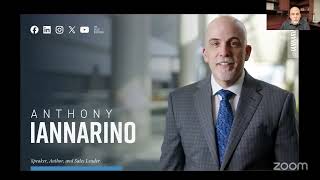
Anthony Iannarino argues that meaningful conversations beat AI in B2B sales. He uses ChatGPT himself but warns against replacing human connection with AI agents and robocalls. His advice: spend time selling directly, keep your tech stack minimal, ask consultative questions, and build relationships.
Questions this video answers
March 1, 2025.
$200 per month.
About 34%.
Free — Iannarino says he'll give it to Gerhard to distribute.
Chapters
You.
Let's get started. This is me. I'm a speaker, I'm an author, I'm a sales leader and I'm a good friend of my friend Gerhard. Okay. I am going to be talking about human things here. Okay. So what we need now more than ever is human centered strategies to outperform AI driven solutions. Okay. So I have to say a couple things about this. Number one, I have, I spend $200 a month on chat GPT. I have the, the best thing that they have. I use it every single day. I find it to be very, very helpful for all kinds of things and I'm very, very enamored with it. I think it's a very good tool. It's like having the best research person you've ever had and it's worth the time to use this. But there's more to say about this. The secret to winning more deals lies in meaningful conversations, not in algorithms. We have our own algorithms and those are like Gerhardt I were just talking about, of being together in a room together. Even if it's a zoom moon like it is right now. But it is important that we can stick with what we are and that's humans and we are better. And if you, if I want to say this one, one time at least I might say it more than that this time.
We created this thing. It did not create us. It is now having an impact on us. A good impact, I would say. But it's not what we are and it is very different than what we know. And it's just an algorithm. It is like a, it's like a trick that somebody figured out how to answer every question that anyone would, wouldn't need answered. So let's stop. Start with the problem with AI in sales. Every single day, maybe two or three times a day, I get a call and the person has recorded.
Something that she wants to say to me. It's always the same woman and it's her voice over and over again. And what they want to do is to help me with Medicare and Medicaid, which I'm not nearly old enough for. But they still call me every single day. And I hear this voice and I know it's the same person. And to do my best, I've tried to be very nice to people. So I take the call from the, the she passes it off to a salesperson and I'm very nice to them. Just saying like someday I'll need that. But for now can you, like for the next 10 years, could you just leave me off the list and they just hang up on me and they just keep coming back. And it's just an AI, it's just calling, it's just saying the same thing. And then if you say, yes, I have Medicare or Medicaid, it'll give you somebody to talk to. So I keep explaining to them that.
I'm going to waste their time if they waste my time. So the best thing for them to do is to find somebody that's in that age demographic. So that would be useful for them. So what we're doing is we're taking something that should be a conversation with a real human being and we have a. An AI delivering this. And nobody wants to talk to robots, Nobody wants to talk to them. And you've never wanted to do that, and you still don't want to do that. And you're not going to in the future. And I know I'm not going to do that. Okay, how do we spend our time? So mostly is other tasks, and then there's about 34% of actually selling. And if you want to make more money, then you have to flip this and say, I'm going to do much more of this selling and a lot less of other tasks. And we have all kinds of tasks that we have to do. I'm moving fast here. I got to go backwards. Sorry.
There we go. AI agents.
This the first time I've seen somebody do this. It was on LinkedIn and it was a VP and he went out and he created an agent, which is an SDR or a bdr. And the voices are indistinguishable from humans. And they. But they are not a subject substitution for a human connection. You get robocalls every day, and now you get AI pitches. They're irrelevant, they're impersonal, and they are immediately rejected. So we don't want to talk to robots, we want to talk to human beings. Because that's what we do, that's what we are. And now we just have technology overload. I don't know if I have this slide. Let me see if I can find it. This one. This is one. I'm just going to go to this count. How many of these that you used today? Did you use Salesforce? Did you use HubSpot, Zoho, Pipedrive, Dynamics, Outreach? Look at this list of things. Gong, Chorus, Drift.
Docusign, Panda, Doc. All of these things. Look at how many of these are. This is not even a close. I mean, this is a small amount of what we have. And if somebody would look at Chat and if. And tell me, like, how many of these do you actually use on a day?
We spend our time with technology because technology is what we have had for the last two decades for sure. So we've all been in Salesforce or HubSpot or Outreach or zoominfo. My favorite.
Apollo chorus. They're all good and they're all interesting and they can be helpful. But when we spend time with this, what I want you to recognize is that not spending time with these people. So if you want to do a better job selling, making more money, generating more revenue and more revenue for you means greater commissions. And these are the things that cause us to be able to have those outcomes. It doesn't happen because we're talking to an AI. It doesn't. It doesn't help that we use all the technology that we have been given. I like quite a bit of it, but I don't think it's how we're going to succeed in the future. And I'm positive of that. This is true. I always take cold calls from real people and I think it's the right thing to do because the gods of sales punish us who don't take calls while making their own calls. But if the voice on the other end is an AI, I reject the call immediately. I have no interest in talking to a robot except for my own robot, which is chat GPT for me. So we have to talk about this.
I want to tell you about the original B2B sales tech stack that I had when I was a very young kid. I had index cards, a Sharpie.
A phone, and an index finger to, to dial that phone. That is the only thing that I had. And I did millions and millions of dollars in staffing simply with just this. I didn't have any technology because there wasn't any at that time. And I remember getting my first CRM.
Maybe in the early 90s. And it was nice to have something that was better than index cards. But I still use index cards and I still think that's the way that we should be doing this, is writing our notes on something like this and then being aware of what we're doing and why we're doing it. We're, we're not here to help.
Tech companies make more money. They're all, they're all doing fine. We need to do better. And we're going to do that by doing it with, with humans. So you've got CRM plats, you've got engagement plats, you've got Generation for tools. Those are Nice to have AI tools. Some are good, some are better than others. We all have the contract stuff, which is very helpful. A lot of things get done because of that. I think that calendly is great, but it's not the same thing. The only tech that you really need is CRM. That's Salesforce prospecting tool. Zoom Info Video is Zoom Cut the rest. I mean, if you have 10 more things that are underneath these three that I have right here, I would tell you if it's not directly contributing to a sales conversation, it's likely a dis. A distraction. And I would try to avoid that if I could.
If you want the key to winning deals, it starts with empathy. AI is not capable of, of having an understanding of human understanding of themselves. The second thing that is very important if you want to be successful is business acumen. Buyers want somebody who already understands their business, cares about their strategic outcomes and can offer real advice behind or beyond by my solution, which a lot of people still do that. And then relationship building.
At one time a number of people wrote a book and they said on HBR that relationship selling is dead. And when they said that, I thought.
Obviously they've never been in sales because, you know, it's about the relationships. You get the relationship with the client before you get the. The contract signed. And it's because of your strong connections, your partnership, your caring of what they want. And right now we have people who think that they can still pitch and pitching isn't going to work. So we have to find other things that we can do in.
I am missing slides. I'm sorry, so. But I don't need it. I can talk about this. Here's what I would recommend. If you want to increase your commissions, generate more revenue, spend more time with more people. And right now I think if you're getting the same thing that I'm getting, so you probably are. I'm getting emails that are automated, I'm getting phone calls that are automated. I've got stuff coming in in LinkedIn that's automated and you can see all of it is AI. And in a few months, I think you're going to see a big switch from where we are right now, which is everything is AI. And I think you're going to see people rejecting some of this and deciding that we're going to go back to doing what we are supposed to be doing. And that means meeting with clients. In one of my businesses, I had my reps and I asked them how are they doing? And they said nobody picks up the phone voicemail is completely full. And I think that's on purpose. They don't want any more voicemails coming in. And what I said, what if we did what we used to do, which was just walk into a client's office or their facility. And that's what we used to do, is we would walk in, we would sit down, and we'll have a conversation with them. And the more that you know about their industry and the more that you know about what their problems are and how you can solve them, the better the conversations that you're going to have. But it does start with the relationships. And I think when anybody says something about the technology, I just think that they're off. Off of this. The reservation. It just doesn't work this way. So I'm here because I have a relationship with Gerhard. We've known each other for a long time. And I would rather be playing chess with Gerhard, which I will do later on, and he will probably slaughter me. But it's a relationship. And so if he asks me to be here, I'm going to be here. And if I need something from him, he'll help me because that's what humans are doing. So I'd like to G. Can I ask people for questions?
G. G's gone.
You can? Yes. You can ask people for questions.
Yeah. You want to drop them in the chat?
I'll do that.
Absolutely.
You'll manage that part and I'll answer the questions. And then I'll try to get Gerhard to say something nice, too.
I admire your presence of mind when you couldn't find the slide. And then you said, I. I can talk about it.
I can. I can talk about it just about anything. So, yeah.
Did you see we do have a question there in the chat.
Might be yours. Would you? Or did you just type it?
I typed it in from the chat. That is from Denny Ying.
Denny, thanks for your question. Would you say AI is great at identifying opportunity and we should responsibly and we are responsible for building relationship and human interaction? Yes. I. I think that's exactly what I wanted to make out of this time that we had together. I would rather be with people than with just anything else. Like technology.
The good technology is the. The chess that we're going to play later on, right? Yeah.
Right.
Just because he knows he's going to beat me. I think the relationship building is the most important thing in a. In a world where everything is going to be I. AI and I'm going to tell you, by 2030, most people who are paying attention of the Singularity. We're not going to have any jobs anymore. I mean, that's what the, that's what the, the smart people. Kurzweil says that by 2030 it's over. What are we going to do? I would say we could cut each other's hair, except for one of us doesn't have any hair, so we can't do that. So I have to find something else. Maybe I could be a. A cook or something, I don't know. But it is going to go faster than people think it is. It already has. It was shocking when it came out and we never saw Chat GPT and we were all stunned with it, just like that. And now what comes after this is going to be way different than what we have right now. This is like the. Just the beginning of this thing. It's going to be very different in the future. And if you re. If you haven't read it, the book is called the Singularity is Nearer. And that is a very good book. And it will explain to you just how everything that we know is going to be very, very different very, very soon.
So do you really think that we have. We will have no jobs because AI is doing everything and we just direct an army of agents to the problem spots.
As soon as we put. As soon as we put thumbs on a. A robot, we're pretty much done right.
Once they have a. A thumb, they can do all kinds of things. They can pick things up and move them around. I think it. I'll go back to this. First thing, building the relationship and the human interaction is how we win. Nobody cares about your tax.
Let's take that example and move it to a farm where the farm animals, the machines that milk the cows and, you know, and.
There'S a vending machine outside the farm that, where you can get your milk or get your bottles of milk.
What.
Will humans do?
I. I think you're gonna watch tv.
Watch TV and play games.
Chess. I think it'd just be chess for you. I, I know you well enough to know that that's true. Like, you would be happy to just have the chessboard in front of you, wouldn't you?
Why not? Yeah, me too. There's even now a, A Chinese manufacturer that created a chess set where the chess pieces move automatically. So you make your move and the opponent is virtual and makes a move. And then you can set up game positions and learn new openings. And you. You don't have to play with anybody anymore.
Yeah, but that's no fun. I think that Kurzweil calls it the law of, you know, everything getting better in the future. That that's what he thinks. But he doesn't say very much about how are we going to change as humans. I think most of us are going to still be human.
And there's one, one comment that Thierry says, design, design, design. And I think that what we are challenged by is how do we design our future in a meaningful way? And that's why I like the title of your presentation. Meaningful conversations and meaning comes before money and meaning comes before technology. And so we. My hope is that we are going to transition to a more meaningful world because the trivia work that or the drudgery work or the heavy lifting is done by machines. So now we can design the life that we imagine and design something that is even better than what we have.
I'm trying to move something over here.
Right.
Jonathan says Satya. You mean Satya Nadella from Microsoft has a different take. Even if we had today's cognitive labor hand cognitive. Today's cognitive labor to AI the range of cognitive labor for humans will shift and expand. We'll need to govern our affairs. And I like that a lot, Jonathan.
I, I just hope, I hope that we start like this law of accelerating great and out. At some point we have to figure out how we have to change because this will change us. I think it will. I'm going to show you this just because I want to talk about the conversation. If I can do that. So this is second thing. I'll make sure you guys get it. If, if you want it, I'll give it to you G. So you can give it to people. I've noticed that when people start talking about consultative selling, there's not a lot of consulting. It's. It's just mostly a still a conversation, which is great. But what I decided to do was to share this.
High gain questions for each stage. So if you can see this, I hope you can see it. If not, we'll make sure you get it.
We have to have a very early conversation about who needs to be there, who's going to have impact on a decision.
Has your company purchased something like this? How did it go? What are the key steps that you need to take to be able to make a final decision? So what I'm showing you here is all of the areas where you should be being consultative and helping them through a decision making. I don't think that what we're selling, we're not selling the way we used to Sell. And let me say why.
Buyers think that they have. They're trying to pursue a rare decision with strategic outcomes that they're trying to get right on the very first attempt. And so when you don't do something like this and help them understand what they're going to have to do to be able to do that, then they're going to struggle doing this. And you're going to hear a lot of people say that there's very hard for people to make decisions, but that's because they're missing a consultative salesperson who would sit down with them and ask these questions for them. Maybe not all of them, but the ones that you think are important for the conversation that you're having. And I think prioritization and budgeting, I think that's important and your ability to have a strategic influence on the decision makers and stakeholders. And then we get over here to. My favorite part of this is the being an expert in an authority and we don't do enough about these things. And I'm trying to spend more time building things like this so people can have a list of conversations that would be better than the ones that they might be having right now.
What do you say about that?
G. I like the idea. I. I think that.
The word consultative.
Is.
Is difficult to understand for salespeople because they think or assume that.
If.
They turn into that walking product encyclopedia that the company trained them for, then they're going to be consulting to a consultant to the company. And that's true in many cases. However, what you are saying is that the decision tree is different for every organization and for, for every buyer. And it is more important to understand what is the process for making a decision within the buyer company than to.
Speak about the solution.
Yeah, your solution, what you're selling.
So I, I think we've left the era of solution and we've entered into the one of the era of decision making.
Exactly.
That's where we are right now.
Right, right.
And.
And I think that the salesperson, a good salesperson, needs to be that sort of.
That authority that leads the buyer to an arena where they can all look at the same criteria that they're looking at for making the right decision. So there's the right fit, there's the right solution. So I agree with you. We are. We are. That's the end of solution selling. And with AI, you can get a lot more information about the client's situation. You, you were the one that last September was teaching our audience.
A methodology where you ask ChatGPT what are the five headwinds that the company that I'm calling on is experiencing and what are the five tailwinds? And then you look at both and you see an opportunity for a more meaningful conversation.
Yeah, that, that is what I think clients want more than anything else is somebody to understand them and to help them with the things that they don't know.
Right.
So the best thing.
I want, Stephanie's point of view, because you have, you have a lot of kids that come to college and they want to have a bright future. But.
What does that decision making.
Matrix look like when they come and speak with you? Do they know what they want? Do they know how to make a decision?
They might think they know what they want when they come into college, but they're probably going to change their mind. And, you know, we do a lot of applied learning and, you know, hands on, help them understand what those jobs are really going to be like. And we focus on getting internships. But it has been very scary hearing people say, you know, we are replacing sellers. We're going to have agents, you know, act on their behalf. What am I training my students to do then? So we've been focusing a lot on how to have great conversations, meaningful, empathetic conversations where they're listening and they're tapping into AI. Regardless of what they go into, selling skills will help them. But we're at a point now in academia. Many of my friends are also wondering, how do we adjust our curriculum? What are the jobs that we're really preparing our students for and how do we help them to win?
I don't think we know what those jobs are going to be. Maybe just shining up robots. It could be, I have no idea. I have a, a degree with political science and English literature. I have a JD and I also went to Harvard Business School. And I, I mean, I'm not doing any of those things. You know, it's just, you think that you're going to do these things after college, but then the world just does give you a nice jerk towards something and there you are. Right.
But I think there's another analogy that sort of contradicts that, which is when you go to the gym, you do things that you never do in real life, but the gym prepares you for feeling fit on your job and doing a better job. And I think that you're going to those universities and Harvard, you trained for mental fitness and you got your brain into a high performance mode. And that's what we want salespeople to achieve and sales leaders to prepare their sales teams for. Because what is more challenging than anything else is earning the future with.
What Mark Benioff says, like a beginner's mind. We need to have that reset of our mindset and say whatever we learned up until today is history and we need to be open to the possibilities of the future.
I agree.
So we need a mindset shift. And I know we are running out of time. We could continue that conversation, but I think any.
Any other questions in chat?
Well, Anthony, you had a lot of fans in chat just telling the group how much they like you and how you've impacted their careers and you've taught them so much. So you have a whole fan club over there.
Well, I'm happy to answer any question questions while we've got a few minutes.
Yeah.
One. One person asks, will buyers reject AI or will the convenience of AI and the perception that salespeople don't create value maintain their adoption momentum?
If you have a. A serious problem.
You'Re not going to want AI to do it. You're going to want a human to do that. I'm. And I'm just telling you as a person who's had two brain. Brain surgeries. So I'm doing this with half a brain. I have more than half of a brain. But the. The part that I do have is. Is still working very well for me. So it's. I think that that's still going to be what's running everything. It should be, anyway.
Yeah. Yeah, that makes sense. Let's see. Is the High Gain Question Playbook available for sale?
No, it's for free. I'm going to give it to Gerhard and he can give it to everybody.
Yes.
And what are the telltale signals that the email or voicemail you recorded as AI.
Oh, it's. It's so easy to hear that. I think if you. If you hear it once, you'll recognize that it is not. It's a recording or it's an AI voice, one of those two. And I think we know that when it's fake.
And also there is a new rule for YouTube that when you publish a video, it's altered by AI you need to state that upfront. And if you don't, your video may get removed.
So we live in an age of where authenticity is mandatory.
Yeah. You have to tell the truth. Right. Think about how they're gonna. AI is going to.
Harm people. So I like the good part of it, but there's a bad part of this, too. Somebody can take your voice, Gerhard, and they could make a phone call with.
Oh, yeah?
Yeah. So where all that stuff's now going to start showing up.
So we need an AI to manage the other AIs that are trying to steal from us.
More from Gerhard



What Selling Looks Like When Your AI Agents Have the Context Your Sellers Do

Better Conversations, Smarter Support: Wearable AI in Business






When Scarcity-Built Systems Meet Abundance - The Judgment Gap in AI-Powered Sales Leadership
