The Modern Sales Enablement Stack: Practice with AI, Perform with AI
William presents how AI augments sales training and performance. Enablement gaps are real: 43% of reps report no time for skill development. AI-powered practice platforms and in-the-moment coaching tools drive measurable gains in pass rates, practice volume, and cost savings at companies like Sumuda and Novo Nordisk.
Questions this video answers
43%
71%
83%
Before: 10% failed; after: all trainees in the cohort passed.
Reduced by 65%.
Chapters
So, as you can see, I'm talking about the modern sales enablement stack. And of course this is about AI and we're going to hear that word a lot. I'm sure there's a lot of noise about AI in sales. Some people are going to promise it's going to do the selling for you. Others think most AI tools are just overhyped add ons. And I agree with what Stephanie shared in the opening remarks. I definitely, definitely understand the skepticism. Like myself, I get sales outreach in my inbox that's obviously AI generated and really it turns me off. So what I mean is that I see the bad use cases, but my hope is not to get you stuck in one lane or the other, but to give you a framework for thinking about what's going to be discussed over the next three days at this conference. So I'm convinced that the more complex the sale, the more sales rep skills matter. Technology itself can't replace the judgment, the relationship building, and the trust that top performing reps bring to the table. But what I'm going to introduce is how we can enhance sales rep skills in two key ways. We can offer technology that can prepare them better and give them the skills they need now more than ever, and offer technology that they can use themselves for better outcomes. So in this short session, I want to leave you with some examples that can maybe inspire you and again, some ways of thinking that might set you up well to make the most of the conference. To start us off, I do want to do a quick poll with the audience here. And to do that, I would like to invite you to participate in this quick survey. What you can do to participate is really just scan the QR code if you have your phone handy with you and it will bring you to answer the questions. It's very quick. It invites you to share the common challenges that are affecting your sales organization. So some of the options that you'll have are whether it's limited resources to train your sales staff, is it a more competitive environment? Do you have difficulties using the tools that you have? So I already shared this link around a little bit before, so I'll give it about 20 seconds to get people to participate a little bit. Again, all you need to do is scan the QR code and it'll allow you to answer the question here.
All right, we got a few more answers pouring in and I'm not going to linger on this too long, but once we have another five seconds or so, I'll show some of the results.
All right, I did Share this around earlier. So with the participants of this conference here. So what we see are some of the commonalities. Actually, far and away, the biggest response is limited resources to trained sales staff is the biggest challenge, followed by a more competitive external environment. And then the others vary a little bit, whether it's metrics or hiring or retaining staff or a lack of alignment between marketing and sales. But definitely that limited resources is the number one challenge. So what this does is bring us to some of the insights that we have gathered with research we sponsored with our partner, the association for Talent Development, and it kind of aligns with some of those responses. The first challenge far and away is the limited resources to train sales staff. So 43% of organizations say that there's no time for real skill development. If there is coaching, it's reactive if it does happen at all. And the second most common response, which was a little higher than the results we saw, was the competitive sales environment. So your teams are competing on the same things they always have, but things like the customer experience is only becoming more important, and so is speed. This means that your teams need to be more agile and responsive because our buyers are more informed and they're more selective than ever. And I think it's worth pointing out that a third of organizations do say that their tools are not meeting their needs. So even if they do have the best of intentions, if the tools are in place but they're not aligned with your goals, it's really hard to see progress. And that's where the latest tech enabled by an AI comes in. It can be a better tool, but it can also help in meeting some of the other challenges that we see here.
So a quick moment to ground ourselves in what's actually happening in the world of sales and AI right now. We all live in the same world and we see the same things. And McKinsey says that 71% of companies are using AI in at least one function, and sales is actually one of the most common use cases.
Salesforce reports that 83% of sales teams using AI saw year over year revenue growth compared to teams that are not using AI. And whether that's biased or not, I'll leave that to your judgment. But third, it is worth noting that this isn't a story about automation replacing salespeople. At least, you know, not yet. I hope so. The number of salespeople the US has actually risen over the past decade. And Harvard Business Review predicts that unless we have a really significant downturn, the number of sales reps is more likely to grow than not. So the demand for skills from real people is going to grow alongside AI adoption. But when we think about the tools that we offer, it's important to be strategic. And we can think about this in two categories. One are tools to train your reps. So these are tools that help your sales team build the core skills they'll rely on every day before the flow of work, before they get in front of a customer. And these are things like helping them practice their pitches, strengthening their objection handling, or getting real meaningful feedback. And it's the latest technology that makes this type of training more effective than it has been in the past and it enables speed. And that's really the game changer in this category. Category two are tools that the reps can use themselves. And this is the other half of the equation that's just as important. Reps need tools to help them do their jobs better, to support their real workflows. And the strategy for supporting your team should account for both. So if you're a trainer, this also is where you need to be paying strong attention. Are you providing them the skills that they need to use the tools that they have?
So let's look at some examples of the tools in these categories. The field is evolving very quickly, so these tools vary in their maturity and in their use cases. So the ones that you see here aren't exhaustive, but I group them into the same categories to train reps. AI coaching tools can provide that instant unbiased feedback. And they're especially valuable when manager time or trainer time is limited. But obviously the reps still need guidance on how to improve AI. Video practice tools are another example where sales reps can practice their pitches or their product messaging on demand and AI roleplay chatbots, I'm sure you've seen they can simulate real sales conversations, they can help your sales reps sharpen their decision making in a safe environment in a scenario based practice. But the next category is AI the rep can use in the moment. So the first are general large language models. And these are things like Copilot or ChatGPT or Gemini. And whether you're telling your team to use them, they are using those types of tools. They can boost their productivity, but the reps need to be trained well on how to use them. Another category is chatbot assistants that are trained on your company's knowledge base so your reps can get answers to their quick questions like what's the pricing difference between product A and product B? And they can get those answers instantly and more quickly. Than before. And the third category is kind of an umbrella term. These are the guided tools that are designed specifically for sales. They use the power of large language models, but they're pre designed to not require reps to write their own prompts in the same way that a general large language model requires. So these are some examples. Now normally I would ask at this point what your team is using, but I'm sure you've maybe seen some of these tools or might actually be using them yourself. But it's actually good to see some examples of what this looks like from successful companies.
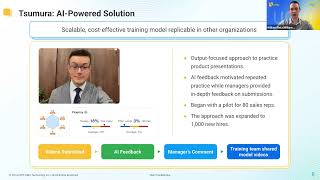
So when companies actually implement these solutions, we can look at this first case in a Japanese company actually called Sumuda. And they have over 130 years of experience in pharma. But they had challenges that are pretty common across sales enablement. The old training methods weren't going to be effective. They relied on long lectures and passive document reading. So as Gerhard said at the opening, if you're Gen Z, this training method was not meeting them where they are and it didn't give them the product knowledge that they needed. So the solution that they implemented was an AI learning platform that shifted from that passive learning to a more output focused approach. And this is a key advantage of using AI, enabling output oriented training with meaningful feedback. So the goal was to use a tool powered by AI to provide reps opportunities for repeated practice, presenting information about their products. And this was impossible to scale with the trainer's time alone. So it was a very simple training flow. After going through the materials, the trainees were asked to record themselves delivering their product presentations, which they could do as many times as they needed. And so the tool, like the one you see here, scanned the rep's facial features, it analyzed their speech, it gave feedback on their communication, and it generated a performance report on things like their clarity, their eye contact, their body language. And it's this type of feedback that doesn't replace a trainer, doesn't replace a manager's judgment, but it is a powerful motivator because it encourages reps to practice over and over. So this was followed up by submissions to their managers and the highest quality submissions were shared by the training department. So in this scenario, AI plays a supporting role, it can help with that scalability issue and it can promote practice, but it doesn't replace trainers.
The results for them were that before 10% of the trainees failed passing their exams, but after the new system all the trainees in the cohort passed and the shift allowed the company to reduce instructor led training. Time by 65%. And this doesn't mean they didn't need trainers, but it did mean that it freed up more time for the trainers to focus on the higher value interactions with their trainees. And as you can see on the right, it's the results in the field that are the most important for any sales organization. So when this company looked at the changes in sales activities, they found that the number of sales activities was 1.6 times higher than the year before. Before they required the AI video practice. And when they did require it, they, they saw much better performance than the year before.
So these results are great. And this type of a design is also fairly easy to replicate, right? Have an AI tool enable practice within your existing training flow. But the next company is Novo Nordisk and their sales reps were tasked with mastering detailed product knowledge in their industry. It's medical terminology, it's pharmacological effects, so they really need highly standardized and consistent training. Their sales challenges were pretty similar to most of the ones that you can imagine. But this company, if you're familiar, has grown a lot. So they had thousands of new employees across the globe. So they needed a high level of quality and consistency in an efficient way. So they implemented a similar tool. It's an AI powered coaching tool, but in the previous example that was an off the shelf tool that provided that immediate feedback on how the rep presented the product. But this AI coach was custom designed to give them further and deeper feedback on what they presented on things like their product knowledge, logical structure, how they presented the features, advantages and benefits of their product, but also the body language and their closing techniques. And in this model, the AI coach actually eliminated the need for managers and trainers to constantly supervise the practice. So this is not built for every organization, but in an organization where those resources are very limited to provide coaching or they might be absent. At some companies, this means that in the case of Novo Nordisk, they could engage in deliberate practice at their own pace without requiring a, a trainer or a manager to give them feedback in order to improve. And so for Novo Nordisk, they trained more than 3,000 medical reps in the first year. They submitted 85,000 exercises, which was 23,000 hours of practice time.
In comparison with the training programs conducted during the same period of time. Using traditional modalities, they reduced their costs by 52%. And the analysis by the company showed that learner scores were in direct correlation with the number of exercises they had submitted via the practice. So these are just two examples, but they do demonstrate that AI Technology is making training more engaging, efficient and effective than ever before. So you can create personalized programs. The AI can accurately assess each employee's knowledge gaps and provide them with the necessary training they need to improve their, their skills. So this is one side of the equation. And I think you're going to hear about some, some tools this week that fit this type of model. But the next important thing that we're going to only going to touch on very briefly is using the power of AI to help your sales reps. So in this case, it's the importance of AI that the rep can use. Are they prepared to use large language models or the other tools that your organization provides to actually improve in their work? Whether you have healthy skepticism when employees are actually trained and provided guidance, this is where they can actually see those, those gains. So this is one more piece of research that we did with the association for Talent Development, and it shows that what most companies are doing is, is when they're providing tools to their sales reps or all of their employees, they're basically telling them learn through trial and error. They're given a tool like Copilot or another large language model or a sales tool that has an AI component, and they're just saying, go figure it out, right? And if we're trainers here, we know that that's not the most efficient or effective way to learn any skill. So what typically happens is that we reps are going to get generic results from large language models, they're going to misuse the tools, and I've seen some pretty horrendous sales messaging in my inbox as I mentioned. So when your reps are not, are using this through trial and error, they're not using them very effectively, or there is that group of people that lose trust in the tools and they don't use them at all. So that's why we believe that AI literacy needs to be part of your enablement strategy. You don't need every rep to become a prompt engineer, but we do need them to be at least proficient in how AI fits into their role. So to give you one picture of how AI skills training can have an impact on sales, a quick example from another pharma company. We tend to work with a lot of them. So at this company, they were about to roll out Copilot to more than 500 employees. They knew that they were not prepared to use this tool. And so they began with a pilot of 50 learners and implemented an AI training program to help their sales reps use AI for their tasks. And so they started with 50 reps and they scaled this up to their whole organization. But you can see some of the quick results here. 75% reported immediate productivity gains from generative AI and 100% wanted to continue learning how to use AI more effectively. So this is actually the cultural shift that is just as important as the technical skills. Understanding what AI is is important, but understanding how to use it in practice is where that builds confidence in your sales reps. That's what makes a difference when you're implementing an AI training program. So this momentum continued and with the company wanting to tailor training for specific roles and departments, I'll take it one more step further. I know we're at time. I think what we encourage and what we've built, this is my one minute sales pitch, is that we've developed a structured curriculum, what we call building top salespeople with AI. So whether you build this internally or you're looking for a partner, we found that effective AI literacy training for sales has to move beyond generic prompt engineering. It needs to anchor on specific sales behaviors. The goal isn't a rep that just uses AI, but it uses AI to turn thinking into better behavior. I know we're almost already at time. It's a very quick 20 minutes. But this is one message that I think you can take with you. This is a message that we convey in pretty much all of the messaging that we have. And you can tell your reps, stop copying and pasting from generative AI if your reps are doing that. I'm sure there are some who are. They're doing something that can easily be replaceable and they're adding no value to their work or they're doing something that can be done by AI better in the future. So this is why a complete AI enablement strategy needs to have not only the tools to help them before their work to train them, but.
The tools to give them the confidence to use large language models and the other tools you're providing effectively.
I'll finish there. And I just encourage you to reach out over the course of the next few days. You can contact me through this link. And I want to thank everybody for joining today. It's going to be a fun conference.
William, I can't thank you enough. Audience has a few questions and.
Bob.
Britton is asking.
Let'S see.
Who believes that the AI can train a seller better than a human? How do you respond to that?
I mean, it's a private question. And that's. I'm saying it cannot. Right. Saying AI can provide things that can solve challenges that real organizations have. Right. You can enable practice because I'll just bring it. Very quick anecdote. Right. I was a, you know, an early career salesperson at one time and I was practicing by myself, learning our products. The only time that I could get real feedback was when I could schedule time with my manager, which happened maybe once a week for 30 minutes.
Right.
What was I doing the, the rest of the time? I was just hoping that what I was doing was effective. But AI can give real meaningful feedback. It can motivate me to practice. And I'm just referring to myself. It's not taking away the judgment that a trainer or human can provide, but it is motive.
Filling a gap that real organizations face because we're all constrained with the resources that train, you know, the real life constraints of having limited trainer and manager time. So I think that's how I'd respond.
So there are a whole bunch of books now out on the market that talk about constraint based learning. So there's constraint based coaching in basketball, in hockey, in golf, in football. And what you would seem to be doing is create a model for organizations to step up to the plate and practice in a more difficult situation than what you would encounter in real life.
What's not to like about it?
Yeah.
As we saw. Right. The constraint based learning, I think is a good way to think about it because we saw the results from the research that we've done in people's answers. It's constraints like limited resources, limited time. We need to use the tools that we have to solve those constraints. And I think that's where AI is just another tool to help solve those challenges. It's easy to get caught up in the larger discussion around what AI is. But just think of it as a tool that helps you solve a challenge.
And since you're in Tokyo, we need to mention the word tantatsu.
So to us, okay, so dontatsu, you taught me Gerhardt. But dontatsu, that's, it's, it's a Japanese concept. Meaning like being the best in your field. Right. Striving to be the best to outpace your, your competition. It's not a mindset that's unique to Japanese culture, but I do think that's, that's one we can carry forward and that, you know, we all should have with our sales organizations. That competitive spirit is something that is important regardless of where we are.
Stephanie, at Bryan University, you've done like.
30,000 role plays and learned a lot about what is the right Amount. So what advice can you give to the audience for structuring role plays that are more effective than.
Role plays that are over designed or over engineered or under designed?
Sure, yeah. I mean, gosh, you know, between. Well, with rainmakers, over a million, but with Bryant University students, gosh, thousands and thousands and thousands, I would say, you know, thinking about giving quick feedback, right. You want to get the feedback as fast as you possibly can. The longer the, the gap is between when the learning or when the execution happens and the feedback happens, you have these diminishing results that are coming, diminishing gains. So giving that opportunity for feedback and well structured, constructive feedback. Right. I see a lot of the feedback that people get in roleplays like you did a great job, but they're not clear and specific on that. So the other thing is just remembering that it takes a lot more practice than you think. Just having one conversation or two is not going to make you master a new skill or develop that. And so what we saw was it takes sometimes as many as 30 to really form a new habit and ability to gain that skill.
And what is the right length of.
A role play.
Really depends on what you're trying to accomplish. If you can do little drills that, that can be very effective to continue to reinforce and to keep someone's attention. But I think it really depends on how much they're talking and their stamina as well. So if you can keep their attention for 90 seconds, five minutes at a time, that's, that can be pretty helpful. If you're going to have a 20 minute conversation, you can't have as many of those conversations and you're going to have a lot of skills that are displayed across that 20 minutes. And it might be a little bit more difficult to get the feedback if you give the feedback at the end instead of during the actual conversation.
William, what's your take on the ideal length of a role play?
I'm not sure if there's an ideal length, but I just would agree with what Stephanie mentioned. You know, if I go back to some of the examples that I shared.
The Novo Nordisk. When they analyzed the amount of times that people practice, there was a direct correlation between how many times they practiced and the results that they saw when they were actually in the field. So it's maybe not necessarily the length of time that I would focus on, but as Stephanie mentioned, it's the repetitions. Right. We all need reps in order to, to improve whether we're swinging a golf club or having a sales conversation. So that is, I think, maybe the bigger variable than the length of time.
Well, in my experience, when I did video role plays, I found that if role plays go over like three minutes or five minutes, they become more difficult to analyze because you have too many data points.
Yeah, I think that can be true. So that's definitely something to consider. But another thing that I'll pick up on from Stephanie is that it's true sometimes the feedback from roleplay is.
Not helpful. Yeah, you did a great job. That's wonderful.
I'm not encouraging only using AI, but AI can provide something that people know is just analytical. It has no personality. It's just analyzing what you're saying and providing some direct feedback. So that can be a good complement to some of. Maybe the. The warmer, softer feedback that some managers are. Are providing. That's not actually helping them, you know, get those skills. So that's another thing.
A good rule is to tell students what was good and why, what can be improved and how.
Yeah.
More from Gerhard



What Selling Looks Like When Your AI Agents Have the Context Your Sellers Do

Better Conversations, Smarter Support: Wearable AI in Business






When Scarcity-Built Systems Meet Abundance - The Judgment Gap in AI-Powered Sales Leadership
