The Neuroscience of Selling
This is a transcript of a December presentation titled "The Neuroscience of Selling" by John Asher. He explains how recent fMRI-based neuroscience informs sales practice, describing six unconscious "activators" (three instinctive, three emotional) that influence buyers, recommends modern AI research tools (Sales Navigator/LeadIQ, Crystal Knows), and distills cognitive-bias findings (184→45→9 relevant biases, e.g., similarity bias). He offers concrete action items (research prospects, start with buyer needs, use videos and customer stories, develop USPs) and points listeners to follow-up materials.
Chapters
Thank you. Great to be here with all y'. All.
And I forgot to mention, you also the founder of a movement that focuses on longevity.
Thank you. So, co founders of company. None of us have any intention of ever. John. Hanged that we have the answer. It's just a lot of fun.
Can you speak up a little or get close to the microphone so we can hear you?
Yeah. How's this? This better?
Much better. Thank you. John, take it away.
Thank you. I just want to mention about the longevity company that gave mention the foundings of it six years ago. We have no intention of ever dying, and we all have the answer. So it's a lot of. It's a lot of fun. All right, so let's talk about sales. I want to cover the neuroscience of selling. And so in the last 10 years, there's been an explosion of neuroscience studies worldwide. All these neuroscientists sharing the results in the cloud. So just an incredible amount of new information. And our job, of course, is to see how it applies to sales and help salespeople be more effective. And so most of these new studies are done with what are called functional MRI machines. So you can see the young man with an MRI machine on his head. And then when the researcher will show him a video, show him a slide, ask him a question, make a statement, then the researcher can see when the positive hormones light up, the dopamine, the oxytocin.
And when more than one lights up, and maybe when the cortisol, the fear hormone, lights up. So we've always had the personality and how it fits for sales, and we always add the sales process, but now we have the neuroscience behind sales. And actually, I'm an engineer, so for me, it's thrilling to know there's real science behind it as well.
So when you look at the neuroscience and how our brain works, we have three areas of our brain. There's the rational brain. We're all kind of using it right now. It's conscious. We know what we're doing. We're making lists, we're making goals. But there are other parts of our brain that are unconscious. And one of them is called the instinctive part of our brain. And when you're with a buyer, there are three ways to wake up the buyer's unconscious brain and get it to tell the rational brain what to do and, of course, what you want them to do. And then there are also three areas of our emotional, unconscious brain. And so I'm going to cover all six of these and how they apply to us as Salespeople. So this would be the typical average salesperson's agenda. And when you look at the first activator called me, me, me focus, the background is no species survived through evolution that wasn't focused on its own safety. Makes total sense. It's true for us today. We're all focused on our own safety, own success, own happiness, own family. And when you watch average salespeople, their focus is their presentation, their rent payment, their car lease payment, their quota, their commissions, their products, their services. And so a typical presentation with an untrained salesperson would look like this. It's all about the salesperson. But this has nothing to do with the buyer's BBB focus. For them, it's all about their issue, their challenge, their aspiration, their decision.
And so here's a young woman giving a presentation. Oops, lost one of the buyers already looks like the other guy's about to go. Here we go. My favorite video, by the way. Boom.
So the first instinctive brain activator is a me, me, me focus. And the question, of course is, does the buyer actually, their instinctive brain actually care about your product? You can tell by the reaction on the audience here, they really don't care.
And what they really care about is how. What their issue is and how you can, what their needs are and of course, how you can satisfy them. So that's the me, me focus for the, for the buyer. We all know, we all know this. And for the, when the untrained salespeople get this, then things turn around for them fairly, fairly quickly.
So a practical application would be, if you have to give a presentation, don't start with how great your company is. Always start with your understanding of the customer needs.
And here's how salespeople today can figure that out. There may be an RFP that the buyers put out. There may be other people on your team who have some knowledge of this. For this buyer and their needs, it may be that you can do industry research and find out what everybody in that industry needs. You may have a referral who can fill you in. From the Miller Hyman training, you may have the inside coach, or from the Covey training, you may have the inside champion that can fill you in.
And then there's a brilliant new set of tools and Sales navigator infused with AI techniques. One of them is called Sales Navigator of IQ. And so today, Sales Navigator as an app in LinkedIn, Microsoft has spent millions of dollars upgrading all these with AI tools. So Sales Navigator, for example, IQ before, would look in the LinkedIn network to find out about the company. Now it looks globally.
And so the question would be is how can we use AI to thoroughly research a company quickly? And that would be again, sales Navigator iq. So if you're a hunter salesperson looking for new business companies, this is an absolute must have tool. So it goes globally to find out about the company, goes to a dozen different websites looking for all of this information.
And therefore reduces your time to research a new company by a factor of 10 at least. And some of my salespeople will say, you know, in some cases, navigator can get around a paywall or a firewall and get information that you normally wouldn't be able to get. But this is a must have tool today for the hunter salespeople.
Now, let's take a collaboration between Harvard University sales research department and Harvard University's neuroscience department. So they've collaborated and what they found is once you do rapport building and now you're about to ask the buyer about their needs. Instead of asking about the needs, the old solution selling idea, mention what you know the needs are. Here's our understanding of your needs wherever they are, bullet, bullet, bullet, and then ask a simple question like this, do I have this about right?
And so the research at Harvard shows if you have a really good idea of what their needs are. In almost every case, it results in a big conversation between the buyer and the seller that naturally leads into the discovery process. And the buyer is actually very impressed. And so it used to be we all, we all know, 30 years ago, salespeople would start with a presentation. A couple of books came out. Solution selling consultant and selling said about the same thing. Don't do it that way. Start by building rapport. First make the buyer comfortable, then do a needs analysis, find out what the buyer needs and then offer a solution that fits. Today, half the buyers will say, don't ask me what keeps me up at night. You should know. And when buyers haven't done sufficient research and don't understand the buyer's needs, the buyer is actually disappointed. So huge difference. Now, today, as a salesperson, we must be fundamental about research.
We've got the, we've got the data to do it. Now with Sales Navigator.
Now is a buyer's instinctive brain stimulated when listening to salespeople talk. I think we all know that the answer is no. And so when you first meet a new buyer and you're doing rapport building or as they say in the uk, chatting them up, you want to get the buyer to talk. The best salespeople are not the best talkers, they're the best listeners as I know we all know and so do great research. Find out about their interests, their passions and ask them about it. When they start talking about it, the good feelings generate their instinctive brain exceed good feelings that they have when they have a great meal or they talk about how they fell in love or they talk about what they would do if they got a big bonus. So then the bottom line is always again, be a fanatical researcher about the person themselves. Use Crystal Nose to find out their personality style and then use Sales Navigator Lead IQ to find all about them. Find out similarities and commonalities in our background.
And so again, this is the second tool within Sales Navigator called LeadIQ. It's always been there but now with all these AI techniques you can find out so much so fast. It's a lightning fast research tool and what you want to know is what are the commonalities between you and that and this new buyer? And essentially what happens is this.
When a Homo sapien met another Homo sapien in the jungle or on the savannah, that looks safe, the Homo sapien that didn't look safe and may explain why the Neanderthals never made it. Only 2% of our DNA is from the Neanderthals. So anytime you can find a commonality between you and the buyer and you use that to build rapport, it says in their instinctive brain this person is safe. And so they no longer have the buyer's mask on as they say in China. And then second, find out their personality style. Use, use. Crystal knows it's a web app. It's been around for probably at least a dozen. So you can see one of our partners over here, Kyla. It's got John and let's LinkedIn profile pulled up. At the time John was a prospect, now he's a customer. He's got 50 salespeople in Quebec out there looking for.
Graduates and corporations to give money to the un, any of the colleges in the university. And you can see under Kyle it says View Personality. And that is because she has Crystal knows as a plugin to LinkedIn. So she clicks on it, she can see his discs per profile and hers.
She can see.
Of our assessment, the APQ of the nine personality traits, how much the buyer has of these personality traits and how much she has. She can see what you should and shouldn't do if you're selling to this particular personality style.
She can see email templates and all salespeople have email templates in other Words. If you have an objection, you know what to say. Now however, with Crystal knows when you know the personality style, there are four different ways now to handle that objection. In other words, if the buyer is a driver buyer and only cares about the big picture and you're a thinker salesperson and you try to overwhelm them with the details, things aren't going to turn out too well. So now there's different ways to handle objection. The way you would handle with a driver or a thinker. Totally, totally different. And then email advice that you're going to send them an email.
So that's the first instinctive brain.
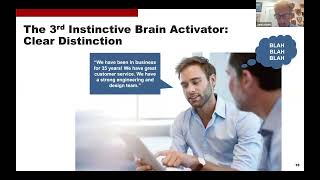
Activator. The second is the data behind the science behind the KISS principle. So when the sales guy says something like this, we've got this flexible, scalable, integrated solution with all these waypoints very confusing for a, for a buyer. So the practical application is simplifying everything. Your videos make them shorter than you think you should. Your elevator pitches your unique selling proposition. Keep everything simple. Now the third activator is clear distinction. So management consultants have been beating up on CEOs for about 50 years about the need to be different.
An example would be this. This would be a bad example. We've been in business 35 years, great customer service, blah, blah, blah. And so it's a bad example. The buyer thinks is thinks three words and they're all the same word and the first word starts with blah. So if the buyer's rational brain's asleep, there's no chance that the instinctive brain is going to wake up. So this is not a good example of being different.
And most of us have heard this term unique selling proposition. And the way to think about its importance would be this. If your company and two other competitors have similar experience, quality, great prices, everything's good. And in the buyer's mind, all three companies are tied for first. Then I think we all know where the discussion goes. It goes right to the price and that is not where we want it to go.
On the other hand, if your product or service or company is clearly unique, the buyer's instinctive brain will make what it considers a quick risk free decision.
And the price is almost never mentioned. So then the practical application for your company is make sure you've got these strong USPs. Or we can say we're unique or we're the only company. And a USB doesn't have to be global. It could be in the, in the, in Birmingham, uk or it could be in a specific competition.
But this would be a Much better example. This is actually one of our USPs. So we're the only global sales training company where every trainer is a former CEO. So this accounts for a lot of, probably half the business we get for sales training is because of this. So a much better example because of the word only.
So then your message must be unique if you're going to wake up the buyer's instinctive brain. And the action item, of course, is develop these USPs.
Now, another way to be different is from the Simon Sinek training. He claims every company can describe what they do, how they do it, but very few companies can describe why they do what they do. And if you have a strong why that everybody in your company likes customers like the prospects, like you've got a great way to differentiate your company. An example would be in this company, I've got these two companies in this company, the sales training company. Our Y is making the complex simple for CEOs and sales managers. So we're kind of following our own, our own advice.
So now let's, we all, we don't want to just sit and get, we want to have some action items for ourselves. So I'm going to show you a list of a few potential action items that you could take away from what we just covered.
So research, Become a fanatical researcher now about the company and the prospect themselves. Always start your discussion, say after rapport building with the buyer's needs, not with how great your company is. Find out the buyer's personality style in advance and then use Sales Navigator with these new great AI upgrades to research the company, the buyer's background to find out the commonalities, the similarity behind you and the buyer. And of course, it'll help you also determine who all the other buyers are and then essentially simplify everything that you're doing and develop these USPs and a company Y. So these are potential action items you could take away from what we just covered about waking up the buyer's instinctive unconscious brain. Now let's take a look at the emotional brain. There's three ways to wake it up. First is the beginning and the end. And so if you have a pastor, a rabbi, a priest, and you ask them, you know, when you went to theological seminary, how did they train you to give a sermon? They all trained the same way. So take a biblical passage, bring it to life with emotion. Everybody in the church is on the edge of the pew listening. Then tell them what you told them. And that's when the 18 minutes of the boring stuff starts and we all kind of nod off and then at the end wake them up again, show how the place to their daily lives. So one example of the importance of the beginning and again back to the homo sapien meeting a homo sapien looks safe.
The second is vivid images. So the brain store as we go through life, we take pictures, our brain does, we store them and then as we see new pictures, we use them for pattern matching to make decisions. And actually words have little influence on our emotional brain. It's all about pictures and videos. And it's the reason videos should always be as self explanatory as possible. And as you probably know, in many of the social media sites the default position is the video.
Is off. You need to actually turn on the words if you want them.
Now the big example of course is movies and videos of movies for a video. So when we're watching a movie, our rational brain knows it's just Hollywood, a made up story or an adaptation. But we also know if you're going to the movie and you don't get engaged right away, you're going to leave the movie.
And then once the our emotional brain actually feels like we're in the damn movie. And if it's funny, a flood of hormones make us laugh, or if it's sad, the tear ducts are engaged to make us tear up. So then the practical application would be use pictures and videos everywhere on your website, in your proposals, in your presentations. An example would be.
If you have blogs. Words on your website just recognize in today's world, nobody's reading them, they're only watching your videos.
And the great websites now have what's called an explainer video. You go to the website, you can't figure out what's going on, it doesn't take long, we leave. But if you go to the website and right there on the homepage is somebody important like the CEO and you click on that arrow on their chest and they explain what the company does. Now we're kind of hooked.
Another part of this, the beginning and the end, is first impressions. And so here's the data from a huge study at ucla. And that is when make a first impression quickly. If we have a bad first impression, we don't change our mind much. And here's how we make a first impression of another person. How they look, 55%, how they sound, 38%, what they actually say, only 7%. So it means our appearance is really the most important part of this. And it isn't fair. It shouldn't be this way, but just recognize that's the way it is. Recognize how important our appearance is. And this would be a fairly good example. You might have a good impression of a woman who looks like this. And maybe if she looked like this, it wouldn't be a very good first impression. So again, it isn't fair. It shouldn't be this way, but that's the way it is. Just recognize it and take advantage of it.
The second emotional brain activator is again, all about videos. Here is a video on our website of a Cassie Harland interview for three of us. And if you were on our website watching this, what we would like you to do is watch other videos on our website. We don't want you going to other websites. And if you have a, if your videos are on YouTube and you're on YouTube watching a video, well, then you can go watch whatever else you want. And Google will suggest other things that you can watch. So you really want to have a video portal so that people will stay on your, on your website. And, you know, my, my education, I'm a physicist by training. I'm an engineer. But I, I couldn't do real work. I didn't like real work. So I have lots of friends here in D.C. will say, you know, if you can't do real work, get into sales. So that's why, that's why I've been a sales guy for all these years. But I still remember physics and optics. The comprehension rate of our brains for video is 2000 times faster than reading words. So again, just recognize in today's world, nobody's reading anything on your website anymore. They're only looking at your videos.
Now, the third emotional brain activator is emotional. Emotional engagement is a customer story. And most of us have heard that the best salespeople are the best storytellers. Actually, the best CEOs and executives are the best storytellers. And once you know how to tell a story and Harvard University showed us exactly how to do it, then the buyer's emotional brain starts to feel like they're, they're actually in the story. At the end of your story, their emotional brain is going, wow, I wonder how I could also get these same results.
And so then the practical application is the great salespeople and executives are the great storytellers. And any company should have at least 10 great customer stories that all the salespeople can use.
And then here is the architecture of a great story from Harvard. So back to first impressions. Start with the buyer's need Any emotions they expressed relate the story directly to the buyer. So if it's a manufacturer you're selling to, then the story should be about another manufacturer. Include details on how you actually help them, include the benefit the company got the roi and then finish with the buyer's emotional positive emotions. An example would be the CEO was thrilled with the results. So when you're going to tell a story, use this architecture.
And then finally, let's combine the second and third emotional brain activators. When you go to a website now and you see that explainer video by the CEO, and then on the same screen right below it are three videos of customers telling a story about how your company helped them. Now you got the buyer hooked up.
So now let's see if there's any action items here for us based on the way to wake up the buyer's emotional unconscious brain.
They use pictures and videos everywhere. Get that explainer video going.
Develop ten great customer stories. And of course use the stories when you're influencing buyers.
And use that great architecture that developed by Harvard to tell these stories.
And then of course, as appropriate, put them on your homepage as well.
I'm going to cover one other thing quickly and show you how you can get all the rest of it there. Neuroscientists now have identified. I know it sounds like a lot of 184 cognitive biases and they're in this wheel. I know you can't see it, so I've got a slice of the wheel here so you can see it. This is what it looks like. So we're a group of engineers. We've analyzed all 184 over five years and we've come down with these 45 that directly apply to both sales and marketing. And nine of them really stand out as ultra important for salespeople. And that is these nine.
And I'm going to show you one how it works. And then I'll be, I'll. I'll show you a way to get the information on all the rest of them.
And that's the similarity bias. Now, a little background. At the Naval Academy, I took a course, an elective course called the History of War. And There were only two big ideas. One was in the 3,000 years of recorded history, there's only been 27 years when there was no war. I look at today, we got the Ukraine war, we got the Hamas war, we got civil wars in Yemen, South Sudan and Ethiopia. This was 99% of all these wars over all these decades and centuries were caused by One of three things, one religion against another. And you may if you've studied history. The Pope a thousand years ago commissioned six crusades against the against the Muslims in the exact same spot where the Palestinians are. Back then they were called the Philistines and by the way, they weren't successful. Second, one ethnic background against another. In China it's the Huns and the Uyghurs. In India it's the Muslims and the Hindus. And three, a battle over resources which explains the Russia Ukraine war. Russia wants that eastern industrial heartland of Ukraine to imagine in the history of the world two of the three reasons for wars are based on the similarity bias. It is one of the very strongest biases and again it's we like people who are similar to us because they look safe and we're more likely to buy from them. Salespeople who are look safe to us in all aspects. And then the practical application is again find similarities based on using sales Navigator lead IQ and Crystal knows. So now we know their personality style, we know their backgrounds. When we chat them up.
It'S essentially we'll say to their emotional brain this person is safe.
And of course in many companies I'll give you our example, there's seven of us that are partners. We're all former CEOs and we take leads from larger companies in turn. And so I'm a communicator personality, big picture, people oriented. If the next prospect is a thinker personality that is detail oriented and task oriented no, it's totally the opposite for me. We will not give that to me. We'll skip me and give it to a partner who is the same personality style. So you'll see elite sales managers doing the same the same thing.
And then number third way to use a similarity bias is using NLP techniques neuro linguistic programming and we've all heard that term that describes it mirroring. So just one example of the nine biases super important for salespeople today. And if you would like the rest of them, email one of our senior consultants, Kim and she will send you a slide deck of the other cognitive biases that are super important for for salespeople. And with that Gerhard, we can open up to Q and A if we have time.
Yeah, we are running out of time but I want to say thank you because your framework gives gave our attendees a new lens for reading the bias emotional state for shaping conversations more intentionally and increasing win rates. But here's the thing. Sales becomes easier and far more effective when we align what we say with how the brain actually works and listens. So I can't thank you enough for.
Opening our eyes to neuroscience and apply it to sales.
So.
You nailed it. I look at the the comments from the audience, and I want to ask the audience, join me in thanking John Asher for sharing his expertise in elevating the profession of selling. Thank you, John.
Thank you all. Great to be with you.
More from Gerhard



What Selling Looks Like When Your AI Agents Have the Context Your Sellers Do

Better Conversations, Smarter Support: Wearable AI in Business






When Scarcity-Built Systems Meet Abundance - The Judgment Gap in AI-Powered Sales Leadership
