The New Frontier of B2B Sales: Rewiring the Sales Engine with AI
In this presentation, Jay, a McKinsey consultant, shares field learnings on applying AI to commercial B2B sales. He begins by defining an "efficient frontier" for sales – a hypothetical ideal where reps have perfect opportunity targeting, hyper‑personalized outreach, and data‑driven pricing. He then outlines the common pain points that keep most organizations far from that frontier: data silos, low‑quality leads, limited customer insight, manual proposal creation, and pricing governance challenges. Jay quantifies AI’s impact, citing 5‑10% top‑line growth and 25‑30% productivity gains when AI frees reps from administrative chores. He identifies three adoption archetypes – Taker (plug‑and‑play tools), Shaper (buy‑and‑customize platforms), and Maker (fully custom‑built agents) – and explains how firms can recognize their current style. The core of the talk is the RE:WIRE framework, which stresses a holistic, domain‑focused, value‑driven AI transformation across five dimensions: use‑case roadmap, talent, operating model, technology & data, and change/governance. Jay illustrates concrete workflow re‑imaginations such as AI‑driven account intelligence, autonomous outreach agents, seller copilots for meeting prep, and dynamic deal‑scoring pricing tools. He stresses the need for new talent (prompt engineers, data scientists, system designers), revised operating models that embed human‑in‑the‑loop governance, robust data pipelines, and scalable tech orchestration. Finally, he offers five takeaways: go beyond productivity to growth, adopt a holistic mindset, redesign operating models, continuously tune agents, and treat AI agents as co‑workers with performance management. The session ends with a brief Q&A on adoption archetypes and a reminder to explore McKinsey’s research library.
Chapters
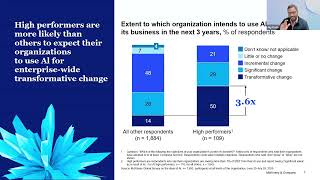
Thanks for the intro and pleasure being on this call. Thanks for having me. Really looking forward to sharing some of the learnings we are seeing from the field and more importantly, a topic I'm very passionate about, especially with AI. Every conversation in the room is about like, hey, how does this apply to commercial domain? What does it do to our existing sales operating models, go-to-market motions? A lot of questions, a lot of learnings over the last year and a half from pretty much all enterprises of all sizes, all industries kind of experimenting with AI in this, in this commercial domain specifically. So happy to share our learnings and my personal learnings as well. With that, like, let me just set a little bit of context of what I mean by rewiring the sales engine, especially with AI, right? Before we even jump into AI, sales hasn't necessarily changed as a business function to the extent we think it is, right? Imagine if we think about like what is that ideal world of a sales motion? Imagine a world where a sales rep or a sales team could reach out to the right opportunities You know exactly who your customers are, where should you prioritize and spend time. You have the right systems in place, you have the right operating model, the right territory structures, and the right efficiencies in design of your go-to-market motions. And you are able to pitch the offer with the right people, with the hyper-personalization required. You really understand, your customer needs and you tailored your conversations to address those needs of your customer, right? And imagine a world where you can actually offer pricing which balances your margins with the willingness to pay of your customers. And you're able to do that every single time with every single one of your customers, irrespective of your sales rep. As an organization, you're able to drive that consistency. It's a great place to be, right? Like if you think about it, that is what we are referring to as this efficient frontier of sales. But if you take a step back and like look and reflect how most organizations are, where they are today, they're obviously far from it. And it's easier said than done. And this takes a lot of coordination and reimagining And we also striking that balance of art and science that is very, you know, specific to sales as an organization, right? And especially in B2B, we are talking about a lot of data, a lot of silos in data, tons of workflows, processes that organizations have. The larger the organization, the more, you know, the bureaucracy or the operational complexity that comes in. And then obviously there are productivity gaps with all these coordination. Every time there's a handoff, there's some loss in productivity leakage and things of that nature. So if you put that in perspective to what I just discussed as that efficient frontier of like what would that North Star be, right? And what are some limiting factors for organizations? So for reaching out to the right opportunities, there's a lack of clarity on which ones to focus on, right? Like there's often, tons of leads and opportunities that sellers have ability to engage on. But how do I optimize my time? That's extremely critical, and most organizations suffer from it, right? The quality of the leads from your marketing activities sometimes is not of high quality. So you're kind of like, oh, I don't have this information. Who do I contact? I know the name, but like, I don't have the right email or the phone number. Or you have 10 of those with not good quality, right? In terms of the outreach, you don't have enough information about your customers even if you wanted to reach out to them. So how do you drive that market visibility in terms of insights? What are my strategic conversations to be had to win a deal, right? So those are some very tactical challenges we see organizations face. Again, I want to caveat this, right? These are pain points that existed for a long time, and it's not going to be very specific to how organizations are approaching today. These are still very important to be addressed. And I talk a little bit about how and where AI is coming into picture and where organizations are seeing success in, in doing this, right? And making sure like the efficiency of, of information flow across your marketing and sales and making sure you, you meet your customers where they expect you to in terms of the channel engagement and having the right go-to-market structure. And you have a unified way of communicating and engaging with your customers when you actually do that outreach. I talked about the importance of having the right pitch, the personalization aspect, and often not just the data challenges that offers even more difficulty in like really personalizing that content. But what we see a lot is when you're trying to put together content, like there's a lot of like lift and shift, or I have this copy-paste proposal. And in that process, the personalization and the specific nuances you need to engage with that customer significantly reduce, right? So that often continues to be a pain point. It ends up being that very labor-intensive process. Price especially is so important, right? You, you have on one side sellers willing to offer deep discounts. If you put that in perspective of the margins, yes, you're hitting your quota, but it's not really driving the top line. So how do you make sure you have the right discounting strategy that is scientifically and data-driven? And more importantly, How do you have the governance process in place where you not only predict what your customers want, but at the same time meet them in the middle with the right price? And keep in mind, you have one chance with the competition for most organizations to get it right. So it's very important to have that capability and muscle as a sales organization. And I do want to emphasize the ability of doing this single time, every single time. This is where the enablement and the tech and the AI aspect really shines, right? You always have top performers and sellers who, who have their own ways and their own Excel sheets, which help them do all of the things that I talked about really well. But really being able to scale this and multiply the, the impact across your sales organization is extremely critical, right? Being able to have the right data, dashboards, insights, and everybody being able to perform this at the same task and same level. With that as backdrop, right, I wanna like talk a little bit about what is the impact, right? Why do we even talk about AI and the impact? Clearly, I think there's very tangible impact to be had, right? Especially from the growth perspective, we are already seeing organizations who are doing this well Hitting the 5% to 10%, you know, top line growth depending on the size of the organization. Productivity has become table stakes with 25%, 30%. I see a lot of clients really achieving that by layering in AI and things of that nature. And more importantly, there is also an element of customer success, right? AI and tech also helps you give an offer, that experience that your customers are looking for, which is very critical, especially if you're in a very tight and competitive market. With that in mind, we did some benchmarking around like how much of value are people actually getting specifically from AI, especially in the B2B, and this example is from the tech industry specifically. And then we see across that sales motion, which are the different shades of blue you're seeing here, there is a significant amount of time an account executive spends on a day, right? Be it about like the top of the funnel prospecting, qualification activities, redoing those cold calls, outreach, making sure they're moving forward, the deals qualifying them. And as deals progress, there's a tremendous amount of like manual work of putting together quotes, proposals, and then going through the rest of the backend or back office processes to close out deals, start onboarding, things of that nature. We're clearly seeing a significant productivity benefit here, which is roughly 30%, which is freeing up time the account executives would have otherwise not have, like were busy with all the chores and the administrative burden that they had. But what is most important that we are seeing is organizations who are taking that 30% and converting it into some real value-driving activities are the real winners, right? So that I do wanna emphasize. The ability of AI to really drive that productivity benefit is table stakes, but then how do you take that time that AEs are gaining back and really using it to drive more deeper human relationships with the right set of folks and be able to like research and learn more about each of your customers at a very deeper level, right? So I do wanna talk about like 3 patterns we are seeing a lot, right? Which it has been codified into how we are approaching some of these large commercial transformations especially from AI and tech enablement point of view, right? The first pattern we are seeing is organizations who are focused purely on, hey, I need to drive productivity. It's great. Like most organizations are already doing that, right? So as you can see, organizations who are performing versus the leaders, they pretty much have the same ambition in terms of driving productivity. However, the real difference is organizations who are doing this really well and also seeing that value are the ones who are also focusing on growth and innovation. But obviously for this conversation, I'm going to focus more on the growth elements of this. The second element that is really coming to life is the mindset of organizations and the ambition they're setting for themselves. Right? And this is— we've been talking about this for about like 6, 7 months at this point. There was this whole MIT Fortune article that came out around like 1% pilot purgatory where pilots are not really scaling and not really translating to real value, right? So on the left-hand side, we are seeing a lot of that in the form of like the mindset and the ambition organizations are setting for themselves. Which is to layer in AI to see how it can drive some of that productivity gain. But organizations who are thinking about this as an opportunity for driving that enterprise-wide change, but with a transformative mindset, are really the ones who are performing and outperforming in this case. So that's the second nuance, which I think is a key data point that we are seeing. And then the third one is another interesting one, which is not just like looking at your ambition and focusing on growth, but also how are you approaching it when you are actually doing the transformation and going through that process? And especially the ability to rethink, right? AI especially has this transformative impact It's a great opportunity for organization to really take a step back and think, how would I do this differently? With the autonomous capabilities of agent AI, you have tremendous amount of generative capabilities in terms of the content creation and the logic and the ability to drive and synthesize information. You also have predictive capabilities that have existed for a long time, right? And then I talked a little bit about that AI symphony where you really have to make sure you think about all these different layers of AI brought to life at the same time. So if you were to put that in perspective, organizations who are taking a step back and reimagining, like forcing them to think, I have a lead outreach process, how do I do that differently? What should an agent do? What should a human do? And how would that change and influence my operating models? Really going to that level of the task and the process and the workflow level and reimagining it in the world of AI is extremely important. And 3x is a significant change in terms of the difference that high performers who are taking this approach versus others, right? So these three, I would say, are the fundamental learnings that are feeding into how we are approaching these large commercial transformations. We have a framework that I'm sure pretty much most of you have seen it somewhere on the internet or have read if you followed McKinsey. We call that framework RE:WIRE framework, right? Which is basically A transformation, AI-centric transformation cannot be just a single tool implemented for a specific use case, right? So being able to take a holistic view of how does this transformation really come to life where it has some top-line impact has a few elements and dimensions that have to be accounted for, right? And to start with, Every use case, every transformation has to be obviously user-backed and more importantly, value and impact-driven, right? So you want to have a clear roadmap of where are you actually going to see value from and which of those specific domains within your organization are going to see and help you realize that value. So having that roadmap is extremely important and obviously you want to trace, track it back to and align your roadmap to what is feasible today with AI, right? A lot of that is feasible, but AI is also constantly evolving, innovative. There are so many innovations coming every day. So you want to account for what's feasible today versus what you want to achieve in 6 months from now, right? And then take a little bit of what we call as a domain-based approach, right? Pick a domain that gives you the biggest opportunity. And don't piecemeal it across your domains. Then you're sprinkling your investments too little, too less across all your business functions where you're not really going to see the needle move with any of those, right? So you've done AI for the sake of AI at that point and you're not really going backwards towards driving impact. So our approach here is about picking one domain and really reimagining how does that change going forward in the agent era, right? And I'll talk a little bit with a few examples specifically, but what we are seeing, and then I also shared the data previously around taking that approach of like where and how and fully reimagining. But a lot of organizations are missing the second, the other two layers here that we are looking at. The fundamentally, there is a need for new talent, right? There are different skills that are evolving. How do you improve and tune the agents that you're building to layer in the business context to build the knowledge agents are going to need? And more importantly, how do you prompt? So we are all learning and making sure you have the right talent. Also from the technical standpoint, you have talent from systems design and application engineering point of view. You have talent from data scientists who have built these predictive models. But really this cross-functional ability to build these agents is extremely important, right? So really able to think about that from the talent needs is equally important. Operating model is an interesting one. I feel this is by far like what I'm seeing as the most, most of it as an afterthought for many organizations. Trying to fit in your existing organization structure within like how agents and humans are going to coexist and work is not the most effective way. So it doesn't really mean reduction in force or I think what we are still talking about AI as an assistive capability on top. You very much need these roles which are going to, who are going to govern and make sure agent is within the realm of of possibilities here. And that's why shaping an operating model to shift your roles and align your skill sets to co-work with agents is extremely important as well. And I don't have to emphasize too much on the tech and data. I think we've talked enough about the need for orchestrations. Organizations are struggling scaling one agent towards multiple agents. There's a whole lot of reference architectures. So that goes, becomes like foundational in terms of making sure you have the right technology and tooling required to actually scale your architecture in terms of enabling the agent vision that we are talking about. Data is obviously gonna be the fuel for everything. I do wanna emphasize one thing about data, right? A lot of organizations I speak to sometimes think they're not ready for embracing this roadmap or, are embarking on this journey mainly because they don't have data. And the reality here is very few organizations have data that's like really clean and everything is ready to go. As you evolve on this journey, data is gonna evolve. It is absolutely important to work and invest and make sure your data is clean, but it's not gonna happen overnight. Still tremendous amount of data that you already have that still works, that is complete, that can be used as you are cleaning up your data. So it's not a binary, I see them as parallel paths here that most organizations should take. All of this is coming with tremendous amount of change. So change management and how are you actually building the capability and governance of agents and impact tracking All very critical elements. So if I take a step back, I've talked a lot about like the overall framework. Organizations who are thinking about like large transformations and doing it big, it's important to think about all these different blocks, right? If you were to think about only rewiring your domain and look at all the use cases and have a roadmap, you're not really thinking about setting you up for success at that scale. So I want to reemphasize the need for looking at all of these boxes and maturing along that journey across them, right? All of them you have as an organization in some form or fashion, but you want to make sure you are intentional about reimagining how each of these would work when, when you get there. So if I have to like take one more level deep, right? So very tactically, Once you have that vision of here is this commercial domain I'm looking to transform, you identify what are those workflows, right? We talked about the different business capabilities that exist. And workflows is an important nuance here because agentic AI has the ability to drive and do different tasks for you. So if you do have to think of it from the lens of workflows and not necessarily purely use cases. There are different elements of the workflow where the handoffs are happening between human and agents. And as you're reimagining your workflows, you're not just thinking about those nuances, but you're thinking about the specific tasks which is critical and right for agentifying and enabling them through the AI. Capabilities you're building over time. And, and once you have a laundry list of all your use cases that are critical to fully transform an end-to-end workflow, you want to like take a step back and think about the complexity of each of the use cases and prioritize them. And then more importantly, trace it back to which of these should I build first, which of these are practical, feasible, but importantly are going to really drive that value amongst the list of opportunities you have. I have a couple of examples again to hit it more from the commercial standpoint. If you're thinking about sales, let's pick like lead outreach and nurturing as a specific example. And as you kind of think about the outreach, you want to understand like how do you want to fully capture, web scrape, and really understand who are you reaching out to, what are they interested in, who are the key decision makers. So we're seeing a lot of those AI capabilities where part of the workflow is to really understand your customer better. And you would have an agent which does all of that account intelligence, the contact stakeholder profiling and mapping, doing that for you before you do the outreach. We are also seeing a lot of autonomous outreach. So you would want to at that point build an agent which is doing that outreach. But is that really a fit for all types of organizations? If you have, let's say, key account management or more strategic accounts, you have very deep relationships. You have an agent sending even personalized information is probably not gonna cut it, right? So you wanna have some element of assisted outreach capability, which is still going through a rep, but agent is doing all the homework to prepare that notes or even an email draft for them. So there are, and that's what I mean by reimagining your workflow, putting them in context of what is relevant for your organization and how would you reimagine it in this new world, right? Same thing in terms of like going further down, like you can create Once let's say you've done an outreach, you wanna set up a meeting, you have like all these other things you have to do as a rep that the AI can assist, and each of those tasks have to be reimagined as well, right? So just putting this back to the original context of what does that efficient frontier look like, right? It looks like how do you reach out to the right opportunities? We are seeing a lot of AI capabilities which are enriching who you reach out to. That way your effectiveness of your reach out and your response rates significantly improve. We are looking at a zoomed-out version of market opportunity maps, right? If I'm a sales rep, I have a territory assigned, I have specific opportunity that I'm mapping on a territory, I have quota planning. How am I looking at AI to predict what kind of areas are most impactful for me to go after? Prioritization, like I said, that part of the AI has existed for many years. Many organizations are actually mastering that at this point and really feeding in that prioritization. But at the same time, as you're capturing new signals, new selling signals, buying triggers, how are you layering that to further prioritize it dynamically? Being able to do all kinds of web scraping, third-party data sources to really understand the intelligence of the account. So very critical for doing that top of the funnel. We are seeing a lot of AI capability to automate this, right? The second one around being able to do this more efficiently, we are seeing Seller Copilots being used for synthesizing, summarizing information, for preparing for meetings with the right pitch. Like I said, a lot of those personalized across their previous history, their, interaction on your website, all of that really driving towards like how much you can personalize. But at the same time, spending time to like tone and personality, that way your ability to engage and meet your customers through your own brand, your own values is still extremely important, right? Talked about pricing, especially in terms of We're seeing a lot of like dynamic deal scoring to help sellers to think about, is this the right price? Should I be offering this discount? What are the guardrails? Even we're seeing a lot of cases of competitive pricing insights and how much of flexibility do we have as part of that negotiation, all AI-assisted in this case, right? Obviously there's a ton of other use cases. It's not exhaustive list. But I want to leave behind a few specific elements or use cases and ideas here, especially in the context of the 5 pillars that we talked about. And I think I kind of touched upon all of this, but especially each of these boxes you see underlying are the agents, are the AI capabilities that you are procuring and making sure all of them work in tandem across this sales journey. And if you see, there is the opportunity identification, a human rep is, or account executive is fully involved. The outreach is being done by the agent here. There are auto-generated emails, materials that the agent is creating and assisting the rep for follow-up conversations, for further fine-tuning the pitch, for practicing and coaching elements. And then there is data-driven pricing, where AI is constantly pushing those insights to make sure you are offering the right information, right? There's a lot of other use cases, and in the interest of time, I do want to leave behind 5 key takeaways for you all to take away, right? Don't just stop with productivity. I think productivity is gonna become table stakes at some point. Look at how you can use AI to drive growth for your organization. We are seeing a lot of significant difference in the value capture when you have that mindset. Second, don't think of like layering in AI, buying a few tools and offering it to your sellers to just drive that. Again, goes back to a little bit of productivity, but it's focused more on the mindset and making sure your organization, your approaches to really rethink and how it will work. The third point I want to again emphasize is around your operating models, right? You've gotta think about where do you need your sellers to fully offer that oversight required for agents, even if agents can fully do autonomously. Do you have governance dashboards? Who are going to like, who's, who from your commercial organization is gonna be constantly reviewing it if it's about a specific account? How do you keep your rep or AM fully in the loop around what agent is doing? And that's the human-in-the-loop element that is often underscored here. And the other important point to also keep in mind is from the tech perspective, there's no real plug and play, right? The effectiveness of the agent is centered around how you tune and train them. So it's important how you think about it. And then lastly, think of agents as your coworkers and how you would do performance management the same way. I think you should think of AI and sellers to coexist, and performance management metrics and capabilities should be adjusted to account for that as well. Jay, there's all kinds of comments about very precise and great structured presentation. And I personally love it that you put in there, take time, given that everything you're talking about is the fact that there is no need for time anymore if you just look at the information. But, but of course, taking the time to tune, optimize, and then ensure that it's anchoring into the commercial success of the organization is so important. There was one question. Gary Gilchrist, thank you so much. What percentage of companies actually approach AI adoption in the way that you're suggesting? We don't have necessarily data for me to share, but especially for the organizations we are working with, they are starting to see the value in thinking about like this holistically. Obviously, the answer to this also depends on the industry, the size of the organization, especially for the more mid-market and enterprise. I think there's a clear shift from layering in AI versus being very intentional about how do I go and capture value and think about it more holistically because it's here to stay. And that's, that's like the new paradigm for most organizations.
Jay, I want some clarity about McKinsey's research on AI for sales. And you have so many interesting papers on your website and I've been trying to learn about the 3 implementation archetypes, the taker, the shaper, and the maker. Can you give us a little bit more background on that? How did you come up with those interesting terms? And how can sales leaders identify which adoption style they have embraced now and how can they get to the next level?
Yeah, great question, Gerard. I think the idea behind taker, shaper, maker is pretty much synonymous with like the build versus buy and everything in between, right? If you think about what do organizations have at offering in terms of procuring AI capabilities is you have off-the-shelf tools that are easy to quickly implement, plug and play. An example of that is like commodity commoditized capabilities like ChatGPT of the world. Like you have your Copilots, you have your email draft tools out there, right? Pretty commoditized. It's easy to plug and play. There are obviously tons of other commercial-specific tools for doing outreach, for scoring and and coaching, sales coaching, and so on and so forth, right, across, let's say, commercial workflows. And then on the other end, you have very advanced AI, agent-to-KI platforms and capabilities like the Langchains of the world, where you have the ability to really build and push the envelope with what AI can do today. And in between, you have platforms like Salesforce Agentforce and ServiceNow and others who give you all the different tools to build agents which increase your speed to market. And that's basically the shaper element there where you buy, procure, but at the same time you buy and build to make things work for you. So it's a great balance between what you can do, push the envelope from like just out-of-the-box capabilities, but at the same time tailor them to your needs. A bit more, right? And then there's the whole nuance around how does this fit into with my existing architecture, the integrations, the complexity to actually make this real. So we do see organizations starting a lot on the left. They do continue to stay there with buying capabilities, but we are seeing that becoming like the more you go and stay in that territory, especially for enterprise clients or customers, we're seeing that as a new challenge to address. Now you have this vendor proliferation, so to speak, where you now have to consolidate and go towards like a platform approach. So it becomes, it's an interesting challenge that most organizations are going through. And our perspective is there's no one answer to this. Depending on your situation, depending on the use cases, you will have to like identify an answer and often If you have some IP-related issues or concerns about like you have a very specific secret sauce, obviously Maker is the right way to go, which is fully custom building it. But if you have a platform you've committed to, you want to layer in and build in and feed in agent or AI capabilities, platforms like Agentforce, Shine, but then there's also other hundreds of other AI capabilities and tools out there. Hopefully that answers your question.
It really does. You did very well, Jay. It's very enlightening and illuminating. And I want to remind the audience that tomorrow at 10:40 AM, you will have the opportunity to meet a maker like what Jay described just now. Chris Koenen, he is the global head of human resources with MS International. They have over 1,000 salespeople and they designed their own CRM system. They designed their own platform. They designed their own AI tools. And I can't wait to hear that because you have opened my eyes, Jay, and I invite the audience to go to McKinsey Company's website. In search for all that wonderful research that's available for sales leaders when it comes to AI for sales, I think that McKinsey is one of the top leaders on the topic. And I cannot thank you enough, Jay, for taking the time and educating us, sharing your wisdom, and help us grow.
Always a pleasure. Thanks for having me, Gerard.
More from Gerhard



What Selling Looks Like When Your AI Agents Have the Context Your Sellers Do

Better Conversations, Smarter Support: Wearable AI in Business






When Scarcity-Built Systems Meet Abundance - The Judgment Gap in AI-Powered Sales Leadership
