The Powerful Impact of AI on Sales Coaching
Presentation by Spencer and Jennifer Banman (Brooks Group) about using AI to strengthen sales coaching. They argue AI can scale managers’ coaching capacity, provide real-time feedback through practice modules (monologues and avatar dialogues), and improve consistency and cadence of high-quality coaching across the sales process (Impact). Practical considerations and adoption guidance are offered.
Questions this video answers
About 40 years.
7% better performance against target.
28% higher win rates.
68%.
About a 5,000-word document.
Chapters
Hey, we are super excited to be here and we appreciate everyone who has joined this virtual session and agreed to spend some time with us. We've got some exciting ideas to present to you. We're going to take some questions, hopefully have some dialogue as part of this 30 minutes as well. So if you do have questions, if you do have comments, please put those in the chat. We've got some people monitoring those and we'll try to set some time aside at the end of this session to take them. So we want to talk about AI today. Huge topic, dynamic topic, powerful topic. It's a constantly changing topic. I think it's interesting is reading the McKinsey article that came out recently titled the Unconstrained Future as it talks about gen I in B2B sales. Now, we would all hope and wish and love for a future to be totally unconstrained. We'll see where that goes. But it's amazing the new ideas and just the momentum by which we're watching AI change our industry of B2B sales. Now, Jennifer and I don't want to boil the ocean of all of that today. We do want to just talk about something very specific, very targeted use case for AI that we found as we work with our clients and as we develop salespeople all over the world in various markets in different kinds of sales models, a way in which we are using AI. They're using AI to strengthen the impact or the power of sales coaching. So just as a quick introduction to the Brooks Group, we are a sales training and transformation organization. We've been around for about 40 years. You may some of you remember Bill Brooks, our founder who set our philosophy for selling in motion. And over those 40 years we've been able to interact with, develop and transform sales organizations touching millions of individual salespeople. So we're excited to talk about some of the new technologies that we're finding supporting sales coaching and the development of salespeople by their managers. So let's talk about coaching really quickly. It's a thing we've been talking about for many years. I personally have been studying coaching for about 20 years and I don't think this comes as a surprise to anybody on this call the power of effective sales coaching. We know that a formal sales coaching procedure drives better 7% better performance against target for sellers. We know that companies with dynamic coaching programs achieve 28% higher win rates. We know that 68% of sales teams report receiving of successful engaged sales teams report receiving regular high quality coaching from their sales managers. That's almost 7 in 10 of these engaged sales teams connect that very directly to high quality coaching from their managers. I think we all know the statistics, we know the power of coaching. But I want to highlight some of the nuances that we see here because I think they're very important as we think about how AI can support this process, formal coaching procedure necessary for driving that benefit of performance against target. Do we have processes, actions, accountability in our coaching infrastructure such that we know that activity is happening and that we can measure it? Companies with dynamic coaching programs what's interesting about this definition of dynamic coaching programs is they're coaching that can flex to support various needs. Not just that very tactical support of a particular opportunity, but but long term skill development support for individual sellers, lifting them, transforming them out of one mode of behavior or capability into a next mode of behavior or capability. So our coaching needs to be a formal program, needs to be a dynamic program. And the coaching that we're providing needs to be regular and of high quality. And that's a very high bar. Oftentimes I think organizations will have a motivation around coaching at a particular period of time, maybe because they feel they need it, maybe because it becomes the thing of the month, day, quarter year that they're focused on. But we have to sustain that activity at a high quality in a regular cadence over time. And that's not an easy thing to do in any organization for any group of human beings. We're going to talk about ways in which technology and AI in particular can support us in doing that.
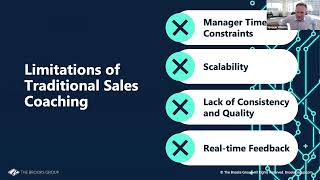
So we know coaching is important. We know it drives better performance results in the organization. We also know it's dynamic and it needs to flex. There's different coaching elements that are out there as part of our ecosystem. But let's talk about four types of coaching conversations that take place. We've got our pipeline reviews and our opportunity coaching there on the left hand side of this slide. On the right hand side we have skills, performance coaching observations and field rides that managers are doing. And you'll notice that very thin line that divides the two. And we did that in purpose on this slide because we want to highlight something that's very important to consider. The coaching motions on the left hand side, the pipeline reviews and the opportunity coaching. These are the things we're driven naturally to do. These are the things we tend to be able to find the time to do in our organization. And why is that? Well, because they're important, right? They're driving the urgent need to generate pipeline to close opportunities to drive the revenue engine in the business. We're compelled or we're pushed as managers to focus on those elements of coaching. And I know throughout today and tomorrow you'll hear a lot of feedback and ideas around how AI, how Genai technology, co pilots, teammates, whatever you want to call them, supporting the activity around pipeline reviews and opportunity coaching. And a lot of that was talked about at Dreamforce more recently in some incredibly compelling presentations. There's a lot of great technologies to support there. The question is how then do we find the time, have the effort and the focus to do what's on the right hand side, which may not be as urgent, but is equally important in developing our salespeople. It's developing those skills over time, having the capacity to really observe what's going on with our sellers in the market. So what are some of these constraints that are holding us back from doing that coaching activity there on the right hand side when we're so busy as well, focusing on the left hand side? Well, we've just got time constraints. Managers, if you think about what they're doing on the left hand side, let's say I'm a manager of eight individuals. Each of them has a target of 2 million. Their average deal size is 50,000 and they have to have a 3x pipeline coverage of opportunities that they're working on in a given year. That's almost 1,000 opportunities that that manager needs to think about touching or engaging in in some way. Clearly AI is needed to support that, but you can see the capacity load just on the left hand side of those coaching activities, to say nothing of the right hand side. So there is a real constraint on managers time to focus on developing skills of their team. How do they scale that activity such that it is spread across the team that they are giving each of their team members some equal beneficial portion of their focus, of their activity, of their quality. There's a lack of consistency and quality in the feedback that we give. We're human beings, Maybe we don't notice everything, maybe we have a bad day, maybe we make a decision to hold back when we shouldn't in providing that feedback. But as we look at coaching and as we study it and we get that feedback from individual sellers, we know lack of consistency and quality is a big issue. Then how do we give that feedback in real time? We're not there on every call, we're not there to run and manage and view every role play. But if we don't give that feedback quickly, if we don't make it in the Moment is it really attached to the development need that that individual seller has? We've got to think about in each of these areas, freeing up time, scaling our activity and our support across our team, giving consistent quality to each of our sellers and giving that feedback in a real time area. We need technology, we need tools like AI to support us in, in doing that. I want to introduce now my colleague Jennifer Banman who runs our product development and innovation here at the Brooks Group. Bring her in to talk more specifically and tactically about what we are thinking about and supporting in our clients, using technology to manage all of these limitations.
Great, thank you Spencer. It's wonderful to be with you all today. And Spencer and I talk a lot about coaching and how important it is just echoing what he has said, especially in that real time feedback. So we've been using and really digging into what AI powered coaching actually looks like. We have found an enormous level of benefits for them. We are looking at this unlimited practice. We have it set up so the seller could go in and practice. Even if it's, you know, nine o' clock the night before a presentation that they have, they can go in and practice, they can run their story that they want to try to connect the value to the recommendation. They have real time feedback that they actually get from the AI that we have prompted behind the scenes and we'll show you that in a few minutes. And it often gives them an opportunity to in their practice, it's risk free because they're not actually in the moment with the client and with the prospect. They're practicing, they're working through it and then they can talk through it and if there's any part of it that they're struggling with, they could engage the conversation with their manager. The benefits of the manager is, as Spencer was saying, it allows to scale coaching ability and the manager can see the feedback and continue to produce accountability and expectations and achieve the consistency that is really important in this high quality interaction. I know over the years I've been on calls with sellers who when they practice and they are ready to go, they feel stronger and confident and they have this opportunity to work through the things that matter and the connection points that they want to make about the client and about the prospect to what it is that they're selling. These benefits are, you know, really important and really actually help elevate the conversation. But between the humans, the sales manager and the seller in the back end part of the coaching.
Yeah, I appreciate it Jennifer. And so what's interesting is we know using AI we can drive a tremendous amount of benefit both to the individual seller and to the manager. We can reduce a lot of those limitations and constraints that are on the manager's activity. But we have to choose wisely the areas in which we focus on the support of AI in practice and in coaching, in role playing, all of those elements to prepare for sales interactions. What I want to do here is I want to look at a sales process mapping out a framework for selling clearly aligned to a buying journey that that buying group might go through. But think about very particular moments where it's important for us to practice to strengthen skill today and how AI can support us in doing that. So there is a process we use at the Brooks Group called Impact. It was designed, developed originally by Bill Brooks, our founder. And it's a, it's an elegant way for us to just think about or contextualize the various elements that the activities, the focus points that sellers would have as they're engaging with a buyer in that buying journey. But let's talk about very specific ways in which AI can support a targeted practice or a targeted coaching moment as we go through that sales process. So it starts with investigating, it starts with that prospecting, that presentation to the market, that pre call planning. And really a key thing for us to be practicing in that moment is our ability to deliver an effective value statement. That can be done in monologue by a seller recording the way they would present that initial pitch and allowing AI to provide its perspective or its feedback on there that the manager and the individual seller can look at together. When we get to meeting, having that initial engagement with the client, are we engaging those clients? Have we put together a strategy to think critically about the behavioral style, the communication style of that client and our behavior and communication style such that we know how to approach in neutral and flex appropriately. Checking an individual seller's thinking and strategy around this is a critically important activity and that can be evaluated, measured and coached around using AI to record your strategy for engaging in that meeting and having the AI provide feedback. Are there things you're missing? Are there things you're not considering when evaluating your communication style vis a vision, that buyer's communication style. As we do our probing, as we do our questioning and discovery, are we asking the right questions to dig deep? Where we're excited here is this can be done of course in monologue by outlining the various questions that you're going to ask. But it can also be done in dialogue, using an AI avatar to actually practice that conversation and get feedback on Are you asking the right questions? Are you asking the questions that the AI has been programmed to evaluate are good questions for digging deep to understand those emotional wants below the needs. It's very exciting technology that we're continuing to develop around measuring and giving feedback on appropriate questioning and discovery. And as we're applying that solution, as we're presenting that solution, are we connecting that solution effectively to a customer's needs and wants that can be very well presented by a salesperson in a practice module that AI can grade and evaluate as well as a manager can review that output and coach the seller on it. Then we get to things like convincing or resolving objections, making sure we're handling any concerns that that prospect may have in making a final decision. Again, here we can practice this in monologue, but we can also practice it in an AI driven avatar dialogue where we set up what are common objections in our business that we see. And individual sellers can practice in a recorded module. AI gives the feedback and they can review it together with the manager. Ultimately, in tying up or closing deals, are we asking for business appropriately? Are we including all of those little nuances or elements that make for a powerful request or a powerful ask at the end of this buying journey connected to a sales process? Again, it can be practiced in monologue, just presenting that ask or in dialogue with an avatar. But each of these are very particular moments. Coaching moments, Practice moments throughout a sales process that can be designed with the designed and customized such that individual sellers can practice, get real time, immediate feedback, and then have a very powerful coaching moment with their manager as they together evaluate that AI feedback. So what we wanted to do first was lay out for you the possible moments throughout a sales process that can be looked at here and now. Talk about very tactically how that's done using an AI module. So, Jennifer, I want to go back to you, I want you to tell us a story here around how we're using this with clients to help them do this practice and connecting the human coaching to the coaching that the AI provides.
Yeah, definitely. And as you were walking through the, you know, our process and our activities, having been somebody who has written training for years, I was thinking about that reaction we get from people that I call the roleplay. Yucks. Like I don't want to do that. And they do it and they enjoy it and they learn in the classroom. But you might have somebody who really struggles or you have a brand new seller, or you have someone who is seasoned and kind of fighting against that change. This is a great way. Again, to do it alone and practice to refine your skills and then find the feedback for it. So you might be that person in a training classroom who leans back and says, I'll just be the observer. And this gives you the opportunity to really dig in and get over that. The necessary role plays for the classroom, which are so critical, but then continue to carry it forward. The beauty of this AI setup is we really can describe it in the background and tell the AI. We want the emphasis to be on the customer.
We to want.
We want to look at key phrases and connection points. We want to say here. Richard, on our team, he did a practice for us. I actually asked him, try not to be perfect. Because as we were learning it and the AI asked him questions like, did I present a targeted solution? And a targeted proposal? So we were able to feed it some information and create an opportunity for him to learn and grow from it. I was actually in the office when he did it, and he came away just with this excitement. It took him all of five minutes. And he did a little bit of prep just to get his recommendation aligned. He got on the AI and he practiced it, and the energy that came out of him afterwards was just amazing. It made it. It got everybody else really excited about it. So it's been a lot of fun to see how this AI even, you know, with his score that I asked him not to aim for perfect. I wanted him to just be real and who he was, and asked him to speak a little fast, you know, and then a little slow a couple times, because it also looks at your tone and your pace and helps you realize, are you taking a break? Are you asking the right questions? Are you creating value for the customer? So it took out that human element, but then gave the human an excitement. Because it's like, I got an instant grade. I got an A on my paper. I got some great feedback and was able to go from there. So I think, to me, one of the best things about this AI coaching is the instant feedback, but the learning, the personal learning, the personal victory moments that you can have in your preparation.
I completely agree. And if I can just add something to that that we're finding very effective as we do this with clients, as we build these AIs.
You'Ve got the kind of, the infrastructure, the technology, intelligence to do it. But what we're trying to do is we're trying to pick very particular moments, first of all, to practice, and secondly, design the way that moment wants to be practiced or needs to be practiced in that particular instance. We design that, we train the AI around that. Then you've got a tool that's very fine tuned to support a very particular thing. And we find that's very helpful in driving that consistency of activity and process adherence that's needed in organizations today to perform right.
We work that right into our reinforcement learning path. So you go into the classroom and then your reinforcement learning path follows the impact process. And the highlights that Spencer just put forward forward is even the ask for the business. Sometimes getting to that place where I can just simply say, are you ready to sign? Are you ready to get started? Takes a lot and it creates nervousness in people. And so we definitely want to be able to give them the.
Positivity, the strength and the ability and the excitement about going forward and producing sales.
So what it's going to tell you is on the next slide is what you did well. So you can see here that it's going to actually give you some great prompts in it. It's going to tell you. Did you say the purpose of your call? Were you very clear? It's going to ask you. You mentioned this. It's going to give you output and everything in the bold is what we're feeding the AI behind it. And then it's giving you very clear feedback and it's telling you what you did well, where you can improve and.
What you can learn from that. One of the things that we've seen is a sales manager who takes the time to read what you can improve and read the feedback and see it. They can also offer feedback within the system and then go into a conversation. It teaches them and models for them how to give constructive, positive, balanced feedback. Because we all know we've been in those situations where in the moment sometimes the coaching can be like, well, you forgot to do this. And this is actually saying, okay, you did this really well. And then here's what you can improve upon. And it provides this feedback that is very clear, very thorough. This feedback on Richard Singh was two pages when we printed it. And I saw him, he went through and he highlighted things and he took from it and he grew from it. And he was also able to sit down with his manager. And the beauty of our system that we use is you can get feedback from your peers as well. So it's a whole picture of it. Finally, we've layered in, as Spencer was saying, in our meet step, we talked about approaching in neutral and understanding communication and behavior styles from others. And we've layered that into the AI. Am I approaching in neutral Can I tell the AI that I'm going to talk to a very high D person and I need to be brief and be bright and be gone? And so do I need to be very focused or am I talking to somebody who's really focused on data? And so the AI is going to provide me feedback and did I actually meet that and adapt to the customers and the prospect's behavior, style and communication style in that which is so critical to what we do and how we communicate.
I think this whole using AI to practice tailoring to communication and behavioral style is an incredibly exciting use case and just helping people to strategize, remember, recognize the way in which they communicate and the way in which they need to adapt their communication to match the communication styles of others. It has incredible promise for strengthening the capability of sellers to engage with buyers. And I get very excited about that being a part of this. Jennifer, thank you for walking through this story. As you can see, I think one of the things that's so exciting about this when you think about the manager, individual, seller dynamic, is the fact that what the AI can produce is that real time, immediate feedback that then makes it not a competition between manager and seller in the providing of feedback. But imagine instead two individuals standing next to each other with the feedback up on a wall like a piece of art and they're evaluating it and they're looking at it together. It's a much more collaborative, comfortable, effective conversation when it's framed that way, as opposed to my opinion about what happened versus your opinion about what happened. And that's what we're super excited about, connecting this AI feedback that gives us the scale, the specificity, the real time delivery of that feedback, coupled with a manager who knows how to have that collaborative development conversation with the individual. So in the interest of time, we've only got about five minutes here left. Just some of the key considerations when adopting or incorporating AI into your coaching feedback. You've got to customize the practice to key scenarios for your business as we talked about. Make sure those scenarios, whether they be monologue or dialogues, are relevant to the selling motion of your people. You can't set it and forget it. It's a thing that needs to be adapted and iterated to provide better, more consistent, more effective feedback for individuals and be a better tool, teammate.
Co pilot, whatever term you want to use for your managers as they go communicate a clear rollout strategy for it, why it's important, why it's important to utilize it, use it, measure that utilization as you go, set expectations for sellers and managers in the use of it. Make it just a core part of the way. Development coaching, the coaching I talked about earlier on the right hand side of that slide. Longer term development coaching is just a core part of the way that's done because we know it brings efficiency, scale and just a depth of analysis to what we're doing. Consider it as a teammate. It is not a human replacement. There needs to be this balance of human feedback and the machine, efficiency, human interaction to really make this go well. What's possible with AI? A bunch is possible. Peer coaching, coaching, organizational strategy, improving manager capability. It goes on and on and on. It is really a limitless future opportunity for the use of this tool and making us more efficient. We couldn't be more excited about it. We're excited around the ways in which we're utilizing it with clients to drive development. If you're interested in some additional resources or having a dialogue with us, please download our ultimate sales coaching guide which is starting to talk about this and some of our more recent blog work talking about introducing AI tools to your team. The benefits of AI tools. We love continuing to have this dialogue connect with us on LinkedIn. We'd love to have more dialogue with you about it, show it to you, show you what we're doing, what we're finding successful in the organizations that we're working with. Mark, thanks for jumping back on.
Hey, thank you so much. Great question. Spencer and Jennifer, thank you. Hey, we got four questions that have come in. Let's kind of do a rapid fire on them. We got just a couple minutes. Question number one, how do you develop the AI prompts to get effective feedback?
Sure, I'll take that. Spencer, please. Actually have a. It's about a 5,000 word document that we work on and we align it with the training and the learning and the entire experience. We've tested it multiple times to make sure that it's correct. But we tell it this is what we're looking for. This is what we would strongly suggest. This is what we believe right would look like and sound like. So we utilize all of the different, if you're looking at questions and probe, we utilize all the different questions that we have developed that add for good qualification or good digging in deeper for needs and wants and put that into the prompt. So we have a lot of behind the scenes that we work on to feed the prompt.
Right.
Thank you Jennifer. We got three questions left. Got about a minute. Hey, during the probing part of the process, can AI differentiate between qualifying questions from needs, discovery questions so we can lead the seller through an effective questioning process.
The answer is we believe so. And of course, it all depends on designing it for that particular use case. But I think as we even get better at this dialogue, avatar led AI, that distinction is going to become better and better. If you have a very set sort of journey that you're going on, discovery journey you're going on with clients, I think we can, we can get it pretty solid, but, but it does require some work to get it developed to do that.
Great. Last question here. Can the AI provide an objection matrix to attack the customer rebuttals based on the profile in real time?
Yes, it's getting there. Again, it all kind of depends on the complexity and the, and the degree to which you expect it to be perfect in its adherence to what you're trying to do. Yes, I would say it's good. It's not perfect. It's. It's getting there. We're on this journey like everybody else to try to make it better and better and better, but we have a lot of hope and aspiration in where it can go.
More from Gerhard



What Selling Looks Like When Your AI Agents Have the Context Your Sellers Do

Better Conversations, Smarter Support: Wearable AI in Business






When Scarcity-Built Systems Meet Abundance - The Judgment Gap in AI-Powered Sales Leadership
