The Sales Performance Gap: What's Really Preventing Revenue Growth
Lance Tyson studied 300 sales leaders and 1,000 reps across nine industries to find why teams miss revenue targets. Salespeople often don't know their own numbers, quotas are unrealistic, and negotiation is treated as personality rather than process. One manufacturing firm unlocked 11% growth just by clarifying their negotiation process.
Chapters
Garrett, thanks for the kind words. Like I've always said, your, uh, selling power has always been a part of my success ever, ever since I was early in my career. I think I've even showed you the covers of the magazine that I've held dearly to my heart through the years. So, and I appreciate the opportunity to be on, be on. And, and, you know, what is interesting, Garrett, is, is As long as we've been in the training industry, a lot of our clients— and you mentioned the 76ers, which is owned by Harris Blitzer— we do it. We've done a ton of business in pro sports and media and entertainment. And we keep getting asked like, hey, where are the blocks? In the last couple of years, we've been really working hard to look at things a little bit differently. We've built a framework or an operating system, kind of like an architecture. We start to go into organizations and we realize through our research, and we have a brilliant partner company company, the McChrystal Group, where they have something called Team Science. And we took their platform, they invested, and we start to look at high-performing sales organizations. And as we look at every high-performing sales organization, there's 7 things that they look at that, that they really focus on from a macro level. And I'll just kind of walk you through it. So, so one is management. The way they look at management is how they measure success. What are the processes and things that are instilled to bake in the success? And then they look at leadership a little bit different. They don't use leadership and management as the same words. They say leadership is kind of the— if management's the process, leadership's the people. What's the culture look like? What's the vibe? How are we going to deal with the operating environment that, that we're involved with right now? Are we in a high-growth environment? Are we dealing with the economy? We have one big customer that's owned by private equity and manufacturing. They're in the plastics business. You can imagine they're dealing with fuel costs and they're dealing with tariffs and everything else, shipping. Then you look at the sales process. Is the sales process more a sales process or more of an operating process? Is it mixed up? Predictable process yields predictable result. Then how they measure success, which is effectiveness. And then, then they look at methodology. So, if you come across that methodology piece, you sit there and go, okay, what is our selling process? or excuse me, our selling methodology. What are the methods that are going to make us successful? What's the overarching— are we solution sellers? Are we consultative selling, right? What is that? How do they look at their talent? And what's their tech stack look like? How are they selling through, um, some kind of sales enablement, which, you know, something like we're on right now? And over the past 3 quarters, we've looked at, uh, 30 different organizations And we've surveyed in our diagnostic 300 sales leaders and 1,000 salespeople. And there's definitely things, some things that really stand out that stops revenue growth.
So, Lance, let's look at those 7 moving parts. In your opinion, which one wears out more often than you like?
The, the, it's, it's interesting. The, the two that, like, I'm going to share with you right now is, is we realize that in our, in our diagnostic, when we do our interviews, that the management piece is where it usually fails. And one underlying thing our analyst Victor tells us all the time, and, and same, we have a team member, Dr. Adam Rapp, he's our VP of, um research integration is most salespeople don't know their math. And they don't— and that's what really fails. And I'll show you in the research that it is an epic failure where they may know where they're going, but the math and the methods on how to get there is where the failure is. And that's a failure on management, to be quite frank with you.
And that really echoes what Bill McDermott said earlier today, that I remember interviewing him and he said As a salesperson, the number one thing that I always ask where the salesperson is expected to have a clear-cut answer is, what is your number?
That's right. That's right. And I think we all as leaders have to come to the grips that as Americans, we're not really good at math. How do we know that? Well, anytime you go to a restaurant, they tell you exactly what the tip should be at different ranges. So we're dealing with a generation or generations that don't know numbers as well as they should. And, you know, sales is numbers. It's art and science, right? So interesting enough, as you say that, in, in that research, we start to look at tracking quota.
Yep.
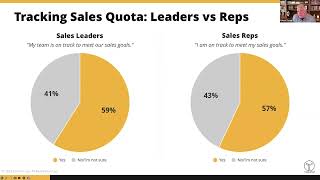
And here's just— this is so interesting. So the question is, is my team on track to meet their sales goals, right? Leaders said— 60% of them said Yeah. The other one said, no, 40% of them aren't on track. And then we asked reps, am I on track to meet my sales goals? Almost 60% said yes, but 40% said no, or I'm not. And here's what's amazing about that. That if you have a team of 10, a small team, that's 4 people. That's a lot. And you could make the argument if you're here and say, Well, maybe we didn't hire the right people. Well, okay, well, that's still on you, right? How are you looking at how you hire talent? It, it could be a system of, of failure training. It could be the right roadmap, right? It could be— and what you're going to see in the, the subsequent slides that— or the subsequent data— that a lot of salespeople don't even think their goals are attainable, right? So, so that becomes an issue like that, that, um, The manufacturing company I was talking about that's owned by private equity, they have to grow this year in double digits, which is against the grain. What did they have to do? They had to really lay out the process. Like, one of the biggest things we found is their salespeople didn't know the difference between objections and negotiation. And they didn't have a well-defined negotiation process. They were looking at it as a characteristic. That's a process example. In a coaching, in a methodology issue.
So, somebody just texted us a great point. Know your math is critical to organization success and failure. The question might be, what is the math that is critical? And are you rewarding it?
I'm going to actually get into that in 2 slides. I think it's important. But if you look at the math, right, Am I on track to hit my goal? If you go a step further into the data, it actually says, excuse me, just one second, alignment on sales calls being attainable. So, if I got people that aren't on track, why aren't they on track? Right? If the salespeople don't believe they can actually hit it. Right? So, best-in-class organizations set clear, realistic goals, but they adhere to a process and they prioritize planning and prep. Right? So, So, one thing that's clear here is this. Half the group don't think the goals are attainable. I mean, that's a problem. And now, we go back to Sales Team Science. Well, part of my job as a leader is to get people to believe that it's possible. Right? Now, as a leader, I may be stuck with an operating environment. Like if I work for a private equity firm or a company that was in high growth that I need to hit certain goals and I got to get certain results and I'll never get the same percentages of resources equal to what my goal attainment is or how my goals increase over time. Right? So, this is an issue of confidence as far as we're tracking there. So, that's another part of that math formula, if that makes sense.
And how do you close that optimism?
Gap? Well, you know, it goes deeper. So if you think back to that slide on Sales Team Science, it's 7 factors, right? So the answer just isn't in how I lead. So I can't just say, I can't be a sales coach and say, hey, we're down, Gerhard, we're down by, we're down 21-7, go score more points. Or I can't set a goal and say, hey, I need you to lift 300 bench press, 300 pounds, but you've only ever done 185. Right. And I got to train you, prep you, plan to get to the next level. So, so now here's, here's, here answers the question in the chat as we did this research. And this is continual research. This is constantly going on. We got 9 more projects happening right now and all the numbers are coming back the same. And by the way, in the research that we're doing and the 300 sales leaders, 1,000 salespeople, there are 9 different industries. I would say it's more B2B complex selling, if you will. But look at this, Gerhard. So sales reps, right, set clear best-in-class— excuse me, sales rep goals and KPIs, right? The sales reps would say, my goals are defined. 70% of reps say that. Only 45% say, I know how many deals I need to get to my annual goals. Okay. So, so we, you know, at Tyson Group, you know, with our Sales 3.0 team, we have about, we have about 8 people on our team and we look at close rates from like meeting 1 to meeting 2. We call them pitch-through rates, right? You got to know that number, but then you got to know your close rate to get to the pitch meeting. And then from there, but how many deals do I need or something simple? That's only half the group knows that. 37% say, I know how many new prospects I need to add to my pipeline to hit my annual goals. We've yet to find an organization where prospecting— you think of all the things going on with AI, everything that's going on. I've yet to really find an organization in complex selling where new logos wasn't important, and it's still on the salesperson to go after the new logos. That's an issue. And then here's this last one's coaching. About half, a little over half the time when I have competing objectives, my manager articulates how I should prioritize. So then you got a coaching problem, right? And this is only part of that. I just, I just, as we were looking and prepping for this, we said, boy, this is really on leadership and management. This is really on us, right? And this isn't even a training issue. This is clear goal setting.
Well, I think there's another gap, which is the thinking gap that sales managers and leaders don't think enough about those issues or know the proper way to think about it.
And that actually leads, that actually, Gerhard, leads to the next point. Because they're not even thinking about things correctly. So, in blue, you have your sales leaders, and in yellow, you have your sales reps, right? So, about 50% of leaders and salespeople are saying, hey, we have alignment on the sales process. Now remember, sales methodology feeds your sales process, right? So, The sales process is kind of the steps. The methodology is what you— is how you do it, right? And then there's core. When we ask the question of what's the difference between sales process and methodology, hardly any leaders can answer that, that even correctly, right? And, and then when you look at the misalignment there, so, so hardly— so everybody agrees kind of half the group agrees on the stages, but nobody really agrees on how to do it.
Yeah.
Right. So then now I, anybody on this call, Gerhard, I've heard you say this before too. Like you want creativity in selling. There's no doubt. That's the artistic side. Sales is half art and half science. But to have that low out of that many groups be out of alignment on sales methodologies blows our mind. It's just, it's, we have to spend a lot of time on that. There are several organizations that we've actually have gone on, gone in and redesigned their sales methodology to meet the marketplace or the operating environment. It's been a big part of our business in the last 12 months.
Because so is the issue, Lance, the design for, there's faulty design in the methodology or Is the methodology not being taught properly to the salesperson, or is it something else?
Well, there's a problem with methodology, and you know this. There's a lot of authors out there that have named methodology. Some of our biggest competitors have done a wonderful job with their business in naming a methodology. Let's say there's 21 methodologies out there. We find that most, most of our clients will say, oh, we're consultative sellers, or we're solution-based sellers, or whatever's hot, right? We're finding a lot of times is we're spending more time looking at the operating environment and saying, based on what you're being asked to do by your stakeholders in the marketplace, you have to come up with a methodology that's mission-oriented to that, and then actually look at the, the length of your sales process, and we got to develop the methods inside the parts of the process. And, and those things have to change, and you have to be agile or have sensory acuity to that, if that, if that makes sense. It, it's a lot more difficult than I thought it, than I thought it was at first. I thought it was just name something when I first got in this business.
So even though there are 20 different, uh, methodologies and, and all claim to be very, very, uh, effective. Uh, the, the gap is really when it comes to sales managers not leading them properly, not coaching them properly, or not training them properly.
That's right. It's, it's on the sales leaders and managers to draw up the right game plan to compete. Right. And, and that you, you said it really clearly here. I'll give you an example of kind of where we're seeing that. So there's sales process challenges. So if you took a complex sales process and you said that you had a prospect, and let's say qualifying is part of the prospecting at some level, it's, it's kind of that connect piece, assessing client, client's needs, needs assessment, discovery, whatever you call it. You gotta have to present, you're gonna have to manage objections, negotiate, close, and, and then do any kind of upselling or reviewing. Here's, here's kind of the, the bit. If you look at the slide, The sales— the agreement or alignments on prospecting, it's pretty difficult. Look how aligned everybody is there. Everybody knows that. You— the breakdown happens in the middle of the process when you start getting to presenting a man, or when you start getting to like managing objections, like that one part. And off of presenting, that's where it starts breaking down. Here's the most interesting thing about— this is my favorite slide, or my favorite My most interesting and complex data point. When you get to objections in negotiation, we find leaders do not look at negotiation like a process. They're more apt to say it's characteristic. Right? And then salespeople don't know where objection starts. Negotiation starts. With one firm that is in the creative space, when we started to do postmortems on deals and pre-ops on deals, and we took a couple looks at it, we took the survey, and we said, all right, your negotiation is starting way before this. When you do kind of a pilot or a trial, that's when your negotiations actually start. And they're like, no way. We're like, yeah, that's— they're starting to negotiate there. And since you have no defined process, And then you don't really categorize your objections. We can teach you how to cushion an objection. We can teach you how to give a compelling reason to move forward. Right. But you don't have an identifiable, identifiable process. It's bleeding into itself. It's just words. So that's, that's the process challenges all in. And that goes back to what you said before. That's coming up with the right game plan to move forward. And, and remember something too, if you're listening to this, You can't just be looking at data points as a leader. So many leaders are just looking at data points, right? You're just, you're reading fuel gauges. You know, if you wanted to get down and dirty, it's practice coach, game coach, practice coach. How often are you, right, watching your salespeople sell or observing them sell? A lot of this you can't, if you're not in there with or have part of your team in there with them, you just wouldn't know, right? That becomes a part of it. Or, you know, Gerhard, when you're— I don't know if you're going to say something there.
No, what I'm fascinated with is the early stages. There's so much alignment, you know, with prospecting and qualifying and assessing the client's needs. How accurate do you think those numbers are?
Well, so, so I definitely have hired analysts because I'm not an analyst, and I know these questions go 6 to 7 deep.
Okay.
And so it's not like a— our survey is so many questions that we look at different data points. Here's why. Like, this next piece might answer that question a little bit better, right? So if you look at sales skill proficiency just with objections, Right. The salespeople are saying, hey, I'm pretty darn confident. I think I'm pretty good at objections.
Right.
Right. And leaders are going, nah, I don't think so. Right. And then, and so as we ask, because this question gets asked after the other questions and after we start defining it for them, they're like, and then if you look at navigating the conversation, salespeople are like, I'm great at it. Uh, then the leaders go, nah, probably not as good as you think it is, right? How do I create a compelling reason to move forward? Leaders— so what that tells me is salespeople are missing a lot of opportunities, or they're, they're in a team selling environment and the salesperson isn't as involved into the orchestration and choreography of it, right? And remember, the sale— the leaders are also answering this question based off of the results. So they're looking at overall results, they're saying, no, this has to be better. So as we continue to do this, this, we, we won't enter and work with an organization unless we, we introduce the framework of Sales Team Science because, because our solution becomes more than a training solution. It becomes actionable advice or priorities. So that's, that's kind of what we see moving forward. I just thought for today, as you look at yourself and say, all right, just looking at those goals, how unaligned is my team with goals? And then you start untying that shoe a little bit. You start to realize there's a lot of points behind that about why that could be happening. And I think that's where it starts.
Can I share a play on words?
Yes.
What that slide is really communicating.
The slide before this or this one?
This one.
Okay.
Which is, I have a hunch that salespeople suffer from illusions of competence and sales leaders suffer from delusions of being great coaches.
I would concur 100% on that. Well said.
And that's why you are being paid the big bucks to help sales organizations get aligned like the 76ers team that is selling like crazy.
No doubt. Yeah, we try to help our partners realize that you don't really suffer from the disease of uniqueness. It's similar across the board. So, and Gerhard, if folks want to learn more about this, There is a Sales Team Science overview if you hit the QR code. And there's a case study also on Sales Team Science. But I'm willing to take any questions if we still have time.
So I have a few more questions. How big do you think is the gap between what leaders think is happening and what actions to take to make a difference that will accelerate revenue?
Well, I'm going to answer that this way. We were just with an organization recently, and I was— we were on site delivering some of these results. And when we were digging in these results, we had about 15 sales leaders, and we asked them a simple question off of this: where are you spending most of your time to kind of address the gap? And who are you spending the time with? We're finding leaders spend a lot more time with the lower performers than they do the higher performers. I don't know about you, Tricia, but when I'm playing the stock market, I don't spend any time at all with my low-performing stock. I spend it with my high-performing stock. So I think that's the biggest way to address the gap as far as I'm concerned. And it's from what we're seeing here.
Go to the next.
I couldn't help but physically react to that. Oh my goodness. Yes. Oh, I'm not saying ignore the low performers, but I think if you have stars, you have folks that are up and coming, you have plateaued, and you have flat-out non-performers, we have a tendency to not want to put people on in the non-performing gap or the spot slot. Excuse me.
So how do you distinguish from a coaching problem from a hiring problem?
It still amazes me that And I'll say as quick as I can here for time, I think leaders and HR people have a tendency to spend more time on who dates well early. My in-laws thought I was the greatest human being on earth until we got 3 years into my marriage. And then like, yeah, maybe this guy isn't as great as I thought he was. I'm not that I'm a bad guy, but we have a tendency to react off of people and their first impression. I think we still put a lot, and you should, it's not like you shouldn't do that, but I think there's so many ways to assess talent. Today, and there's a lot of scientific ways to do it too, just not personality traits. Do they actually have the competency to get the job done? You're not going to be able to change it. You know, we, we've spent the— we won't even work with an organization if we can't, we can't at the very least do a frame on this and, and look at competencies because we got to at least give you a heat map. If not, you know, if you have a duck, you're going to have a duck. I can't— I'm only going to piss the duck off if I try and make it an eagle. Right.
So what is your greatest success story with a client where you saw a really big gap and you helped them close it?
I would actually, I go back to the firm we were, I was talking about earlier, the one that was private equity, private equity owned. They bought the organization at its height. And when we went in and started to do this and that, that one bar chart that I showed, you know, where the inconsistency or misalignment between like negotiation objections, we start to tug on that string and, and help them realize that, that there was their, their negotiation process was bleeding higher up into their sales process than they thought. Then they start to outline their, their negotiation process, and they grew last year by 11%. They had double-digit growth. Wow. I can't share specifically what the company is, but I'm interviewing the CRO on Friday on my podcast. So he's pretty excited about it too. So, and that was a hard one for us. It was really hard because it was all done remote other than a few visits. And I just felt that that was our biggest success story last year as a team. And we had 6 different people from our team involved in the project.
Tell us a little bit about your book, Selling Is an Away Game. How did you come up up with that idea?
Well, um, we do a lot, a lot of our portfolios in sports and entertainment. So if you name— I was telling one of my teammates earlier who they cheer for. I said, we cheer for the team whoever we do the most business with, right? So I'm from Philly originally, but I will— I— there's a lot of teams I cheer for. My family members get really pissed off. So we did a lot, we did a lot in sports, but— and I played a lot of sports, and it's always harder to play an away game than it is a home game. There's a lot more to prep for, a lot more to get ready for. And so as we built that concept, we said, hey, you have to have a predictable way to deal with the patient or, or the client, right, or the prospect. And so we built a very collapsible system that's very easy to use in most industries because it just follows how to give advice. So if Tricia was going to the doctor's office, say she had shoulder pain and she was getting some surgery, that she would connect with the doctor off of credibility. The doctor would evaluate diagnose, prescribe, dialogue about the prescription, and close. And something really simple in that book is you'd never prescribe before you evaluate and diagnose because that's malpractice. So that process, you're always playing an away game with the patient. So that book, the kind of title that book stuck, um, it kind of came into me one night. I would say it's an original thought, maybe it's one of my only original thoughts in life. So I appreciate you asking though.
Well, I think what is implied in the book is that, and the analogy to sales is that the buyer always holds the home field advantage.
They do.
And the question is really how does that mental shift change the way a salesperson should prepare before even walking into the room or picking up the phone.
Yeah, we, we believe a core philosophy at Tyson Group is whether you're leading or selling, there's 3 things that have to happen in equal lateral balance. And think of an equilateral triangle. And, and I don't— you'll never hear me use that sales is about relationships. Relationships are outcomes. It's not something you do. I came from Dale Carnegie training originally, and, and Dale Carnegie didn't say in How to Win Friends and Influence People you actually had to like anybody. It said you had to have rapport. It has some— you had to have a likability, not whether you're friends with everybody. So rapport is at one side. You have to build rapport. That's something I can actively do. I can go to a Wawa and get rapport with the person at the, you know, the cashier. You have to have a level of credibility as a salesperson. That's how you invoke trust. And then the last— so it's rapport, credibility, and you got to show some level of understanding. And that has to happen with you as the salesperson. Person before it happens with your brand.
Final question, which really intrigues me, because I know you have seen that video by Vince Lombardi's second effort and you have been in this game for 2 or more decades. So what's the most stubborn myth about—
There's the, there's the, there it is right there. It's right at my dad's funeral. So yes, please.
So what's the most stubborn myth about grit and hustle and, uh, that, that derails salespeople today? What should they be doing instead?
So a lot of our clients that are in sports have hustle metrics, okay? And I have one of my sons works for the Cleveland Browns. He just started his career, just left college. And I go, listen, if you're not at the top of the board, you better, you better look about as busy as you can. You better be in— if work starts at 9 o'clock, be there by 8:30. Stay late, at least get that done. If you're a good seller, you're my son. If you're not, then I found you on a doorstep somewhere. But other than that, I would also say, listen, like, you gotta hustle, you gotta have that grit. I can't teach that and I can't measure that. And, and that's defined by the role you're in, right? And I, I think, I think the activity you could be really efficient and make a lot of calls and stuff, but you still might be a horrible salesperson, right? I wouldn't put grit above effectiveness because I can be efficient, not effective, and I can be effective and not efficient. So I, I think it's a— I think you have to have it, but you have to be smart too. You know, aim small, miss small. There's some of that also involved in it, and it's, it's a balance between both. It's, it's, it's an interesting question.
Awesome. Thank you, everybody, to scan those QR codes quick. We're at the end of our session, or head over to tysongroup.com. That's the destination where you are going to be rewarded with a sales team that actually increases revenue consistently and Tyson Group trainees are probably some of the top sales producers in the country today.
Thank you.
Good, Lance.
Appreciate it. Nice to meet you, Tricia. Thank you. Great meeting you too. Thanks, Lance.
More from Gerhard



What Selling Looks Like When Your AI Agents Have the Context Your Sellers Do

Better Conversations, Smarter Support: Wearable AI in Business






When Scarcity-Built Systems Meet Abundance - The Judgment Gap in AI-Powered Sales Leadership
