Unlocking B2B Sales with Tech & AI
Jennifer, a former McKinsey salesperson, explains how AI is reshaping B2B sales across five domains: lead discovery, account intelligence, proposal personalization, AI copilots, and post-sale engagement. Companies using AI-enabled sales can achieve 6-point revenue growth and 2-3× higher valuations. She recommends four quick wins: account intelligence, meeting summarization, automated notes, and AI-driven pricing.
Questions this video answers
Jennifer acknowledges the chatter about a SaaS apocalypse but says it’s not existential. While some shake‑out may occur, SaaS firms that deliver compelling, continuously evolving digital experiences will survive and even thrive.
Chapters
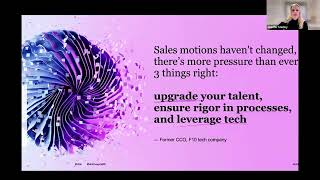
Well, everyone, I would love to share with you some of what I and my colleagues are seeing and experiencing in the world of tech and AI and B2B sales. I should also say I was a salesperson before coming to McKinsey and I also ran a company outside of McKinsey. So I definitely appreciate the realities of what it's like to be both a sales rep and a sales. A sales leader. So some of this is informed by that experience. Experience as well. And what, you know, what I was thinking as I was getting ready for today, that in a sense, for those of us on who may remember, this moment feels a lot like 1999, 2000, when E commerce first hit. And I can remember hearing from colleagues, from customers, from clients, wow, this is existential to the selling profession. It's going to completely rattle us. Will we even need sales professionals and sales reps in. And I'm hearing those questions again now with generative and agentic AI. And so I do think there's a little bit of caution here to remember. You know, we've been here before with really big technical technological advances. It is different now for sure, but it's not so different from eras that others have lived through and used to really expand the sales profession and expand the art and science of selling. So I wanted to maybe put that in context a little bit. And as we kind of dig into what I'd like to share with you all today, I'm going to walk a little bit through that current landscape of how we got to where we are and what that means for what sales leaders should be focusing on in the current landscape. Second, I will share with you what we see sales growth leaders doing with tech and AI, how they're really rewiring the sales function. And I know you'll hear later today even more detail, more detail on that. And then finally just some tips as we think across things like, wow, should we buy or should we build? If I have colleagues in my organization or people on my sales teams who maybe are a little less enthusiastic to embrace new tools, where should we start? What should we be encouraging them to do? And so that's what I will cover maybe if we dive into the current landscape. Just building on this point I was making a moment ago that advances in digital technology are not new. They've actually been transforming every industry, every function, and certainly the sales function for 75 years. So while the current era might feel like something truly groundbreaking, and I know to some people it might even feel like an existential question in terms of agentic AI, like every age has had something that's been a significant breakthrough in the way in which we harness technology to improve how we engage with customers, how we engage with sellers. Sellers. So whether that is, you know, rule based and process automation of 20 and 25 years ago, all the way through to, you know, just a decade ago, machine learning, or what we would now call like traditional or old school AI through to the era that we now find ourselves in with agentic like it has, it is a wave that has been building on itself. So this isn't like truly new or truly unique. What I do think is particularly acute, and I'm sure you all are feeling this in your businesses, is that the environment today is increasingly complex and challenging. So we have in a market dynamics. I don't think it actually matters what country you may be dialing in from. Everyone's got their own set of both global dynamics that you're responding to as well as highly regionalized or highly localized dynamics. But finding growth, sustaining growth, having a great rhythm to your selling engine like it is just hard in a world that is constantly changing, regulations are constantly changing, customers are changing, technology is changing. I would say I don't think we're in. We are in. I should say, I would say we're in a time where I think those dynamics are even more pressure filled than perhaps we would have experienced maybe five or 10 years ago. Everyone's asked to get more efficient. So I'm sure everyone's got a sales productivity agenda. Or if you, you've been asked to have more of a sales productivity agenda to make your people more efficient, customers increasingly expect one to one super hyper personalization of content offers, pricing, communications. And if you think about it like even in our own lives as individual consumers, right? Like if you've planned a vacation and gone on any kind of app or mobile website, like you've automatically experienced generative AI in the booking and travel planning process. If you have recently looked to buy a home or have you know, something remodeled or redone in your home, or you've looked for accounting software to help you with your taxes, you've probably experienced agentic AI and you've probably as a consumer also experienced hyper personalization. Well flash Forward into the B2B world. Like that expectation persists as well. Like know me before I come to you, anticipate what I'm looking forward. Talk to me in a way that makes sense for me. Pricing flexibility. I think this works on both sides of the equation. Companies now have the ability to set much more dynamic prices based on those market dynamics based on the uniqueness of a customer. And on the flip side, customers also have the ability to see more transparently what's available and to demand more flexibility on pricing based on their unique footprint, what they're buying from you, how they're engaging with you, et cetera. And then finally, never goes away, ever goes away. But the demand for great sales talent continues to persist. And I know in a previous conversation that Gerhardt and I had on this topic, I remember saying, and I would say it again to everyone out there who's listening, like, you can find great sales talent anywhere. It is really difficult to teach someone to be intrinsically motivated to care about customers, needs and problems. But you can teach someone your industry basics, you can teach someone business skills. So when you're looking for that great talent, I would encourage you to be open to people who may come from a different industry or who may come from a different role that's not in sales. Because now technology and AI can help upskill that person even faster on the things that you know are teachable beyond the intrinsics. So I get it. It's hard out there, but it's also exciting out there. And I'm reminded, I love this quote from this chief commercial officer at a very large global company who reminds us though, that for all of those challenges, at its core, sales is still sales. And the motions that we need to go through of identifying opportunity, understanding, and really, truly internalizing customer needs, translating that into a compelling offer, and then keeping those customers with you and finding ways to add value to their business over time, those things don't change. And so really what needs to change is the way we think about our talent, the science of selling, the processes we enable, and how we are really leveraging technology as a force for good, as a force for good and selling. So just a reminder, we're all on the right track. That track may look a little different today in this day and age, but like sales is still sales. Maybe a few data points for those of you out there, especially as you're defending investments in technology or investments in new talent with your CFOs and your CIOs. We know quantitatively, quantitatively, that while cost savings is important, cost savings, number one, never gets you the growth and number two, profitable growth. So cost savings with a focus on the top line is always going to be more valuable to you as an organization. So we can see over the last decade, when we look at publicly available information on companies, that companies who sustainably grow their Sales year over year consistently have a 2-3x higher valuation, whether that's a private valuation or it's a public valuation. Similarly, we also see that those same firms will completely outperform on total returns to shareholders. Again, whether you're a public company or you're a privately held company. So putting the mindset or having the mindset of growth not being something that's optional. Investing in sales not being something that you do only when times are good and then when times get tough, like that's the cost cutting time. No, like we should always be optimizing for a great cost model, but a great sales growth engine as well. And the market will reward you for that. Like it's just, it's just super clear. So if we think about what could you invest in now or what should you be investing in now to get that kind of profitable growth? Looking specifically at AI, generative AI as well as agentic AI, I'm speaking about those types of AI, not necessarily just machine learning or kind of traditional AI. What can that get you? So I'm in an amazingly privileged position to be able to work with so many different companies in different countries, in different sectors, but on very similar use cases like help my sellers cover more accounts, but cover them more deeply, get me more productive, help me think about growing in new markets, or cross selling and upselling to existing customers so I get more revenue growth. How do I help delight my customers with a better experience so that they are more satisfied, they're more engaged, they're more likely to stay. And what we at McKinsey have been able to see as we track companies that have truly deployed AI solutions. And when I say truly deployed, I mean like not just a use case here or there, but like you're rewiring a domain so you're taking lead generation or customer success or negotiation through to close of a sale and you're embedding and infusing multiple use cases across those domains. When companies do that, these are the kind of results we see. And if I kind of boil it all up to like the top line and the bottom line, like getting six points revenue growth year over year, continuing to eke out cost savings year over year, those six points are worth a lot. So I'm really, you know, for all of the appropriate caution we should have around modern technology, I think, you know, the ability for it to truly impact our operations is, is significant. And there are two other points on this page that may seem like throwaway points or like, well, duh, of course you can make faster decisions. And wow, great that people are excited, but they're not throwaway points. Because if you think about what's saving a third of your time in deciding how do I price this proposal? Do I prioritize this customer opportunity over this other lead? When you think about what saving a third of your time and your organization's time making those decisions can do to your sales cycle, you've just sped up the velocity of your sales cycle by double digits. You're closing fast, you're identifying faster, you're closing faster, and that is order to cash real money in your pocket. On the excitement point, we ask this question because I think we're starting to see what I would call like the virtuous flywheel of AI emerging, where if leaders are excited and role modeling appropriate use of AI, others in the organization get excited and then they do it. And then initial adoption quickly morphs into like, this is just the way that I work today. And it ceases being like this big need for change management, which there is some, let's be clear. But it shifts into like a constant curiosity in your organization of wanting to see what else can technology do? What are other technologies we should be experimenting with? So the ones who've truly like embedded in a domain and seen this kind of impact, they remain excited. And I think that's important for adoption. And then when we think about generative and agentic AI just in sales. I wanted to share with you a few data points here. And of course like you're, if you're not snapping screenshots, you can and you should, I'm totally happy with that. But just to give you a sense again of like the business case for these things across, you know, different areas of, of your selling function. All right, so let's talk a little bit about now what companies are actually doing. So we tend to see five areas of, you know, as Stephanie mentioned, like the need for a framework or the need for a theory. So our framework is kind of A through A through E. Five areas where we think companies need to be focused and deploying their technology solutions. But they also tend to be areas where they're pretty substantial challenges, challenges that many sellers still face. So the first is like just finding the right opportunities. Where am I most profitable or will be my most profitable customers of tomorrow and my targets. Sometimes you don't have clarity on the data. Sometimes I know every seller out there is going to complain, whether it's a marketing qualified or now an AI qualified lead. They're not that high quality, like A lot of them go nowhere. I don't have visibility into who are the customers that are emerging that we should be trying to reach out to. Very real challenges, but an area you need to get to, finding those opportunities with the right people and the right go to market model. So a lot of times we still, for those of us in multi channel companies where you're selling on E commerce, you have partners, maybe ISVs or bars. If you're a tech firm or in the mix, you have field sellers, you have inside sellers, you have remote sellers, you have chatbots. Now like all of that can lead to disconnected flows and disconnected experiences for customers. So getting that right is the next big thing with the right message. So getting the right pitch and offer, making sure your proposals are truly bespoke without having to create a work of art every time. Not being generic, not needing to go through like a lot of bureaucracy to get the same kind of thing done over and over again. Tech can help that. And then of course, pricing. I think we've all probably been in one of those deals where it feels like it, it's escalation after escalation with legal, with finance, with risk, with our sales leadership on like are we actually, you know, getting the pricing on this, getting the pricing on this right? And then sometimes it comes down to just like taking a risk. Technology can help us make better decisions there and then do it every single time. I've preached for years. I'm sure Gerhard is tired of me saying this phrase, but the science of selling, like I loved that book in the 90s, hope is not a strategy because not it's not. You can actually apply precision science to the art and the profession of selling and make sure that every day, day in, day out, more often than not, you're doing the right thing across these five areas. So if we imagine right, what could that look like for a seller to across those five areas, not have those challenges? Imagine if like it was easier for them to just quickly know and have confidence in the leads that are coming in and already sorted and prioritized. Jennifer, this day, this week, this month, this quarter, here's what you need to go do and why and what you should expect as a result. And I can spend my time thinking about, all right, does that make sense? Does it not make sense? What would I move around if I'm traveling, I might shift that around, but like I no longer have to build that list and I can't and I can trust it. What if I could quickly see for an account not just like CRM playing back to me what I've already put into it, or like what the customer history is with our company, but generative AI infusing the latest news and information on that customer. So I would know, like, there are certain influencers or decision makers that I should reach out to because they've changed roles or they've landed a big deal themselves. But I have a much, much richer view of the customer every single day at my fingertips, and I'm not the one having to research it. What if I could give customers a proposal that is uniquely tailored, that blows their socks off every single time and they learn something new about my company? So it's not just, oh, same old, same old time for renewal, like same team, same same message, but something that is truly unique and innovative each time you connect with the customer. And then of course, as we think about closing and moving into maintenance of customer mode, how can I reduce the need for those pricing and escalations and still know that I am optimizing my, my personal as a sales rep, when I think about what I get paid as well as for my company, optimizing our economics and then keep seller, keep the customers happy and have great predictability in terms of who's likely to churn, who's likely to stay, and then therefore, like, what are the actions I take, I take as a result. So guess what? Like, that world is here, right? You can, we can. In the AI era. I really think what's so exciting to me about the sales profession is that, like now we really do get the time to focus more as human beings on the most exciting parts of the job. So if we think about, like, what AI will do, can do, is doing, and if you're not benefiting from it, and you should, right, It's a lot of that research and data gathering and administrative work and analytics that, you know, even one, two years ago, and maybe even for some of you right now, we're still doing a lot by hand. Like it might be powered by machine learning, but like, it still can take a lot of human work, but it doesn't need to. And then therefore, that means I spend my time building more trust with customers, building more trust with my partners, really investing behind relationships. I might be managing agents, by the way as well, and giving them new prompts and giving them new information as Stephanie was sharing new theory, new frameworks so that they can generate new insights. Like, I think we have to make remember generative AI, like it's generating from something and those somethings are human created content. And human curiosity, human creativity. And like that's not going to go away for sellers. Like it just gives us more time to focus on those more strategic questions and those more relationship building activities. But it's going to happen alongside agents. Like that's if I think back to like okay, E commerce became this channel that had to coexist alongside face to face sales. Now I sort of think about it like, like trying to not get myself overwhelmed. All right, now sellers have to coexist alongside, you know, AI agents who take on very specific roles. So you may now have AI agents doing classic business development, BDR sales development, SDR type of activity. You may now have agents fully owning basic account renewals and customer success and service functions while the humans actually manage those teams of agents and manage their human teams as well. And we see new roles emerge. One question I get a lot, maybe some of you out there have, have this question is wow, well if the BDR sdr, if we just think about like that role goes away, what's the new entry point for a young person starting off a career in sales? Because like that's a pretty typical role where you learn what it's like to become a sales profess. Well, you know, maybe the new entry role is you're managing a team of BDRs or SDRs, maybe a new role is you're a BDR, but actually it's an elevated BDR role because you're now picking up from the point at which the aql, the AI qualified lead takes off and you're actually getting to have customer conversations and be part of that flow much more quickly in your career. Maybe you get to use an AI enabled coaching tool that will help you get up the learning curve even faster because it's tailored to you and you're not waiting for your company to host a big sales training program somewhere in person six months into, you know, your, your time being hired or you're waiting for sales kickoff to occur, which I know a lot of you have just had at your own companies, but you're, you can learn on your own time and get better at it. So yes, maybe some historic roles as we know it will go away, but that then means that the roles can change and new roles can come along as well. So for example, in some firms, firms we're starting to see a go to market AI engineer. So the go to market manager, a director historically who thought about what's my strategy across different channels to market. Like now that person is thinking about all of that plus like what Agents do I need, and how do I deploy agents across all of those channels to market and how do I help them work with my people? So a different kind of go to market role. That to me is what I think is kind of exciting to think about right now is it's less about like what goes away and more like what emerges and what happens new and what does that do to expand the roles available in our profession. And so if I, if I sort of step back and think about like the typical account manager, maybe you're a key account manager and you have two or three accounts you manage. Maybe you're a regional account manager and you've got a roster of, I don't know, 20, 50 accounts that you manage. You know, I was just trying to think through, like, your day could really look different now. And so it could for the customer as well, versus, you know, six months ago or a year ago, maybe your, your customer. Jane reaches out and says, hey, like I got, you know, it's. I'm getting my prompts on time for subscription renewal. Let's talk about pricing what, what new products you have, what your product roadmap looks like. And that email comes to me, or in this case on here, comes to Steve. But an AI agent, in this case Steve's AI agent, intercepts his email and like, like analyzes that ask from Jane and then starts pulling information externally, internally, et cetera, to put that ask for renewal and for new product information fully into context and then plays back to Steve. Actually like the best sort of messaging offering converse, you know, series of conversations you could have for. With Jane in this context is here blank. And then meanwhile in the background is setting up the time for Jane and Steve to connect. Like, Steve hasn't had to do any of that. All of that comes to him. And then his mind is focused on how do I plan for the meeting, how do I. How do I get ready for a negotiation. And so, you know, as that happens, as Steve and Jane are meeting, like in. It could be same day, it could be just a few days segregated. Steve's agent is se supporting him through this process, like taping, like we are right now, the conversation that Steve and Jane have, playing back those meeting notes and those meetings, next steps and recording all of that for Steve, putting it into Steve CRM no more does Steve have to deal with that painful part of the job for some people, I actually always quite, quite liked it. But I get that some of you out there, it's not the most fun part of your job. The agents can do that, right? And then whatever Steve and Jane agree to, the cycle starts all over again. And Steve's agent, his co pilot can then email or WhatsApp or text, whatever. Jane's preferred method of interaction is so like it's a really different rhythm to the day for the customer and for the account manager. And maybe to give you a flavor of what I see out in the market within the sales cycle as like the most experimented with and now scaled in many cases sales agents. There's 10 of them, I've listed them here all the way from like a market scraper to just, just find, help, find those new opportunities through to an impact and interaction tracker that's helping you, you know, do the right thing every single time, every single day. And these show up like across all elements of a selling cycle. And here like I've simplified. I know we all might think about our funnels or label them in different ways, but if you can imagine from finding new opportunities and building campaigns through to retention and growth like basic cycle and then we can line up these agents against very, very specific activities and reimagine the day in the life of the rep for those activities. And one thing I would say is the companies that I'm seeing are more successful with deployment of AI and when I say success, I mean it's both adoption and financial and operational impact. They're picking a part of the domain in the entire selling cycle and using multiple agents against it. So, so for example, upper funnel demand generation activities, you're doing market scraper, campaign manager, opportunity finder all together. And that's helping you build your campaigns and build your upper funnel pipeline. You might be doing negotiation to close as a, as a domain. And then you're taking market scraper, value proposition identifier, pricing manager and you're putting all of those together and actually fundamentally transforming those that stage, stage of the cycle. And then similarly as you kind of get into customer onboarding, for those of you who have that as part of your business, there are onboarding managers and sales co pilots that can help you as sellers and help your customers with that experience to be much more straightforward. So just, I'm just trying to give you a flavor of like they're out there, put them together, bundle them and experiment because it is actually working. And if we think about maybe some companies that are doing this really well, one, one of the other things that I notice is that there are some archetypes out there. There are companies like really, really experimenting with how do we improve the experience for our People. How do we make people more efficient, more productive, more effective with their selling roles? There are some that are really, really deep on the process element. So how do we think about completely rewiring, completely rethinking the way in which, the way in which we do the art and science of selling. And then finally there are some that like are just completely rethinking their organization. And these tend to be like AI native AI, native organizations. But like as an example like WPP is automating tasks like you know rote sales planning, analytics, basic like sale basic admin tasks for, for their people. T Mobile has an agentic coaching platform for 35,000 of their frontline frontline employees. You know Amazon on optimizing warehouse and supply chain. Not unsurprising, right Using it for that. At Klarna they have customer service agents doing the work of about 700 FTEs alongside their actual human and FTEs. And then of course on the organization you have companies like wonderful AI where like agents coach and train agents. Like it's just AI native from the ground up. But you know, you probably should be doing a little bit of all people processes, thinking organization wide. But where your start point is might lead you to one archetype or another. So if I think about what are the implications for your selling organization and your operating model, there are six big ones we see. Number one, you maybe need to be recruiting and training for a whole different set of skills in, in your salesforce all the way through to like teaching people. Like before we had to teach people like how do you manage a key account team and interactive, you know and help different stakeholders in different parts of your organization come together as one team and have one face to the customer. Okay, yeah, you need to do that still. And now you have to think about the role of agents in that collaboration as well. And what does that look like? We will have to rethink training and continuous learning as something that is not an event that you go to but a part of your day job because the technology is so fast moving. I also get often asked the question of do you buy or do you build? And I'm not going to go deeply into that because that's not the point of today's conversation. But I did want to give you like, like if you are actually thinking about like should we invest more like what McKinsey did. We built our own LLM Lilly named after our first partner bank of New York built Eliza, named after Eliza Hamilton, wife of Alexander Hamilton as their own LL man LLM and the Reason we both did it is because we have proprietary knowledge and information and frameworks and theories that only we have and so that LLM needs to work for us. So if you are in a situation where you've got like competitive advantage linked to knowledge building is probably a good idea for you. But if you need to buy. This is not an exhaustive page. It is just, you know, a snapshot that I could fit on one page which hopefully you all can read to show you of just like what is out there in the AI world, particularly on agentic, also generative across the entire selling cycle. Like, I promise you, if you've got a problem, there's a solution. And then my final message to you would be, look, if you're still really, really early days or your company has a lot of these tools but you haven't personally adopted or your team hasn't adopted, these are the four areas to just go start now. I would say they're the most. No regret, they're easy. People will be delighted by the impact. Sellers will be happy to not have to build account plans from scratch if you give them account intelligence. Managers will be happy that meetings are automatically summarized and they don't have to beg someone to take notes. Like, your AI is going to do that for you. You can now go back and look at every kind of customer conversation or interaction and AI will tell you the most important things that came out of it. You don't have to read it, right? And then of course, you know, I would say against all of that, like have adult supervision and have some common sense, right? We need to do this in the context of upholding your company brand standards and always ask, asking like, does this seem right to me? What's the source of this information? Like that doesn't go away. So with that I am, I am wrapped up with the overview of the state of AI and sales. If you'd like to learn more, QR code on the left will take you to like a global AI report with more data. And if you'd like to stay connected with me, the QR code on the right will take you to my LinkedIn page. It's been a real delight.
That was amazing. Thank you so much. Jennifer. Stephanie, what, what are your thoughts?
There were so many nuggets of information that were great.
Right. I think. Thank you.
I'm glad people probably had their, you know, their cameras or their however they screenshot information. I just thought it was so valuable, you know, kind of pointing people in the direction no matter where they are in the process, but especially those people that are just trying to figure out how do we get started? Because I'm usually asked all the time about like, how do we, how do we get adoption? And they need to think about more immediate solutions about, you know, how do we help people get quick wins. And so that last part you were just sharing about this is how to get people some help. Yes, exactly. You know, thinking about summarizing the meetings, like just things that are, are just so simple where people can feel like, okay, this is actually helping me. What else can it do now?
Right.
I have more time back in my day now. What else can I do? So I thought that was just fantastic. Thank you so much.
Jennifer.
Jennifer, I have a quick, quick question. What is your take on the, the current sort of scuttlebutt that I hear out there that SAS companies endangered species.
Oh, is this the SAS apocalypse that you're referring to? By the way? I've heard that consulting companies are endangered species. So this isn't a new question. I actually think anywhere where you've got like you're, you're heavily reliant on, on intellectual property knowledge or, and, or a digital experience, like it's a relevant question to ask. Ask how does our business need to transform in the age of AI, like to continue if you're a SaaS company that's going to keep doing the same thing the way you've always done things is probably not the best recipe, recipe for success. But I actually have some colleagues in my technology and media practice who dug into this and were like asking the question, do we think the SaaS apocalypse is real? I think they came to the conclusion of there will be some shakeout. But for companies that, that actually figure out how to provide a truly compelling continuous digital experience, like it'll look different, but it's not existential.
Well, for those that are in the SaaS business, I have some words of comfort and wisdom, which is I just did a research on Claude Telemagic act and goldmine those tools before AI, before CIM that came out 85 to 89. They're still being used today.
Wow. There you go. There you go. You know, creative destruction, I don't think that goes away, but it just also means creative innovation. So yeah, there's hope out there for sas.
Still cling to the old. So thank you, Jennifer, for joining us today. We.
My pleasure.
More from Gerhard



What Selling Looks Like When Your AI Agents Have the Context Your Sellers Do

Better Conversations, Smarter Support: Wearable AI in Business






When Scarcity-Built Systems Meet Abundance - The Judgment Gap in AI-Powered Sales Leadership
