Using AI to Do More, Not Less
AI should amplify salespeople, not replace them. ChatGPT hit 100 million users in two months, but most reps still don't use AI daily. Voice summaries, account research, and persona profiling work best when paired with prompt engineering and solid CRM data, not sloppy high-volume outreach.
Questions this video answers
Five days
100 million
Five years
81% (speaker-cited stat)
28% (speaker-cited stat)
Chapters
Gerhard, thank you so much for inviting me to the summit. You know, what a great couple of days and the thought leaders and speakers and you know, it's really amazing to be here. So I'm really excited about this. And you know, the topic I want to talk about, like last, last year when we sponsored, I talked about elevating talent on the front lines. And you know, that's something that has been happening over a number of years is where companies are trying to do the most, the most important thing, engaging with their most senior stakeholders and putting the absolute, most inexperienced, low cost person on the front lines to do that. You know, today I even saw a company that I know has very complex operational technology and they're looking for someone with the lowest skill set. And that's, that's not going to get you where you need to be. And now we have this version two of there's AI out there. So you want to use it as an individual. You want to know how to do this so that you can become more. So you don't want to go down this path of, of this reductive type of activity in sales, but you want to make yourself worth more, more effective, you'll make more money. You know, one of the things that I've been seeing is, you know, all of us get emails. So I own a marketing agency. I get a ton of B2B outreach, outreach from like, you know, marketing tech, sales tech. And I can always tell if they're using AI because their emails are off. You know, say, oh, I want to congratulate you on this thing. And it's like some award I won like five years ago or something. So you know that, that is not adding value. So that's another way of doing things kind of sloppy. And some of that is just the way that it's set up. You know, the, the goal of the outreach, you know, they're just thinking, oh, we'll just send 10,000 emails and see who bites. But that actually just creates more barriers, more obstacles in sales. You know, like we've tried some of those things when it first came out and for us, yeah, that, that was rough. So, you know, we use AI in a way to be very precise with what we do. We're not using it to impersonate us and we're not using it to, you know, take shortcuts without verification. So that's, that's what's important. And the reason that AI is so important right now and I wanted to talk about some adoption statistics because this is kind of mind Blowing.
You know, the, just chatgpt is really what exposed everybody to generative AI. So AI has been around for a long time. We've, we've been working in the space for a long time with clients. But to be available to the general public and, and to end users and companies, you know, that's been a couple, about two and a half years. And so ChatGPT, you know, they've got this huge, huge volume of users. So Google took over a year to get to a million users.
The CRM took five years to become a mainstream adopted tech. ChatGPT hit a million users in five days. They hit 100 million users in two months. So the actual adoption curve is unmatched by anything. So, you know, by iPhone, by Facebook, Instagram. Well, you know, whatever. It's like this is something unprecedented and it's rapidly being adopted in companies. And so you want to be there, you don't want to be a laggard in that. So I know there's other tech, other sales tech that a lot of companies were laggards about. This is what can actually help you to get in front of sales cycles. And you don't want to be a laggard around adopting things that make you better.
So the thing that I want to talk about is, you know, how can AI help you to do more, not less, and really leaning into this skill as an individual. So, you know, I often talk about the front lines because that's where stuff falls apart. So you've got this kind of digital journey. Even if you have these amazing level of AI environment in the background that's doing your digital marketing, if it gets to a person and it falls apart, that's it. And that happens all the time. So I want to address that frontline human interaction piece because that's where you lose a ton of deals from everybody doing their own thing, doing stuff different and not really arming themselves with what can help them with a lot more precision and effectiveness.
This skill right here is something to really lean into because it's going to make you more valuable to your company. It's going to, you're going to make more money and you're going to stay ahead in your development of skills that are necessary. You know, like if you look at job specs now in sales, you've got to use a CRM. And CRM adoption took a long time, like I just mentioned, and now it's like you got to have that. You have to be able to work in a system and AI isn't there yet, but it will be because it's something that companies are going to rely on to be able to expand the reach of their reps.
So I want to talk about like what's already out here. So there's already a lot of tech on the front line. So you've got voice AI, there's AI agents, account planning, and there's these tools that can analyze the meetings in such an amazing way and give you feedback, summaries. You know, one thing I want to remember, want you to remember is, you know, with the video calls, a lot of times, and again, this is where you don't want it to make you less. A lot of times reps will read the summaries and they'll say, oh yeah, I read the summary, but there were things that happened on that call that the tools aren't catching. So there's a lot of things that, you know, for example, you're talking, it's like, oh, Dan made a weird face when you said this thing or something. Sarah was totally checked out, or Stacy was making, you know, looking really confused when you talked about this one thing. And then you can actually observe the exchanges. And that's where the human piece is so important because if you just relied on text that made it sound like everything went great, you know, you're, you're going to totally miss the mark in your follow up. So you gotta, you gotta watch it. And it does take time, but in the big picture it's going to take you less time because you're not spending a bunch of time trying to chase them down, having stuff fall apart, they went quiet, all that kind of stuff. You know, another thing that you can use it for now is, you know, understanding the sales landscape. There's, there's so much that you can learn about companies like analyzing annual reports and analyzing the company and where they're at and public sentiment and all these different things about them. Like we've actually built GPTs for our customers where they're addressing really specific things that gives everybody a jump start in understanding the account. You know, something that happens all the time. And this, this still happens. And so there's kind of these parallels of technology really accelerating and then these practices that just are like crash and burn kind of stuff that happens is still happening and it happens even more because there's more B2B outreach. So the thing that happens is there's these breakdowns between interactions and it doesn't matter if you're outsourced in house, whatever, if you've got somebody making outbound calls Building relationships and then bringing in account executives and getting them on board and engaging them. There's often huge breakdowns right there. I've seen it as a prospect, like maybe. And I'll remember one specifically that I'll mention. Talked with the guy that called. I thought he was the rep. It was great. We had this great call and then we end it. I said I'd have the meeting. I told him really specifically what I wanted to talk about, why I was willing to have the meeting there. There were some nuances, totally understood the tech, but there was, you know, kind of some conditional interest. And so then he says, okay, great, I'm going to connect you with the vp. And I'm like, oh great. Okay. So, so then we get on the call and this VP gets on and he just starts asking all these really basic questions again. I'm like, did you have any notes or anything from our conversation?
You know, the thing was, is this is an engagement tool and they're like doing opposite of good engagement right now. And he's like, yeah, I just, you know, I'm going from call to call. And I just thought, wow, okay, I'm not going to tell you anything about my internal tech stack. And you know, there were some really specific reasons that I was interested in this. And so why don't you go do the research and then we'll just kind of regroup because this isn't a good use of anybody's time because I'm in the business I'm in, I've got probably a much lower threshold than other people. But you know, it's like that kind of stuff happens all the time. And so with, with the AI capabilities of capturing data, transferring knowledge, keeping it with the account, you can avoid things like that. And so, you know, I was, I was looking at some stats of how understanding AI and how to be a really proficient user is impacting things. In this KPMG study, they said that it is going to be key for retention. And that's the thing is when you are able to have this skill set that's going to become a high value skill set, you know, that's going to make you worth more because they're going to see it in the results and you're going to see it in the result.
So you know, one of the things.
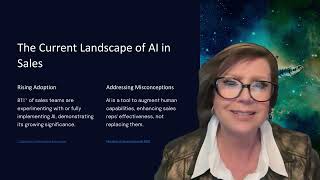
Here to talk about because again, there's this fast track of adoption on one side and then there's things on the other side that are not happening. So, okay, we've got this rising adoption. So there were 81% of sales teams that are using at least one tool with AI. And a lot of times a lot of vendors are bundling that in now, so you kind of automatically get it.
And that's great, but it is growing in significance and companies have more trust with that. Like, I do notice that companies are more apt to adopt something that one of their vendors has than going out and building it themselves and bringing it in. You know, in fact, in companies, I'm seeing a lot of companies that have a, you know, they've got a more measured approach, they have a very conservative approach to adopting AI. And so they're not going to be building anything. They might buy it because that kind of fast tracks some security questions and things like that. But it's the, the misconception is that it, it's not going to replace you. So, you know, there's this whole thing of, you know, AI is going to take over the early sales cycle, it's going to displace SDRs, it's going to do this. It's like, no, it's not. Because people that you're prospecting to don't want to talk to a machine. So if you're in tech, we all get it. We're in tech. We, you know, I'll get on a website, I'm trying to buy something, whatever. It's like, I'll interact with their bot to get my questions answered. But, you know, the people that you're talking to in these industries that are not early adopters and that are taking this very conservative approach, or they're even afraid of it, you know, they're, they're not appreciating that. They are not appreciating the idea of interacting with a bot. So that's, that's the thing that will always need a person involved. Like, I was just watching this, a video. There's a company called Mega AI. They're so cool and they're doing some really amazing things in some critical services.
For the public. And they were saying, it's not going to replace humans. You're always going to need a skilled human that has empathy, that's able to engage. What AI can do is it accelerates your reach and your capability. That's really the correct way to look at it. Not in a fearful, you know, it's going to take my job. I'm not going to adopt it. I'm not going to use this because, you know, I'm going to keep all the information and hold the information so, you know that that's not going to Help that's actually going to make your role obsolete if you do that. And I'll give some examples about that. Like, you know, the reality of adoption is, you know, there's, there's really not a lot of people that are using it individually. So you know, 28% are using it for work related stuff. So maybe they're using a GPT at their company. They might have Copilot or something like that, or maybe they've got a team's GPT or whatever it might be. And then 10% of those are using it every day. So that's not that much. There's also issues that have been longstanding that are still long standing and that's c CRM adoption. That's still a problem. So you know, instead of worrying about AI is going to replace you, it's like not using the CRM is a bigger problem because companies, they, they want to use AI to measure activity in companies. But that's kind of like a garbage in, garbage out type of scenario. And if you aren't, if you don't have any kind of compliance or governance management of data in your CRM, you know, that's not going to get you the kind of output that you want from your AI tools. And the thing that AI can help you with is it can help you to be able to have that compliance. Because you know, I remember back when CRM was really new and it was so hard for people to use it because they weren't used to having to key in stuff. You know, a lot of sales reps, even in tech, they're not, they're not super techy to be able to get in there and navigate a bunch of stuff and run reports. I mean their, their deal is selling. They know how to sell. You know, I had one company and it was a very technical company, but their rep was not using their CRM. And I remember asking him, how are you managing our stuff if you're not using the CRM? And he said, well, I print it and I put a dot up here at the top if my, I have one call and then I put another dot. And I'm thinking, okay, this dot system is like not going to work, right? But there's, there's versions of that today that are still happening and that's, that's something that companies have to use at look at. So instead of like freaking out about AI, it's like you have to make sure that you've got a data environment. And how can I help that? I can help like your, your Notes and summaries from your voice. AI, you can have that populate your CRM. You know, it does take a lot of time. And that's something that I look at. Like, if we're adopting a new technology, I want to see how much time does it take to use this, how much time does it take to learn it, and how much time does it take to use it? Because, you know, like, some tools that are very popular aren't good for us just because there's so much, you know, so many views you have to go through and pages and clicks and everything. And it's like, you know, you can spend 10 minutes in an account, that's not a good use of time. So we always look for things that are very fast and that you can move through them very fast. And you know, that's, that's something that AI can help you with, so it can help you get more information, it can help you be able to populate that. And as a rep, it's not like holding onto the information makes you worth more at this point. Um, because, I mean, that was kind of the feeling years back, right? Where they don't. It's like giving away all your work, putting it in a CRM and then they just take the account away or something happens or whatever. But it's, at this point, it's your ability to be able to leverage that data and act on that data that's important, not that you have it. You know, there's. There's one thing that I found here that I thought was really interesting is AI doesn't make people lazy. It amplifies the. Whatever mindset they have. So this is going to be where hiring comes in. So I was talking about elevating your talent on the front lines. That's going to be part of it, is are you actually digging in and learning this stuff, or are you just using it to write an email for you? And you just send it and then it sends something wrong because it does make mistakes. I'll give you a recent mistake is I was asking it about a certain technology industry and I said, who are the players in this? And it spit out this list of names and the biggest one wasn't on there. And I said, how come this one isn't on there? And they said, I'm sorry. So it apologized very conversationally, but it's like it's still going to make mistakes and that's why you can't rely on it. And that's, you know, these emails that are going out with weird stuff. In it, you know, that's the kind of thing that happens, that's what turns people off, it turns prospects off, it turns companies off, all that kind of stuff. So you, you really want to avoid things like that.
The team you have today. So there's always this kind of dream team like, oh, we're going to implement this, we're going to do that. Okay, what are you working with today? So today is you want to see how everybody's using it. Just because it's available doesn't mean they're using it. And you don't want to get on all this micromanaging thing where you're looking at what everybody's doing. But ask them, because if you've got 10 reps, you've probably got 10 different use cases of how they're using the AI tools that you do have available. You know, even if they're just standard ones, even if it's things in your CRM or if you have some voice AI or if you've got some kind of, you know, if you have some sort of GPT that you're, you're pulling information from, everybody's doing something different with it. Some might be using projects in GPT and chat GPT, others not others. You know, like one of the things somebody mentioned, another very popular AI that does deep research, it's not deep seq, but it does deep research but it instantly forgets everything you told it. So you know, Personally I like ChatGPT because it learns over time and it retains things. So you know, that's another thing that companies can learn out is, you know, what, what's going to be the shelf life of the information. So you know, putting it using something that instantly forgets, you know, that might be good for some deep research, but it's not going to be good for, you know, long term retention if you don't put that information somewhere. So again, you've got to learn yourself. And this has just been like any other sales training type of thing where a lot of people wait for the company and it's like, well, my company hasn't done this for me or I haven't had any sales training. And there's a huge percentage of companies that don't provide sales training, they provide product training but they're not giving you like deep dive, like kind of social dynamics, you know, how to read the room, read between the lines kind of sales training. So you've got to do this yourself and you have to invest in yourself so you can do that on the. I just named A few here. I did some searches on here. There's literally thousands of courses on Coursera, LinkedIn, edX, Udemy, all of that. You've got so much access to information, the there is zero excuse to not understand prompting. And that's really what you need is prompting. Because, you know, a lot of, you know, I kind of look at this sort of like marketing automation. Like when marketing automation first came out, a lot of people were just using it to send emails. So they go spend like 50 grand on a thing just to send emails. But really you need to get in there and create a workflow and there's a lot of complex elements to it that you have to know. And it's the same thing with AI. There's a lot of complexity to prompting and you have to know how to prompt. So how do you engineer the right prompts so that you get the information?
Your, your output is only as good as your input. And so the more depth you can add, the more insight, the more traits you know. How, how do you want to view this? Do you want to view it from your prospect standpoint? How would your prospect view things like this? There's so much that you can get. It's, it's really amazing. And so you want to understand how to have that deep prompting knowledge so that you can use it effectively and not just to do, you know, really basic things.
You know, there's, there's also insight into individuals. So you've got your, you've got your, your overview of companies. You can analyze their, their annual reports or their industry and challenges and all these different things, but then you can get to who's in the room and there's a lot of different tools out there that you can use. But agent AI has some really cool stuff and I'll show you one output from that. But you can, you can drill down so much that you can find, find the company landscape, what's going on in there, how you want to present, why this is the right thing to talk about. And then you can get to everybody that's in the room and you can say, okay, here's all the people in the room, here's what I know about them and what, how should I present to I. So I address everybody in this room. You know, there's something that I've used for years, which is based on the hbdi, the Hermann Brain Dominance Instrument, where, you know, there's kind of these four quadrants of people and how they think and it's not really, it's not role based it's just how they consume information as a person. And you know, so you've got your, your analyst logic person and your kind of creative spatial thinking person, your operational task oriented.
Your relational kind of people oriented person. And, and DISC is, is similar to that. And so how do you present so that you're covering all your bases so that nobody's losing interest or wondering, you know, that's something I have my team take when they join us because I want to understand how to communicate with them if I can understand kind of how they're consuming information. And, and so you can actually automate that now. And I'll show you a profile like if you're going to use disk, for example. So here is Gerhard's disk profile.
So I just, actually I just used his.
His LinkedIn and I put it in here on agent AI. And there's an executive disk profile that you can get. And so you can do this with everybody in the room and then you can do it with the company. So you can prompt this whole thing so that you've got a meeting structured, you know, probably 30 minutes, you can put the whole thing together versus hours of prep with a ton of blind spots. And I'm not saying this is totally correct. I've known Gearhart for many years, so this sounds kind of correct. But you know, this, this is really an amazing type of tool because it's so multidimensional and what it can give you.
You know, so, so really it's embracing AI is it's not going to make you less. It's not going to make, it's not going to, it's not going to replace your job, it's not going to replace early engagement. But the more, you know, and the more you empower yourself and the more that you upskill yourself, that's what's going to make money for you. Because just like how with CRM adoption, like, you know, years back it was kind of a nice to have. Now nobody's going to hire you if you don't know how to use a CRM. You know, it's like it's not our job to teach you something that's been around 20 years, right? And that's what's going to happen with AI. And if you look at the adoption curve, it's so much faster. So we're going to reach that level where that's a requirement. And you know, if companies are using it and the more they adopt it, the more they're going to require that the team uses it too.
So here's my information. I wanted to put this here for everybody. I'll make myself small so you can see it. And. Yeah, so connect with me on LinkedIn. I've already been getting a bunch of connections, so this is awesome. Connection requests from the summit. I'm on X. Reach out to the company.
You know, really excited to be here and I will look forward to continued conversations with everybody. So have a great time. Gerhard, thank you again. I really appreciate this opportunity and have a great rest of the day.
More from Gerhard



What Selling Looks Like When Your AI Agents Have the Context Your Sellers Do

Better Conversations, Smarter Support: Wearable AI in Business






When Scarcity-Built Systems Meet Abundance - The Judgment Gap in AI-Powered Sales Leadership
