Virtual Instinct – Empowering Sales with Practice
Michael Eaton's Virtual Instincts uses professional actors and role-play to train salespeople like athletes train. Record every practice session, build a library of wins, repeat the hard conversations until they stick.
Questions this video answers
Over 33 years (with the last 20 in leadership roles).
About 14 years ago.
About 30 conversations.
Up to a 30% increase in win rates in each pipeline stage and about 75% knowledge retention rate.
Six Super Bowl championships.
Why don't you join us? Michael, you like a product because you have acting experience. And I remember when I, before I started my sales career, I was in an amateur theater group in Austria and I learned how to act, but also I learned how to direct and what I did to start my career. When I was asked to help salespeople become better at their job and improve their skills, my mission was to help salespeople impersonate a professional through acting techniques. And it worked phenomenally. So, Michael, introduce yourself and tell us what can we expect from you today?
Yeah, Good morning, Gerhard. Yeah, thank you so much for having me on here. And somehow we found that rapport between you and I, Gerhard, on performing arts, like right away, earlier in our conversations. I don't know, maybe it was the passion we had for what we were doing, specifically with professional actors and virtual actors. So as you can tell, I'm excited about going into this presentation. Let's just back up a step and I'll establish who I am. So I am Michael Eaton. I'm the founder and president of Virtual Instincts Instinct. And I have over 33 years in direct sales, with the last 20 in leadership roles building companies from zero to multi million operations, not hundreds of millions, multi million and leading sales teams. And over 14 years ago, I began taking on camera acting classes and improv classes to really become a better communicator, to be more instinctual in the way I was conducting a conversation. And from the improv's perspective, not about being funny, just about being more engaging, more interesting. In both those class formats, you really learn how to break down a conversation into what we call moments. So the material here today is going to reflect on that experience and how it translates so well to sales. And yeah, Gerhard, we're very passionate about how performing arts learning to conduct a conversation with feeling and be a good active listener and how that can be very productive in a professional setting. So let's just get right into it. The first thing I want to establish with you is Virtual Instinct is a sales practice agency. And that might be a new term that you're not quite hearing about yet. However, you will kind of think of us as an advertising agency. We're going to create material for you, go out to different media channels and get the advertising distributed to your audience. We're going to do the creative work that drives interest back to your product or solution. Think of us like an insurance agency. We're going to take your needs to market. We're going to qualify where your risk is and recommend the best Carrier with the best coverage for the lowest premium and represent your risk management needs. So let me toggle over here to the next slide. So Virtual Instinct is.
Michael, can you share your screen?
Yeah, I forgot to do that. I knew I was getting right into it. Okay, here we go.
Nice lake.
Did we even rehearse that? Okay, here we go. Yeah. So Virtual Instinct is a sales practice agency. We're going to take your needs to market for practice and really we are designers of high impact sales practice. Sales practice environments using the best in class platforms to bring real scenarios to life with either virtual or professional actors, specifically to drive measurable results in sales. So practicing skills, skills are immediately available upon practice. And what we want to do is create a real life, real world scenario and bring that to life with either a real or professional actor. So what we're going to do is really qualify and understand where you're experiencing the most resistance in your sales process, where you have identified gaps in skills and recommend sales practice plans to become highly skilled in those areas and proficient. Gerhard this slide touches on how you open this conversation with where sales is today and how many sales leaders are experiencing the same thing. There's mounting pressure in producing results and also realizing growth. Buyers are more resistant. They're getting inundated with AI messages and phone calls. Therefore, people are more reluctant to pick up a phone call or even reply to an email even though it's really written well and it's personalized. The competition is tougher. There's more technology out there, there's more choices out there. You really got to vet it and qualify it and make sure that's the ideal solution for you. And then even when you do, the technology can change very quickly and there could be something better. Sales cycles are longer, just more conservative, more evidence, more proof, more use cases, more financial justifications. You're really going through a longer process there to justify both financially the value of your product and demonstrate it, along with all the technical requirements to implement it. If it is something unique like a technology integration, Sales cycles are longer, budgets are tighter. The economy is going to improve from where we are right now. However, we're hearing that specifically in fourth quarter and maybe carrying over in the second quarter. There's just uncertainty in the market and we need to become skilled at working through that uncertainty, creating certainty for our clients, either the way that we're communicating or even structuring our deals and entering into an engagement that demonstrates the value of what we're offering before. And then there's multiple stakeholders in the decisions now, that's very common, that multiple positions, either even C level or director level, are participating in the decision on behalf of their company to make sure it's right. And then that job function is looking at it, how it relates to their position and what their responsibilities are. So a multi stakeholder decision is more complex to conduct. You really need to relate to the different Personas in the meeting. So training, ramping and coaching at scale is more critical than ever. And it's only going to get tougher. All right, let me slow down here. You have a thought there, Gerhard? Do we just. What you said on the open.
I'm just looking at what Carl is saying on those obstacles, the same as we faced 50 years ago. And my answer is there's always a perception that the time we live in is the most difficult and challenging time ever. And that has never changed. However, the dynamics of the resistance has changed dramatically through technology. And what the. I think one of the biggest shifts is that we are mesmerized by our screens and our minds. A state of mind goes into next, next, next, next mode instead of the now mode. And what Michael is trying to explain here is that the salespeople need to practice like a professional actor or like a professional artist or like a professional player, like in a. In a batting cage. We. We need to hone our personal skills because technology is taking care of so much already. So we need to hyper personalize the sales conversation.
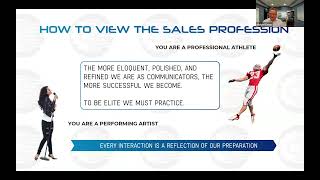
Yeah, that's absolutely right. Hey, I wrote down it was the best of times and it was the worst of times. It's the best of times in technology enabling us, and it's the worst of times in technology us having to compete with all the messages that our prospective clients are getting. So in that moment, we make a connection. We need to be highly skilled, we need to be practiced, and that interaction is going to reflect our preparation in doing so. We're opening and pivoting from many different conversations where that buyer is along the journey. Maybe they opened a piece of content, maybe they did click on and open an email. And something in our CRM signals us that we can reach out to that person because maybe they're ready for a phone call, and we got to be ready to open that conversation with skill. So in my mind and Gerhard, I know you feel the same way because we've shared this is. There's two ways to look at the sales profession. You're either a professional athlete and we love watching football, or you're a performing artist and we love watching Taylor Swift. And both those Professions are highly rehearsed. That's what makes it so fun to watch. And that that's why we're so drawn into the performance or so drawn into the drama, because we're watching the best of the best. And the more eloquent, polished and refined we are in the way we communicate, the more success we're going to have both in our personal lives and in our professional lives. So really, with the technology enabling us, helping us administer the sales process where you said 70% of the time a salesperson has throughout the day is on non selling tasks, hopefully we're going to get freed up with the technology enabling us in that area to where we now can get freed up to go and practice. And that's what all the sales practice platforms out there offer us is now an opportunity to practice at scale and practice to a high degree of skill. Okay, so we implement what's called a constraint led approach to designing our sales practice environment. And this is a sports science Gerhard. And really what it means is that me, being a designer of these environments, will want to recreate a performance driven simulation that puts a salesperson in an immersive environment where they have to think and feel their way through a conversation while they're being challenged. So the constraints are the challenge that the salesperson experiences in a conversation, such as objections, multiple Personas, how they're looking at a decision, budgets, time constraints, brush offs, whatever it is that we are experiencing. The sales process now can be recreated and simulated in what would be ultimately a role play. We want to bring that moment back to life with a real or virtual actor and then have your salesperson practice that moment to where they become highly skilled and have a deep repertoire of skills in that particular section of the conversation. So what CLA is, is a constraint led approach that mirrors a real performance. Think of a team scrimmaging that has the salesperson adapting in real time with both thinking and doing. So they become adaptive to that moment and become skilled in handling that particular area of the conversation. Okay, so we create environments that mirror real performance. We throw a lot of different tasks at them and we add resistance. So think about a different Persona adding resistance, antagonist Persona. Someone that's maybe realized that they answered a phone call, it broke their focus, they were going into a meeting and they're distracted. Salesperson has to overcome that moment with something that's going to convey value. Okay, all right. There's four components to a constraint led approach. There's interaction, coupling, organization and retention. So what we'd want to do is apply all four components to creating a role play or sales practice environment where the constraints are the challenges the salesperson is going to face. The objections, the brush offs, the last minute resistance to a meeting or the last minute objections to a close. The perception is the salesperson having to field and react to the social cues of that meeting while in the meeting and adjusting in real time to overcoming it. So if you want to implement a specific technique like medic spin, Chandler, what's the other one? There's so many challenger consultative approach, then you need repetition in that environment to develop that skill. And when do you use what particular technique? You won't use all of them at the same time. And then you're exploring it similar to an improv exercises. You're exploring that environment with the person you're talking to. And that exploration allows you to adjust on the fly and react with instinct. You're building an intuition for how to conduct the sales process. And because you're thinking and doing at the same time, you're really creating muscle memory for that particular technique and know how to use it based on how you feel. Okay, I want to pause there, see if you have a thought.
Well, I'm. I want to add something that it may be obvious, but it needs to be stated that there's a fundamental difference between a professional and. You use that word many times now in this presentation and the amateur, which you didn't mention. My definition is that the amateur has an occasional win like the blind chicken, but the professional delivers consistent results in adverse circumstances. And that's why we need to look at that constraint led approach from several perspectives. One from a sports perspective, but also from a war perspective. Like the Russian General Suvarov said, train hard and fight easy. And you want to practice with a solution like virtual instincts because you have two modes of engaging. You can engage with a bot and an agent. As an AI agent or, and that's what I love about your solution, you can practice with a professional actor. That is, in my opinion, brilliant. It's new on the market. I've never seen this before. And in the, you know, 15, 16 minutes we have left, I'd like for you to show us some examples.
Yeah, let's do that now here while we're on the slide, we'll just tie down the concept of how a constraint led approach translates to sales. So just thinking on the left hand side, a head coach is going to design a practice. Maybe it's a scrimmage and it's a seven on seven. Seven offensive players going against seven defensive players. That's the environment. However, the constraint could be it's fourth quarter, there's two minutes left, they're in the red zone, and it's third down and they need to score a touchdown to win the game. So that's a good idea of how a constraint size approach is going to create a simulated environment for which to perform and practice that mirrors a real world game. Okay. The same thing applies in sales practice. What we want to do is bring a customer Persona to life emotionally. Right? The salesperson needs to react emotionally into the social cues of the conversation. And then maybe they only have 25 minutes to meet with that particular prospective client. Maybe they're going to make a decision here at the end of the week. So there's a time constraint. Maybe the salesperson's proposal is slightly overpriced in comparison to competitive proposals. So we can create a situation that is real world, real life and have that salesperson practice that so that it mirrors what they would experience in a normal on a regular sales conversation with a client. All right? So then when that happens, the salesperson becomes more adaptive and more instinctual to how they're conducting the conversation through the repetition itself. Okay, so let's toggle out and give you an idea of a real actor and a virtual actor and what we call our success library. So every practice session that we conduct is recorded and converted to a video gallery, and it breaks the longer practice session down into one or two or three minute clips that we call key moments, which is the individual skill that they're practicing. So let's watch, say, Logan practicing with Fred. And just to set this up a little bit, Logan is a commercial real estate broker and Fred is the CEO.
At the very least.
And Fred is not interested in meeting with another broker. There's just not a need for them right now. So Logan's having to work through the initial resistance of a cold outreach to begin developing a relationship with Fred so that hopefully one day Logan can be.
The broker representing real estate. And I just wanted to at the very least introduce myself and create. Create a line of communication.
My.
My team over here at Colliers out of Atlanta, as you guys in your offices in Atlanta, we specialize in industrial real estate. And specifically helping, you know, companies like yourself with their renewals, relocations, expansions, whatever that might be, really all your real estate needs. And that's. Yeah, that's what we specialize in. So I'd just like to hear a little bit more about the whole situation and maybe your future plans.
Yeah, we're all set for right now.
And you said Colliers.
Aren't you the guys with the real high fees?
Hey, I want to stage this. This was a pilot here between Logan and Smitty. And Smitty's a professional actor. Logan is a commercial real estate broker. And the resistance here is that Logan is cold calling Smitty. Smitty's the CEO of the company, and he's not interested in meeting with. With Logan because they're already in a lease. They're already working with another broker. Let's play another clip here. This is Jamal practicing with Kathleen. Kathleen's the professional actor here, and Jamal is working through the initial resistance of a cold outreach.
And if we were to build our, you know, surprised at all to hear that you all work with a broker. And, you know, what we do is offer information and we share relationships. And so, you know, we wouldn't be stepping on any toes. You know, we'd just be offering you information to better help your situation. And if we were to build our, you know, relationship over the time and you would want to try to explore, you know, you know, doing business with us, that's something that we would be more than happy to bring on. And if not, you know, we're perfectly happy with just building a relationship and making sure that you understand that our team.
Okay, so Jamal is working through a similar resistance that Kathleen's already working with another broker. Kathleen was asking Jamal to explain why it makes sense to work with a competing broker, and Jamal's hand having to handle that particular, let's say, resistance by Kathleen to the opening of that conversation so that he can begin building a relationship with Kathleen and his company when it's time to get a new lease. Let's take a look at a virtual actor here. And the virtual actors are really good. They are sentimental. They have a lot of expression. And here's our partner here.
Tell me what you're currently prescribing for your patients with type.
This is a pharmaceutical demonstration.
Hi, my name is Arden.
David is a very structured, very compliant oriented talk track where it's regulatory driven. So you really have to stay within a framework here that needs to be practice.
And I'm your account representative from Davis Pharmaceuticals. I'd like to talk to you today about Renodexa. Can you tell me what you're currently prescribing for your patients with type 2 diabetes and CKD?
Hello, Arden. Right now I have many of my patients on far CIGA and they seem to be doing fine with it.
I'M glad to hear that. Have you had any issues at all with your current medication regimen?
Overall, my patients are doing well, but as with any treatment, there are always areas where improvements could be made. Some patients still struggle with glycemic control and managing the progression of their kidney disease.
That certainly makes sense, and that's something I've heard from a lot of other providers as well. Raina, Dexa does have an advantage with glycemic control in minimizing hospitalizations due to heart failure. But currently with your glycemic control issues, is that taking up a lot of staff time or, or do you just send those patients to an endocrinologist?
We manage most of our glycemic control issues in house, but for more complex cases, we do refer patients to an endocrinologist. It can be time consuming, but it's important to provide the best care possible.
Okay, so that was a really professional response. The virtual actor is on the left. Obviously the real actor or the real person is on the right. And that was a very good demonstration of a virtual actor handling a complex practice session in the pharmaceuticals industry, which is a regulatory, regulatory driven environment to conduct the sales process. So, Gerhard. Yeah, we gave you two examples there of real actors versus virtual actors. You can see they're pretty close. And that's definitely what I would say is an immersive constraints led environment that has the salesperson practicing a real world conversation.
Now, when it, when it comes to the avatar, the agent, AI agent that's giving the response, do you offer some choices of different agents? Can I, as the student, practice with somebody male, female, different ethnic groups?
Yeah, you can choose different AI avatars or different virtual actors. You can choose different personalities, different job functions, and we can also create them for you. So that would be one way of building out a sales practice environment for you would be to build the virtual actors to represent your buying your customer Personas in many different positions. So yes, absolutely, you can choose from more for more than one you can choose from.
That's good to know. And it's also important to know for our audience. There was a study at the University of Heidelberg, when students are given choices between avatars to work with, the learning went up.
Yeah, yeah. People want choices. And these two approaches, virtual actor and real actor, will complement each other. And one could be good for getting repetition and going through or say, an iteration of how you're going to explain something and getting the framework for how to conduct that conversation down into what I would say is a repertoire. And then Maybe you want to go live. The other way to look at it would be that we could arrange a multi Persona practice session where there's more than one real actor on a meeting that represents a multi stakeholder virtual meeting. So we can do a lot of different things. I want to kind of give you another analogy here. We use the analogy of an insurance agency or an advertising agency. Also think of us as a TV and film production company for sales. We're going to create the right environment for your team to practice that represents how you're selling your product and how those decisions are made. So we have the creativity and the resources to do that.
If I understand this correctly, you can actually create a sort of a talk track or a conversation that you want salespeople to replicate. Where you have a best practice model in your success library that every salesperson can watch.
Yes. That's the only benefit of this is getting the video recording. We will see what's good and be able to create a success library and then organize that library by skill set and by talk track. So you'll really have a very good resource for your company of proven sales methods based on how you are selling across different skills and techniques. Yeah, that's a good point. I'm back on the. The. The presentation here just kind of giving the idea. Practice is separate from training and we really do a good job of differentiating how training is different from practice practices. The opportunity to use any one technique that your company is implementing as a sales method and where you are now wanting to incorporate different sales methodologies such as consultative spend, Sandler, Medic or Challenger. We're agnostic of that, we're independent of that. We're going to focus on pos. The challenge for your team to use those techniques by creating the right environment and you think about. There's so many different elements of a conversation. Along the journey to a buying decision. You might have to make financial justifications demonstrating a return on investment. That means you need to go into a set of questions qualifying what those assumptions are. You may have to in the very beginning displace the competition, which is very, very hard to do. You may have to de escalate a decision that's 70% all the way through the buying process. You'll do product demonstrations. You'll tailor that demonstration specifically to how that company would use that product. You'll field questions and everyone relates to questions differently. If they have a lot of technical terms and acronyms, you really need to break that down and make it simple so that they understand and Then more. One of the most important things I think you can do in designing your sales conversation is design that closing track. We can allow you to practice that. How are you installing the clothes in the beginning of your conversation? How are you navigating trial closes, tie downs, and what we call anchors in acknowledgments to get to a close? We can practice that as well. So there's a lot of things you can do in the right environment to practice and become highly skilled in any one method or technique. We're going to focus on closing the chat.
Can you share your screen again?
Oh, I didn't, I didn't scrap my screen. Yeah.
But while, while we are talking, while you're displaying the screen, Eric has a quick question. How long does it take to get the AI smart enough to train with a salesperson?
That's a, that's a good question. So the AI trains as you go. We can take transcripts from Zoom Recordings or MP4s, look for the better moments in that. And then our partner on the virtual side also has scenarios and templates already somewhat created. We will want to consult with you to find out more about your sales process, the sales methodology you're implementing, and where you are experiencing the most resistance or where there is a skill or gap in the skills to conduct that conversation. So that's a good question. The AI will learn and train and get better the more structured information you give it, such as transcripts and recordings.
Three minutes left.
Yeah. Well, let's work it towards a close here. Thank you very much. Hey, here's why you want to practice. Skills are immediately available upon practice, specifically when you have targeted practice. And companies that consistently do see up to a 30% increase in win rates and each section of their pipeline and then a 75% knowledge retention rate. So if you are conducting a sophisticated conversation using a lot of technique and a lot of technology acronyms and terms, then practicing that in the constraint led environment where you're creating the muscle memory for using those techniques will help you retain that knowledge and then improve on it going forward. Most companies have five stages of the pipeline. If you look at prospecting, qualifying, discovery, then proposal to close, you really want to develop a deep repertoire skills in each of those areas to where you can handle and adapt to any question in any area or any objection or resistance in any one section of the call. So when you talk about a 30% increase, that's a 30% increase in each stage. So if you have, if you get a 30% increase in your appointments, will you get a 30% increase in qualifying, you get a 30% increase in discovery, you get a 30% increase in the proposals and the proposals converting to a close and just kind of going back to here, these are the different things you want to practice in each section of or each stage of the pipeline. So in the prospecting stage, you want to be really skilled in overcoming the objections, the brush offs, resistance, and then handling the flow of that conversation and somehow creating value on the front end of it. All right, so I'm going to move forward here and just tie it down with Bill Belichick. Hey, he's famous. The most winningest super bowl, most winningest NFL coach we know. He's won six super bowl championships and he was very well known for implementing a constraints led approach to organizing and designing his practices. And he felt practice needed to be more rigorous than the game itself. And their practice was an indicator of performance. So I wanted to tie that down here and then talk a little bit about the success library. We want to build that success library of proven strategies from practice, curate and refine it, and offer a lot of different ways to practice. Looking at the long term view of our relationship and how we consult with you is bringing different practice methodologies, different ways of developing skills, and then challenging your salespeople for growth. Capturing that moment and then putting it in the video gallery. That would be a resource for you going forward. Okay, so let's go back to tying this down. In sales. You're either a performing artist or a professional athlete. Virtual instinct is going to provide the stage, the sporting cast and the script for you to rehearse with, or the practice field, the team to scrimmage with and the plays to run. So we're focused on designing that environment for your team to become highly skilled in conducting your sales process with real or virtual actors. Hey, I just tied it down really well. Okay, I'm going to skip over this one here because we're right on time. Hey, the question, the closing question here is do you need results? Every company we talk to needs results right now. And the way to get immediate results is practice. And now the technology is available for us to do it.
How much is enough practice?
Yeah, it takes 30 conversations to improve skill or to reskill. Let's say we've got some bad habits that we need to improve on, or let's say we have some gaps in skills from one way of conducting the sales conversation to the next. It takes about 30 conversations to improve and refine that. So different environments are going to do different things depending on how we break down the exercise itself. So we're just focused on objection handling well. We will have a practice plan that would support having many different ways and many different repetitions and overcoming the objections. So it depends, Gerhard. It's just a little bit different depending on how we structure the practice.
Well, thank you so much, Michael. That was awesome. You did a fantastic job in defining the problem and presenting a nuanced, multi level solution. Because we all need to improve the performance of the sales team and prepare them with difficult situation, with constraints that are natural and. And rehearse in the safety of the virtual office and rehearse with customers.
Yeah, thank you very much. If we're rehearsing or getting our experience in front of live clients, as hard as it is, we're just risking real clients to do that. And we have the platforms and the technology.
All right, we need to stop. We have eight minute break and we will come back in eight minutes. And don't go anywhere. Keep letting like, you know, text me your questions as you think of them. Henry Clickel, Michael. He wants to know what's the cost? Is this per user, per company, per amount of videos? Yeah, maybe you set up a call with Henry. How is that, Michael?
Yeah, that'd be great.
All right, I'll help you connect.
Thank you very much.
Okay, thank you.
More from Gerhard



What Selling Looks Like When Your AI Agents Have the Context Your Sellers Do

Better Conversations, Smarter Support: Wearable AI in Business






When Scarcity-Built Systems Meet Abundance - The Judgment Gap in AI-Powered Sales Leadership
