What AI Can't Replace: The Human Skills Still Winning Deals
Tim analyzed 150,000 deals across 500 companies to identify what actually predicts sales wins. Eight specific buyer experiences matter far more than product knowledge. He found 53% of losses were winnable, and sellers misread what buyers think 70% of the time. Role-play simulations and targeted skill training drove 7-30% revenue lifts at United Rentals.
Questions this video answers
About 150,000 deals from over 500 companies across 50 industries.
About 70% of the time.
Approximately 53% of losses were winnable (buyer perspective).
Eight predictive buyer experiences (the "great eight").
Area under the curve measurements reported roughly from 91 down to 73.
Chapters
Well, appreciate you guys having me here today. It sounds like maybe there's been some dialogue already about this topic because I think everybody's asking themselves, well, what's left for the seller? What, what keeps us special? Where do we add value? What, where do we still make the difference? And, and I think everybody's searching for that framework of competencies and skills that remain, any that might be new. And I'm hoping to share some of that with everybody today.
Take it away, Tim. Thank you.
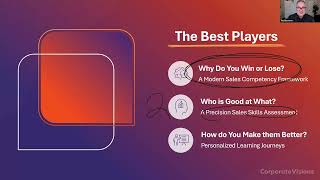
All right, good to see you all again. All right, so that's what we're going to talk about. I like to do this. I like to, I like to start with this story. If anybody's heard me tell this one before, don't blurt it out, because I think it, it lines up with this premise of the human skills that remain the deciding factor. The 103 stands for 103 million hands of online poker. They studied them because there's a lot of data. And what they found out is, in much to my surprise, because I don't play any poker, is that only 12% of the time does the best hand win. Literally, just because you have the best hand doesn't guarantee a win, especially if you're playing against somebody who's better than you. The best players win 88% of the time regardless of the hand they're dealt. And I think it's that way in sales yet, because a lot of things are going to go to. Even AI is going to do a lot of things to improve productivity, but it's still going to get us to a level of stalemate. And the deciding factor, I believe, and I think the data I'm going to show you still believes is going to be who, whoever plays it best. The one who tells the best story with the best skills is still going to win regardless of the hand they're dealt. And pretty much anybody who's in business anymore has a good hand to play. So what does it, what does it take to be the best player then? Really? Three things I'm going to talk about today. What it takes to be the best player is you have a competency framework that is for the modern selling and buying journey. And we're going to talk about how you find that modern competency framework, the remaining skills that matter, and how you do that through win loss analysis. Second, you need to assess, and there's going to be a lot of people talking about assessment here. I think I'm going to give you a new spin on the idea of assessment. The Idea that you can't just declare, I'm good at math, you have to do math. Yet every day we're telling sellers, how good are you at selling? And we ask people to reflect on and self assess. A new day is coming and we're going to talk about that. Third, you need to begin to personalize learning journeys to deficits identified by the individual and eliminate the idea of plausible deniability in order to get the behavior change you're looking for. So really, three sections we're going to cover today. The first here is what does a modern selling competency framework look like? And the first thing that we did is go out and figure that out. Not from the perspective of what sellers think good and bad looks like and or what wins or loses deals, but what the customer believes causes deals to be won and lost. Because at the heart of a win or a loss is an understanding of the experience that you do or don't create and the experience that still matters and the experience that makes the difference. We sit on top of a large database because we do win loss analysis. We have over 500 companies worth of data, 50 different industries worth of data into 150,000 deals worth of data that we're looking at. And a couple of things jumped out at us that I think are important as we look at what skills and competencies still matter. First, I'm not sure you can trust your salespeople when you ask them, why did you win or lose? Because the answer you get when you look at the exact same deal, ask your seller, ask the customer on that same deal, the answer is different 70% of the time. So at one point we're all going to have to declare, do we have the right insight in order to know why we win and lose and what matters in a win or loss if we aren't asking our customers, I've done it for you. So here you go. Here's a couple insights that we've got to share for you. One is that when you lose, most often our sales teams declare it was something outside of their control. Turns out the majority of your losses are fully within the seller's control. It's based on, from the buyer's perspective, the experience that they had with your team. So 53% of losses, the majority of losses were winnable.
If it wasn't for something your team did or didn't do, we'll just grant that 100% of your wins are because your team team was awesome. But. But even in loss, it's still about that experience. We can't just blame it on product or price or politics. There's a good chunk of this that's still within our control. Kind of gets back to this idea that it's the best player that wins and even when you lose, the player had the most opportunity to affect that. So the question then becomes, well, what experiences? What do we mean by experiences? What I want to show you today is, is that we've been able to identify and isolate eight specific, what we call predictive buyer experiences. Why is this important? Because from the buyer's perspective, when they look at a decision they made and they ask themselves, or really we ask them what made the difference and we get them to express what one vendor did versus another vendor and we asked them to score that and compare that and then we look at what they said relative to whether it was a win or a loss. What we find is that there are eight experiences that are predictive. These numbers that you see in the Top here, from 91 to 73, is a measurement called area under the curve. And that basically says you got about a 91% shot of winning if you create that experience, or a 73% shot of winning if you create this experience or any of these other experiences in between. So now what we have is a look inside of the mind of the buyer as they make decisions and as they judge the experience they're having with your human seller. In other words, this is the human to human connection. These are the experiences that a buyer can observe, score and compare. And these are the ones that matter to wins and losses. Things that fell below the line over here to the right actually were things like product knowledge, industry knowledge, ease of purchase. Those things were 0.5 or no better than a coin flip in terms of.
Impacting wins and losses. They weren't not necessary, they just weren't different and they weren't observably different. The things you see in front of you are. So what we're proposing moving forward is that everything you need to do to run an engagement in your process is important. But at some point there's going to be a stalemate. And what you need to train and enable for is, yes, you need to run an engagement consistently in order to drive predictable pipeline and manage that well. But the thing that's going to make the difference is the experience that your teams create. That's where the difference is still going to be made. In other words, that's where the best players make up for or take advantage of the hand that they've been dealt. And these Eight align well, but the expectation is that you're going to create a certain level of experience. So what we've done with that is acknowledge that if these are the experiences that matter in our predictive, this is our new competency framework. The idea that there are specific experiences that buyers can identify as meaningful and predictive of wins and losses means these are the things you should train to, these are the things you should enable. And spoiler alert, coming in the new year we are beginning to sift through this data and those deals that were renewals and or we could attribute to cross sell and upsell and we're starting to see sort of, we euphemistically call these the great eight. There's another great eight and the great eight for acquisition is different. At least six out of the eight for retention and expansion. If you just look at these, you can begin to see the formation of a, of a buyer evidence backed competency framework for your selling teams and recognizing that they can be optimized for the human to human conversation based on the experiences that matter to buyers and are predictive of a win or loss or retention or churn. So what you've got is a modern sales competency framework. But then you got some questions. Now you got questions when you look at your team is like okay, if this is what really the customer or the prospect is judging us on and we got to be good at these, who's good at what. And that takes us to point number two here and the idea of being able to precisely assess your teams and for each of these eight competencies in each of these two cases. And I'm going to move into that discussion and I know you've probably heard something about assessment. I know there's things about assessment coming up. I hope you find this unique because here's where the power of AI is really making a difference. The power of AI is unlock this idea of a performance based assessment. And the reason I want to emphasize that is there are really no.
Calibrated validated performance based assessment for sales. Pretty much every assessment that exists and that you're probably hearing about is a set of behavioral questions that a seller reflects on and answers for themselves about how they think the interactions with their customers are going to. What you have here is a underlying database or data set of competencies based on what buyers want to see and the underlying skills for each competency that are predictive of wins and losses. And then an AI simulation exercise in three parts performing the initial outreach against one Persona, then a more senior Persona where you now move to value proposition and solution presentation. And then in the next simulated vignette, same deal, you have the next most senior Persona where you're giving a business justification and negotiating to a close. So think of it as a business case, a standardized business case. Think of it as sort of the act for sales. And now you can start to accurately think about this experience. It's about a 30 minute, 10, 1010.
Simulation, and it isolates each of the skills underlying each of the competencies in an experience. Sort of a seamless experience where you're doing role plays, you're having conversations, you're listening and.
Checking some boxes on some things. You're, in other words, demonstrating the skill in context of an actual deal. And what you're getting back again isn't a self assessment. What am I, a 1 or 5? On this skill, you're getting back actual performance data and the company's getting cohort sort of heat map information against the eight predictive experiences. So this is where it all the whole world comes together. You're now assessing against those competencies and skills that have been identified by buyers, modern buyers, in recent history, telling us why they buy. And now you're being assessed in a calibrated, validated deal scenario in a simulated environment to get a precise baseline of your skills and completely different than anything that's really being experienced or delivered right now. But I'm going to show you some results. I'm going to let your eyes adjust for a second here. So what you're looking at is across the top are the eight. And this is a recent client work. The names are anonymized, but the data is real. So the first thing you're going to experience is suddenly a visual, a visualization of the cohorts in your company that are doing really well, those who are doing poorly, and those kind of hanging around the middle in each of these competencies. That is an interesting sort of way to begin thinking about who needs what, who does what well, and who does what poorly. But the questions evolve from there. Okay, so now what happens next? You can start to think about personalized learning journeys for the first time. You could have a singular individual and begin to recognize that this person has a different learning journey than this person has. And you can begin to think about assigning people into learning journeys that matter to the deficits that have been identified in, in their performative assessment. And now they're working on things that are hard to deny. Instead of us giving everybody the same training and assuming we all need it.
Recognizing that everybody might need a little something different. And knowing that the thing that they're getting trained on is the result of a pretty intensive assessment of where they stand, you now improve the odds of adoption and utilization because it's personalized and it comes from a place of precision assessment. So that's one way to think about the future of training against this competency framework is now to assess and provide individualized learning journeys. We're also thinking about them at the team level. So this is not a real name again, but it's real data. Here's Alison and her team. And you can start to see both Alison and her skills against these competencies and her teams. And you can start to think about what training and enablement and coaching looks like. Especially when you're like, we need a manager first, manager led sort of effort. And you look at a team and say, well, let's focus on these folks who need to do this thing better. Because it's pretty predictive of wins and losses. Remember, it was 91%. But lo and behold, you can't just be like, hey, manager, go help your team be better at this. So why do I show you this? Because.
30 minutes later, after everybody does this assessment, you have this incredible look at how to engage your team in a training and enablement and coaching manner. You see things like this where the team struggles, for example, at being a great negotiation partner. But Allison is killing it. And you can start to understand that possibly she's saving every deal or showing up at that moment in every deal and her team could be developed in that area and she seems to have some skills at it and just things. Light bulbs pop. As you now get a chance to look at this data, remember, it's about this point where everybody goes, how did we get to this data? Again, Everybody did the 30 minute performative skills assessment where they went through an entire business case scenario, through the entire selling journey, and it revealed the scores against these eight competencies. One of the things that's interesting is if you have a manager who's struggling in a certain area, I know companies have thought about peer led training or mentoring, and usually your mentoring assignments and your.
Mentoring or peer coaching assignments have been, hey, work with this person. They have more tenure than you. Oh, hey, work with this person. They seem to achieve quota more than you. And the reality is it doesn't mean they're good at the thing that you need help with. So now what we're going to be able to show is against a certain competency, you know who your cohort is that needs some training and coaching and some sort of intervention. But you also know who can help them be better. Somebody they might respect from their peer group, somebody who can come alongside them as well as maybe even their manager because they are demonstrating what good looks like. And, and, and they can be paired with somebody who might be struggling. I want to bring this all home to you and one more idea around the assessment results and then I want to talk about personalized learning journeys, the third piece. But real quickly, we had a client whose win rates were down and they came to us and had their team assessed and basically they had that spread of people who were good, bad and middling for each of the eight competencies. And they're like, okay, now what? So what we did is we took the assessment data and asked for the win rate data for all of the people on this team. It was about 100 people across 10 managers in a couple states. And what happened when we looked at the top quartile and then the bottom quartile and then took the win rates of the bottom and the top quartiles is we saw this interesting spread show up, turned out in a line solution to needs the top quartile and the bottom quartile. From the assessment when we looked at their win rates there wasn't much of a difference in the win rates. But in three others there was a huge gap in win rates, like north of 20% difference in win rates for the top quartile versus the bottom quartile for those competencies. So what we're able to do is identify three cohorts against those three competencies and begin a program for them sprints because they want to hit the ground running for the new year. And we are just now through the second sprint and they're coming back to us and saying it's already moving the needle. People are loving the experience. One just knowing and accepting that they are in this deficit and getting the specific help they need. This was a notoriously overperforming group who was struggling with why are we underperforming? And this revealed a very directional and highly now measurable before and after intervention based on the assessment and then putting learning and enablement sprints against these three cohorts. So that kind of gets us to the idea. And again, I know we are on the clock of a modern sales competency framework based on actual buyer evidence. And now a precision AI driven, simulation based.
Calibrated, validated skills assessment that heat maps your cohorts that could be bumped up against KPIs that you want to affect where you can now see which competencies need help first and most and who needs it first and most. And you can begin to personalize learning journeys or remediation or enablement from there. So I'm going to talk about how that looks because I think companies are going to have to recombobulate, if I can choose that word, recombobulate your content, your enablement, your training content to be aligned to these competencies because they're the ones that matter from buyer's perspective. And then be ready to respond when you have assessment data that says Cohort 1, 2 or 3 need help on Competency 1, 2 and 6. And so your content needs to be reorganized to be responsive and solve for that particular gap. So what we're talking about here is basically creating 16. I'm not going to circle them all, but you're going to get the point. 16 specific.
Competency based learning intensive experiences. And what that looks like is recognizing now the predictive buyer experiences as competencies and then taking each competency and, and understanding underneath it which specific skills will get you to competency and putting together a learning journey, a learning sprint by competency that includes modular skills training content that will get you to competency that you then can plan against and prep against, and you can practice and demonstrate proficiency against. So thinking about each of these competencies, then recognizing where they come from, buyer evidence, then being able to assess and understand who is strong or weak at which ones and beginning to prioritize against these 16 which skills they should be taught in order to get to competency and putting them through a specific intensive sprint for behavior change is what we're talking about. In fact, what it looks like for us is we're creating competency based intensives and the experience includes learning content, application content, practice experiences and reinforcement content. So imagine 16 of these kits now being accessible and deployable in personalized learning journeys. Like I said, 1, 5 and 8 or an acquisition, you have account management, they're doing 2, 4 and 7 for any given individual based on their assessment result. And they're learning the key skills and concepts. Every skill under each competency has learning content, application content and practice content. I'm just going to pause there for a second. Practice content looks like custom planner built out to against a rubric for that competency that then is uploaded into a role play so that that role play now becomes that seller and that seller's account and that competency driven roleplay so that you can practice and get to A level of certification. Quick story here is yesterday I just recorded a podcast. So this is fresh news. A client of ours is going to come out January 13th, and I can say their name. So United Rentals, the largest equipment rental company in the world and the University of Houston's leading sales professor, looked at AI roleplay simulations done on the release of a new skill set and a new message around disrupting and creating change at their customers. In other words, trying to open up new business opportunities at their customers. So they built a new message and they taught some new skills and then they put people through a role play. 2,000. Oh, 2,000 sellers, 400 of them, for some odd reason, chose not to do the role play. So you had 1600 who completed it. And we created a control group that emerged by basically people who weren't willing to practice. So that was great. So we had a control group among the same exact selling group. So we had 1600 role playing. On an average, they role played five times. On average, five times. And 400 who did it zero times. And this is getting a little ugly, but over here, between the different selling types, they saw a difference in 77 to 30% revenue increase.
Correlation, a correlation of a 7 to 30% revenue increase for those who had used the role play at least one time or more versus those who didn't. And they also saw a plus 1% correlation increase for each time you did the role play. It's a correlation, to be honest, but it's real data. So what does it say? Practice and getting and attaining a level of proficiency in an environment that is simulated to be as real as it possibly can, it can be correlated with increases in revenue. And you're gonna. There's more to talk about on that. There's subtle layers of detail there between manager involvement and tenure and high and low performers. But suffice it to say, when you put it together, there was a highly correlated increase. So we know this is important. And what we know is their managers were not going to be able to scale to run people five times through a role play and give each time detailed feedback and precise results and continue to get them to a level of proficiency. And you get one time, if you're lucky. This is an organization that usually did this with their trainers, and they have four trainers for 2,000 people. So that was not going to scale. And then you have the opportunity to reinforce. And so the point being is that being able to learn, in this case, think about our competency, make a case for change, learn that concept, apply it through A message and a skill set and then practice, practice, practice five times and you can start to see a revenue increase around an area that was extremely important, strategically important to that organization. So there you have it. Gerhardt. I think I left three minutes for questions. 1, 2, 3. Sales competency framework, a precision skills assessment, performative assessment and personalized learning journeys that include.
AI to assess and AI to role play, driving 7 to 30% improvements. If you can focus on the need that is important to customers and is needed for that team and you can give them a specific learning journey that matters to that competency and you can see results.
Olivia just said.
You'Re always at the, at the front of what makes sellers better. This is, Damien says this is very useful.
Our title was AI. What is the role of AI in all of this? Is it in analyzing the role play? Is it in designing the role play? Is it in customizing the.
The, the case study?
Yeah, so. Well, my title was what AI can't replace and it's these 16 competencies and their underlying skills. But yet AI is present in all of it. AI was used to review all of these win loss records to figure out which competencies and experiences were predictive. AI is used in the simulation, in the precision skills assessment to determine the skills gaps and AI is at the center of the practice and proficiency in support of the learning journey. So AI exists in all of these areas, but the ultimate outcome is a more effective seller in a conversation with a buyer. So it's all of the goodness together.
And Tim, how long is it that you see between when the learning is happening, when they're going through this and then the actual impact on their revenue on average? I know it can vary a lot. Right, but.
Right, so these guys.
They did all the role playing in the training at the beginning of the year and then they told me that they were going to start monitoring results and crunching the data and at the midpoint and now we're at the end of the year and we're getting the results. So I think you can kind of look at sort of training and role playing and then reviewing results as that was over the course of almost a year. But that's programmatic, end to end, Right. Build the message, put the training out there, get people through it, get them role playing now, monitor their performance and now crunch those numbers. So that was give or take a year long exercise or at least nine to ten months.
That's great.
Where you see consistently the biggest skills gaps.
So it's interesting because when you do these assessments you see every company has a different.
Sort of heat map for, for which ones they're stronger and weaker at. And so the thing we've been doing is using that KPI like win rates to help us then see for a specific company where that might be the most important. So we always have cohorts in all of these competencies. We see poor performers in all of them. And then to figure out what you need most and how to prioritize these, it's always good to match that with a KPI. It could be, let's look at your pipeline data and now look at which competencies matter the most versus win rate data. And all of a sudden these competencies flash. So it's, it really is kind of fun on a per company and a per objective basis to then see how the cohorts sort. But what I would say is that in general we see the alignment of solution to needs and good solid upfront work to define and gain agreement on the problem statement and be sure that that's solid for the rest of the sales cycle is primarily the. Almost like the, you must have like if, if all else fails, you start there and, and, and companies definitely have gaps there. I think there's a lot of things that are assumed and I also think there's a lot of training there that's about 30 plus years old and the modern buyers just not responding as well.
So you've been in this business for almost three decades and you have seen.
The science of selling change and the art of selling change.
Now I'd like your.
Insight on.
How can sales leaders.
Become more scientific without throwing out the art of masterful connections.
I feel like the buyer evidence that we got was really heartening because it showed that the experience that we, the human create is still paramount to wins and it is the main reason we lose if we don't do it well. So that tells me that as long as human sellers and buyers are in the loop together, we can AI the snot out of it and there's still going to be that moment. So we can all take heart that, that, that that exists. And I think though that what we're finding is it, it's. We can get more and more precise and more and more prescriptive and more and more personalized about how we coach and on what we coach. I think it was a guest fest up to this point and what I love about it is it's getting closer and closer to certainty and that's going to improve all of us. So the science is helping us Be better at improving people's art.
Wow, Stephanie, what would you add to that?
I love hearing Tim talk because we talk the same language of data and science. And the fact that he's building all of this based on real numbers, real science, working with real researchers, it just, it says a lot.
Do you know Johannes at. At Houston?
I do, yeah.
He's the one who did this research. Yeah, he's the one who just did this research with United Rentals. So you'll have to ping him on and it's pretty exciting stuff. And I know you like your role play stuff stuff too, so it's great.
Yeah. No, I mean all of this backed in science, having that certainty and objective ways to measure data instead of just a gut feeling or a guest. I mean, it really is driving performance. So we see it here.
I. I like the idea.
Yeah, I forgot to put my freebie up. So there you go.
I love Tim's idea of building the art of selling on a foundation of science.
Yeah. And moving from guesses to certainty. And when our confidence is up that we're putting the right activities against the right objectives, everybody wins.
So we want to also invite people. Tim is gracious enough to host a invitational executive forum that will be only 15 minutes, very high level, only for C level executives. And we do this in January.
Tim, tell us about it.
Yeah, well, I mean, I, I was honored to be requested to come back and do whatever. I think you call it a master class. And, and so for my money, the best thing that could happen there is I'm answering the hard questions like people who want to dig below this and really touch it, really feel it and, and posit, you know, what ifs or what about my situation. So, you know, what do they call it? Stump the chump. You just. Let's take a shot. Let's. Let's talk about it. Because again, I got more data, I got more idea. I can throw more stuff out, but let's, let's work it. So I'd be happy for people to join and make it a lot of fun.
Wonderful. And we will send out an invitation link to everybody who attended your session. Tim, thank you so much. I encourage you to get that ebook scan that QR code right now, which will disappear in the next 30 seconds. And we need to move on to our next session. Tim, thank you so much.
Always a pleasure. Thanks, Gerhardt. Thanks, Stephanie.
More from Gerhard



What Selling Looks Like When Your AI Agents Have the Context Your Sellers Do

Better Conversations, Smarter Support: Wearable AI in Business






When Scarcity-Built Systems Meet Abundance - The Judgment Gap in AI-Powered Sales Leadership
