What AI Can't Replace - The Human Skills Still Winning Deals
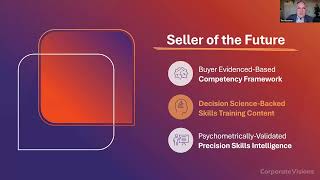
Tim from Corporate Visions breaks down which sales skills AI can't replicate, using data from wins and losses. The human edge: building trust, reading the room, and adapting to what buyers actually need. Competency-driven training and AI-powered simulations help reps close the gap.
Questions this video answers
June 27, 2025
103 million hands
12% of the time
150,000 wins and losses
Over 500 companies in 50 different industries
Chapters
Welcome back, everyone. We are thrilled to introduce Tim, our very good friend from Corporate Visions, and he's going to talk to us about what AI can't replace. Although he's got some really interesting AI tools up his sleeve, I guess. Tim, what are you most excited about that's happening right now with AI, with coaching, with training? You're right in the thick of it.
Yeah.
It's interesting to watch from two different angles.
We have a client, for example, who has applied the skills and the stories that we've helped them with, and they're growing 30 to 40%. So their emphasis is, how can I get these people who are producing well to produce more? And so they're leaning into the tech for productivity. We have another client whose win rates are abysmal and they're like, if I just add AI productivity to the suckiness, I'm just going to speed up the sucking. And so they're focused on making sure that their team has the ability, when given more access and more opportunities to actually deliver when they get there. And that's where I'm going to lean the most into today is do you still have. Let's, let's, let's improve productivity, but let's make sure that the folks who are doing more are actually good at it. And then what is it? That's the question is what's left for the human and what is it that AI can't replace? And that's where I'm spending a lot of my time, because that's the question that until our audience is all bots, that's important because all the audience is human and they want to know what's still important, how they can add value. And that's what I want to talk about. Thank you.
Yeah, I love that you point out that dichotomy between the two and where you're really going to focus, because we do have a bunch of humans that are still in the sales force and we have to support them.
Yeah, they're asking these questions for sure. Some of this I shared at Gartner's leadership conference. So if anybody was there, here's a little reinforcement. But this was really well received. I think everybody needed to get their head above AI water at that conference and probably during this conference as well. So maybe a bit of a reprieve. This is probably the, for the, for the majority of this time, this is the only time you're going to see AI until the very end. I'm going to bring it back because I'm going to reveal what's up my sleeve, as Stephanie said, so.
Oh, very good. Well, Gerhard, this audience is in for a treat because Tim is a fabulous speaker and. And I love how he writes on his slides, too, to keep us more engaged.
Well, I'm tempted to say that what AI can't replace is face to face. And on the other hand, if you don't use AI you will show up with egg on your face. How's that?
I can always count on you for Gerhardism.
And I love it. I think that face to face. But, hey, we're not face to face right now. And there's still things humans can do to make this mom matter and make it a good memory, and I hope that's what I do today. All right, all right. To get that started, I'm going to start with three numbers and have everybody write these down. If you have not heard my poker story, this one's free for you today. I know we're talking about sales, but bear with me. I saw a study that looked at 103 million hands of online poker. I do not play poker, let alone online. So I was shocked when I found out that only 12% of the time did the best hand win. I found that fascinating because I'd be praying to the poker gods, please give me the best hand. Please give me the best hand. And it turns out that I would have lost the majority of the time to someone who knows how to actually play this game 88% of the time or really close to almost all the time, the best player, and they got the data to know who that is, wins regardless of the hand they're dealt. And I believe that's really where sales is at. Like, this is the opportunities. We're all going to have the same hand to play. I think our products are very similar and our tech stacks are very similar, and the things they tell us is going to be very similar. And then at some point, you got to show up and you got to do your thing, and that's the opportunity. So I want to talk about that. So what are the distinctly human skills that the seller of the future must have? So I'm going to talk about a new, modern competency framework, not one that's based on guesswork and opinion, but one that's based on actual buyer evidence. I want to talk about then how to align training content, coaching content, enablement content to that competency framework. Then I'm going to talk about how do you figure out who needs what? One of the biggest things moving into the future is going to be validating the skills that are needed, but then identifying the skills gaps. People are going to learn best when their personal, when their journey is personalized and we have some ways that we want to share that will create a valid, unassailable sort of assessment of what somebody needs in order, what they need in training and content in order to become competent at the skills needed for the human to human decision making process. So let's talk about this buyer evidence framework, wins and losses. I don't know how you all document your wins and losses, but, but a lot of companies I talk to ask their sellers to put something in the CRM. Why did you win and why did you lose? What we found out is if you ask customers why did that company win or lose and then you ask salespeople the same question, you get two different answers at least the majority of the time. So the buyer and the, and the seller talking about the same exact deal disagree on why you won or lost. Imagine that. But the problem is then what do you, what are you going to do if the only data you have is from your internal team? Well, we're going to fix that for you. I'm sitting on a data set, a data set where we have looked at over 500 companies, wins and losses in 50 different industries and we now have 150,000 wins and losses that we can examine and figure out what's in there that we can learn from real decisions made by real decision makers who are reflecting on those decisions and identifying what made the difference from their perspective. And all of a sudden you start to learn things. One of the things we learned that was quite shocking is if you remember my poker analogy, that it's the best player who wins. It turns out when you win, true. When you lose. It's also true, if you will. 53% of buyers said the losing vendor could have won the deal if it weren't for something that did or didn't happen in the sales experience. So what happens in losses is the seller will often blame things outside of their control. It turns out that more than half of losses were things within the seller's control, meaning something that the human could have done different in the human to human interaction. And that's what we wanted to dig further into. And what we were able to find is that there are specifically eight predictive buyer experiences. What does that mean? There are eight experiences that a buyer can observe and they can score you on and they can give feedback on and they can compare you to the competition. And the reason they're called predictive is because these are predictive of wins and losses. There are other experiences that they have that are not predictive of wins and losses. We'll talk about that. But these eight in front of you right now are actual experiences that the buyer observes, scores and compares. And these numbers that you see are something called area under the curve. 1.0 is a perfectly predictive experience, so meaning that experience will absolutely guarantee a win or loss. These experiences are all on the upper end of area under the curve, which means they are highly predictive. And. And there are things that are not on this list that were no better than a coin flip when it came to predicting wins and losses. Things like product knowledge, industry knowledge, ease of facilitating a purchase decision did not make this list. Not saying those aren't important, but they do not make the difference in wins and losses, I could argue, because you shouldn't even be doing the job if you can't do those three things. But here's where the seller sets themselves apart, where the buyer can see the difference and can recognize it between the competition and in score it in a way that you go, if you do this well, you're going to win. If you do this poorly, you're going to lose. So they're buyer experiences and they're predictive of wins and losses. But they ultimately then drive a new competency framework. So what we've been able to do is look at those.
150,000 deals and identify two competency frameworks. So here's the eight that you just saw for what I would call business development or acquisition. There are eight observable experiences that become competencies. When you sort of reverse engineer them and say these are the things that matter to the customer. These are predictive of wins and losses. Why wouldn't this be our competency framework? But when we look at client experiences, because we also have a data set for that. The difference between retention and churn. Pretty much eight different, I'll say six different, two overlapped experiences flashed. These are the ones on the right that matter to whether a customer stays or goes. The ones on the left are whether they choose you or someone else. So it turns out there's an opportunity to identify the human to human experiences from the buyer's perspective that matter to your seller or your account executive or account managers. And they are distinct. So I leave this up for a second because I don't know what your competency framework, competency maps, seller excellence, profiles, whatever you call them look like, but maybe you sat in a room with top performing sellers and managers and had sticky notes and you tried to ascertain what those profiles look like. I'm here to say that's interesting, but I think the opportunity is before us that why not listen to what the buyers have to say? And really never before has there been a data set like the one we're working with where it just emerges from it. When you can see these things cluster, you can then see them statistically valid and prove out as predictive and know then that these are the things you should be good at. So that's important to understand that there's a competency framework opportunity that the modern buyer is telling us from wins and losses and retentions or churns is it makes the difference to them. So therefore we should be good at those things. So what that means inside of companies is you need to rethink how you're organizing your training and your content. I'm offering that you should rethink that courseware and processware needs to be replaced by competency driven approaches. So what you see here is I've just identified the eight competencies and what I'm encouraging you to do is use this framework and I'll show you how a little bit later and to rethink how to organize the skills that you currently coach and teach on and recognize that you want to help somebody be great at creating these experiences for the customer. And some skills help create competency in one area, other skills create competency in another. And again, instead of some fabrication of courseware or some fabrication of onboarding, or some fabrication of a process and methodology training, let's think more about the distinctly human competencies and related skills and then group those skills and those concepts and those tools that you provide again by specific competencies so that you can train to those things that matter to the buyer and you can ensure that your teams are great at those things that are predictive of wins and losses. And now even your sellers understand the purpose and the gist for this particular training because they can see how it lights up the experience for the buyer as opposed to, we're all going to put you through this generic slop and sheep dip you all the way through this. And everybody goes, yeah, I suppose we probably need it. But there's always a level of plausible deniability like, I suppose we need this, I don't need this, but I suppose everybody in the rest of the company needs it. Which then takes us to the next piece of the discussion is the main thing you have to do is begin to create a deficit. That's meaningful to a seller so that they no longer have plausible deniability about whether or not they need to work on something and create more personalized learning coaching and enablement journeys that will improve adoption and usage. Because there's buyer evidence and there's also assessed evidence to help them understand that this is a deficit they need to work on. I believe in deficit learning. You can't tell somebody they need to learn something until they actually believe or see or know or realize they need to work on it. And let's talk about how you get them there. So one way to do that is to think about assessments. And the first way we think about assessments is think about the competency and then think about 1, 2, 3, 4, the four skills that make up a given competency. We've got research to back each of these skills behind each of these competencies. We also have the research from the buyer's feedback that says here's what a 1 sounds like and here's what a 5 sounds like, and then here's degrees in between that. Meaning what we heard from customers in the feedback was this is what it looks like when I'm really happy with this experience, or this is what it looks like when I'm not. And so what we've done is created behavioral outcomes questions for the competency and then down to the skill level. You can now see that there's a rating system. And the rating system isn't a guess, it's. It's based on the client feedback. So we kind of know what we're saying here, but it's also written in a way that's a behavioral outcome question. I'm not just asking a rep to rank themselves in terms of how they think. They do actually reflect on what you're hearing and seeing and feeling from the customer in these situations. So if you read these questions, you'll see they're angled to be much more reflective of the actual experience you're having and, and what you're getting back from the buyer in that experience and what we've done. And I want people to be prepared to grab their cameras and grab this code is built a reflective self assessment. We built it for both the acquisition and the expansion competencies and the related skills. For each competency, you get this for free and you will get a report for doing it and a PDF of that to show you where someone who's reflected on these experiences thinks they are relative to each of the skills under those competencies. And now you begin to have a personal profile of what that person might need so that you can begin to tailor, personalize or align training, coaching and enablement to that deficit for that specific rep. And a powerful tool because we've Learned that taking six, maybe 10 minutes at the most to go through this will help you.
Take take in then the coaching suggestions or the training suggestions that follow up. People who self evaluate before receiving manager feedback are likely to more likely to act on that. People who have more self awareness which a reflection tool like this will do are more likely to exceed quota. People who are reflecting on these things are the coaching is sorry more effective. And adult learning theory also shows that if you're self directed in your evaluation it increases your retention and accountability. So there's goodness in self reflection and I give it to you free and I'm going to give you a QR code at the end to go at the end so you don't miss it. But what's happening in the industry today is that sales is going to look a lot more in the future like it has its own ACT exam. What's been hard to do, what's been easier to do in other industries? Let's say if you took the ACT or a math assessment, are you good at math? You don't get to say I think I'm good at math, I'm going to give myself a five. You don't even the teacher is like I think they have a math proclivity. No. Until you actually do some sort of performance based or demonstrative assessment assessment you're not seen as good. You have to be able to do it. And so self assessments are solid but they have their limitations. The world is moving towards something that's being referred to as precision, skills and intelligence. Essentially that's bringing demonstrative or performative assessment, ACT like level validity to sales. And we're working with and this made possible by AI. So I, I waited to the end to bring up AI. What AI has made possible is the ability to create micro simulations and experiences throughout the buying journey. So imagine These, these are 10 minute vignettes and the person going through it is actually going to on the seller side experience a buyer journey. And the right competencies and skills related are are baked into the experience. Like you're performing these things but you're just doing it as a matter of course by taking a potential buyer through to close and you're going to now get reports that aren't based on your own reflections or manage your observations. It's going to be based on how you actually did in terms of realistic Skill isolating scenario based situations. The fancy pants word here is it's psychometrically validated but I want you to think of it as the act for selling. And so the one thing that had to make this happen is you can't have the act for selling until you understood what the competencies were that mattered. So being able to get a buyer evidence backed competency framework that are predictive of wins and losses is way better than building one that's based on sticky notes and opinions. But that's what's then the foundation for then leveraging AI to have created a valid type simulation experience. So it is, it is a simulation experience based on these things. It's not just a generalized role play for example. It is a very distinct sort of calibrated assessment. And the result of it here is that the ability to identify cohorts and, and, or personalized training needs that are unassailable, if you will, where you've again eliminated plausible deniability. And trust me, when you take this assessment, you feel it, it's like you know, you know where your weaknesses are going to pop up on the end just because you're feeling it as you do it. Just I said this one, this one makes you sweat. It doesn't make you cry, but it makes you sweat. So that's the future of the seller. What are the behaviors that, that matter.
Based on real buyer evidence, modern buyers telling you what matters, the realignment or the recombobulation of training enablement and coaching content to that validated competency framework and then being able to confidently assess these very complex skill clusters that you know are valid and now you can figure out who's good at what and what not they're not good at. And then begin the journey of helping develop your teams in these distinctly human skills that AI won't replace. So I promised I would bring this back. Here's, here's that QR code to take the free self assessment again, recognizing reflective assessments have their limitations, but it's a good start and it's free. And here I am if you need any more information about anything else that you heard today and would want to explore it deeper. So how did I do on time, gang? That was pretty close. I might be a minute over.
You did awesome, Tim, as always. And I wanted to engage you in, in sort of an exploration of the evolution of the hunter and the former. And I'm proposing the idea to.
Think about AI as a tool that will allow salespeople to elevate their skills to the Level of a trapper, where they trap the data that they need in order to serve customers better and create better solutions.
I love it. So everybody, you heard it here first. Hunter and farmer is so yesterday. There's an elevated skill set called the trapper. Yeah, I think so. If I can extend on that in a way that's hopefully meaningful. Your idea of they have access to all of this data, so they kind of trap that data. It's not like they then go out and trap the customer. It improves their ability to track and trap, if you will, because they are leveraging AI to be more personal, to be more targeted and, and to be prepped to be more effective. But then you have to have these skills on top of it. So maybe that's where the distinctly human skills and all the AI, data analytics and tools align. It's around the new, the, the new definition of the modern seller, which is the trapper. I love it. You heard it all here first. If it folks, if, if it starts to go viral.
You know, you can, you can give all credit to Gerhardt.
Stephanie, what do you think of this crazy idea?
I like it. I like it. But you know what I really like? I love Tim's ability to just kind of go with the flow and answer all of the questions no matter what they're about in this session.
I'm just gonna, I'm gonna take this off for now so people can still get the code clear. Well, I appreciate that. Although I go to pretty good clip on my own, but appreciate that. Stephanie.
No, that's, that's, that's wonderful. I, I love this. I mean, always forward thinking, always helping us have this vision of what the future should look like, how we can do better for ourselves and our teams. So thank you for that.
So.
My pleasure.
My suggestion is that corporate vision is an easy decision if you want to grow and accelerate your revenues.
Yeah. And as you as a human want to want to lead out in this new modern selling and buying future, that's what we're here to do. Those are the vibes we're trying to drive is we want to turn you into the best player who wins regardless of the hand you're dealt.
That's awesome. Thank you so much for.
Always a pleasure. Thanks, Gerhardt. Thanks, Stephanie.
More from Gerhard



What Selling Looks Like When Your AI Agents Have the Context Your Sellers Do

Better Conversations, Smarter Support: Wearable AI in Business






When Scarcity-Built Systems Meet Abundance - The Judgment Gap in AI-Powered Sales Leadership
