Why Buyers Say Yes: The Neuroscience of Trust in Sales
In this virtual Selling Power session, Jeff Bloomfield explains why buyers say yes by applying neuroscience to sales conversations. He introduces the "performance activation gap"—the difference between a seller’s trained behavior and their behavior under high‑stress, real‑world pressure. Bloomfield maps the buyer’s decision process onto six sequential "intersections" (safety, understanding, diagnosis, solution fit, path‑to‑change, and buyer self‑trust/commitment) and shows how each intersection triggers specific neurochemicals (oxytocin, dopamine, cortisol, adrenaline) that either build or erode trust. He contrasts the brain’s emotional‑empathic network with its analytical network, arguing that the first three intersections must satisfy emotional needs before the analytical network can be engaged without resistance. Practical tactics such as box‑breathing, deep preparation, and a "serving‑by‑solving" mindset are offered to keep sellers in a growth state. Bloomfield also demonstrates an AI‑driven diagnostic (Braintrust) that analyses call transcripts to reveal a seller’s default habits under pressure and suggests targeted coaching. The Q&A covers stress‑management techniques, distinguishing threat versus growth states, and how coaches can detect over‑reliance on analytical versus empathic brain activity. The session ends with references to Bloomfield’s book Neuroselling 2.0 and links to further resources.
Questions this video answers
Jeff recommends box breathing (the military technique), taking a pause before the call to breathe deeply, and shifting mindset from "I must close the sale" to "I am here to serve the buyer’s agenda," which reduces cortisol and keeps the seller in a growth state.
Jeff explains that threat states arise from pressure and trigger cortisol, leading to defensive, habit‑driven behavior. Growth states come from preparation, practice, and a supportive coaching environment. Leaders can detect threat by observing high stress signals and reliance on defensive tactics, and can foster growth by providing repeated, reinforced practice (e.g., AI‑driven simulations) and coaching focused on development rather than correction.
Jeff notes that managers who focus on scoreboards and data over‑drive the analytical network, causing sellers to become defensive and feel micromanaged. The cost is reduced trust and stalled performance. Coaches should instead engage the empathic network by sharing values, understanding the seller’s world, and using "windshield" coaching (future‑oriented) rather than "rear‑view" criticism.
Chapters
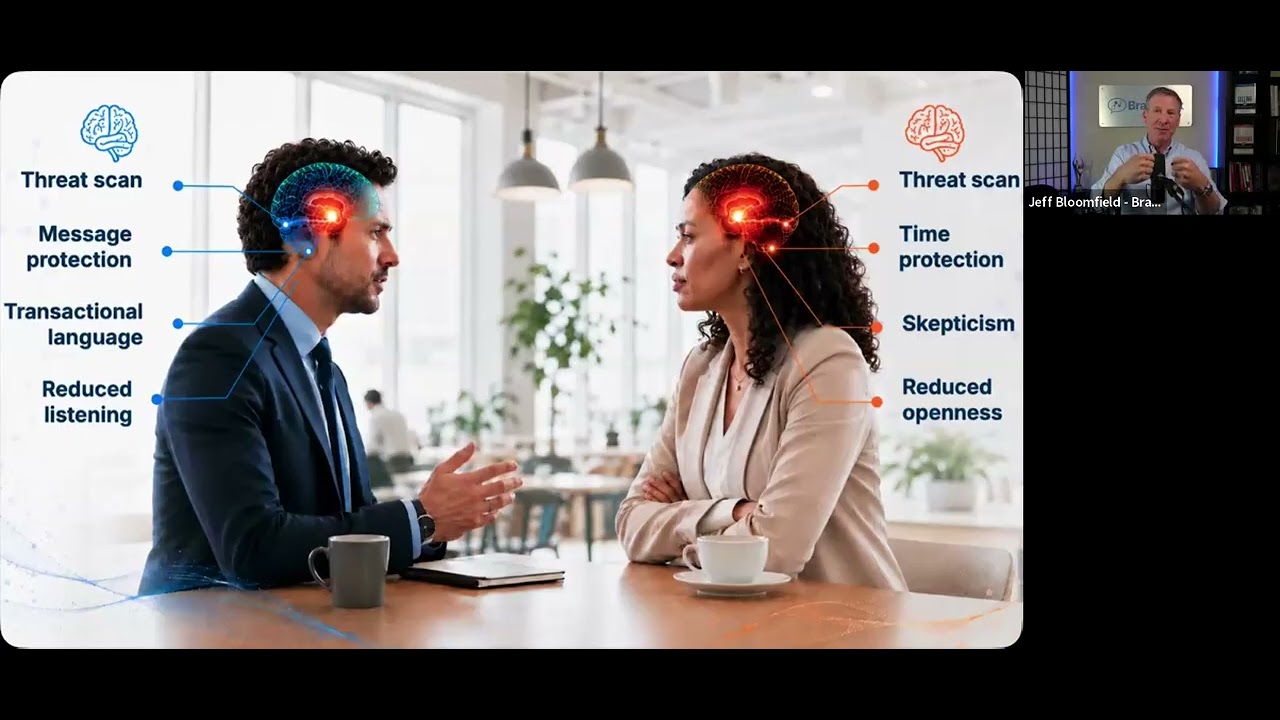
Hello everyone. It's always an honor to be back with the Selling Power Crew on these virtual sessions. It's just so much good content over a pretty compact period of time, and I enjoy a lot of the content myself. So today I'm going to put our track shoes on and we're going to go reasonably fast through some information I think will help us as sellers in today's kind of modern buying landscape understand a little bit more about what's going on between our ears In a selling conversation, but also what's going on between the ears of our buyers. Now, for many of us, they might have had this experience. You had a meeting prospect you've been trying to get into for a long time or meet with for a long time. Maybe it's someone you've known for a while, but you've never got them across the goal line, and you feel like you crushed it. You were prepared. You knew the customer. You asked the right questions. They nodded along. They had questions back. You told your solution story really well. You left the meeting. You're high-fiving yourself mentally. And then what happened? You wait and you wait. No decision, no meaningful next step. They might even ghost you on emails and you just for the life of you can't figure out what happened. So you start replaying that call in your mind. Did I not give them enough information? Was it price? Was it something I didn't communicate with features? Was it timing? Was it a competitive analysis I missed? But here's the thing, and this is the underscore of our time together today. Buyers rarely say yes because you gave them more information. They say yes when they feel safe enough to engage, when they feel understood enough to listen, and when they feel confident enough to act. That is what trust is, and that's what we're going to talk about at a little bit of a deeper level today. So let's start here. Most of us learned how to build trust with others and how to trust others Way back when. So I'm going to take you on a quick little rewind back in your days, in your childhood for a second. And I'm going to ask you to kind of reflect back on how did you learn how to build trust when you were young? And how did you learn how to create trust with others when you were young? For me, it was this guy, Jill and Gerhardt and Jeff and I were talking about it in the pre-show, my Papaw, my grandfather, Willie Bloomfield. He was a medic from World War II. He's just an 8th grade educated guy from the hollers of Kentucky. Yet he was my guy and he had this knack. That when he talked, people listened. People just were drawn to him. And I, and I couldn't put my finger on it growing up. Like, what was it about him? Yes, he was incredibly wise. Yes, he was a constant servant of others. Yes, he was a really good communicator and a great storyteller, but there had to be something else. There was something there unconsciously that drew people to him that caused them to trust him. And as I made my way through my own career, the light bulb started going off. But what happened to me in junior high was I found out that Papaw had lung cancer and he passed away relatively suddenly, and I lost my sage what felt like overnight to me. But that drove me to be good in school. I went into college, on to college, and I ended up in biotech where I was fortunate enough to help commercialize a drug for lung cancer. Now, as it turns out, I was pretty passionate about it because I lost my grandfather to it. But as it turned out, I also had a knack for communicating really complicated information in a really simple way. Well, guess where I learned that from? Papaw. That's just how he always taught and communicated. And as I made my way through my career in biotech, I was fortunate enough also to help build a team to launch a drug for brain cancer. This is where everything changed for me. We had functional MRI and EEG and PET scans, and we're looking at it through the blood-brain barrier. None of the stuff that you care about. But what I started studying was the impact information had on the brain. What types of information activated which parts of the brain, and why did that matter? Why did it matter that when when when Gerhard speaks, everyone leans in and wants to learn more? But when I speak, people tuned out. What was it? Was there a difference to that? What happens in the brain? And so what we were able to do is start to map the brain in a unique way. And this is really kind of cutting-edge information if you think about it. Next to deep space and the deep ocean, the human brain is one of the least explored. Areas of the entire universe, and we're starting to get glimpses and peeks at why and what we can do about it and understand it as communicators, especially in a sales conversation. So to simplify the aha for me coming out as I started to become more of an applied neuroscience researcher and recruiting PhDs to help me understand this at a deeper level, I kept going, make it simpler, make it simpler, because everyone seemed to know what to say. In sales, they seemed to know they were trained. They also seemed to know pretty much how to say it. But what was off time and time again when we would evaluate even effective communicators, effective experienced sellers, was the sequence in which they said it. This was the epiphany. So I began studying this at a deeper level to understand what the problem was. Now here's where I want you to start to relate to yourselves in your world this way. So in the chat, I want you to tell me how many years have you been driving a vehicle? How many years have you been driving a vehicle? Throw it in the chat. Let's get a little interactivity going. And then right after you put that, I want you to put how many years you've been in some sales capacity. Even if you're a leader today, you've had some sales capacity, whether it's 10 years, 3 years, 30 years. Throw it in the chat. How long have you been doing it? How long have you been driving? How long have you been selling? So what we're going to do is now we're going to equate those 2. I want you to imagine that your sales career is akin to your driving experience. You've been doing it a long time. You've committed a lot of your behaviors to selling to memory. You're very comfortable driving down a highway with cruise control on at 70 miles an hour. That's you, you're an experienced driver, right? Then you go to a new organization. And that new organization is reflected by the top image. Now they just need to teach you how to drive their vehicle. You already know how to drive. They hire experienced drivers. Now they want to train you on how to drive their vehicle. So you go through their onboarding, you go through all of their training, go through their product training, go through their objection handler, you go through their competitive intel training, and you learn all of the stuff from their vehicle. And then they put you out on the road. But what we studied and learned is something happens between the environment of your experienced comfortability driving and then the training environment that you learned in, and the moment when you get in front of a high-stakes conversation with a prospect. And this moment that breaks in the brain is the difference between your comfortability on the highway on cruise control and your brain feeling like it's going 200 miles an hour on, on a racetrack. We call this the performance activation gap. It's that distance between what a seller or manager can show during training Compared to what they can demonstrate under pressure. Pressure changes everything, and until recently we really haven't had a great great insight into what's going on in a seller or a manager conversation under pressure. But you have to think about it, and this is where I think we had a great conversation in the pre-show. You know, Jill's a Marine, and I came from a long line of veterans myself—a Marine—and you heard my. example, being an Army medic, from the Marines to professional sports to musicians to high, you know, high-performing chefs in restaurants. We all have something similar in, in, um, with, with all of these careers. In a low-stress environment, we have high access to information, whether it's the training we're receiving. Our executive control works really well. Our working memory is very efficient. Our flexible thinking— we're able to take perspective very well. That's why I can teach you something in a controlled environment like this and then ask you questions and you'll actually know the answer. It's just like why you can do in a sales role play with it, with your, with your manager or with a training manager, you do really well. You knock it out of the park. You can go on the LMS and learn some new content and take the test and ace it. But then when you go into that real high stakes environment, why does it change? That high stress environment actually starts to imagine on the left side, you have a dimmer switch on that part of your brain. That dimmer switch is all the way up and high when you're in a low stress, high access environment. But the minute I put you in a high stress, low access environment, the dimmer switch goes down. Your threat detection goes up, your self-preservation elevates, executive functioning drops, thinking narrows down into that safety box, and all you have access to is what you've built in your nervous system habitually. Doesn't matter what it is you're doing. Whether you're shooting a shot at the buzzer, whether you're in the military, or whether you're in a sales call, when you're under pressure, your brain will only have access to what you have encoded as a habit. So now let's multiply that by 2, because in a sales call, you're going through this experience mentally. So is your buyer. So now you have 2 individuals, both oriented towards self-preservation, both going through a threat scanning process. And as a, as a seller, when you start communicating with a buyer and you start to recognize unconsciously How are they thinking? What are they feeling right now? And you start to orient yourself. Am I saying the right things? Am I asking the right things? Well, they're scanning you the same way to determine what is— whose agenda are they on? What are they after today? Are they trying to sell me something I don't need or want? What's at risk for me? So now you have 2 humans actually oriented toward safety, trying to communicate in a way that gets one of them to change and buy something from the other.
Mm-hmm.
Now you can see why trust is not just a cliché, and what it is in a deeper level is something that I think has always been missing from sales, sales enablement, and our ability to communicate effectively under pressure. So I want you to picture— now we're going to go a little deeper— picture your favorite city in the world, doesn't matter what it is. And I want you to imagine 6 intersections and then 6 stoplights that you can see down in sequence. And remember earlier I said, know what to say, know how to say it, but do you know the sequence and how, and, you know, to deliver it in? Now I want you to imagine your buyer's brain has these 6 intersections in them, and each intersection there's microexpressions of trust either being built or eroded. And the order matters to getting me to a yes at the end. Trust is the fuel that gets you through these intersections, and I'm going to explain, explain them to you. And then I want you to reflect on how they're affecting you in your, in your sales calls today. Most of us don't even think about this this way. We just kind of work off of our instincts, our habits, because we've— Jeff, I've been selling for 25 years. I've made a living, put my kids through college selling. I think I know what I'm doing. You probably averaged 20 to 30% closing ratios your entire career, maybe 40. That means you missed over half the time. So there had to be something that caused even the most experienced, successful sellers in the world to miss out on, and I think we've identified it. So the first intersection is this: I'm the buyer and I'm processing you. Remember, threat scanning. Are you safe? Are you safe? I am actually trying to see if I can trust your intent based on how you're communicating, and my brain is processing 20 quadrillion bits of information per second, a vast majority of which is happening unconsciously. 20 quadrillion. You can look that number up. So all of that initially is oriented toward, are you safe? Are you friend? Are you foe? Are you for me? Are you for yourself? And how you're communicating with me will determine whether I give you a red, yellow, or green light in that first intersection. Most of us think we've got a green light because we go, hey Jill, I see you have a picture of a sailboat on your wall. You sail, I drink water. And then we run through the intersection because we think we have something in common. Of course we don't. Now I know none of us does that. I know, I know. Their brain is oriented toward this, and they're still— now, if you run a yellow or red light here, they'll let you keep talking, but now the elevation of threat goes up. So now everything they're doing now is really starting to fine-tune against whose agenda are you on. But let's just say hypothetically you got a green light. They believe you. You're connected. You're relatable. There's a values-based trust that took place. The second intersection is, can I trust your understanding of my world? Can I trust your understanding, your perspective? Do you actually communicate in a way that shows me that you not only understand what I care about, but that you actually care about what I care about? And this is where a lot of sellers get off the rails because we've been trained in discovery to go through a needs analysis. And those— that needs analysis is a bunch of questions that are oriented toward me, the seller, trying to learn information to convince you that my solution will fit your problem. Not until I can demonstrate that I understand your world do I earn the right to ask you questions about it. I'm going to pause there for a second. And this is— that's an important one. It's a mic drop line. Not until I've demonstrated that I understand your world have I earned the right to ask you questions about it. So where do you put discovery? So now let's say I get a green light here because I came and I showed you that I really did my homework and I understand your world. I'm going to tell you a story about you and And everything I think about your role in your company. And then I'm going to ask you questions about what I got right and wrong, and you're going to go, wow, this person actually seems to care. Now, can I trust your diagnosis? This is where you start to say, now here's some of the problems and challenges that I, as an expert in the field, see that are preventing you from getting where you're trying to go. Now imagine if I ran the first 2 intersections, I ran red lights, and I started poking at the problem. I'm the problem. Like, I'm the bringer of doom at that point. And so the trust is going down. But if I get green lights in the first 2 intersections, they lean in and they view me differently. And I can actually talk about the problem at a deeper level because they are now seeing me as an advocate. And I get a green light on the problem. Now I actually get to show them the whole reason I came. How can I help you? How can my solution fit that problem? to solve yours in a quantifiable way. So then the buyer's thinking, can I trust your solution? Can I trust the fit for me? Do I believe it will now work? Then this is where I go next. Can I now trust the path to put your solution in place in my organization? And does moving or changing feel safer than staying the same? Many of us get through the first 4 intersections and think we've hit a home run, or at least we like, I survived the first 4 intersections and I got to present my solution. And this is where things drag on. The status quo bug jumps up and bites us. There was 15 stakeholders involved in this decision, and I only got to 3, and I didn't understand why. There's a million reasons why things drag down in intersection 5, but at an individual buyer level, I have to feel like I understand the path of change here and that it's actually safer for me to change to you than staying the same. And then the last intersection. Most of us in sales have been trained it's closing. It's not closing. It's gaining a commitment where I actually do such a great job of building trust that I create an environment where they feel self-trust enough to confidently make the next step with me. That's not closing. Closing is seller-oriented. Gaining a commitment by helping them feel confident enough to make the decision themselves. Self-trust in the buyer, that's gaining a commitment. So these are the 6 intersections, and what I'm going to do really quickly then is show you a couple things that's happening in those, and we'll come back to those. You know, we've been studying this a long time, and some of you know some of the neuroscience and the neuropsychology behind this, but the, the 2 networks in the brain, the analytical network and the emotional empathic network, are vacillating between each other all the time. Uh, they don't activate at the same time, by the way. They don't operate at the same time. They, they vacillate between, you each other. Why this is important as communicators is the first 3 intersections— do I feel safe? Do I feel understood? Are you an expert? Those are all emotional in nature. And yet solutions and products and your speeds and your feeds and all the things that you like to talk about, those are more analytical in nature. So we are so comfortable at running 3 red lights to get to our product, not realizing that we're actually activating the analytical network in the buyer's brain, which will cause them by Biological. There's no way around it. It'll cause them biologically to be resistant because the analytical network's job is to evaluate, compare, and analyze. It's not to actually like you, trust you, or feel connected to a problem. So now here's the order again, the sequence. So if we can build trust in the first 3 to 4 intersections, then the analytical network in the buyer can kick in and they actually start to look at why they should choose us because now they're looking for reasons to justify our product. And you know you've been in that situation, right? When you've, when you've done it right the first 3 intersections, the buyer's like, oh well, yeah, that makes sense because I could use your product to do this for that. And they start selling themselves with their analytical network on why they should choose you. So that's why the order matters so much here. And then the, not just the biology, the physiology is kicking in gear, and we'll show that in just a second because then I'm going to give you some take-home, some take-home and some homework. Every conversation you're having in those little micro expressions of trust through those intersections is eliciting some type of neurochemicals in the mind of the buyer and in yourself. So when I really build a connection with someone, whatever reasons, usually it's values and experiential relatability based in that first intersection. Their oxytocin goes up in their brain. And you know, you know, I referenced Jill earlier. We were talking in the pre-show. We've never met before. We never talked to each other before. And within five minutes, I feel like we could go have a beer and hang out because we have. So many liked experiences. We have so much in common, and we probably, even though we didn't expressly state it, we share a lot of values. And our— my unconscious brain felt that way. Hers probably did as well. We had high levels of oxytocin. That's what happens with a buyer when you let yourself tell them that part of your story, and that connection and trust goes up. Dopamine starts to activate when I can demonstrate that I understand your world. They feel seen, heard, and understood. Now, adrenaline and cortisol can have the opposite effect. If I'm on my own agenda, telling my own story, convincing you why we're so great, your adrenaline and cortisol will go up naturally in your brain in the first 2 intersections, which then creates resistance. However, if I could do it the right way, I want your cortisol to go up in the 3rd intersection because that's the problem. You see what we're doing here? Cortisol is the stress. So just know that the, the way you communicate will Determine the level of neurochemicals that are happening inside the brain of the buyer and yours as well. So let me pause here for a second because I want to give you a little bit of self-analysis. When you're feeling stressed because something's at risk and you're— you can feel, you know, you pit out, the old sales call pit out that happens, that's your adrenaline and cortisol overactivating inside your brain. Which causes you to go into self-preservation, narrows your focus, and forces you into a place where you're communicating transactionally. And then the mirror neurons kick on in the brain of the buyer and their cortisol goes up. You created your own problem because you weren't cool, calm, and collected, and you didn't have a mindset that you were there on their agenda. It caused you, by your own stress, to create an environment that was actually resistant to your very message. Okay, we should drop the mic there and stop, right? That's the, that's the whole, the net-net of it. So here's what we want to do. When you think about those intersections in how you run a meeting, how you run a sales call, it doesn't matter whether it's the first time you're with a prospect or the fifth. This sequence matters. And you can see down below the science involved in each of the steps. It's not voodoo. It's neuroscience and neuropsychology. It's in play in every single conversation you have with every prospect. And yet the higher the stress you feel, the less likely you are to create the environment to get you a green light at each of these intersections. And I always say this, and sometimes I get a little pushback from people that are really sales-driven oriented closing type of mentality. If you have a sales mindset, you've already lost. You have a sales mindset, you've already lost. But if you have a serving by solving Mindset, sales as an outcome naturally. And when you follow the sequence of these intersections and you consciously know I can't run a red light, I've got to stay in this intersection until I believe we both feel the love, right? We both feel the green light has happened. Then I can move on to the next intersection. So what we tell folks a lot is. It's really about having a series of comfortable stories that you can tell in each intersection at each stage of your sales cycle. And it's not a once upon a time there was a guy from Ohio who had a papaw who died of lung cancer who went on to become an applied neuroscience researcher story. Every intersection might require a slightly different story. A story could be an analogy. A story could be some details and data in the problem story that shows the cost of a problem. A story could be a series of questions that allows the buyer to share their story more in depth with you. The point is the story has to be oriented toward activating that green light inside of each of the intersections in the right sequence. Now, here's what we've been able to do for the first time ever, I think, in history. We're able to actually look at that inside of your actual capabilities in front of a customer. And whether we do that with a simulated buyer experience on our AI platform or actually take your own Call transcripts from a meeting. We can actually run them through this now trust profile, and we can tell you exactly what your habits are under pressure. Now I will tell you this is not comfortable. I've run this assessment and this diagnostic on myself over the last six months to a year multiple times, and shocker! I'm sure everyone listening. My default is I tend to become a professor. And I give too much cognitive load because I love to teach. You're like, oh yeah, we got that. Geez, yeah, my brain hurts right now listening to you just for 25 minutes. My brain hurts. So what is yours? What do you think yours is? So on the right side are the domains of trust that are required, and on the left side are all the behaviors or dimensions. And you'll see this is an actual diagnostic of a seller. We see this one very commonly. They don't stay in buyer orientation very well. They're not great at problem development and they struggle with pitch resistance, which means that under pressure, their instinct is talk about what I know, which is product. So when you think about what your performance under pressure is, this specific seller, their default was a pitcher. They defaulted to product and their secondary was professor, which is my primary. They like to teach and like to give information which can create cognitive overload. So as you think about what you're doing to develop yourself as a seller, what do you think your habits are under pressure? You probably, if you pause long enough, do you talk faster? Most of us do. Do you ask self-serving and leading questions without realizing it? Do you see how quickly you can get to talking about your product in hopes that the buyer can actually orient the problem they think they have with what you just thought they thought you said? About your product? Like, what are your defaults under pressure? Because that's your brain going 200 miles an hour around that racetrack. And unless you know what that is, you can't slow yourself down enough to change a new habit. And that's where I want to kind of challenge the group today is we've learned over the years studying the brain, you can't actually break a bad habit. How about that? All you can do is rewire a new neural pathway over top of it. The bad habits you have, you've had them for years. You can't break them. You can bury them. And so our job as communicators is how do we continue through repetition and reinforcement, take our existing habits that aren't getting us green lights and learn new communication skills and techniques and do them over and over and over again in that safe environment until they become a habit that that shows up in that stressed environment. That's what the best sellers, the elite sellers around the world do intuitively, but never really intentionally. And so that's what all of us can work on to do better as we go through this together. And I'm telling you, with AI tools now, with multiple buyers more than ever before inside the sequences of— we work with so many clients who have now 10, 12, 15 stakeholders. In a buying decision, you can't just run this sequence in the stoplights one time with one person. You're going to find that that you're going to have to run it multiple times with multiple people. And what we're seeing is the sellers that understand how to do that are actually speeding up the sales cycle because they're building trust in the buying group faster, as opposed to waiting on the one stakeholder champion to go tell that story a million times to 15 other people. So I'm gonna pause there and I'll allow any questions here. We've got, we got 5 minutes here for questions, um, comments. I can't tell if I—
I, I've got the comments here for you. Yeah, thanks, Sean. So, um, here's a comment, not a question, but this came from Martin Smith. Thanks, Martin, for typing in the chat. Valuable insight on the neuroscience. That what's interesting too is each of the 6 questions at the intersection are from the perspective of the buyer. And that's worth noting. So it's all about the buyer. That was a great one. And Jeff agreed with that. So those are the ones I see. Carly's giving you a compliment, favorite session of the day. So lots of great things. I've got a question for you. So you talked about stress. Any hints for us to do if we're selling or one of our sales reps is selling and they get stressed? Any tips from your expertise on how to Calm the nervous system so we can continue the conversation.
So I'm going to clarify your question, Jill. Are they stressed because you're the manager and you're with them, or are they just stressed?
No, no. Like, they're like— actually, my question is both sides. Like, if, if someone is feeling stressed as they're in front of the buyer and maybe it's not going well, or maybe they're even perceiving that maybe it's not going well, you know, with the, with the buyer, like, you know, and then cortisol goes up and they— and then usually that's where they really crash and burn. So any tips on how to calm the nervous system for a neuroscience Well, there's both.
You know, you can do the box breathing that we learned, like the military knows the box breathing stuff. People forget that, and then they're trying to do it in the middle of the stress. So part of it is in your preparation. So I could spend an entire— another hour on just preparation, both for yourself and of the buyer. But preparation is huge. And, and one of the things that we don't do well enough because of our fast-paced world is we don't do enough preparation. Is whether we're on a camera doing a virtual call or whether we're about to walk into an office. We don't pause long enough to whatever whatever your faith perspective is, whatever your you know whatever your meditative perspective is to take a couple of long deep breaths and remind yourself you're not here to sell somebody something. You're here to serve them by solving, and you're here on their agenda, and and you don't really actually even need to care whether they say yes or no.
Hmm.
Now, every seller that listened to that right now just said, that's a bunch of BS. It, it's— if you go in oriented that I've got to make this sale, you have put so much pressure on your unconscious brain that it cannot function in a way that's actually on the buyer's agenda. So if this makes sense, process, pause, take those deep breaths, remind yourself that, hey, whether I get this sale or get this deal or not today, It isn't my identity. It doesn't change the world around me. It's, it's, it's one spot on the radar of my life. And so if I can orient myself back to the customer's agenda, you'll create a different climate.
Yeah. Ah, that's powerful. Yeah. Well, that's gotta be like the quote. And so let's make sure all we write this down. And I talked about the way I learn. I always, so I wrote this one down. It's serving by solving.
That's right.
And then selling is the consequence. So if we just have that in our heart as we go in there, it's probably gonna go well. Gerhard, I know he's got some questions too.
Yeah, I, I'd like to learn from you. What, what's the difference between a threat state and a growth state? And how can a sales leader tell which one the salesperson, which state the salesperson is in so they do the right coaching intervention?
Well, today, well, in the old, in the old days, the only real, you know, diagnostic we had as sales leaders was we'd go out in the field with the rep and watch them. And, and now, or maybe get, you know, join them on the Zoom or the Teams. And we might do that once every couple of months. So we wouldn't have a lot of great data. And they're already nervous as can be because they're afraid that you're, as their manager, going to come out and tell them what they're doing wrong because we don't know how to coach. All we know how to do is manage, and we're under pressure as a manager. So we go out and then we hear, I got to give you 3 things that you're doing wrong so you can fix them. So we create that environment ourselves as managers, and that's on us. So the answer to how do you actually get into that state is it's repetition, reinforcement, and the feeling that I have a leader who's coaching me and not managing me. And so with AI tools today, like I said before, we built Braintrust AI is the most unique practice session you can put up against personas. Is sellers who are putting in the work to practice— I know that's almost a bad word for sellers. It's crazy to me. Can you imagine going in and getting brain surgery from a surgeon who never practiced? Like, can you imagine going on Sunday and watching your favorite football team who decided not to practice at all?
Mm-hmm.
Like, think of any profession in the world where you have a level of expectation of that professional. That doesn't practice. There's only one. It's called sales. And it's absolutely maddening to me that our sellers don't want to practice. That's the only way to reduce that threat response in yourself is to feel comfortable enough because I've ran that scenario 50 times and it's not— there's nothing that's going to come up in this actual live environment that will surprise me. That's the answer.
Hmm. Well, we are almost out of time, but I want to squeeze in one more question. You described the brain as sort of toggling between the analytical and the empathic networks, and it's like a seesaw. So how does a good coach know which one they're overusing? And What is the cost of imbalance?
Well, that's the question of all questions. And I can already tell you right now, managers, you're overdriving the analytical network. And I can tell you that because you're managing to the scoreboard. And the scoreboard is data. And that's analytical by nature. And it triggers in the seller a defensive response to try to prove that I need you out of my way. Like, you're not helping me. And then there's this death spiral. Uh, feeling micromanaged and not wanting to improve, wanting you out of my way. Let me go do what I've always done. So the environment is, as a coach today, if we have a coach mindset, is do we have shared values? Do we have a shared vision? And can I orient you as a, as a seller to understand your world? Do I understand what you care about? And I start to coach you through the windshield more and less through the rearview mirror. So I can give you the same exact coaching That was something that happened, but done through the windshield that you receive versus if I just describe what you did wrong in the, in the rearview, you will not receive it. See the flip? The flip is, hey, remember Gerhard on the call with his customer? You said X, Y, and Z. Remember when you said that? Yeah, I was thinking about that. And when I think about when we go talk to Jill next, how I, if I were, maybe we could reorient that and let's see what, let's run that with Jill for a second in our mind and see. Suddenly my brain activates the emotional empathic network. And I'm not defensive because I'm like, oh yeah, I want to get it right next time. Not, oh yeah, I did it wrong. It's, it's a coaching skill that we're lacking while a lot of managers aren't great coaches today, unfortunately.
Well, Jeff, you have made a difference in so many people's lives by explaining how the brain works. And I'm, I'm still trying to figure out how mine works.
Well, listen, I will tell you this as we close. This is for everybody listening. I, I, I'm faster than one person being chased by a bear in the woods when it comes to neuroscience of decision-making. We are all learning as we go. Some of us are ahead of others because we're researching it, but none of us really fully truly understands exactly how the brain works. And if anyone tells you they do, you should run from them because we're learning new stuff every year, but none of us have it solved. I can promise you that.
And for if anyone loved what you heard, and the comments in the chat are clear that they loved it. There's also links in the chat to connect with or follow Jeff on LinkedIn. Also, to be able to buy his book, there's a link there in the new book, Neuroselling 2.0. So if you want to learn more, please pick up your copy. And thank you so much, Jeff. This was— I wish we had more time to ask you more questions, but I think we—
Somebody wants the books on Audible, Jeff. That's a hint.
Hey, Neuroselling 2.0 is on Audible. Neurocoaching is not yet. So, all right. And I think we have a virtual booth somewhere, I was told. So if you want to stop by and talk to Abby and Ben and learn more, please do so. We'd love to talk to you.
Yep. And that link for the virtual booth is in the chat if you just scroll up a little bit by Amanda. Yep. Great.
Fantastic. Thanks for having me again, Gerhard and Jill.
It was a pleasure. Thank you. Awesome.
More from Gerhard



What Selling Looks Like When Your AI Agents Have the Context Your Sellers Do

Better Conversations, Smarter Support: Wearable AI in Business






When Scarcity-Built Systems Meet Abundance - The Judgment Gap in AI-Powered Sales Leadership
