Why CROs Fail
Warren Zenna explains why 70% of CROs fail within two years: misaligned expectations, weak organizational support, and short-term thinking. He breaks down four categories of risk and offers a diagnostic framework plus three concrete steps to fix it: audit risks, assess your competencies, and talk honestly with stakeholders.
Chapters
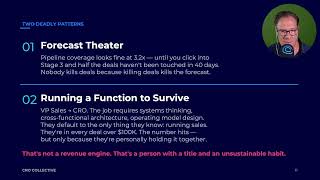
Hello everybody, I'm Warren Zenna. I'm the founder of the CRO Collective. Uh, I spent the last 6 years or so working exclusively with Chief Revenue Officers, coaching them, advising them, and advising the companies that hire them. And I watch what happens when it works and when it doesn't work. There are roughly around 300 people or so in this webinar right now. And if the data holds, about 70% of the CROs here will be out of the current role in under 2 years. Now that's not entirely because you're bad at the job, and it's not entirely because the job was bad before you got there. It's actually a bit of both. For the next 30 minutes, I'm going to hold up a mirror. Uh, some of you will see, uh, what's wrong with your company. Some will see what's wrong about you. Both parts will be uncomfortable. And that's the point, because by the time you leave this room, you'll have a diagnostic framework that will tell you exactly which risks are active in your current situation and whether the gap is in the environment in your own toolkit, or both. And that's actionable, and that's what you're going to get in the next 30 minutes. So I want to try something. So think about all the people that are here right now. Imagine you're looking to the person on your right, or you're looking at the person on your left. I'm not going to tell you the punchline you're expecting because you already know it, but 2 out of 3 of you won't be in the current role in 18 months. Now you've heard this stat, and some of you have lived this stat, and some of you are living it right now. But that's not what I want you to sit with. Here's what I want you to sit with: you're likely all pretty good at your job. So why does 70% fail? That's because most CROs took the wrong role at the wrong company with the wrong mandate at the wrong time. And here's the hard part. Most CROs accepted that role without honestly assessing whether they had the full toolkit to do the job actually requires, which is not just sell, but build. So there are 4 things that kill CROs, and the 5th thing is the CRO themselves. We're going to talk about all of it. So when I work with companies that are about to hire a CRO, I ask them a simple question. What is it that your CRO does? And I get a very different answer from the CEO, the CFO, the board, and the head of HR every time. So think about that, like the most expensive hire in the revenue organization, and nobody in the building agrees on what the job actually is. So there are 4 categories of risk that the CROs— that predict CRO failure. And the first one is role risk. Now, most companies hire a VP of Sales, give them a CRO title, and wonder why the revenue transformation never happens. This distinction I use, uh, is the house flipper versus the city planner. So the house flipper CRO is hired to come in, fix the sales motion, hit the number, and move on. You're probably all familiar with this. Now, the city planner CRO is hired to redesign the entire revenue architecture—marketing, sales, CS, rev ops—into a new system. Now both are valid, but when a company hires a city planner and manages them like a house flipper or vice versa, that's role risk, and it kills CROs faster than anything else. And here's the CRO side of it. Most CROs don't ask these questions before they take the job. They're so excited to get the title, they just skip the diagnostic. They don't ask, am I a house flipper or a city planner? And which one does this company actually need? That's risk 1, role risk. Now we've got 4, but mark this one, role risk. It's about misaligned expectations. And if you're feeling that right now, put a mental checkmark to it because risk 2 is organizational risk. And this is the one that I think you're living inside of. So I coach a CRO, let's call her Sarah, uh, Series C SaaS company she's working at around $28 million in ARR. Now on paper, she owned marketing, sales, and CS, but in practice, the CMO had a dotted line to the CEO, the VP of Sales, and the CS reported to product. And the only org chart that mattered was the one that was actually in the CEO's head. Now she presented her Q2 revenue plan, fully integrated demand to expansion, new segmentation model. The CEO nodded, looked at the CMO and said, Jessica, what do you think about the marketing piece? Not Sarah, walk Jessica through the plan. Just, what do you think? And in that 5 seconds, Sarah realized she didn't have a revenue organization under her. She had a sales org and a title, and she was out by month 14. That's role risk. But here's the thing, Sarah's company set her up, and Sarah also didn't ask the right questions before she took the job. She assumed the org chart was real, and that's a competency gap, knowing what to audit before you sign. That's one risk, and here are 3 more. The next one is going to be something that most of you are living inside of right now. I'll explain what I call the panda problem, okay? Because most CROs who are great will still fail inside of an environment that wasn't designed for them to succeed in the first place. So giant pandas in the wild are actually really competent, very resilient animals, whereas pandas in captivity, they're a mess, okay? They don't eat, they don't mate, They don't behave normally. And the conclusion for decades was that pandas are an incompetent animal. Well, the actual conclusion is the environment was wrong. And CROs are like pandas. You know, when you put them in the wrong environment, they don't perform. And most CROs are evaluated by the companies that they're in, but they're taking on the responsibility of a system they've inherited and they actually don't have the ability to do anything about it. And then they fail and they leave the company. And they have a patina of failure on them, which many of it was because of the organization they worked for. And I'm not taking the blame off of the CRO. There are many, many, many competencies that CROs have to have, but the environment they're in is unique because the role is so systemic. So organizational risk is what happens when the CRO title has the mandate but not the actual power to execute. So you got the title, you've been given your marching orders, They don't give you any authority. They don't give you the autonomy or the resources, the runway to succeed. These are the 4 key things that CROs need. This is the AARRR. You need authority to do the job, to have decision-making power. You need the autonomy to operate without seeking too much permission. You need resources, which is obviously budget, headcount, tools. And mostly, and the hardest one, is you need runway. You need time. You need time to be able to get the results because unfortunately CROs battle 2 fronts. One is getting the short-term goals and also building a long-term organization. That's a very difficult challenge for chief revenue officers. A CRO I know, his name is David. He joined a $65 million company. He was a founder CEO, and the CFO and the CTO had been there since the seed round. So David was like the first outside executive VP. During week 3, it's a Monday standup. David presents a restructuring plan, you know, normal CRO stuff, consolidates the BDRs, AEs, and CS under his organization. Etc., etc. And the CFO says, I have concerns about the cost structure. And David starts to respond, and the CEO cuts him off. Good point. Let's table this, and Mark and I can discuss offline. Offline at this company meant the founders group chat that David would never be added to. Every decision that mattered was made before the meeting, not during it. Authority, autonomy, resources, and runway. David had 3. He had authority on paper, autonomy in theory, and resources, but what he didn't have was runway, which is the political patience for his changes to take hold. So 3 out of 4 will kill you. That's a near miss, almost the right environment, but not. Now the third category is execution risk, and this is where I see the most heartbreak because this is where genuinely talented CROs destroy themselves. There are two patterns I see consistently. One, the first is forecast theater. Your pipeline coverage looks fine at 3.2x until you click into Stage 3 deals and realize half of them haven't been touched in 40 days. Now the $14 million backstopping your Q3 forecast is really fiction, but nobody has the courage to kill those deals because killing deals means killing the forecast. The second pattern is where I have to be honest with this room. Most CROs in mid-stage SaaS companies come up through sales leadership. VP Sales to CRO. And the job of VP Sales is fundamentally different from the job of a CRO. VP Sales runs a function while the CRO builds a system. This is a much different set of competencies that a VP of Sales may not be prepared for before they say yes for the job. Now, that's not a revenue engine. That's a person with a title and an unsustainable habit. I call this running a function to survive. And here's what makes it cruel, that nobody told this guy. Nobody said the skills that made you a great VP of Sales are necessary but not sufficient to be a great CRO. Nobody gave them a competency assessment. Nobody mapped the gap. So they fail. And everyone calls it a bad hire when it was actually a development problem. This guy Josh was a second-time CRO. He scaled his last company from $18 million to $90 million. He knew the playbook. So day 1 at one company, at the new company, he ran a full revenue diagnostic. And then week 4, he ran a pipeline review. He clicks into the first Stage 3 deal, last activity 47 days ago, second deal 31 days ago, and he scrolls through all 42, and the average days since the last activity was 38 days. These weren't deals, they were memories of deals. Now he had a pipeline scrub that wiped $22 million from the forecast in their first quarter. The board saw a new CRO who walked in the door and immediately lost $22 million. And then he spent the next 2 quarters rebuilding the pipeline while explaining to a board that didn't want to hear it, that the previous pipeline was never real in the first place. Here's the thing that nobody wants to hear. Most of you already know which of these risks is killing you, and you knew this before you walked in there. And some of you know that part of the problem is a gap in your own toolkit. This fourth category is future risk. This one is the cruelest because it's the CRO who did everything right and it still wasn't enough. There's a disease I call quarterism. Okay, it's the quarter becomes the operating system and every decision gets evaluated against the 90-day window. It's when the quarter is the operating system, the long-term is always sacrificed. And when you don't invest in partner ecosystems because they don't pay off this quarter, you don't restructure territories because the disruption allows— shows up this quarter. You don't build PLG because the ROI isn't measurable this quarter. And then one day a board member asked, why haven't we diversified our growth engine? And the answer is, well, because you measured me every 90 days and I optimized for survival. There's also a generational shift happening. Most CROs today are running what I call a Gen 1 playbook, outbound heavy, SDR to AE, high velocity. The market is moving to Gen 3, which is product-led, partner-influenced, community-driven pipeline. And the CRO who can't evolve past the playbook that built their career becomes a CRO who gets replaced by someone who does know how to do that. So here's my question: if the environment is broken, and it is, then why do CROs keep accepting these roles without auditing them first? What are we missing? Here's the thing I've learned after working with hundreds of CROs over 6 years, and here's the thing that should make you uncomfortable: you are hired to transform the revenue engine, but transformation requires authority, resources, aligned leadership, and time. The very things that don't exist in the organization that just hired you. And you were hired to fix the environment, but you're constrained by the same broken environment. So the C— it's the CRO paradox. You are the solution to a problem that won't let you solve it. But there's a second part that nobody says. Most CROs, and I include people I coach in this, accepted a job that requires them to be a system builder. An architect, a cross-functional operator, when their experience is running a sales organization. That's not a character flaw, that's a gap, and it's a gap that can be closed, but only if you're honest about it. So you have two problems, not one. You're in an environment that wasn't built for you, and you may not have the complete toolkit for the job you accepted. And both of these things can be fixed, but only if someone names them. And if nobody in the room has ever said that to you out loud before, if you felt both of those things but never heard them articulated, then that's what tells you something about how isolated this role really is. But it doesn't have to be this way. Okay, there is a solution to this. I'll bring this all together. Okay, 4 risks. Each one has a diagnostic question. So if you're a CRO evaluating a new opportunity right now, okay, run them on your current situation tonight. If you're a CEO or a board member, run them on the role you designed, and the answers will tell you more than any interview ever will. But the framework is only half the equation. The framework diagnoses the environment, but what about the CRO? And here's what the 30% who survived do differently. Yes, they diagnosed the risk early, and yes, they had a peer network, but the biggest differentiator? They were honest about their own gaps, and they invested in the competencies the role actually requires, not just the competencies that got them promoted. And this is what we call the dual solution. The company has to build a CRO-ready environment. Clear role definition, real authority, adequate resources, honest runway, and the CRO has to invest in becoming genuinely CRO-ready themselves. Systems thinking, cross-functional leadership, operating model design, board-level strategic communication, both sides, or it doesn't work. A great CRO in a broken environment fails, and developing CRO in a perfect environment fails. You need both. So look at these questions, ask them to yourself tonight. Think about what the answers are. So I'll leave you these 3 things, right? So audit your risks, run the 4 diagnostic questions, not next quarter, but tonight. Audit yourself honestly. Where are your competency gaps? Are you building a system? Are you running a function? Because if you're running a function, you already know it and the clock is already running out. Number 3, have a conversation nobody wants to have with your CEO, with your board, with your peers, and with yourself. And if you're a CRO in this room, your job before anything else is to diagnose which of these 4 risks is active in your current situation, and then be honest about which competency gaps you're carrying—both sides. And if you're aspiring to get the role, learn to diagnose these risks before you take the job and invest in the toolkit the role actually demands, not the toolkit that got you this far. And if you're a CEO or a board member, stop looking for a hero. Start building the environment that doesn't require one. And then find a CRO who's committed to growing into the full scope of the job, not just the part they already know. So that's what today is for. The conversations you're about to have in this room with people who understand exactly what you're going through, that's where the real work starts. Not out there, not out, not up here, but out there. So let's all get to it. So thank you very much. The CRO Collective offers ways to help all of our clients solve these problems through diagnosis, training, development, and CRO readiness. Look forward to hearing from you, and thank you again very much.
More from Gerhard



What Selling Looks Like When Your AI Agents Have the Context Your Sellers Do

Better Conversations, Smarter Support: Wearable AI in Business






When Scarcity-Built Systems Meet Abundance - The Judgment Gap in AI-Powered Sales Leadership
